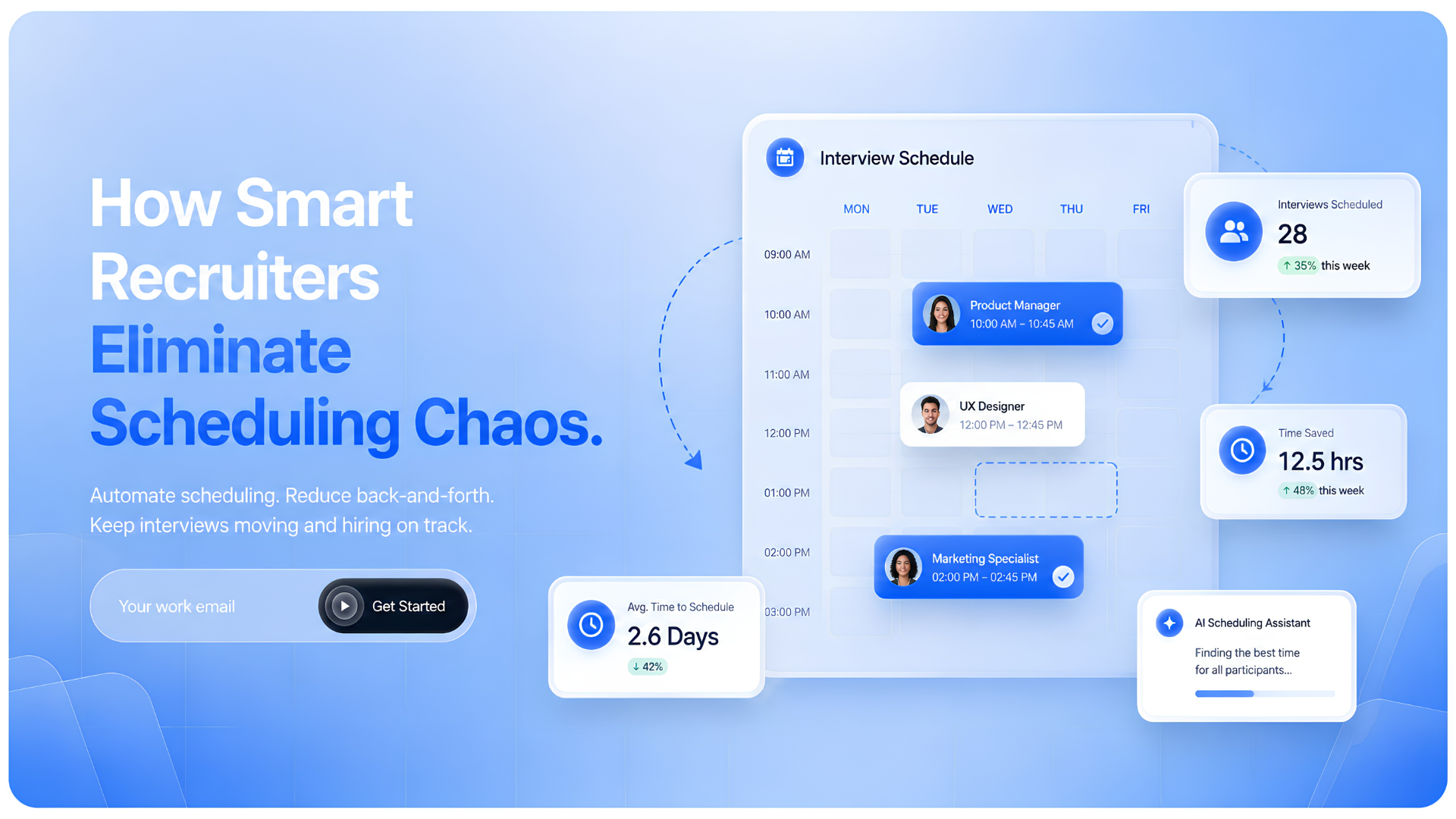
Jonathan leads talent acquisition at a cloud infrastructure company with eighty open engineering roles. Six months ago his recruiters averaged fourteen calendar exchanges per scheduled interview. Today they average one. The change was not a new calendar tool. It was a fundamentally different approach to how scheduling fits into the recruiting workflow. Previously, each recruiter managed scheduling manually, emailing candidates for availability, cross-referencing interviewer calendars, proposing time slots, handling conflicts and reschedules, and following up when someone did not respond. The process consumed roughly a quarter of each recruiter's working week and generated more candidate complaints than any other stage. Candidates described the experience as disorganized, slow, and frustrating. Some withdrew during scheduling. Others accepted competing offers while waiting for a confirmed time. Jonathan recognized that the problem was not the people. It was the process. He deployed an AI recruiting platform that unified availability intelligence, automated coordination, and integrated scheduling into the candidate experience. Within two months, the team's average time from screening to first interview dropped from twelve days to four. Candidate complaints about scheduling fell to near zero. Offer acceptance rates climbed eleven points, driven largely by the improved experience during the pre-interview stages.
The difference between managing scheduling chaos and eliminating it is not a matter of effort or skill. It is a matter of architecture. Recruiters who manage chaos are working within a process that was designed for a simpler era of recruiting, when hiring volumes were lower, interview panels were smaller, and candidates expected to wait. That process puts the recruiter at the center of every scheduling interaction, making them the coordination hub for information that lives in calendars, email threads, ATS records, and hiring manager preferences that no single system aggregates. The recruiter becomes the integration layer, manually transferring availability information between candidates and interviewers, proposing times,
resolving conflicts, and following up on non-responses. This architecture is fragile because it depends entirely on the recruiter's capacity, which is finite and already consumed by the many other demands of the hiring process. Smart recruiters eliminate chaos by changing the architecture. They remove themselves as the coordination hub and replace manual mediation with an intelligent system that owns the scheduling process end to end. According to SHRM's talent acquisition research, organizations that have restructured their scheduling architecture around AI-powered coordination report not just faster scheduling but higher candidate satisfaction and lower recruiter stress, because the process no longer depends on individual recruiter capacity.
Architecture Before Tools: Why Process Design Determines Scheduling Outcomes
The scheduling tools that most organizations deploy fail not because the tools are inadequate but because they are plugged into an architecture that still depends on the recruiter as the coordination hub. A calendar link reduces one round of back-and-forth but does nothing to address the fragmentation of availability information across calendars, email, and ATS records. An automated reminder reduces no-shows but does nothing to resolve the conflicts that cause reschedules. Understanding the difference between AI sourcing and AI recruiting is essential to this architectural shift, because the scheduling intelligence that eliminates chaos operates in the recruiting phase, where candidate engagement is built or broken. The recruiters who achieve the most dramatic scheduling improvements are the ones who redesign the process architecture first and then deploy technology to support the new architecture, rather than deploying technology into the old architecture and hoping for incremental improvement. Huntlo's platform provides this end-to-end scheduling architecture, unifying availability, automating coordination, and keeping candidates engaged throughout the process.
The Five Strategies That Eliminate Scheduling Chaos
The first strategy is unified availability capture. Most scheduling chaos originates from fragmented availability information. The candidate's availability lives in an email. The interviewer's availability lives in a calendar that the recruiter may or may not have access to. The hiring manager's preferences live in a conversation or a note that is not connected to any system. The first step in eliminating chaos is to capture all availability in a single intelligent layer that can match participants without manual cross-referencing. This means giving the AI system direct access to interviewer calendars, providing candidates with a structured availability capture mechanism that is more efficient than free-form email, and maintaining a living record of hiring manager preferences that the system can apply automatically. The second strategy is autonomous proposal generation. Instead of the recruiter manually reviewing calendars and proposing times, the AI system generates scheduling proposals that account for all participant availability, time zone differences, interviewer preferences, and room or conferencing capacity. The system does not just find a time. It finds the optimal time based on the candidate's engagement risk, the interviewer's performance history, and the strategic priority of the role.
According to McKinsey's organizational insights, autonomous scheduling proposals reduce the number of coordination rounds by sixty to eighty percent, because the system proposes times that actually work for all participants on the first attempt rather than generating proposals that require multiple rounds of revision. The third strategy is direct participant communication. The AI system communicates directly with candidates and interviewers to confirm, reschedule, and update, removing the recruiter from the communication loop for routine scheduling matters. The recruiter is notified of outcomes, not asked to mediate the process. Organizations that add tools without changing this communication architecture often find they have more tools but the same hiring problems, because each new tool still requires the recruiter to serve as the communication bridge between participants.
The fourth strategy is proactive conflict resolution. Scheduling chaos is not created by the initial scheduling of an interview. It is created by the conflicts and changes that occur after the initial schedule is set. An interviewer falls ill. A hiring manager's meeting runs long. A candidate needs to reschedule due to a personal obligation. In a manual process, each of these events triggers a new round of coordination that consumes recruiter time and creates candidate uncertainty. An intelligent scheduling system monitors for conflicts before they occur and resolves them proactively, proposing alternatives to affected participants and confirming the new schedule without recruiter intervention. This proactive capability is especially critical when hiring for niche and technical roles, where the interview panel includes senior engineers and domain experts whose schedules are the most constrained and whose last-minute cancellations are the most disruptive. The fifth strategy is experience-layer integration. Smart recruiters understand that scheduling is not a back-office process. It is a candidate experience moment. Every scheduling communication is an opportunity to reinforce the candidate's positive perception of the organization or to damage it. The AI system turns scheduling into an experience advantage by sending confirmation messages that include relevant information about the interview, providing proactive updates that prevent uncertainty, and maintaining communication between the scheduling confirmation and the interview itself. Research on how many followups one hire actually needs reveals that many of the follow-ups recruiters send are actually scheduling-related status checks. When the scheduling system communicates proactively, those follow-ups become unnecessary, freeing the recruiter to use their touchpoints for relationship-building rather than status updates. Huntlo's platform implements all five strategies within a unified system, transforming scheduling from a persistent source of chaos into a streamlined, candidate-friendly process.
The Data Behind the Scheduling Transformation
The impact of eliminating scheduling chaos is measurable across every dimension of recruiting performance. The most immediately visible impact is on time-to-interview, which is the metric that candidates experience most directly and that most strongly correlates with candidate withdrawal. Organizations that deploy AI-powered scheduling typically reduce their average time from screening to first interview by fifty to sixty percent. A process that previously took ten to fifteen days now takes four to six. This reduction matters because every day of
delay increases the probability that the candidate will receive and accept a competing offer. The secondary impact is on recruiter capacity. Recruiters who no longer spend twenty to thirty percent of their time on scheduling coordination regain that time for the activities that produce hiring outcomes: candidate engagement, hiring manager consultation, offer strategy, and relationship-building. According to LinkedIn's recruiting resources, recruiters who have been freed from scheduling coordination report thirty to forty percent higher job satisfaction and twenty to twenty-five percent higher hiring output, because they are spending their time on work that is both more strategically valuable and more personally fulfilling. The third impact is on candidate experience scores. Organizations that measure candidate experience systematically, through surveys at each hiring stage, consistently find that the scheduling stage shows the largest improvement after AI deployment, often improving by forty to sixty percent, because the scheduling stage was previously the lowest-rated stage in the process and the AI transformation addresses the specific frustrations, delays, and communication gaps that drove those low ratings.
The fourth impact is on hiring manager experience. Hiring managers are often the forgotten participants in scheduling transformation, but their experience matters enormously because their willingness to participate actively in recruiting directly affects the quality of hiring decisions. When scheduling is chaotic, hiring managers dread the coordination process and become less willing to invest time in recruiting. When scheduling is seamless, they engage more willingly, provide feedback more promptly, and participate more fully in the evaluation process. An agentic AI recruiting platform like Huntlo delivers this seamless experience by handling the coordination complexity that previously burdened both recruiters and hiring managers, creating a scheduling process that feels effortless to every participant. The recruiters asking whether AI will replace their jobs should note that the data shows the opposite effect: AI scheduling makes recruiters more valuable because it frees them to focus on the judgment-intensive, relationship-driven work that distinguishes great recruiters from adequate ones.
Why Data Quality Is the Hidden Foundation of Scheduling Intelligence
The quality of the data that powers these scheduling improvements is foundational. Teams that have struggled with outdated candidate data in AI tools understand that scheduling intelligence built on stale data creates more problems than it solves, because conflicts and inaccuracies erode the trust that participants place in the system. When selecting technology, use the framework for evaluating an AI sourcing tool before buying to verify that real-time data integration and continuous availability updates are core capabilities that support reliable scheduling. The data consistently shows that referred candidates have smoother scheduling experiences because the referring employee provides informal coordination. Data confirms that referrals outperform cold outreach partly because this informal coordination reduces scheduling friction. AI scheduling provides this same coordination benefit for every candidate, not just those with an internal connection, creating a level playing field where every candidate experiences the same efficiency and respect for their time.
Building a Chaos-Free Scheduling Process From the Ground Up
Building a chaos-free scheduling process requires more than deploying a tool. It requires rethinking how scheduling fits into the broader recruiting workflow and establishing operating principles that prevent chaos from re-emerging as the organization grows. The first operating principle is that scheduling should never require recruiter mediation for routine coordination. If the process depends on the recruiter to check calendars, propose times, or resolve standard conflicts, it will break at scale, because recruiter capacity is the constraint that created the chaos in the first place. The system must handle routine coordination autonomously and escalate to the recruiter only when human judgment is required, such as when a candidate requests an accommodation that falls outside standard parameters or when an interviewer conflict cannot be resolved through available alternatives. The second operating principle is that scheduling communication should always advance the candidate experience. Every message sent to a candidate during the scheduling process should either confirm a plan, provide useful information, or express respect for the candidate's time. Messages that ask for availability without context, propose times without explaining the panel composition, or confirm without providing preparation guidance are missed opportunities to build the candidate's confidence in the organization. According to Gartner's HR trends research, organizations that treat scheduling communication as a candidate experience moment, rather than an administrative notification, achieve fifteen to twenty percent higher candidate satisfaction scores and ten to fifteen percent lower withdrawal rates during the scheduling stage, because candidates interpret the quality of scheduling communication as a signal of how the organization will treat them as an employee.
The third operating principle is that scheduling data should flow into recruiting intelligence, not into a silo. Every scheduling interaction generates data that is valuable for recruiting strategy: the time candidates take to respond to availability requests, the interviewers whose calendars create the most conflicts, the time slots that produce the highest interview quality, and the scheduling patterns that correlate with candidate withdrawal. A chaos-free process captures this data and uses it to continuously improve the scheduling system, creating a feedback loop that makes the process more efficient over time. According to Deloitte's talent research, the recruiting organizations that achieve the greatest scheduling efficiency gains are the ones that treat scheduling data as strategic intelligence rather than operational noise, using it to optimize interviewer allocation, predict scheduling conflicts before they occur, and identify the process bottlenecks that are creating the most candidate friction. According to EY's technology insights, the most successful recruiting technology deployments are the ones that integrate scheduling into a comprehensive AI-powered platform rather than treating it as a standalone tool, because integration ensures that scheduling intelligence flows into and benefits from the broader recruiting workflow. Huntlo delivers this integrated platform, providing the unified availability, autonomous coordination, proactive conflict resolution, experience-layer integration, and continuous intelligence feedback that eliminate scheduling chaos at any scale. Smart recruiters do not manage scheduling chaos. They eliminate it. Huntlo makes elimination
possible. Start eliminating scheduling chaos with Huntlo.