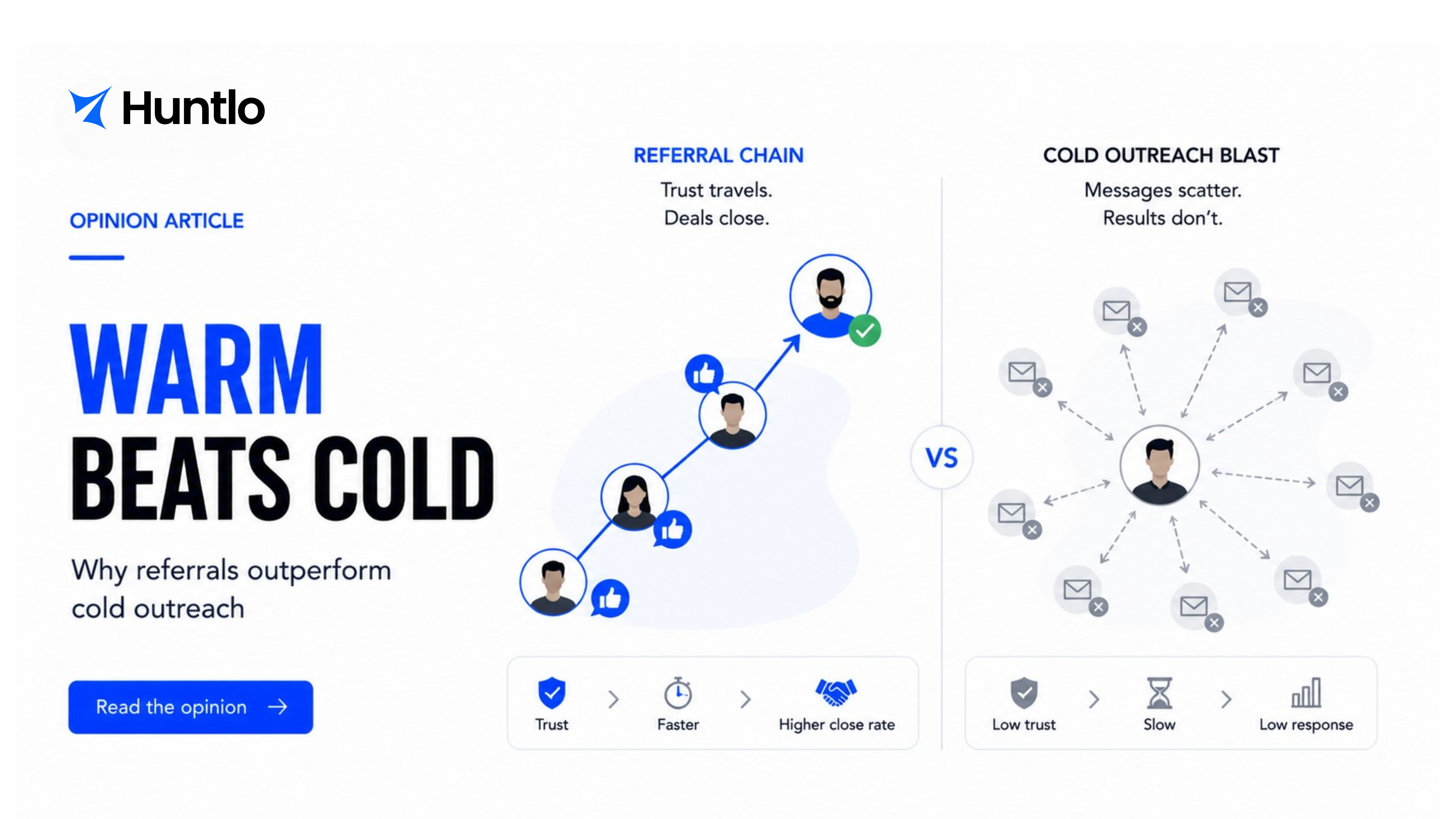
The data on referral hiring is unambiguous, and it has been for decades. Jobvite's annual recruiter nation report has tracked source-of-hire quality for over a decade, and referrals have ranked as the highest-quality source in every single survey. Referred candidates are 2.6 times more likely to be hired than candidates from job boards. They have 45% higher retention rates after one year. They reach the offer stage 55% faster than cold-sourced candidates. They are 30% less likely to be rejected by hiring managers after interview. The numbers are so consistently favorable that they have become a truism in the recruiting industry: if you could fill every role with a referral, you would.
But you cannot fill every role with a referral. The fundamental limitation of referral hiring is scale. Even organizations with the most generous referral programs — offering bonuses of $5,000-10,000 per successful hire — typically source only 15-25% of their total hires through referrals, according to SHRM's source-of-hire analysis. The remaining 75-85% must come from other sources: job boards, career sites, LinkedIn, and — increasingly — AI-powered outbound sourcing. The challenge is clear: how do you get referral-quality outcomes from non-referral sources?
This article answers that question by first explaining the specific mechanisms that make referrals outperform cold outreach, and then demonstrating how an AI sourcing platform like Huntlo can replicate each of those mechanisms systematically, at scale, and at a fraction of the cost of maintaining a large referral bonus program.
Mechanism One: The Trust Transfer
The single most powerful advantage of a referral is the trust transfer that occurs when a candidate is introduced by someone they know. When a software engineer receives a LinkedIn message from a recruiter they have never met, the message starts at zero credibility. The candidate must evaluate the recruiter, the opportunity, and the company from scratch, with no prior relationship to base their judgment on. The cognitive effort required to evaluate a cold outreach message is significant, and many candidates simply do not invest that effort — they archive the message and move on.
When the same engineer receives a message from a former colleague who says "Hey, I just joined this company and the engineering team is incredible. They are looking for someone with your background — would you be open to a conversation?", the trust dynamics are entirely different. The candidate trusts their former colleague. That trust transfers to the company, the role, and the opportunity. The candidate does not need to evaluate whether the recruiter is credible, whether the company is legitimate, or whether the opportunity is real — their colleague's endorsement provides that assurance automatically.
Research from Stanford University's credibility studies demonstrates that trust transfers through social networks with approximately 60-70% efficiency. If a candidate trusts their colleague at a 9 out of 10 level, they will trust the colleague's recommendation at approximately a 5.5-6.3 level — significantly higher than the near-zero trust level of a cold outreach message. This trust differential explains much of the response rate gap between referrals and cold outreach: candidates respond to referrals because they trust the source, and they ignore cold outreach because they do not.
Huntlo's AI-powered personalization engine is designed to simulate the trust transfer effect in cold outreach. When the platform generates an outreach message, it does not rely on generic templates. It analyzes the candidate's full professional profile — their work history, published articles, GitHub contributions, conference appearances, and professional network — and generates a message that demonstrates specific, verifiable knowledge about the candidate's career and accomplishments. A message that says "I noticed your recent work on the Kubernetes auto-scaling module that you presented at KubeCon Berlin" signals a level of knowledge and attention that creates a micro-trust effect: the candidate perceives that the recruiter has done genuine research, which increases their confidence that the opportunity is real and worth exploring.
This micro-trust effect is not as powerful as a personal referral from a trusted colleague, but it is significantly stronger than the zero-trust baseline of generic cold outreach. According to G2's outreach personalization benchmarks, highly personalized cold outreach messages achieve response rates 3-4 times higher than generic messages. The gap between personalized cold outreach and referral outreach narrows further when the personalization is powered by AI that can process more candidate data than any human recruiter could analyze manually.
Mechanism Two: Pre-Qualification Through the Referrer's Judgment
When an employee refers a candidate, they are implicitly vouching for the candidate's quality. The referring employee would not recommend someone they did not believe was capable of doing the job — doing so would damage their own reputation with their manager and team. This implicit vouching creates a pre-qualification effect: the hiring team receives the referral with a baseline assumption that the candidate is qualified, and the evaluation process starts from a position of confidence rather than skepticism.
The pre-qualification effect has measurable consequences. According to LinkedIn's hiring outcome research, referred candidates progress through each stage of the hiring process 20-30% faster than cold-sourced candidates. Hiring managers spend less time evaluating referred candidates because they trust the referrer's judgment. Interviewers approach referred candidates with a more positive disposition, which research on interview bias shows leads to more thorough and fair evaluation (because positive expectations reduce the cognitive shortcuts that lead to superficial assessment).
The pre-qualification mechanism is essentially a human-powered matching algorithm. The referring employee has observed the candidate's work (if they are a former colleague) or knows their capabilities (if they are a friend or professional contact) and has made a judgment that the candidate's skills and the role's requirements are a good fit. This human matching is remarkably effective because it incorporates information that is difficult to capture in a job description or a resume — communication style, work ethic, cultural fit, and interpersonal dynamics.
AI matching can replicate and even exceed this human pre-qualification capability. Huntlo's AI matching engine evaluates candidates on multiple dimensions — not just keyword matching on a job description, but nuanced analysis of skills, experience level, career trajectory, industry context, and role-specific requirements. The AI can assess whether a candidate who has experience with React and TypeScript is likely to be a strong fit for a role requiring Next.js and TypeScript, even if the candidate has never used Next.js specifically. It can evaluate whether a candidate's career progression suggests readiness for a leadership role. It can analyze the depth of a candidate's technical expertise based on their published work, open-source contributions, and professional certifications.
This AI-driven pre-qualification achieves something that human referrers cannot: consistency at scale. A referring employee might accurately assess one or two candidates for a specific role, but they cannot assess hundreds of candidates across dozens of roles. Huntlo's AI can. And because the AI's matching is based on data and analysis rather than personal relationship and subjective judgment, it is less susceptible to the biases that can distort referral quality — such as the tendency for employees to refer people from their own demographic or social circle, which can reduce diversity.
Mechanism Three: Cultural Fit Signaling
One of the most important but least discussed advantages of referral hiring is cultural fit signaling. When a candidate is referred by a current employee, the hiring team implicitly assumes that the candidate shares some cultural characteristics with the referring employee — because people tend to associate with others who share their values, communication styles, and work preferences. This assumption is not always accurate, but it provides a useful starting point for the cultural assessment that is part of every hiring decision.
Harvard Business Review's research on cultural fit in hiring finds that cultural fit is the second most important factor in hiring decisions (after technical competence) and that it is the most important factor in long-term retention. Candidates who are a good cultural fit are 50% more likely to still be at the company after three years. Referred candidates benefit from the assumption that they are a cultural fit, which gives them an advantage in the subjective portions of the evaluation process.
However, cultural fit is also one of the most problematic concepts in hiring, because it is frequently used as a proxy for demographic similarity — "culture fit" often means "someone who looks, talks, and thinks like us." This bias is well-documented and has significant negative consequences for diversity and organizational performance. The best approach to cultural fit assessment is not to rely on social similarity signals (as referral hiring tends to do) but to evaluate candidates against specific, defined cultural attributes of the organization and the team.
AI sourcing platforms can support a more rigorous approach to cultural fit. Huntlo's matching engine can incorporate cultural fit criteria — such as communication style preferences, work arrangement preferences (remote, hybrid, in-office), industry experience, and team composition factors — into the candidate evaluation process. This allows the AI to identify candidates who are likely to thrive in a specific team's culture based on objective criteria rather than social similarity. The result is better cultural fit assessment than referrals provide, because it is based on defined attributes rather than assumed similarity.
For organizations hiring in diverse markets like India, where NASSCOM's research highlights the importance of cross-cultural team effectiveness in global technology delivery, this data-driven approach to cultural fit is particularly valuable. Referral-based cultural assessment tends to produce homogeneous teams, because employees refer people from their own networks, which tend to be culturally similar. AI-based cultural assessment can identify candidates who will thrive in a specific team culture regardless of their demographic background, supporting both cultural fit and diversity objectives simultaneously.
Mechanism Four: Faster Engagement Through Warm Introductions
Referrals engage faster because the introduction has already been made. The referring employee has typically spoken to the candidate about the role before the formal recruiting process begins, so the candidate arrives at the recruiter's door with a basic understanding of the opportunity, a positive impression of the company, and an expressed willingness to explore further. This pre-warming effect compresses the early stages of the recruiting funnel — the candidate does not need to be discovered, contacted, educated about the opportunity, and persuaded to engage. They arrive pre-educated and pre-engaged.
Indeed's candidate engagement data shows that referred candidates take an average of 9 days from initial contact to first interview, compared to 23 days for cold-sourced candidates. This 14-day acceleration is not because the referral process is more efficient — it is because the referral process starts further along in the engagement journey. The candidate has already moved past the "is this opportunity real?" and "is this company worth my time?" stages before the recruiter first contacts them.
Huntlo's multi-channel outreach and conversational AI screening can replicate much of this pre-warming effect. When the platform identifies a strong candidate match, it can initiate outreach on the candidate's preferred channel — email, LinkedIn, WhatsApp, or AI voice — with a message that provides specific, relevant information about the role, the team, and the company. The conversational AI can then engage the candidate in a natural dialogue that answers their questions, addresses their concerns, and provides additional context about the opportunity. This AI-driven engagement process accomplishes in automated, multi-turn conversation what a referring employee accomplishes through personal conversation — it educates the candidate about the opportunity and builds engagement before the human recruiter gets involved.
The speed advantage of this approach is significant. Huntlo's AI can engage a candidate within minutes of identification, conduct a screening conversation the same day, and advance a qualified candidate to the recruiter for review within 24-48 hours. This is dramatically faster than the typical cold outreach process, where days or weeks pass between identification and first meaningful engagement. While it may not match the speed of a warm introduction from a trusted colleague, it comes much closer than traditional cold outreach — and it scales to thousands of candidates simultaneously, which personal referrals cannot do.
Mechanism Five: Lower Candidate Anxiety and Higher Commitment
Referred candidates approach the hiring process with lower anxiety and higher commitment than cold-sourced candidates. They have a personal connection to the organization — the referring employee — who can answer their questions, allay their concerns, and provide informal guidance throughout the process. This informal support system reduces the anxiety that candidates naturally feel when navigating an unfamiliar hiring process with people they do not know.
Lower candidate anxiety has a direct impact on offer acceptance rates. According to Glassdoor's offer acceptance research, candidates who report low anxiety during the hiring process are 35% more likely to accept an offer than those who report high anxiety. Referred candidates consistently report lower anxiety, partly because they have an inside connection who can provide reassurance, and partly because the referral itself signals that the organization values the candidate enough to pursue them through a trusted channel.
Higher candidate commitment also affects the quality of the hiring process itself. Candidates who are anxious or uncertain tend to perform below their capability in interviews, ask fewer questions that would help them evaluate the opportunity, and make decisions based on fear rather than assessment. Candidates who are confident and committed perform better in interviews, engage more substantively with interviewers, and make more thoughtful decisions about whether the opportunity is right for them. This means that referred candidates are not just more likely to be hired — they are more likely to be accurately evaluated, because the evaluation happens under conditions that allow the candidate to show their best.
Huntlo's conversational AI screening and multi-channel engagement create a candidate experience that reduces anxiety and builds commitment. The AI screening conversation is designed to be natural, informative, and respectful of the candidate's time. It answers the candidate's questions about the role, provides context about the company, and gives the candidate a clear understanding of what to expect from the hiring process. This information-rich, candidate-friendly approach reduces the uncertainty that causes anxiety. The multi-channel capability ensures that candidates can engage on their preferred platform — a WhatsApp conversation feels less formal and intimidating than a corporate application portal, which reduces the psychological barrier to engagement.
The talent pool management system further supports candidate commitment by maintaining long-term relationships. A candidate who is not ready to move today but is interested in future opportunities receives periodic, relevant touchpoints that keep the relationship warm. When the right opportunity arises, the candidate is already engaged and informed, reducing the anxiety of starting a new conversation from scratch. This long-term relationship management is something that referral networks do naturally — people stay in touch with former colleagues and friends — and that AI-powered talent pools can replicate at scale.
The Referral Limitation: Why You Cannot Referral-Hire Everything
Despite the overwhelming evidence for referral quality, referrals have a fundamental limitation that prevents them from being a complete hiring strategy: the size of any employee's professional network is finite. According to Dunbar's number and related research on social network size, the average professional has meaningful relationships with approximately 150 people. Of those, perhaps 20-30 work in a similar field and might be appropriate for a referral. Even in a large organization with thousands of employees, the total addressable referral pool is limited by the overlap and redundancy in employees' networks.
This limitation creates a scaling problem. If an organization needs to hire 500 people per year, and 20% of hires come from referrals, the referral program must generate 100 hires from a network of perhaps 5,000-10,000 reachable candidates (assuming 200-500 referring employees, each with 20-50 relevant contacts). This is feasible for common roles but breaks down for specialized, niche, or high-volume requirements where the referral network simply does not contain enough qualified candidates.
The referral scaling problem is particularly acute for organizations in growth mode. A startup that is growing from 50 to 200 employees cannot possibly referral-hire 150 people — the existing 50 employees' networks are not large enough to sustain that volume, and new hires have not yet developed the internal relationships and network knowledge to become effective referrers. Similarly, organizations entering new markets, launching new product lines, or building entirely new teams often need to hire for skills and experiences that do not exist in their current employees' networks.
This is where AI sourcing becomes not just an alternative to referrals but a necessary complement. The AI can discover and engage candidates who are outside any employee's personal network — candidates in different companies, different industries, different geographies, and different professional communities. Huntlo's sourcing across 50+ platforms provides access to a candidate universe that is orders of magnitude larger than any referral network. The AI may not have the trust advantage of a personal introduction, but its ability to find candidates that no human network can reach is a compensating advantage that is essential for any organization that hires at scale.
How Huntlo Bridges the Referral-Cold Outreach Gap
Huntlo bridges the performance gap between referral hiring and cold outreach hiring by systematically replicating each of the five mechanisms that make referrals effective.
For the trust transfer, Huntlo's AI personalization generates outreach messages that demonstrate specific knowledge of the candidate's career, creating a micro-trust effect that significantly exceeds the zero-trust baseline of generic cold outreach.
For pre-qualification, Huntlo's AI matching engine evaluates candidates on multiple dimensions — skills, experience, career trajectory, and role requirements — providing a quality signal that, while not as powerful as a personal endorsement, is more consistent, less biased, and infinitely scalable.
For cultural fit, Huntlo's matching can incorporate defined cultural attributes rather than relying on the demographic similarity bias that often undermines referral-based cultural assessment.
For faster engagement, Huntlo's multi-channel outreach and conversational AI screening compress the early stages of the funnel, moving candidates from identification to qualified submission in 24-48 hours.
For lower anxiety and higher commitment, Huntlo's candidate-friendly engagement experience — natural AI conversations, multi-channel accessibility, and long-term talent pool management — creates an experience that is closer to a warm introduction than to traditional cold outreach.
The result is cold outreach that performs significantly closer to referral quality than traditional cold outreach does. The gap does not close completely — a personal referral from a trusted colleague will always have a trust advantage that no AI can fully replicate — but it narrows enough to make AI-sourced candidates a genuinely competitive source of quality hires.
At $99/seat/month with no usage caps, Huntlo provides this referral-quality outreach at a cost that is dramatically lower than referral bonus programs. A typical enterprise referral bonus of $5,000 per hire, applied to 100 referral hires per year, costs $500,000. Huntlo's platform for a 20-person recruiting team costs $23,760 per year — roughly 5% of the referral bonus budget. And while the referral bonus program generates 100 hires, Huntlo can source, engage, and screen thousands of candidates, producing far more than 100 qualified submissions.
The Optimal Strategy: Referrals + AI Sourcing, Not Referrals vs. AI Sourcing
The data does not suggest that organizations should abandon their referral programs. Referrals produce excellent hires, and they will continue to do so. The data suggests that organizations should stop treating referrals as their primary sourcing strategy and start treating them as one component of a diversified sourcing approach that also includes AI-powered outbound sourcing.
The optimal approach combines the two sources strategically. Referrals are most effective for roles where the organization's employees have deep networks — typically the core functions and seniority levels where the current team has the most relevant connections. AI sourcing is most effective for roles where the referral network is thin — specialized technical roles, new skill areas, high-volume hiring, and positions in new markets or geographies.
In practice, the combined approach works like this. When a new requisition comes in, the recruiter first checks the talent pool — Huntlo's managed database of previously engaged candidates — for potential matches. If strong matches exist in the talent pool, those candidates are re-engaged first (this is the AI equivalent of a "warm" contact, because the candidate already has a relationship with the organization). Then, the recruiter activates the referral program, asking the hiring manager and team members to share the role with their networks. Simultaneously, Huntlo's AI sources new candidates from 50+ platforms, generates personalized outreach, and begins multi-channel engagement.
This three-layer approach — talent pool first, referrals second, new AI sourcing third — maximizes the quality and speed of candidate engagement while ensuring that no qualified candidate is missed. The talent pool provides instant access to pre-engaged candidates. Referrals provide trusted, pre-qualified candidates. AI sourcing provides scale and reach that neither of the other sources can match.
Huntlo's integrated platform supports all three layers in a single environment, which means the recruiter does not need to switch between a referral management tool, a talent pool CRM, and an AI sourcing platform. The entire candidate pipeline — from referral submissions to talent pool re-engagement to new AI-sourced candidates — is visible and manageable in one place. This integration eliminates the data silos, workflow fragmentation, and cognitive burden that plague teams trying to manage multiple sourcing channels through disconnected tools.
Competitors in the AI sourcing space charge significantly more for less integrated capabilities. hireEZ at $149-400/seat/month provides AI sourcing but not multi-channel outreach or conversational AI screening. SeekOut at $169-500/seat/month provides AI sourcing and some outreach automation but not WhatsApp integration or AI voice. Fetcher at $149+/seat/month provides sourcing and email outreach but not the full multi-channel suite. Manatal at $119/seat/month offers a broader feature set but with more limited AI capabilities. Huntlo's $99/seat/month pricing provides the most comprehensive integrated capability at the lowest price point in the market — making it the clear choice for organizations that want referral-quality outreach at scale.
The Bottom Line
Referrals outperform cold outreach because they provide trust, pre-qualification, cultural fit signaling, faster engagement, and lower candidate anxiety. These are real advantages, and no technology can fully replicate the power of a personal endorsement from a trusted colleague.
But AI can come remarkably close. By generating hyper-personalized outreach, conducting intelligent multi-dimensional matching, supporting data-driven cultural fit assessment, enabling rapid multi-channel engagement, and creating a candidate-friendly experience through conversational AI, platforms like Huntlo narrow the gap between referral quality and cold outreach quality to a point where AI-sourced candidates are competitive with referred candidates on most hiring outcome metrics.
The organizations that will win the talent competition are not those that rely on referrals alone or those that rely on AI alone. They are the organizations that use both strategically — referrals for the roles and candidates they reach best, AI sourcing for everything else — within a single, integrated platform that makes the combined approach operationally manageable and financially sustainable. At $99/seat/month with no usage caps, Huntlo is that platform.
Related Topics:
AI Sourcing for Tier 2 and Tier 3 City Hiring in India — A Recruiter's Guide