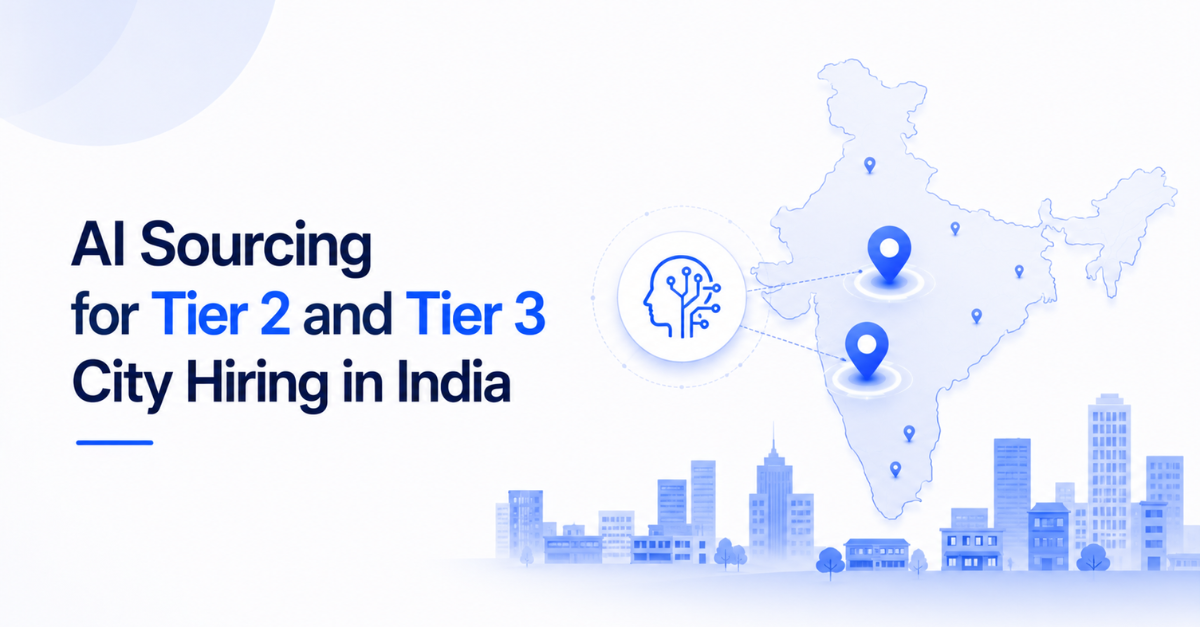
AI sourcing for Tier 2 and Tier 3 city hiring in India helps recruiters identify talent in emerging markets, improve candidate discovery, and expand hiring beyond major metro cities. However, successful regional hiring requires more than sourcing alone. Candidate engagement, qualification, follow-ups, and recruiting workflow automation often have a greater impact on hiring outcomes.
For years, Indian recruitment strategies centered around a handful of cities:
Bangalore
Hyderabad
Mumbai
Pune
Chennai
Gurgaon
These metro hubs continue to be major talent markets.
But India's workforce landscape is changing.
Today, companies are actively hiring from cities such as:
Coimbatore
Jaipur
Indore
Kochi
Mysore
Bhubaneswar
Chandigarh
Surat
Lucknow
Vizag
Trivandrum
Nagpur
Several factors are driving this shift:
Remote work adoption
GCC expansion
Rising metro hiring costs
Improved digital infrastructure
Distributed workforce strategies
As a result, recruiters are increasingly responsible for hiring across geographically diverse talent pools.
This creates new challenges.
Finding candidates in regional markets is important, but the larger challenge is engaging, qualifying, and converting candidates efficiently across multiple locations.
In this guide, we'll explore how AI sourcing helps recruiters hire in Tier 2 and Tier 3 cities, where sourcing tools create value, and why recruiting automation is becoming critical for distributed hiring success.
Why Is Hiring Expanding Beyond Metro Cities?
Organizations are no longer limited to traditional hiring hubs.
Talent Distribution Trends
India's skilled workforce is becoming increasingly distributed.
Engineering, technology, customer support, operations, finance, and manufacturing talent can now be found across a much wider geographic footprint.
Companies are leveraging these emerging talent markets to reduce hiring pressure in crowded metro regions.
Cost Advantages
Recruiting outside major metros often offers benefits such as:
Lower compensation expectations
Reduced operational costs
Greater talent availability
Lower employee attrition
These factors make regional hiring attractive for employers.
Remote and Hybrid Work
Remote and hybrid work models have fundamentally changed recruiting strategies.
Employers can now hire talent based on skills rather than proximity to headquarters.
This shift has accelerated hiring activity in Tier 2 and Tier 3 cities.
The Rise of Tier 2 and Tier 3 Talent Markets
Several Indian cities are emerging as important hiring destinations.
Key Emerging Cities
City
Key Talent Strengths
Coimbatore
Manufacturing, engineering, software services
Jaipur
Technology, startups, digital services
Indore
IT services, software development
Kochi
Technology, GCCs, shared services
Mysore
Software development, engineering
Bhubaneswar
IT services, technology operations
Chandigarh
Technology, consulting, support services
Surat
Manufacturing, operations
Lucknow
Government, technology, services
Vizag
Engineering, logistics, IT
Trivandrum
Technology, product development
These cities increasingly attract investment from enterprises, startups, staffing firms, and GCCs.
Industry-Specific Talent Hubs
Different cities often develop specialized talent ecosystems.
For example:
Coimbatore and Surat have strong manufacturing talent pools.
Kochi and Trivandrum continue expanding technology hiring.
Indore and Jaipur are growing startup and software ecosystems.
Bhubaneswar is attracting IT and engineering talent.
Recruiters who understand these patterns can build stronger sourcing strategies.
What Challenges Do Recruiters Face in Regional Hiring?
Hiring across distributed locations introduces operational complexity.
Talent Visibility
Many recruiters have limited visibility into regional talent markets.
Common challenges include:
Smaller professional networks
Limited local referrals
Less familiarity with regional hiring ecosystems
This often makes candidate discovery more difficult.
Candidate Engagement
Engagement challenges vary significantly by geography.
Candidates may have different expectations regarding:
Communication channels
Hiring timelines
Employer branding
Work location flexibility
Recruiters must adapt engagement strategies accordingly.
Geographic Complexities
Regional hiring frequently involves:
Relocation discussions
Remote work policies
Travel considerations
Hybrid work arrangements
Managing these variables manually can slow recruiting processes.
How Does AI Sourcing Help Recruiters Find Regional Talent?
AI sourcing platforms improve candidate discovery in emerging markets.
Talent Discovery
Modern sourcing platforms analyze:
Candidate profiles
Professional histories
Skills
Experience
Employment patterns
This helps recruiters identify candidates outside traditional hiring networks.
Location Intelligence
Location-aware recruiting technology can help recruiters understand:
Talent concentration areas
Regional labor markets
Candidate proximity
Geographic hiring patterns
This improves sourcing accuracy.
Skills-Based Matching
AI matching systems can identify candidates based on skills and experience rather than exact job titles.
This expands talent pools and helps recruiters uncover overlooked candidates.
Where Does AI Sourcing Alone Fall Short?
While sourcing technology improves discovery, many recruiting challenges emerge later in the process.
Candidate Communication
Finding candidates is only the first step.
Recruiters must also maintain consistent communication throughout the hiring journey.
Follow-Ups
One of the most time-consuming recruiting tasks is follow-up management.
Without consistent follow-ups:
Response rates decline
Candidate engagement decreases
Pipeline conversion suffers
Interview Coordination
Scheduling interviews across locations, time zones, and hiring teams often creates additional delays.
These operational bottlenecks can slow hiring regardless of sourcing quality.
Why Does Candidate Engagement Matter in Regional Hiring?
Many organizations focus heavily on sourcing.
However, engagement frequently determines hiring success.
Response Rates
Regional candidates often receive fewer opportunities than candidates in metro markets.
Well-executed outreach and follow-up strategies can significantly improve response rates.
Trust Building
Candidates in emerging markets may have less familiarity with employers hiring remotely or from different cities.
Consistent communication helps build trust and confidence.
Candidate Experience
A positive candidate experience increases:
Interview attendance
Candidate conversion
Offer acceptance rates
This becomes especially important when hiring across distributed locations.
See How Huntlo Helps Recruiters Engage and Qualify Candidates Across India's Emerging Talent Markets
Modern recruiting teams need more than sourcing capabilities. They need systems that help manage candidate engagement and recruiting execution at scale.
AI Sourcing vs Recruiting Automation
Many recruiters evaluate platforms primarily based on sourcing features.
This approach often misses the bigger opportunity.
Finding Talent
AI sourcing focuses on:
Candidate search
Talent matching
Candidate discovery
These capabilities solve visibility challenges.
Moving Talent Through the Hiring Funnel
Recruiting automation focuses on:
Outreach
Follow-ups
Qualification
Scheduling
Workflow execution
These activities often determine whether hires actually happen.
Capability
AI Sourcing Tool
Recruiting Automation Platform
Candidate Discovery
✓
✓
Skills Matching
✓
✓
Candidate Outreach
Limited
✓
Follow-Up Automation
Limited
✓
Candidate Qualification
Limited
✓
Interview Coordination
Limited
✓
Recruiting Operations
Limited
✓
The most effective hiring teams combine sourcing and recruiting automation.
How Does Agentic AI Support Distributed Hiring?
As recruiting complexity grows, organizations are looking beyond sourcing software.
Automated Outreach
AI agents can initiate candidate engagement and maintain communication throughout the hiring process.
Candidate Qualification
AI-powered workflows can collect information and assess candidate fit before recruiter involvement.
This reduces administrative workload.
Workflow Automation
Agentic AI can automate:
Follow-ups
Scheduling
Candidate progression
Recruiting coordination
This helps recruiters manage larger candidate volumes without increasing headcount.
Discover How Agentic AI Recruiting Infrastructure Supports Distributed Hiring at Scale
Huntlo's Agentic AI Recruiting Infrastructure helps recruiting teams automate sourcing, engagement, qualification, and workflow execution across diverse hiring markets.
The Future of Hiring Across India's Emerging Talent Hubs
Regional hiring will continue growing as organizations expand beyond traditional metros.
Hyper-Local Recruiting
Future recruiting platforms will increasingly leverage:
Local labor market intelligence
Geographic hiring insights
Regional candidate preferences
to improve hiring outcomes.
AI-Powered Recruiting Operations
The next generation of recruiting technology will focus less on candidate discovery and more on recruiting execution.
This includes:
Candidate engagement automation
Qualification automation
Interview coordination
Recruiting workflow automation
Organizations that automate these processes will be better positioned to scale distributed hiring.
Conclusion
India's hiring landscape is expanding rapidly beyond major metro cities.
Tier 2 and Tier 3 talent markets now play a critical role in workforce growth for startups, staffing firms, GCCs, and enterprises.
AI sourcing tools help recruiters discover talent across these emerging markets more efficiently.
However, sourcing alone is not enough.
The biggest recruiting challenges often occur after candidates enter the pipeline.
Successful regional hiring requires consistent engagement, timely follow-ups, efficient qualification, and coordinated recruiting workflows.
That is why the future of distributed hiring is moving beyond sourcing software toward Agentic AI Recruiting Infrastructure that helps recruiters execute hiring processes efficiently across India's rapidly growing talent ecosystem.
Frequently Asked Questions
What are Tier 2 and Tier 3 cities in India?
Tier 2 and Tier 3 cities are emerging urban centers outside major metro regions. Examples include Coimbatore, Indore, Jaipur, Kochi, Mysore, Bhubaneswar, Surat, and Chandigarh.
How do recruiters hire candidates in smaller cities?
Recruiters use sourcing platforms, job boards, referrals, local networks, and increasingly AI-powered recruiting tools to identify and engage talent in regional markets.
Can AI improve regional hiring?
Yes. AI can improve candidate discovery, location-based matching, talent intelligence, engagement automation, and recruiting workflow efficiency.
What is location-based recruiting?
Location-based recruiting uses geographic information to identify candidates, understand talent availability, and improve hiring decisions based on regional workforce dynamics.
How does AI sourcing work?
AI sourcing platforms analyze candidate profiles, resumes, skills, experience, and location data to identify relevant talent for open positions.
What recruiting tasks can AI automate?
AI can automate sourcing, outreach, follow-ups, qualification, interview scheduling, candidate communication, and recruiting workflow management.
How does AI improve recruiter productivity?
By automating repetitive administrative tasks, AI allows recruiters to focus more on candidate relationships and strategic hiring activities.
What is candidate engagement automation?
Candidate engagement automation uses AI to manage outreach, reminders, follow-ups, and communication workflows throughout the hiring process.
What is recruiting workflow automation?
Recruiting workflow automation streamlines hiring activities such as scheduling, qualification, communication, and pipeline management.
What is Agentic AI recruiting?
Agentic AI recruiting uses autonomous AI agents to execute recruiting tasks across sourcing, engagement, qualification, and workflow coordination while supporting recruiter decision-making.