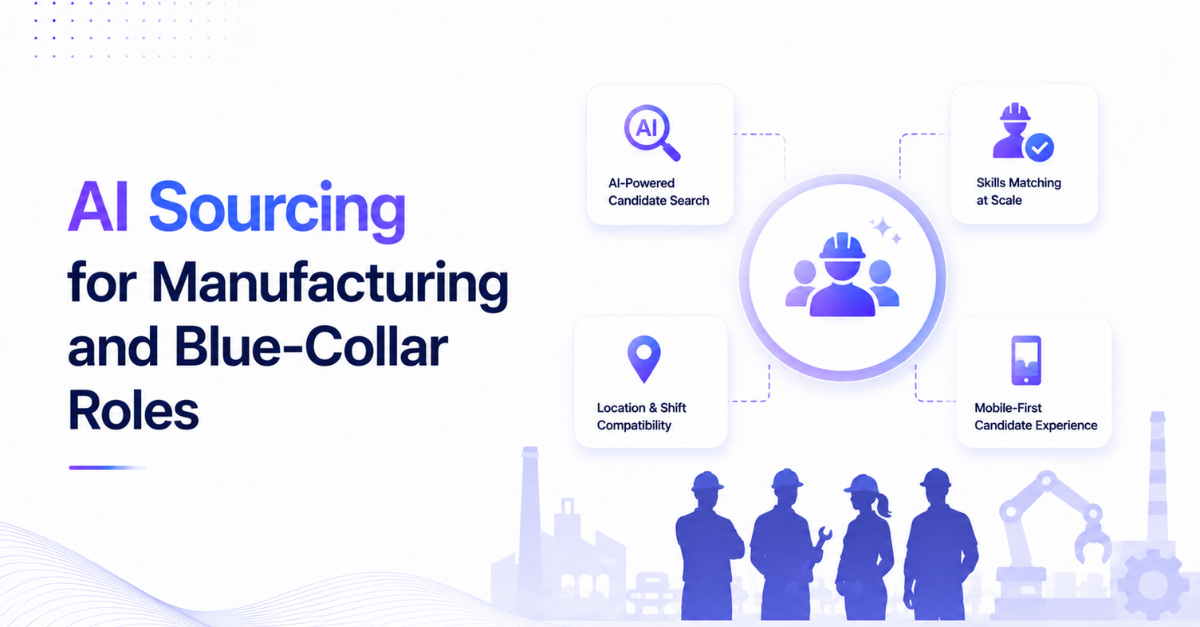
AI sourcing can help manufacturing recruiters identify candidates faster, build workforce pipelines more efficiently, and reduce manual recruiting effort. However, the biggest challenge in manufacturing recruitment is rarely finding workers. It's engaging candidates, reducing drop-offs, coordinating interviews, and managing hiring operations at scale.
Manufacturing and blue-collar hiring represent some of the largest recruiting segments globally.
Whether hiring:
Factory workers
Machine operators
Production associates
Warehouse staff
Forklift operators
Maintenance technicians
Logistics personnel
Field service workers
Recruiters face a very different set of hiring challenges compared to corporate recruiting.
Manufacturing organizations often need to fill dozens or even hundreds of positions simultaneously. Hiring timelines are short, turnover rates can be high, and candidates frequently require multiple touchpoints before they complete the hiring process.
This has created growing interest in AI recruiting technology.
While AI sourcing tools can improve candidate discovery, modern manufacturing hiring requires automation across the entire recruiting workflow.
The organizations hiring most efficiently today are not simply sourcing more candidates.
They are automating engagement, qualification, scheduling, and recruiting operations.
Why Is Manufacturing Hiring Different?
Manufacturing recruitment operates under different constraints than most white-collar hiring functions.
High-Volume Hiring Requirements
Many manufacturing facilities regularly hire for:
Shift-based roles
Seasonal demand
Plant expansion
Workforce replacement
New facility launches
Recruiters may need to process hundreds of candidates every month.
Manual workflows become difficult to scale.
Labor Shortages and Turnover
Many manufacturing employers face persistent workforce shortages.
Competition for qualified workers continues to increase across:
Warehousing
Logistics
Industrial production
Skilled trades
Field services
At the same time, turnover rates can create constant hiring pressure.
Geographic Hiring Challenges
Manufacturing jobs are often tied to specific locations.
Unlike remote knowledge work, employers must recruit candidates within commuting distance of facilities, warehouses, and production plants.
This limits available talent pools.
The Unique Challenges of Blue-Collar Recruitment
Manufacturing recruiters face operational challenges that traditional sourcing strategies often struggle to address.
Limited Digital Candidate Profiles
Many blue-collar candidates maintain a limited online professional presence.
Unlike software engineers or corporate professionals, candidates may not actively update profiles on professional networks.
This can make candidate discovery more difficult.
Candidate No-Shows
One of the largest hiring challenges is interview attendance.
Recruiters frequently experience:
Missed calls
Missed interviews
Incomplete applications
Communication gaps
These issues slow hiring velocity significantly.
High Application Abandonment
Candidates often begin applications but never complete the hiring process.
Reasons include:
Competing job offers
Delayed communication
Scheduling issues
Poor candidate experiences
Without consistent engagement, drop-off rates increase.
See How Manufacturing Recruiters Automate Candidate Engagement and Reduce Drop-Offs With Huntlo
The biggest hiring challenge isn't generating applications. It's converting applicants into hires.
What AI Sourcing Can Do for Manufacturing Recruiters
AI sourcing provides several meaningful advantages for manufacturing recruitment.
Candidate Discovery
AI sourcing platforms help recruiters identify candidates using:
Skills
Certifications
Work history
Geographic proximity
Industry experience
This reduces manual search effort.
Talent Matching
AI can prioritize candidates based on job requirements.
This helps recruiters focus attention on qualified workers.
Workforce Pipeline Building
AI sourcing tools enable recruiters to build talent pipelines more efficiently.
This is particularly valuable for ongoing workforce planning.
AI Sourcing Capability
Recruiting Benefit
Candidate Discovery
Faster worker identification
Talent Matching
Improved candidate relevance
Geographic Filtering
Better local recruiting
Pipeline Building
Larger workforce pools
Search Automation
Reduced recruiter effort
These capabilities improve sourcing productivity.
However, sourcing alone rarely solves manufacturing hiring challenges.
Where AI Sourcing Alone Falls Short
Most AI sourcing platforms focus on finding candidates.
The majority of hiring work happens afterward.
Candidate Engagement
Manufacturing candidates often require:
Multiple reminders
Follow-up calls
Status updates
Interview confirmations
Most sourcing tools do not automate these activities effectively.
Screening
Candidate qualification requires:
Availability checks
Shift preference validation
Location verification
Basic eligibility screening
These tasks consume significant recruiter time.
Scheduling
Interview scheduling remains one of the most repetitive recruiting activities.
High-volume hiring magnifies this challenge.
Follow-Up Management
Consistent communication is critical for reducing candidate drop-offs.
Without automation, recruiters struggle to maintain engagement at scale.
Recruiting Activity
AI Sourcing Impact
Candidate Discovery
High
Talent Matching
High
Candidate Engagement
Limited
Candidate Screening
Limited
Interview Scheduling
Limited
Follow-Up Management
Limited
This is why many manufacturing recruiters still face hiring bottlenecks despite investing in sourcing technology.
The Real Bottlenecks in Manufacturing Hiring
The most significant challenges often occur after candidates enter the pipeline.
Candidate Drop-Offs
Many organizations lose candidates before interviews are completed.
Common causes include:
Delayed communication
Poor follow-up processes
Scheduling delays
Interview Attendance
Reducing no-show rates requires consistent reminders and communication.
Manual processes make this difficult.
Recruiter Workload
Recruiters spend substantial time on:
Screening
Scheduling
Follow-ups
Coordination
As hiring volume increases, administrative work increases as well.
Discover How Huntlo Helps Hiring Teams Manage High-Volume Recruiting Without Increasing Recruiter Headcount
Modern workforce hiring requires operational efficiency, not just larger candidate pools.
AI Sourcing vs Recruiting Automation
This distinction is increasingly important.
Finding Workers
AI sourcing focuses on:
Candidate discovery
Talent matching
Pipeline generation
Moving Workers Through the Hiring Process
Recruiting automation focuses on:
Candidate engagement
Qualification
Follow-ups
Scheduling
Workflow execution
Capability
AI Sourcing Tools
Recruiting Automation
Candidate Discovery
Yes
Limited
Talent Matching
Yes
Limited
Candidate Outreach
Partial
Yes
Candidate Qualification
Limited
Yes
Follow-Up Automation
Limited
Yes
Scheduling Automation
Limited
Yes
Recruiting Workflow Automation
No
Yes
The difference between discovery and execution is often the difference between hiring success and hiring delays.
How Agentic AI Supports High-Volume Hiring
The next evolution of recruiting technology is Agentic AI.
Instead of simply assisting recruiters, AI agents execute recruiting workflows autonomously.
Automated Engagement
AI agents can manage candidate communication and reminders at scale.
This improves response rates and reduces recruiter workload.
Automated Qualification
AI can conduct preliminary qualification workflows before recruiter involvement.
This helps prioritize recruiter time.
Automated Interview Coordination
Scheduling automation reduces delays and improves interview attendance.
These capabilities are particularly valuable for high-volume hiring environments.
What Manufacturing Recruiters Should Automate First
Recruiters often focus on sourcing before addressing larger workflow challenges.
The highest-impact automation opportunities usually include:
Candidate Reminders
Automated reminders reduce no-shows and improve attendance rates.
Screening Workflows
Qualification automation accelerates candidate evaluation.
Scheduling
Scheduling automation eliminates repetitive administrative tasks.
Hiring Operations
Workflow automation ensures candidates move through hiring processes consistently.
Recommended Automation Priorities
Candidate Reminders
Candidate Screening
Interview Scheduling
Recruiting Workflow Management
Candidate Sourcing
This approach often delivers the strongest productivity gains.
Learn How Agentic AI Recruiting Infrastructure Improves Workforce Hiring Efficiency
The future of manufacturing recruitment requires more than better sourcing. It requires automated execution across the hiring lifecycle.
The Future of Manufacturing Recruitment
Recruiting technology is evolving rapidly.
From Sourcing Tools to Recruiting Infrastructure
Historically, recruiting software focused on helping recruiters find candidates.
Modern hiring challenges require much more.
Organizations increasingly need systems capable of:
Engaging workers
Qualifying workers
Coordinating interviews
Managing hiring workflows
Reducing candidate drop-offs
This shift is driving interest in Agentic AI Recruiting Infrastructure.
Rather than simply generating candidate lists, these systems help recruiters move candidates through the hiring funnel efficiently.
For manufacturing organizations facing labor shortages, turnover, and high-volume hiring demands, that operational capability may become the most important recruiting advantage.
Final Verdict
AI sourcing can significantly improve manufacturing recruitment.
It helps recruiters discover candidates faster, build workforce pipelines, and reduce manual search effort.
However, sourcing alone does not solve the most important hiring challenges.
Manufacturing recruiters typically struggle with:
Candidate engagement
Candidate drop-offs
Screening workflows
Scheduling
Hiring operations
The future of manufacturing recruitment is not simply better sourcing.
It's combining candidate discovery with recruiting automation.
AI sourcing helps recruiters find workers.
Agentic AI Recruiting Infrastructure helps recruiters hire workers.
That distinction will define the next generation of high-volume recruiting.
Frequently Asked Questions
Can AI recruit blue-collar workers?
Yes. AI can help identify, engage, qualify, and manage blue-collar candidates throughout the hiring process.
How does AI help manufacturing hiring?
AI improves candidate discovery, talent matching, communication, qualification, scheduling, and recruiting workflow efficiency.
What is volume hiring automation?
Volume hiring automation uses technology to streamline repetitive recruiting tasks for organizations hiring large numbers of workers.
Can AI reduce candidate drop-offs?
Yes. Automated reminders, follow-ups, and engagement workflows can help improve candidate participation and reduce hiring funnel abandonment.
How does AI improve recruiter productivity?
AI reduces manual administrative work, allowing recruiters to focus on candidate relationships and hiring decisions.