Three years ago, a mid-size enterprise software company doubled its recruitment marketing budget. They redesigned their careers site, launched an employee advocacy program on social media, sponsored industry conferences, and ran targeted ad campaigns on LinkedIn. The result was a three hundred percent increase in applications and a forty percent increase in inbound candidate interest. Their hiring outcomes did not improve. They received more applications, but their response rate to outbound messages stayed flat, their offer acceptance rate remained at fifty-eight percent, and their time-to-fill actually increased by six days, because
the larger volume of candidates created more pipeline management overhead. The company's talent acquisition leader analyzed the data and found that the problem was not at the top of the funnel. It was in the middle and at the bottom. Candidates were entering the pipeline at record rates, but they were dropping out at record rates too, because the engagement experience did not match the marketing promise. The company was investing heavily in attracting candidates but underinvesting in converting them. They were running a marketing operation without a fulfillment operation. This year, they redirected forty percent of their recruitment marketing budget toward candidate engagement, investing in AI-powered engagement tools, recruiter training on relationship-building, and communication infrastructure. Their application volume stayed flat, but their offer acceptance rate climbed from fifty-eight percent to eighty-one percent, and their time-to-fill dropped by twenty-two percent. They hired more people with fewer candidates, because the candidates they engaged stayed engaged.
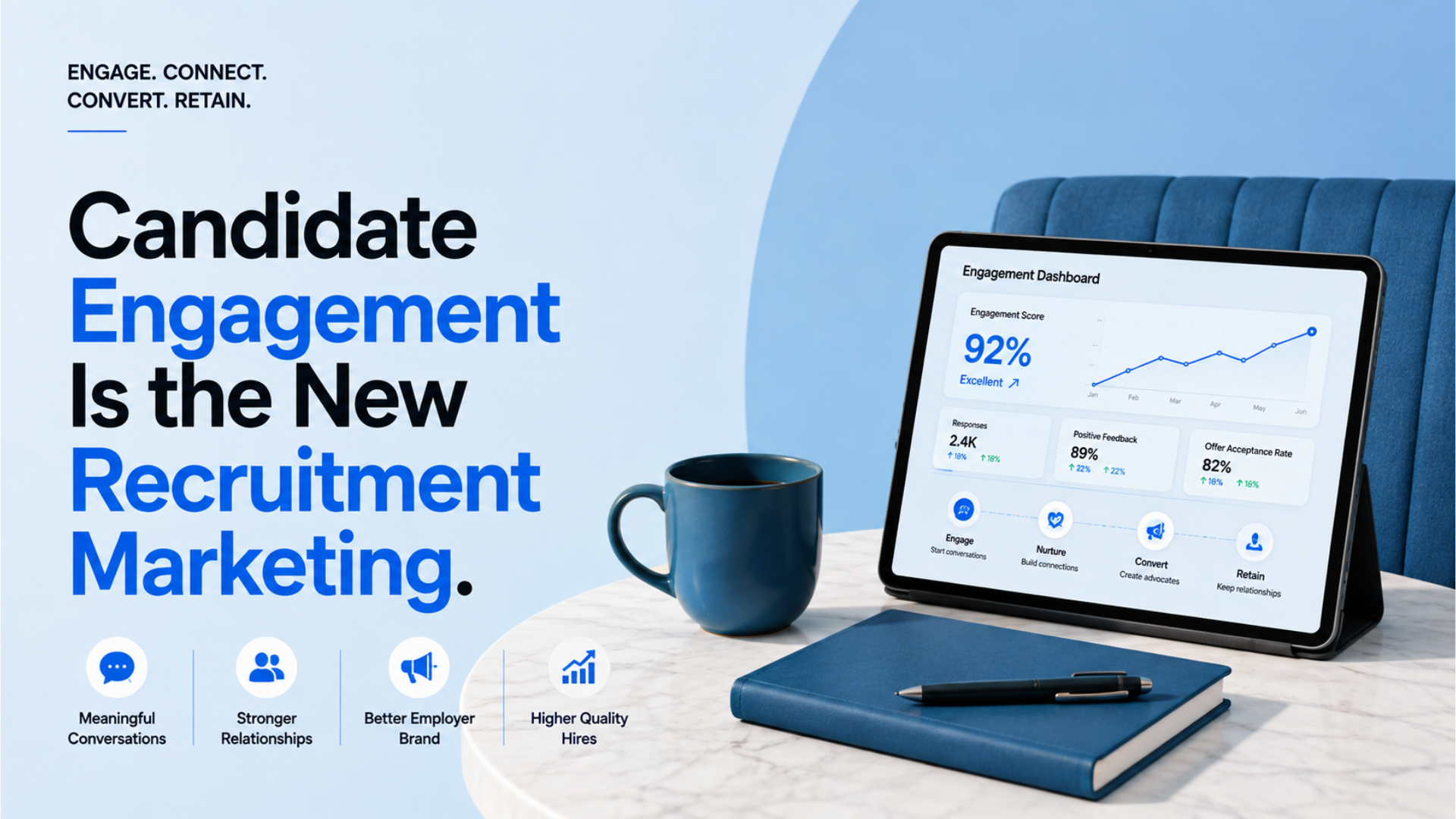
The talent acquisition industry is in the middle of a strategic reallocation that will define the next decade of hiring. For the past fifteen years, the dominant investment priority in talent acquisition has been recruitment marketing, the activities and tools designed to attract candidates to the organization's pipeline. Careers sites, social media campaigns, employer branding, job advertising, and talent community building have consumed the majority of talent acquisition budgets, because the assumption has been that more candidates in the pipeline means more hires at the end. This assumption was valid when candidate supply exceeded demand and the primary challenge was generating awareness of open roles among a large, relatively passive talent pool. That market condition has changed. In most sectors and most seniority levels above entry-level, candidate demand exceeds supply, and the primary challenge is no longer attracting candidates but converting them, keeping them engaged through a multi-week hiring process, building enough trust and excitement to drive offer acceptance, and preventing the withdrawal and decline that drain hiring pipelines of their highest-caliber candidates. According to SHRM's talent acquisition research, sixty-four percent of talent acquisition leaders now say that candidate engagement is a higher strategic priority than candidate attraction, a reversal from just four years ago when attraction was the top priority by a two-to-one margin.
The implication is clear: the organizations that will hire best in the current market are not the ones that attract the most candidates but the ones that engage the candidates they attract most effectively. Understanding the difference between AI sourcing and AI recruiting captures this shift perfectly. Sourcing and marketing fill the pipeline. Engagement empties it successfully. This strategic reallocation is not theoretical. It is already happening among the most competitive hiring organizations, which are redirecting budget from careers site optimization and ad spend toward AI-powered engagement platforms, recruiter training on relationship-building, and communication infrastructure that ensures every candidate interaction is timely, personalized, and brand-consistent. The early results are compelling. Organizations that have made this shift report higher offer acceptance rates, faster time-to-fill, and lower cost-per-hire, despite spending less on traditional recruitment marketing, because the candidates they do attract are more likely to convert. Huntlo's platform is built for this engagement-centric era,
providing the intelligence and consistency infrastructure that converts pipeline volume into hiring outcomes.
The Funnel Problem: Why More Candidates Does Not Mean More Hires
The traditional recruiting funnel model assumes a linear relationship between the top of the funnel, candidate awareness and interest, and the bottom of the funnel, accepted offers and new hires. Under this model, investing in recruitment marketing to increase the number of candidates entering the funnel should proportionally increase the number of hires coming out. This assumption breaks down when the bottleneck in the funnel is not at the top but in the middle and at the bottom, which is exactly the situation most organizations now face. The middle of the funnel, the engagement and evaluation stages, is where the majority of candidate drop-off occurs. Candidates enter the funnel with interest and then lose that interest through a combination of poor communication, long delays, inconsistent engagement, and generic interactions that fail to sustain their emotional investment in the opportunity. The bottom of the funnel, the offer and acceptance stages, is where the accumulated effect of middle-funnel engagement quality determines whether the candidate says yes or no. A candidate who has been well-engaged through the middle of the funnel arrives at the offer stage with trust, context, and emotional readiness. A candidate who has been poorly engaged arrives with skepticism, uncertainty, and a high likelihood of comparing the offer against competitors. According to McKinsey's organizational insights, the average organization loses sixty to seventy percent of its qualified candidates between the top and bottom of the funnel, not because the candidates are not interested in the role, but because the engagement experience fails to sustain their interest. This means that the single most impactful investment a recruiting organization can make is not in generating more candidates at the top but in retaining more candidates through the middle and converting more candidates at the bottom.
The funnel problem is exacerbated by the fact that the candidates who drop out are not randomly distributed. The highest-caliber candidates, the ones with multiple options and the least tolerance for poor engagement, are the most likely to withdraw or decline when the engagement experience is inadequate. This means that investment in recruitment marketing that increases top-of-funnel volume without improving mid-funnel engagement quality can actually produce worse hiring outcomes, because the additional candidates attracted by marketing include a disproportionate share of high-caliber candidates who then drop out due to poor engagement, creating a larger pipeline but a weaker outcome. The teams that add more marketing tools without addressing this dynamic often discover they have more tools but the same hiring problems, because the tools pour more candidates into a funnel that leaks at the engagement stage. The solution is not to stop attracting candidates but to rebalance the investment portfolio toward the engagement capabilities that convert the candidates already in the pipeline. Research on how many followups one hire actually needs illustrates this point precisely: the number of touchpoints required to maintain candidate engagement varies, but the quality of each touchpoint, its relevance, timing, and personalization, is the variable that determines whether the candidate stays in the funnel. This is especially critical when hiring for
niche and technical roles, where the candidate pool is small, every candidate is valuable, and the cost of losing a qualified candidate to engagement failure is far higher than the cost of finding one more candidate to add to the pipeline. The funnel is not a volume problem. It is an engagement problem. Solving the engagement problem is the new recruitment marketing.
Engagement as Marketing: Every Interaction Is a Brand Moment
The shift from recruitment marketing to candidate engagement is not just a reallocation of budget. It is a fundamental rethinking of what marketing means in the context of talent acquisition. In the traditional model, recruitment marketing is a front-end activity that creates the conditions for hiring by generating awareness, interest, and pipeline volume. In the engagement model, marketing is a continuous activity that happens at every stage of the candidate journey, from the first message to the final offer and beyond. Every interaction the candidate has with the recruiting team is a marketing moment that either reinforces or undermines the employer brand, builds or erodes trust, and advances or reverses the candidate's progression toward a hire. This reframing has practical implications for how recruiting organizations design their processes, train their recruiters, and deploy their technology. If every interaction is a marketing moment, then the quality of every interaction matters, not just the quality of the careers site or the job advertisement. The timeliness of a follow-up message, the personalization of a screening call, the transparency of post-interview communication, and the thoughtfulness of an offer presentation are all marketing activities with direct brand impact. According to LinkedIn's recruiting resources, candidates who experience high-quality engagement throughout the hiring process are four to five times more likely to recommend the organization to peers, regardless of whether they were hired, because the engagement experience itself has created a positive brand association that the candidate carries into their professional network. This is marketing output that no careers site or ad campaign can produce, because it is personal, direct, and credible in a way that branded content is not.
Treating engagement as marketing also changes how organizations measure recruiting success. Traditional recruitment marketing metrics, application volume, cost-per-applicant, and pipeline size, measure the input to the hiring process. Engagement marketing metrics, response rates, stage conversion rates, candidate satisfaction, and net promoter scores, measure the quality of the candidate's experience and their likelihood of progressing through and recommending the process. These metrics are more predictive of hiring outcomes than traditional marketing metrics, because they measure the factors that actually determine whether a candidate accepts an offer rather than the factors that determine whether they enter the pipeline. The recruiters asking whether AI will replace their jobs should recognize that the engagement-as-marketing model elevates their role from process manager to brand ambassador, because they are the ones who deliver the marketing moments that build the employer brand through direct candidate experience. This is precisely the role that an agentic AI recruiting platform like Huntlo is designed to support: providing the recruiter with the intelligence, context, and operational backing needed to make every candidate interaction a brand-building marketing moment, while the recruiter provides the authenticity, empathy, and judgment that
give those moments genuine impact. The research on referred candidates provides the strongest evidence for this model. Data confirms that referrals outperform cold outreach not because referred candidates are better qualified, but because the referring employee provides continuous, high-quality engagement that serves as the most effective form of recruitment marketing, one that is personal, trusted, and brand-authentic. Huntlo gives every candidate this referral-quality engagement experience by providing the infrastructure that makes it scalable.
Building the Candidate Engagement Stack: What It Takes
Treating candidate engagement as the primary recruiting investment requires a different technology and operational stack than the traditional recruitment marketing approach. The engagement stack has four layers, each addressing a specific capability that traditional recruiting tools do not provide. The first layer is candidate intelligence, the continuous monitoring and analysis of each candidate's professional activity, career trajectory, engagement signals, and interaction history. This intelligence is the foundation of personalized engagement, because without current, accurate information about the candidate's situation, every interaction will be generic and every marketing moment will be wasted. The second layer is engagement orchestration, the systematic management of communication timing, channel selection, and message personalization across the entire candidate pipeline. This layer ensures that every candidate receives the right message at the right time through the right channel, which is the operational definition of effective engagement marketing. The third layer is journey monitoring, the real-time tracking of each candidate's progression through the hiring process with alerts for communication gaps, engagement drops, and risk signals that could lead to withdrawal or decline. According to Gartner's HR trends research, organizations that implement all three layers, intelligence, orchestration, and monitoring, as an integrated system report thirty-five to fifty percent improvements in candidate-to-hire conversion rates, because the integrated system eliminates the communication failures and engagement gaps that cause candidate drop-off. The fourth layer is outcome analytics, the measurement of engagement quality and its impact on hiring outcomes, enabling the organization to continuously refine its engagement approach based on data rather than intuition.
Building this engagement stack requires investment, but the return on that investment is substantial and measurable. The quality of the candidate data that feeds the intelligence layer is the single most important variable in the stack's effectiveness. Teams that have encountered outdated candidate data in AI tools understand that an engagement stack built on stale data will produce interactions that feel informed but are actually misleading, which is worse than no personalization at all. When evaluating engagement platforms, use the framework for evaluating an AI sourcing tool before buying to ensure that data freshness, real-time signal processing, and journey continuity are core platform capabilities rather than add-on features. The operational impact of a well-built engagement stack extends beyond individual hiring outcomes to the organization's overall talent acquisition efficiency. When engagement quality improves, the organization needs fewer candidates per hire, which means less sourcing effort, lower cost-per-hire, and faster time-to-fill.
The ROI of Engagement: Why It Outperforms Recruitment Marketing Spend
According to Deloitte's talent research, organizations that invest in the engagement stack reduce their overall recruiting cost per hire by twenty to thirty-five percent, because the efficiency gains from higher conversion rates more than offset the investment in engagement technology and capabilities. This ROI advantage is structural, not marginal, because every dollar invested in engagement quality produces compounding returns. Higher engagement quality increases conversion rates at every stage of the funnel, reducing the number of candidates needed per hire and the recruiter time required to manage the pipeline. The time savings can then be reinvested in deeper engagement with remaining candidates, creating a virtuous cycle that improves outcomes continuously. According to EY's technology insights, AI-powered engagement platforms are the most efficient vehicle for building this capability, because they provide all four layers of the engagement stack in an integrated system that scales with the organization's hiring volume. The organizations that will lead the next decade of talent acquisition are the ones that recognize this shift and reallocate their resources accordingly, treating candidate engagement not as a support function for recruitment marketing but as the primary marketing function itself. Huntlo delivers the complete engagement stack, from candidate intelligence to outcome analytics, enabling recruiting organizations to treat every interaction as the marketing moment it is. Candidate engagement is the new recruitment marketing. Huntlo makes it operational. Start engaging at a marketing level with Huntlo.