A recruiter needs to hire a senior software engineer.
An AI tool searches millions of professional profiles.
It understands the hiring requirement.
It identifies people with relevant experience.
It ranks the candidates.
It explains why each person may fit the role.
The recruiter now has a strong shortlist.
That is AI sourcing.
The recruiter still needs to find reliable contact information.
They need to decide whom to contact.
They need to write messages.
They need to send follow-ups.
They need to respond when candidates show interest.
They need to qualify those candidates.
They may need to conduct an initial screen.
They need to coordinate interviews.
They need to keep the hiring workflow moving.
AI can help with these activities too.
That is where the broader category of AI recruiting begins.
The distinction sounds simple, but recruiting technology has made it increasingly confusing. Many AI sourcing tools now offer outreach. Many AI recruiting platforms include sourcing. Some vendors describe candidate matching as recruiting automation. Others describe complete multi-stage hiring workflows as sourcing.
The result is that two products can both call themselves AI recruiting tools while solving completely different problems.
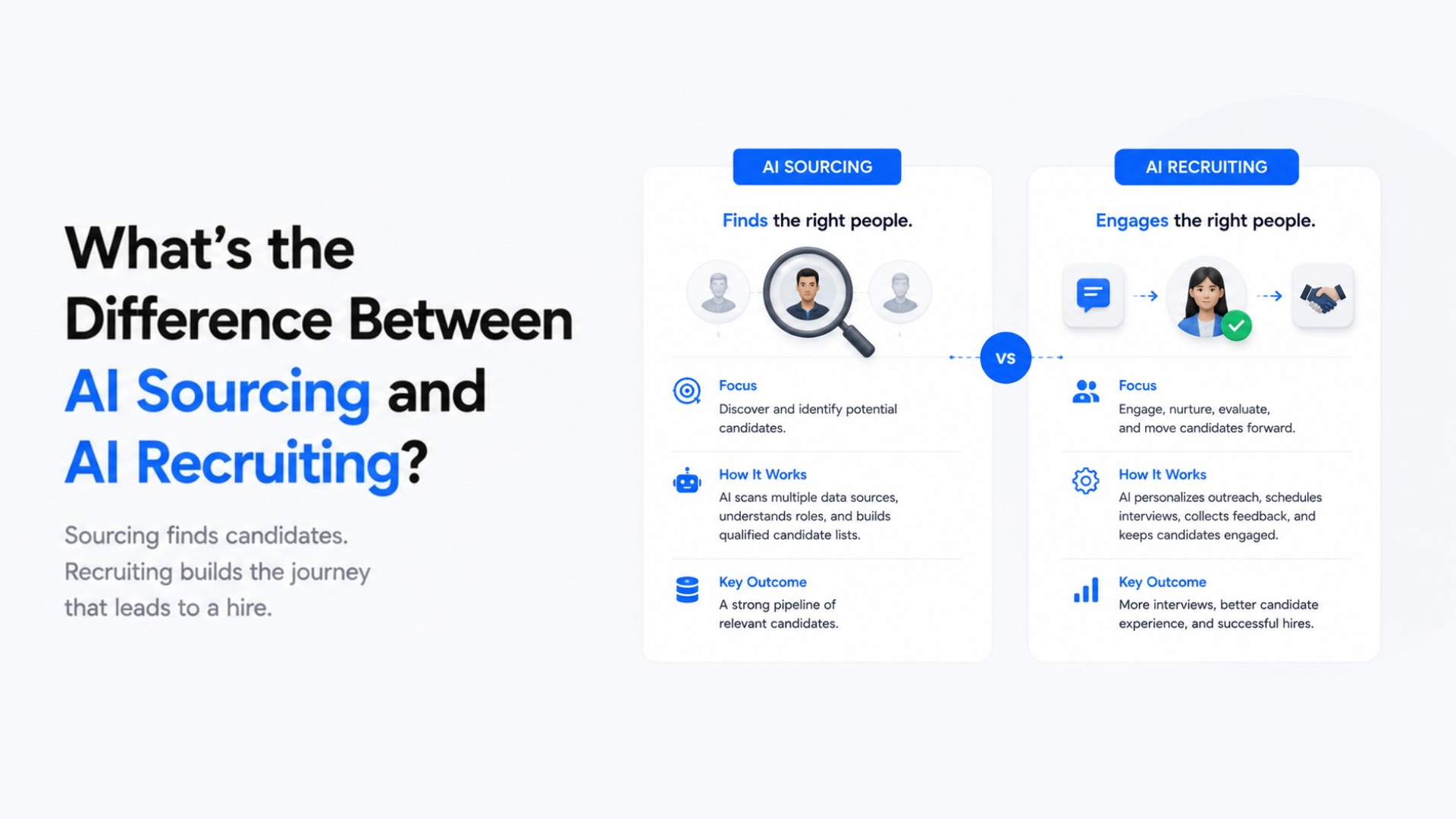
The simplest difference is that AI sourcing focuses on finding and identifying potential candidates, while AI recruiting applies artificial intelligence across a wider part of the hiring process. AI recruiting may include sourcing, but it can also include contact enrichment, outreach, candidate engagement, follow-ups, screening, interview coordination, scheduling, and workflow progression.
AI sourcing answers a question.
Who should we consider?
AI recruiting answers a larger set of questions.
Who should we consider?
How do we reach them?
How do we engage them?
How do we determine whether they are interested?
How do we qualify them?
How do we move them toward an interview?
This distinction matters because candidate discovery is only the beginning of outbound hiring.
A list of excellent candidates is not a pipeline.
A candidate becomes part of the recruiting process only when the organization can create engagement and move the person toward a meaningful hiring outcome.
What Is AI Sourcing?
AI sourcing is the use of artificial intelligence to help recruiters discover, identify, match, rank, and organize potential candidates for a role.
Traditional candidate sourcing often depends heavily on manual search.
A recruiter opens a professional network or candidate database.
They enter job titles.
They add skills.
They build Boolean strings.
They adjust location filters.
They review profiles one by one.
They change the search when the results are too broad or too narrow.
AI sourcing changes the interface between the recruiter and the talent market.
Instead of translating a hiring requirement into a complicated search query, the recruiter may describe the type of person they need in natural language.
The AI can interpret the requirement.
It can identify related job titles.
It can understand adjacent skills.
It can consider career progression.
It can compare professional evidence with the role.
It can rank candidates according to likely relevance.
This is the core of AI sourcing.
The technology helps answer the discovery problem.
Where are the potentially relevant candidates?
Modern AI sourcing tools may also provide additional capabilities.
They may enrich candidate profiles.
They may identify contact details.
They may generate candidate summaries.
They may create match explanations.
They may help recruiters organize talent pools.
Some also provide outreach features.
The category has expanded.
The core function remains candidate discovery.
If the product’s main value is helping the recruiter find the right people, it is primarily an AI sourcing tool.
What Is AI Recruiting?
AI recruiting is a broader category.
It refers to the use of artificial intelligence across the recruiting and hiring process.
This can begin before candidate sourcing.
AI may help interpret a job requirement.
It may help create a job description.
It may identify the skills connected with the role.
The process can then move into sourcing.
AI can discover candidates.
It can match profiles.
It can help identify passive talent.
After discovery, AI recruiting can continue.
The system may enrich candidate information.
It may generate personalized outreach.
It may communicate through email, WhatsApp, or other channels.
It may send follow-ups.
It may respond to candidate behavior.
It may collect qualification information.
It may conduct an initial screening conversation.
It may summarize candidate answers.
It may coordinate interviews.
It may help schedule the next stage.
It may keep recruiters informed about workflow status.
This wider scope is why AI recruiting should not be treated as another name for AI sourcing.
AI sourcing is one use case inside AI recruiting.
The distinction is similar to the difference between search and the complete hiring workflow.
Search matters.
Recruiting does not end when the search result appears.
Research and industry guidance also describe AI in recruitment as operating across multiple stages rather than only candidate discovery. AI applications can include sourcing, screening, matching, interview support, scheduling, and other recruiting workflows.
The Difference Begins With Scope
The clearest difference between AI sourcing and AI recruiting is scope.
AI sourcing has a narrower objective.
Find potential candidates.
AI recruiting has a broader objective.
Help the organization move from a hiring need toward a successful hiring outcome.
This does not mean every AI recruiting tool covers the complete hiring process.
Some focus on screening.
Some focus on interviews.
Some focus on candidate communication.
Some focus on workflow automation.
The category is broader because recruiting itself is broader.
A sourcing tool may stop after creating a shortlist.
An AI recruiting platform may treat the shortlist as the beginning of the workflow.
This is the practical distinction buyers should remember.
Where does the product stop?
If the tool finds candidates and the recruiter takes over, the product is primarily solving sourcing.
If the system continues into engagement, qualification, screening, and workflow progression, it is solving a larger recruiting problem.
AI Sourcing Solves the Discovery Problem
Recruiters cannot hire people they cannot find.
This is especially important in outbound recruiting.
The strongest candidate may never apply.
They may not visit the company’s careers page.
They may not be actively searching for a new job.
They may not appear in the first obvious keyword search.
Sourcing exists to identify these people.
AI improves this process by helping recruiters search beyond exact keywords.
A traditional search may require the recruiter to know every possible title.
The AI can understand that similar responsibilities may appear under different titles.
A traditional search may depend on explicit skill keywords.
The AI can identify related experience.
A traditional search may produce hundreds of profiles in no meaningful order.
The AI can help prioritize candidates.
This is valuable because talent markets are messy.
Companies use different titles.
Candidates describe experience differently.
Professional information is incomplete.
The recruiter’s search language does not always match the candidate’s profile language.
AI sourcing attempts to bridge this gap.
Huntlo’s guide to What Is Candidate Sourcing Automation? explains how modern sourcing systems reduce manual search work by helping recruiters discover and organize potential candidates more efficiently.
The output of the process is still primarily candidate discovery.
AI Recruiting Solves the Movement Problem
Finding a candidate creates possibility.
Recruiting requires movement.
The candidate needs to become aware of the opportunity.
They need a reason to respond.
They may need follow-ups.
The recruiter needs to know whether the person is interested.
The candidate needs to be qualified.
The hiring team needs enough information to decide whether the person should move forward.
Interviews need to happen.
The process needs to maintain momentum.
This is the movement problem.
Many recruiting teams do not struggle only because they cannot find candidates.
They struggle because candidates become stuck between stages.
The sourcing tool creates a list.
The recruiter exports the list.
Another platform finds contact details.
A separate tool sends email.
Replies arrive in an inbox.
Interested candidates are added to another system.
Screening happens somewhere else.
Scheduling creates another manual task.
The recruiting workflow becomes fragmented.
AI recruiting attempts to reduce this fragmentation.
The goal is not only to produce candidate information.
It is to help execute the work required to move candidates through the process.
This is why the distinction between AI sourcing and AI recruiting becomes more important as recruiting technology moves toward agents and autonomous workflows.
A Candidate List Is Not a Recruiting Outcome
This is the easiest way to understand the difference.
Imagine that an AI sourcing tool finds 100 excellent candidates.
The recruiter is impressed.
What has the business achieved?
Potentially a great deal.
Operationally, very little has happened yet.
None of the candidates may know the company exists.
None may be interested.
Some may have outdated profiles.
Some may be impossible to reach.
Some may respond but fail basic requirements.
Some may already have been contacted by the company.
The candidate list contains opportunity.
The recruiting process needs to convert that opportunity.
This is why sourcing metrics and recruiting metrics are different.
A sourcing team may measure candidate relevance.
Search speed.
Shortlist quality.
Candidate coverage.
Contactability.
A broader recruiting workflow may measure positive response rates.
Qualified conversations.
Screening conversion.
Interviews.
Offers.
Hires.
Recruiter effort.
The further the system moves through the hiring process, the closer its measurement becomes to actual hiring outcomes.
AI Sourcing Usually Starts With a Search
The typical AI sourcing workflow begins with a role.
The recruiter provides a job description or hiring requirement.
The system interprets the need.
It may identify skills, seniority, industry experience, location, and other criteria.
The AI searches available candidate information.
It ranks profiles.
The recruiter reviews the results.
The recruiter may refine the search.
Strong candidates are saved.
Some platforms then enrich those candidates with contact information.
The process may continue into outreach, but the product’s center of gravity remains discovery.
The recruiter is still largely responsible for deciding what happens next.
This workflow can be extremely useful.
For many teams, candidate discovery is the biggest bottleneck.
The distinction is not that AI sourcing is incomplete or inferior.
It is that the product is solving a specific stage of recruiting.
AI Recruiting Can Start Before the Search and Continue After It
A broader AI recruiting system may begin with the hiring requirement.
The AI interprets the role.
It creates or improves the search strategy.
It finds candidates.
It enriches their profiles.
It identifies contact routes.
It generates personalized outreach.
It sends communication.
It follows up according to candidate behavior.
It identifies interested candidates.
It collects qualification information.
It conducts an initial screening interaction.
It summarizes the evidence.
It moves qualified candidates toward interviews.
The recruiter remains involved where judgment, relationship building, or decision-making matters.
The system handles more of the repetitive execution between those points.
This is a different product philosophy.
The AI is not only a better search interface.
It becomes part of the recruiting workflow.
Modern recruitment automation is increasingly described in these broader workflow terms, with AI supporting sourcing, screening, personalized follow-ups, and other repetitive hiring tasks rather than operating only at the search stage.
AI Sourcing and AI Recruiting Overlap
The categories are not completely separate.
AI recruiting includes sourcing.
Many AI sourcing tools include recruiting features.
This overlap is why the terminology becomes confusing.
A sourcing platform may provide email outreach.
Does that make it an AI recruiting platform?
Possibly.
The answer depends on the depth of the workflow.
A simple email-generation feature does not necessarily transform a sourcing database into a complete recruiting system.
The recruiter may still need to export candidates.
They may need to manage sequences manually.
They may need to monitor replies.
They may need to transfer interested candidates into another tool.
The platform technically supports outreach.
The workflow still depends on the recruiter.
A broader AI recruiting platform may coordinate the process.
Candidate discovery triggers engagement.
Candidate behavior influences follow-up.
Interest triggers qualification.
Qualification influences progression.
The difference is not the number of features listed on the pricing page.
It is how much of the recruiting workflow the system can actually execute.
The Difference Between a Feature and a Workflow Matters
Recruiting software often contains many AI features.
AI search.
AI email writing.
AI summaries.
AI scoring.
AI interview notes.
The product may still require the recruiter to manually connect every stage.
This is feature-based AI.
The recruiter asks the AI to do one task.
The AI completes the task.
The recruiter moves the output somewhere else.
Workflow-based AI operates differently.
The stages are connected.
The system understands what should happen next.
A candidate is found.
The candidate is enriched.
Outreach begins.
A response changes the workflow.
An interested candidate moves toward qualification.
A qualified candidate moves toward an interview.
The system coordinates activity across the journey.
This distinction is becoming more important than the simple question of whether a product “has AI.”
Most recruiting tools now have some form of AI capability.
The stronger question is what work the AI can own.
AI Sourcing Is Usually Recruiter-Initiated
In many AI sourcing tools, the recruiter remains the main operator.
The recruiter enters the search.
The recruiter reviews candidates.
The recruiter chooses whom to save.
The recruiter decides when to contact them.
The recruiter initiates the next stage.
The AI accelerates the recruiter.
This can create substantial productivity improvements.
The recruiter may find candidates in minutes instead of hours.
They may avoid complicated Boolean searches.
They may discover profiles they would have missed.
The human remains the workflow engine.
AI recruiting can move toward a different model.
The recruiter defines the objective.
The system executes more of the multi-step work required to pursue it.
This is where agentic AI becomes relevant.
Agentic AI Recruiting Goes Beyond AI Assistance
Traditional AI tools usually respond to requests.
The recruiter asks for a search.
The AI returns candidates.
The recruiter asks for a message.
The AI writes a message.
The recruiter asks for a summary.
The AI creates a summary.
Agentic systems are designed around goals and actions.
The recruiter defines the hiring objective.
The AI system can execute a sequence of recruiting activities.
It may source candidates.
It may enrich profiles.
It may initiate outreach.
It may follow up.
It may respond differently depending on candidate behavior.
It may collect qualification information.
It may move the workflow forward.
The difference is autonomy.
A sourcing assistant helps the recruiter complete sourcing tasks.
A recruiting agent can potentially execute parts of the recruiting process.
This does not mean humans disappear.
Recruiters still define hiring needs.
They evaluate context.
They build relationships.
They handle exceptions.
They work with hiring managers.
They make or support consequential decisions.
The AI takes greater responsibility for repetitive execution.
Huntlo’s guide to The Next Generation of AI Recruiting: What's Coming After Sourcing Automation explores this shift from isolated candidate discovery toward AI systems that support broader recruiting execution.
AI Sourcing Usually Focuses on the Top of the Funnel
Recruiting funnels contain several stages.
Candidate discovery happens near the beginning.
The recruiter identifies people who may fit.
This is where AI sourcing creates most of its value.
The system can improve the size and quality of the initial candidate pool.
It can help teams access passive talent.
It can reduce search time.
It can improve matching.
It can support market mapping.
AI recruiting can operate across more of the funnel.
Top of funnel.
Candidate discovery.
Outreach.
Engagement.
Qualification.
Screening.
Interview progression.
The exact scope depends on the platform.
This broader coverage changes the business case.
A sourcing tool may replace or improve one stage.
A recruiting platform may reduce work across several stages.
The Data Requirements Are Different
AI sourcing depends heavily on candidate data.
The system needs enough professional information to identify relevant people.
Titles.
Skills.
Experience.
Career history.
Location.
Industry context.
Potential contact information.
The quality of the sourcing result depends on the quality of this data and the AI’s ability to interpret it.
AI recruiting needs additional data.
Candidate behavior.
Outreach history.
Replies.
Interest.
Screening answers.
Recruiter notes.
Interview status.
Workflow events.
The system needs to understand not only who the candidate is but what has happened in the relationship.
This creates a shift from profile intelligence to workflow intelligence.
The sourcing system asks what the candidate appears capable of doing.
The recruiting system also asks what should happen next.
AI Sourcing Can Work Without Candidate Engagement
A sourcing tool can be successful even if it never communicates with a candidate.
Its job may be complete when it creates a strong shortlist.
The recruiter takes over.
AI recruiting often needs to interact with candidate engagement.
This creates additional requirements.
Communication quality matters.
Timing matters.
Channel matters.
Follow-up logic matters.
Candidate preferences matter.
The system needs to recognize replies.
It needs to distinguish interest from rejection.
It needs to avoid sending irrelevant follow-ups after the candidate has responded.
It may need to move a candidate between stages.
The technical challenge becomes larger.
Finding a candidate is an information problem.
Recruiting the candidate is also a communication and coordination problem.
AI Sourcing Tools Are Often Bought by Sourcers
The typical buyer or primary user of an AI sourcing tool may be a talent sourcer.
An outbound recruiter.
An executive-search researcher.
A staffing-agency recruiter.
A recruitment team lead responsible for candidate discovery.
The person feels the pain directly.
Search takes too long.
Traditional databases produce weak results.
Boolean search is difficult.
Passive candidates are hard to identify.
The product is evaluated primarily on sourcing performance.
Does it find relevant candidates?
Does it reduce search time?
Does it improve talent coverage?
Does it provide usable data?
AI recruiting platforms often involve a wider group.
Recruiters.
Talent acquisition leaders.
Recruiting operations.
Staffing agency owners.
Hiring teams.
The platform may affect communication, screening, workflow management, and analytics.
The buying decision becomes less about one task and more about how the recruiting organization operates.
The ROI Model Is Different
The value of an AI sourcing tool often comes from search efficiency and candidate discovery.
How many recruiter hours are saved?
How many more relevant candidates are found?
How quickly can the team build a shortlist?
Does the tool improve access to passive talent?
Does it replace another candidate database?
These are useful sourcing questions.
The value of AI recruiting can extend further.
How many manual follow-ups disappear?
How many qualified conversations increase?
How quickly do candidates move through the process?
How much screening work is reduced?
How many interviews can each recruiter support?
Can the team handle more roles without adding headcount?
Does the organization need fewer disconnected tools?
The ROI calculation becomes broader because the system affects more stages.
This is why a more expensive recruiting platform can sometimes create stronger economics than a cheaper sourcing tool.
The comparison should not be based only on subscription price.
The organization needs to compare the work removed and outcomes created.
AI Sourcing Can Create More Work Downstream
This is one of the most overlooked problems in recruiting technology.
A better sourcing tool finds more candidates.
The recruiter now has more people to review.
More people to contact.
More replies to manage.
More follow-ups to send.
More candidates to qualify.
The sourcing problem improves.
The downstream workload grows.
This is not a failure of the sourcing tool.
It is a consequence of improving one part of the funnel.
The team needs to decide whether the rest of the workflow can absorb the additional volume.
This is where broader AI recruiting systems become useful.
If AI increases candidate discovery, automation may also need to increase candidate engagement and qualification capacity.
Otherwise, the organization creates a new bottleneck.
Huntlo’s article on How AI Sourcing Tools Are Reshaping Recruitment Agency Business Models explains why faster discovery can change agency economics only when the rest of the recruiting workflow can keep pace.
AI Recruiting Is More About Orchestration
The word orchestration is useful because recruiting involves many connected actions.
Find the candidate.
Understand the candidate.
Contact the candidate.
Follow up.
Process the response.
Qualify interest.
Collect evidence.
Schedule the next step.
Update the workflow.
Inform the recruiter.
No single action is especially complicated.
The difficulty comes from coordinating all of them across hundreds or thousands of candidates.
AI recruiting systems increasingly attempt to manage this coordination.
The value comes from continuity.
The system knows what has already happened.
It knows what needs to happen next.
It can reduce the number of times a recruiter manually transfers context between tools.
This is why the future of AI recruiting is not only better models.
It is better workflow execution.
An ATS Is Not the Same as Either Category
The distinction becomes even clearer when an applicant tracking system enters the conversation.
An ATS primarily manages applicants and hiring process records.
Candidates apply.
Their information enters the system.
Recruiters move them through stages.
The ATS helps track the process.
An AI sourcing tool is usually more proactive.
It helps find people who may never have applied.
An AI recruiting platform can be proactive and operational.
It may help discover candidates, engage them, qualify them, and move them toward the formal hiring process.
The categories can integrate.
An AI sourcing tool may send candidates into the ATS.
An AI recruiting platform may update the ATS.
The ATS may add AI sourcing or screening features.
The boundaries are becoming less rigid.
The underlying functions remain different.
Tracking candidates is not the same as finding them.
Finding candidates is not the same as recruiting them.
AI Sourcing Is Especially Important for Outbound Recruiting
Inbound recruiting begins when candidates come to the employer.
They see a job.
They apply.
The company evaluates them.
Outbound recruiting begins with the employer.
The recruiter identifies potential candidates.
They create contact.
They try to generate interest.
AI sourcing is central to this process because the candidate may not be actively searching.
The recruiter needs to find them first.
AI recruiting becomes important because outbound hiring requires more than discovery.
Passive candidates often need thoughtful engagement.
They may not respond to the first message.
They may need context.
They may need follow-ups.
They may be interested but not ready immediately.
The workflow needs to preserve the relationship.
This is why AI sourcing and AI recruiting are closely connected in outbound-heavy teams.
One finds the opportunity.
The other helps convert the opportunity into movement.
AI Recruiting Also Applies to Inbound Candidates
AI sourcing is less central when a company already receives enough applicants.
The candidate pool already exists.
The problem becomes evaluation and movement.
Which applicants appear relevant?
Who meets the requirements?
Who should be screened?
How quickly can the company respond?
How should interviews be coordinated?
AI recruiting can support these tasks.
This shows why the category is broader.
AI sourcing primarily addresses candidate discovery.
AI recruiting can support both outbound and inbound workflows.
A high-volume employer may have little difficulty attracting candidates.
It may still need AI recruiting to manage screening, communication, and scheduling.
A specialist agency may have the opposite problem.
It may need powerful AI sourcing because the relevant candidates are difficult to find.
The right technology depends on the bottleneck.
The Difference Between AI Matching and AI Recruiting
Candidate matching is another term that creates confusion.
AI matching compares a candidate with a role.
It may evaluate skills.
Experience.
Seniority.
Industry context.
Career history.
Other professional evidence.
This can happen inside sourcing.
The AI finds and ranks external candidates.
It can also happen inside recruiting.
The AI compares existing applicants with a role.
Matching is a capability.
It is not the complete recruiting process.
A high match score does not contact the candidate.
It does not establish interest.
It does not verify every requirement.
It does not schedule an interview.
The system still needs a workflow around the recommendation.
Huntlo’s guide to How Does AI Candidate Matching Actually Work? explains why candidate matching should be understood as evidence-based prioritization rather than a complete hiring decision.
The same principle applies here.
Matching supports sourcing and recruiting.
It does not replace either category.
The Difference Between AI Screening and AI Sourcing
AI sourcing happens before or around candidate discovery.
AI screening happens after a candidate enters consideration.
The sourcing system asks whether the person appears worth contacting or reviewing.
The screening system asks whether available evidence supports moving the candidate forward.
There can be overlap.
A sourcing tool may evaluate candidate relevance.
A screening tool may compare experience with job requirements.
The difference is the stage and purpose.
Sourcing expands and prioritizes the potential talent pool.
Screening narrows the active candidate pool.
AI recruiting can include both.
This is another reason the broader category matters.
A complete AI recruiting workflow may use one type of intelligence to find candidates and another to qualify them.
Which One Should a Recruiting Team Buy?
The answer depends on where the work breaks.
If recruiters cannot find enough relevant candidates, AI sourcing may be the priority.
If recruiters spend hours building Boolean searches, AI sourcing may be the priority.
If passive talent discovery is weak, AI sourcing may be the priority.
If the team already has strong candidate discovery but struggles with follow-ups, a sourcing tool may not solve the main problem.
If candidates respond but qualification is slow, the team needs broader recruiting automation.
If recruiters spend too much time coordinating communication, screening, and scheduling, the bottleneck exists after sourcing.
The company should map the workflow before buying technology.
Where does recruiter time disappear?
Where do candidates become stuck?
Which stage has the weakest conversion?
Which activities are repetitive?
Which tools require manual transfer?
The answer should determine the category.
Do not buy an AI sourcing tool because the team has a recruiting problem.
Do not buy a broad AI recruiting platform when the only real problem is candidate discovery.
The technology should match the bottleneck.
When an AI Sourcing Tool Is Enough
An AI sourcing tool may be enough when the team already has strong systems for everything after discovery.
The organization may have an effective outreach platform.
A mature recruiting CRM.
A strong screening process.
Reliable interview coordination.
The only weak point is finding candidates.
In that situation, a focused sourcing product may be the best choice.
The team should not add unnecessary workflow complexity.
A specialized tool can sometimes outperform a broader platform at one specific task.
The buyer should evaluate the quality of candidate discovery.
Search relevance.
Data accuracy.
Contactability.
Recruiter productivity.
The right question is whether the team needs breadth.
Not whether breadth sounds impressive.
When a Broader AI Recruiting Platform Makes More Sense
A broader platform becomes more useful when the recruiting workflow is fragmented.
Candidates are found in one tool.
Contact data comes from another.
Outreach happens somewhere else.
Screening happens manually.
Follow-ups depend on recruiter memory.
Scheduling creates administrative work.
Candidate context is spread across systems.
The problem is no longer sourcing.
It is coordination.
A broader AI recruiting platform may create value by reducing these handoffs.
The system can preserve candidate context.
The workflow can continue after discovery.
Recruiters can spend less time operating software.
This is particularly relevant for agencies and outbound-heavy recruiting teams.
Finding more candidates does not automatically create more placements or hires.
The team needs enough execution capacity to move those candidates.
What Buyers Should Ask an AI Sourcing Vendor
The buyer should ask where candidate data comes from.
How does the search understand natural-language requirements?
How are candidates ranked?
Can the recruiter see why a candidate appears relevant?
How fresh is the professional information?
How does the system handle inferred skills?
How are contact details found and verified?
What happens when candidate data is wrong?
How much manual review remains?
The questions should stay close to the sourcing objective.
Can the product help the recruiter find relevant, actionable candidates faster?
Huntlo’s guide to AI Sourcing Tool Shortlist: How to Narrow Down Your Options provides a broader framework for evaluating sourcing products based on real recruiting outcomes rather than feature volume.
What Buyers Should Ask an AI Recruiting Vendor
The questions need to go further.
Which recruiting stages can the system support?
Can sourcing connect directly with outreach?
Can candidate behavior change the workflow?
How are follow-ups handled?
Can the system communicate across multiple channels?
How does qualification work?
Can the AI conduct or support initial screening?
What happens when a candidate is ready for an interview?
How much recruiter intervention is required?
Can the platform integrate with existing systems?
How are candidate data, privacy, and human oversight handled?
The central question is not how many AI features exist.
It is how much recruiting work the system can reliably coordinate.
How to Measure AI Sourcing
AI sourcing should be measured close to the discovery problem.
How quickly does the recruiter find the first relevant candidate?
How long does it take to create a usable shortlist?
How many top-ranked candidates are genuinely relevant?
Does the system find people the team would otherwise have missed?
How accurate is candidate information?
How many relevant candidates have usable contact routes?
How much recruiter search time is saved?
These metrics reveal whether the sourcing tool improves discovery.
A platform that returns more profiles but creates more review work may not be improving the process.
A platform that finds fewer candidates but produces a highly relevant shortlist may create more value.
How to Measure AI Recruiting
AI recruiting requires broader metrics.
How many candidates respond positively?
How many become qualified conversations?
How many complete screening?
How quickly do candidates move between stages?
How many interviews are created?
How much recruiter work is removed?
How many manual follow-ups disappear?
How much candidate context remains connected?
How many hires or placements does the workflow support?
The measurement should follow the recruiting journey.
This is the core difference.
AI sourcing is judged primarily by the quality and efficiency of candidate discovery.
AI recruiting is judged by the quality and efficiency of candidate movement.
Huntlo’s guide to How Do You Know If an AI Sourcing Tool Is Actually Working? explains why candidate volume alone is not a meaningful measure of sourcing success.
The same principle becomes even more important in broader recruiting automation.
Activity is not outcome.
The Market Is Moving From Point Tools Toward Connected Workflows
Recruiting technology has historically been fragmented.
One tool for sourcing.
One for contact enrichment.
One for email.
One for CRM.
One for screening.
One for interviews.
One for scheduling.
Each product may work well.
The recruiter becomes the integration layer.
They move candidate information.
They remember what happened.
They decide what should happen next.
AI is changing this model.
The next generation of recruiting systems is increasingly focused on workflow execution rather than isolated assistance.
The AI can understand candidate context across stages.
It can act on events.
It can coordinate repetitive work.
It can help move the candidate journey forward.
This does not mean every point solution will disappear.
Specialized tools will remain valuable.
The shift means buyers should pay more attention to the cost of fragmentation.
A cheap sourcing tool may become expensive when recruiters spend hours moving data and operating several additional systems.
Where Huntlo Fits Into the Difference
Huntlo sits on the broader AI recruiting side of the distinction.
Candidate sourcing is part of the workflow.
It is not the final workflow.
Huntlo can help teams identify relevant candidates across multiple sources.
Candidate matching helps explain why a person may fit the hiring requirement.
Profile and contact enrichment can make candidates more actionable.
The workflow can then continue.
AI-powered outreach can engage candidates.
Communication can happen across channels such as email and WhatsApp.
Follow-ups can continue according to the workflow.
Interested candidates can move toward qualification.
AI voice screening can collect structured candidate information.
Qualified candidates can progress toward interviews.
This is the difference between finding candidates and operating a recruiting process.
The objective is not to create the largest possible list.
It is to reduce the manual work required to move relevant people from discovery toward meaningful hiring conversations.
For a team evaluating Huntlo or any other platform, the key question should be where the system stops.
If the AI stops after search, it is primarily sourcing.
If the AI can continue executing the recruiting workflow, it belongs to the broader AI recruiting category.
Huntlo describes its approach as agentic AI recruiting infrastructure because the system is designed around connected, multi-step recruiting work rather than candidate search alone.
AI Sourcing Will Remain Important
The rise of broader AI recruiting systems does not make sourcing less valuable.
Candidate discovery remains one of the hardest recruiting problems.
Specialist talent is difficult to find.
Passive candidates require proactive search.
Professional data is fragmented.
Titles are inconsistent.
Skills are not always explicit.
AI sourcing will continue to improve.
Search will become more conversational.
Matching will become more contextual.
Systems will understand career paths more effectively.
Candidate rediscovery will improve.
Recruiters will spend less time translating hiring needs into Boolean logic.
The change is that sourcing will increasingly become one component of a larger intelligent workflow.
The question will move from “Can AI find this candidate?” to “What should the recruiting system do after it finds them?”
AI Recruiting Will Become More Autonomous
AI recruiting is moving from assistance toward execution.
The first generation helped recruiters write.
The next helped recruiters search.
The current generation can support screening, communication, and workflow automation.
The next stage is greater coordination across tasks.
The recruiter may define the objective.
Find relevant candidates for this role.
Engage them.
Follow up appropriately.
Identify interested people.
Collect initial qualification evidence.
Move the strongest candidates toward human conversation.
The AI system handles more of the repetitive execution.
The recruiter handles the parts where human judgment and relationships matter most.
This shift does not remove the need for recruiters.
It changes the division of work.
The AI becomes better at operating the workflow.
The recruiter becomes less responsible for manually pushing every candidate through it.
Common Mistakes When Comparing AI Sourcing and AI Recruiting
The first mistake is treating the terms as identical.
The second is assuming that a sourcing tool becomes a complete recruiting platform because it can generate an email.
The third is evaluating AI recruiting software only on candidate database size.
The fourth is buying a sourcing tool when the real bottleneck is candidate engagement.
The fifth is buying a broad platform when the only serious problem is search.
The sixth is comparing prices without comparing workflow coverage.
The seventh is counting AI features instead of examining how stages connect.
The eighth is assuming that finding more candidates automatically creates more hires.
The ninth is ignoring the recruiter work required after the candidate appears.
The tenth is assuming that an ATS, sourcing tool, and AI recruiting platform solve the same problem.
The final mistake is asking only what the AI can do.
The stronger question is what recruiting work the team no longer needs to do manually.
Which Category Will Matter More in the Future?
Both.
AI sourcing will remain essential because candidate discovery is a fundamental recruiting problem.
AI recruiting will become broader because hiring contains many repetitive workflows beyond discovery.
The more AI improves sourcing, the more obvious the next bottlenecks become.
More candidates need engagement.
More replies need processing.
More interested people need qualification.
More interviews need coordination.
The future is therefore unlikely to be sourcing versus recruiting.
It is more likely to be sourcing inside recruiting.
The strongest systems will connect candidate intelligence with workflow execution.
They will help the team understand who matters.
Then they will help the team act on that understanding.
Conclusion: AI Sourcing Finds Candidates, AI Recruiting Moves the Hiring Process
The difference between AI sourcing and AI recruiting is mainly a difference of scope.
AI sourcing focuses on candidate discovery.
It helps recruiters search.
Match.
Rank.
Identify.
Organize.
Sometimes enrich.
The output is a stronger set of potential candidates.
AI recruiting is broader.
It may include sourcing.
It can continue into outreach.
Engagement.
Follow-ups.
Qualification.
Screening.
Scheduling.
Interview progression.
Workflow execution.
The output is not only a candidate list.
It is movement through the hiring process.
This distinction matters because recruiting teams should buy technology based on their actual bottleneck.
If the team cannot find enough relevant people, improve sourcing.
If the team finds candidates but struggles to engage and move them, improve the broader recruiting workflow.
If both problems exist, a connected AI recruiting system may create more value than another isolated point tool.
The simplest way to remember the difference is this.
AI sourcing helps answer, “Who should we talk to?”
AI recruiting helps answer, “How do we find, engage, qualify, and move the right people toward a hire?”
Finding the candidate is important.
Recruiting begins with what happens next.
Frequently Asked Questions
Is AI sourcing the same as AI recruiting?
No. AI sourcing focuses primarily on finding and identifying potential candidates. AI recruiting is a broader category that can include sourcing, outreach, engagement, screening, scheduling, and workflow automation.
Is AI sourcing part of AI recruiting?
Yes. Candidate sourcing is one stage of the wider recruiting process, so AI sourcing can be understood as one use case within AI recruiting.
What does an AI sourcing tool do?
An AI sourcing tool helps recruiters search for candidates, understand job requirements, identify relevant profiles, rank potential matches, and sometimes enrich candidate information or contact details.
What does AI recruiting software do?
AI recruiting software can support multiple hiring stages, including candidate sourcing, matching, outreach, follow-ups, screening, interview coordination, scheduling, and recruiting workflow automation.
Can an AI sourcing tool send outreach?
Yes. Many sourcing tools now include outreach features. The important question is whether outreach is a simple additional feature or part of a connected recruiting workflow.
Is an ATS an AI recruiting tool?
An ATS primarily tracks applicants and hiring stages. Some ATS platforms include AI recruiting features, but applicant tracking, candidate sourcing, and broader AI recruiting automation remain different functions.
What is agentic AI recruiting?
Agentic AI recruiting uses AI agents to execute multi-step recruiting workflows toward defined hiring goals. The system may coordinate sourcing, engagement, follow-ups, qualification, and other actions with greater autonomy than traditional task-based AI tools.
Which is better, AI sourcing or AI recruiting?
Neither category is universally better. The right choice depends on the recruiting bottleneck. Teams with weak candidate discovery may need AI sourcing, while teams struggling across engagement, screening, and workflow execution may need broader AI recruiting software.
How should AI sourcing be measured?
Useful metrics include candidate relevance, time to shortlist, top-result quality, candidate data accuracy, contactability, passive talent discovery, and recruiter hours saved.
How should AI recruiting be measured?
Broader metrics include positive response rates, qualified conversations, screening conversion, interview progression, recruiter workload reduction, time-to-hire, placements, and hires.
Related Topics
Explore how AI sourcing creates value specifically for proactive candidate discovery in What Recruiters Actually Use AI Sourcing Tools For (Survey Insights).
Understand where the next generation of recruiting technology is moving after candidate search in The Next Generation of AI Recruiting: What's Coming After Sourcing Automation.
See how recruitment agencies should evaluate AI sourcing before adding another point solution in AI Sourcing Tools for Indian Recruitment Agencies: What to Know Before You Buy.