AI candidate matching is often presented as one of the simplest ideas in recruiting technology. A company has a job requirement, a system has access to candidate information, and artificial intelligence identifies the people who appear to fit.
The reality is more complicated because neither side of the matching process is as clear as it appears. Job descriptions are often incomplete, inflated, copied from older roles, or filled with requirements that hiring managers do not actually consider essential. Candidate profiles are equally inconsistent because people use different job titles, describe similar skills in different ways, leave important experience unstated, and rarely write their profiles for the exact vacancy a recruiter is trying to fill.
A traditional search system deals with this problem by looking for words. If the recruiter searches for a particular title, skill, company, or certification, the system returns candidates whose profiles contain those terms. This can work well when the recruiter knows exactly what to search for and the candidate has used exactly the right language.
AI candidate matching attempts to go further by interpreting meaning, relationships, and patterns across the hiring requirement and candidate information.
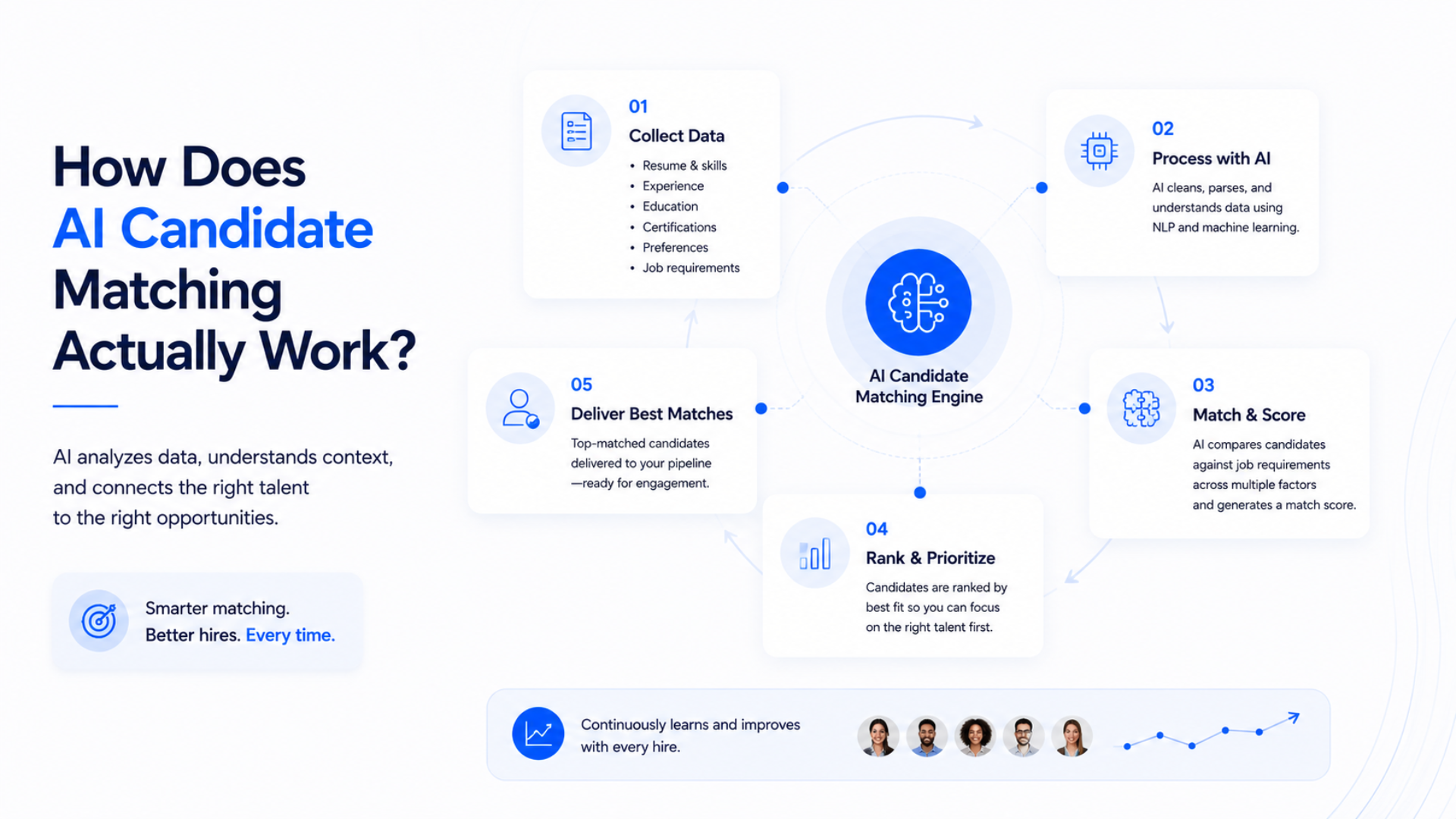
AI candidate matching works by converting a hiring requirement and candidate information into structured signals, comparing the relationships between those signals, and ranking candidates according to their estimated relevance to the role. Depending on the system, those signals may include skills, job titles, experience, seniority, industry, location, education, career progression, company background, and other professional evidence.
The important word is estimated.
An AI matching system does not discover an objective truth about whether someone is the perfect candidate. It makes a prediction based on the information available, the way the system interprets that information, the criteria provided by the recruiter, and the matching methods used by the platform.
This is why AI candidate matching can be extremely useful without being automatically correct. The technology can help recruiters explore larger talent markets, identify candidates who would be missed by exact keyword searches, rediscover people inside existing databases, and prioritize where human attention should go first.
It can also produce misleading rankings when the requirement is unclear, the data is incomplete, or the system gives too much importance to the wrong signals.
Understanding how AI candidate matching actually works helps recruiting teams use it more effectively. The objective should not be to trust a score simply because it was generated by AI. The objective should be to understand how technology can improve candidate discovery while keeping recruiter judgment where the available information remains incomplete.
What Is AI Candidate Matching?
AI candidate matching is the use of artificial intelligence and machine-learning techniques to compare a hiring requirement with candidate information and identify people who may be relevant to the role.
The simplest version of candidate matching compares exact information. A role requires Python, and the candidate profile contains Python. The role is located in Bengaluru, and the candidate is located in Bengaluru. The company requires five years of experience, and the candidate appears to have more than five years.
Modern matching systems may attempt to understand broader relationships. A candidate may have experience with a related technology even when the exact required keyword is missing. A job title may be different while the underlying responsibilities are similar. A professional from another industry may have worked with the same customers, business problems, or operating environment.
The system can use these relationships to estimate relevance.
This is different from saying that AI understands a candidate in the same way an experienced recruiter does. A recruiter can ask questions, understand context, challenge assumptions, and recognize unusual career stories. An AI system works primarily from the data and instructions available to it.
The value of candidate matching therefore lies in helping recruiters narrow a large market.
Instead of manually reviewing every possible person, the recruiter can begin with candidates whose available evidence appears more closely connected with the hiring requirement.
Why Traditional Keyword Matching Misses Good Candidates
Keyword search has been central to recruiting for years because it gives recruiters control. A recruiter can specify the exact titles, skills, companies, locations, and other terms they want to find.
The limitation is that language is inconsistent.
Imagine a company is hiring someone to manage major business customers. One company may call the role Enterprise Account Executive. Another may use Strategic Account Manager. A third may use Client Partner. The responsibilities may overlap significantly even though the titles are different.
Skills create the same problem. A candidate may describe experience with machine learning infrastructure without using the exact technical phrase in the recruiter’s search. Another person may have worked with a specific type of customer without naming that customer category directly.
Traditional search requires the recruiter to anticipate these variations.
This is why experienced sourcers build complex Boolean queries. They include alternative titles, related skills, abbreviations, spelling variations, and exclusions.
The process can be effective, but it depends heavily on the recruiter knowing the market in advance.
AI matching attempts to reduce this dependency by looking for semantic relationships. Instead of asking only whether the same word appears on both sides, the system can attempt to understand whether the underlying concepts are related.
This shift is one reason recruiting teams are moving beyond purely manual search construction. Huntlo’s guide to Boolean search in recruiting and why AI tools are replacing parts of it explores how natural-language and semantic search are changing the candidate discovery process.
The Matching Process Begins With the Hiring Requirement
An AI matching system cannot identify relevant candidates without some definition of what the company needs.
That definition may come from a job description, recruiter prompt, intake conversation, structured role form, ideal candidate profile, or a combination of these sources.
The system then needs to interpret the requirement.
It may identify the job function, likely seniority, essential skills, preferred skills, industry context, location requirements, years of experience, education, certifications, company background, and other relevant signals.
This process is often called parsing.
The system takes unstructured information and attempts to organize it into concepts that can be compared.
For example, a job description may say that the company needs someone who has built enterprise partnerships for a B2B software company and worked with customers across Southeast Asia. The matching system may identify enterprise partnerships, B2B software, regional market experience, business development, and a particular seniority level as relevant signals.
The quality of this interpretation matters.
If the job description contains 25 requirements and the system treats all of them as equally important, the results may become too narrow. If the system ignores an essential requirement, the candidate list may appear relevant while missing a critical part of the role.
This is why recruiter input remains important.
The system needs to understand not only what appears in the job description, but what actually matters.
Job Descriptions Are Often Poor Matching Inputs
One of the biggest misconceptions about AI candidate matching is that a company can upload any job description and immediately receive a perfect shortlist.
Job descriptions are not always designed for search.
Some are written primarily for internal approval. Others are created for employer branding. Many contain long lists of preferred qualifications. Some combine the responsibilities of several people into one unrealistic profile.
An AI system can process this information quickly, but speed does not improve the quality of the requirement.
If the hiring team says it wants ten years of experience in a technology that has existed for six years, the matching system faces a bad input. If the job description lists every possible skill as essential, the system may prioritize candidates who look complete on paper rather than people who can actually solve the hiring problem.
A stronger matching process begins by separating essential criteria from flexible criteria.
What must the person genuinely know before joining?
What can be learned?
Which experience provides evidence of success?
Which requirements are preferences rather than necessities?
What would make the hiring manager reject an otherwise strong candidate?
These distinctions improve AI matching because the system can prioritize the right evidence.
The technology becomes more useful when the hiring team is clearer about what success actually looks like.
The System Then Interprets Candidate Information
Once the hiring requirement has been structured, the system needs candidate information to compare against it.
This information may come from resumes, professional profiles, applicant records, sourcing databases, ATS records, recruiting CRM data, previous interview notes, or other permitted professional sources.
The system attempts to extract relevant signals.
It may identify job titles, employers, dates, skills, industries, responsibilities, education, certifications, locations, career progression, and other available information.
Again, the process is not perfect.
A candidate may have a short profile that leaves out important skills. Another may describe every project in detail. One person may use an inflated title. Another may perform senior work under a modest title.
This creates a data-quality problem.
AI can interpret more than a traditional keyword system, but it cannot reliably infer every missing fact.
If a candidate never mentions managing a team, the system may not know that they managed one. If a professional profile has not been updated for three years, the matching result may reflect an outdated career stage.
Recruiters should therefore treat candidate information as evidence, not complete truth.
A matching system can help identify who deserves attention. Human conversation is still needed to understand the person more fully.
How Semantic Matching Works
Semantic matching is one of the main differences between modern AI candidate matching and traditional keyword search.
A keyword system looks for the same words.
A semantic system attempts to compare meaning.
Suppose a recruiter searches for someone with experience in customer retention. A candidate may describe reducing churn, improving renewals, managing customer lifecycle programs, or increasing account expansion.
The exact phrase “customer retention” may not appear.
A semantic system may still recognize that these concepts are related.
The same principle can apply to job titles, skills, industries, and responsibilities.
A candidate who worked as a Client Partner may be relevant to a Strategic Account Manager search. Someone with experience in natural language processing may be relevant to a role that describes certain language-model applications.
The system does this by representing words, phrases, profiles, and requirements in mathematical forms that preserve relationships between concepts. Modern language models and embedding-based systems can compare how closely these representations relate.
Recruiters do not need to understand the mathematics to use the technology, but they should understand the practical effect.
Semantic matching expands the search beyond exact language.
This can reveal candidates who would have been missed by a narrow Boolean query.
It can also introduce candidates who are conceptually related but not genuinely qualified.
The wider the system interprets similarity, the more important recruiter review becomes.
How Skills Matching Works
Skills are among the most common signals used in candidate matching.
At the simplest level, the system compares required skills with skills found in the candidate profile.
Modern systems may also understand relationships between skills.
For example, experience with one technology may suggest familiarity with a broader technical ecosystem. A particular sales methodology may be related to other forms of complex enterprise selling. Experience with one analytics platform may indicate transferable knowledge relevant to another.
Some systems use skills taxonomies or knowledge graphs to organize these relationships.
A skills taxonomy creates a structured view of how skills are named and categorized. A knowledge graph can represent relationships between skills, roles, industries, companies, and other professional concepts.
This helps the matching system move beyond simple word comparison.
However, skills matching has limitations.
The presence of a skill does not reveal depth.
A candidate may list a technology after using it for one project, while another has spent five years working with it daily. Both profiles contain the same keyword.
The absence of a skill does not always mean the candidate lacks it.
Profiles are incomplete.
Recruiters should therefore ask whether the system is matching skill names or evaluating meaningful evidence of skill use.
The difference can significantly affect candidate quality.
How Job Title Matching Works
Job titles are useful because they provide a quick signal about professional function and seniority.
They are also unreliable.
A Vice President at a small company may have less scope than a Director at a large organization. A Product Manager in one business may perform work that another company assigns to a Product Owner. A recruiter may be called a Talent Partner, Talent Acquisition Specialist, or People Scout.
AI matching systems can attempt to normalize these differences.
The system may recognize related titles and place them within broader job families.
This can help recruiters avoid missing candidates simply because another company uses different language.
The system may also look at title progression.
A candidate who moved from analyst to senior analyst to manager shows a different career pattern from someone who held several unrelated roles.
Career progression can provide useful context, but it should not become a rigid quality signal.
Not every strong candidate follows a traditional upward path. Some professionals move into specialist roles, change industries, take career breaks, or choose smaller companies where titles are structured differently.
AI matching should help recruiters understand patterns.
It should not turn one career pattern into the definition of a good candidate.
How Experience Matching Works
Experience matching can include years of experience, duration in specific roles, industry background, company type, responsibilities, and exposure to particular business environments.
A role may require someone who has worked in an early-stage startup.
Another may need experience inside a large regulated enterprise.
A candidate may have the correct skills but lack experience in the operating environment that matters to the hiring team.
AI can use company and career information to estimate this context.
For example, the system may recognize that a candidate has worked at high-growth software companies, managed international customers, or operated inside a particular industry.
This can improve matching quality.
The risk appears when recruiters confuse correlation with requirement.
A hiring team may repeatedly hire people from a certain company and begin treating that employer as a proxy for quality. An AI system trained around historical preferences could reinforce this pattern.
The better approach is to understand what the company experience represents.
Does the target employer develop a particular skill?
Does it expose employees to a certain scale?
Does it operate in a relevant market?
The matching system should ideally focus on the evidence behind the company name rather than the prestige of the logo itself.
How Location and Availability Affect Matching
Location appears simple, but modern hiring has made it more complicated.
A role may be office-based, hybrid, remote within one country, or remote across several regions. Candidates may be willing to relocate. A professional may currently live in one city but plan to move.
AI matching systems can use location as a filtering or ranking signal.
The key question is whether location is a strict requirement.
If a role legally requires the candidate to work in a particular country, location may be essential. If the company simply prefers someone nearby, treating location as an absolute filter could remove strong candidates unnecessarily.
The same problem applies to notice period, availability, and compensation.
These factors can be important to hiring success, but the data may not be available until the candidate is contacted.
AI matching is strongest when it distinguishes between known information and assumptions.
A candidate should not receive a lower ranking because the system guessed something that was never provided.
How Candidate Matching Scores Are Created
Many AI recruiting systems present candidates with a percentage, score, ranking, or label.
A candidate may be shown as a 92% match.
Another may receive 76%.
The exact meaning of these numbers varies significantly between platforms.
A matching score may combine several signals. Skills may receive one weight. Experience may receive another. Location, title, seniority, industry, and education may contribute additional points.
Some systems use fixed rules.
Others use machine-learning models.
More advanced systems may use semantic similarity between the complete candidate profile and the hiring requirement.
The problem is that a precise-looking number can create false confidence.
A 92% match does not mean there is a 92% probability that the candidate will succeed in the role.
It may only mean that the system found a high level of similarity between the information available and the criteria it was given.
Recruiters should understand what the score represents.
Which signals influence it?
Are essential requirements weighted differently from preferences?
Can the recruiter adjust the criteria?
Why did one candidate rank above another?
A matching score should help prioritize review.
It should not become an unexplained hiring decision.
Why a High Match Score Can Still Produce a Bad Candidate
A candidate can look almost perfect to an AI system and still be wrong for the role.
The first reason is incomplete information.
The candidate profile may contain all the expected skills but provide no evidence about actual depth.
The second reason is a poor hiring requirement.
If the system matches perfectly against the wrong criteria, the result will still be wrong.
The third reason is motivation.
A candidate may be qualified but completely uninterested in the role.
The fourth reason is context.
The person may have performed similar work in a very different environment.
The fifth reason is information that only emerges through conversation.
Leadership style, career goals, communication, expectations, and other relevant factors may not appear in the profile.
This is why candidate matching and candidate screening are different activities.
Matching asks whether the available evidence suggests potential relevance.
Screening investigates whether the candidate actually fits the opportunity.
Huntlo’s guide to AI candidate screening and how accurate it is explains this next stage in greater detail.
Recruiting teams create problems when they expect one technology to answer every hiring question.
Candidate Matching Is Different From Candidate Ranking
Matching and ranking are related but not identical.
Matching asks how relevant a candidate appears to a requirement.
Ranking decides which candidates should appear first.
A system may find 500 people with some level of relevance.
The recruiter cannot review everyone immediately.
The platform therefore needs to prioritize.
Ranking may consider match strength, completeness of evidence, recency of experience, location, seniority, or other signals.
This creates a practical advantage.
Recruiters can begin with the candidates most likely to deserve attention.
The risk is visibility bias.
Candidates who appear lower in the ranking may never be reviewed.
If the ranking logic contains poor assumptions, strong candidates can become effectively invisible.
Recruiters should therefore avoid treating the first page of AI results as the entire talent market.
A good sourcing process explores the search.
Criteria can be adjusted.
Adjacent profiles can be reviewed.
The recruiter can learn from unexpected results.
AI should make talent exploration faster.
It should not make the recruiter less curious.
How AI Matching Helps With Passive Candidate Sourcing
Passive candidates are difficult to find because they are not preparing their profiles for a specific vacancy.
They may not use the exact keywords in the job description.
Their professional information may be brief or outdated.
Traditional applicant matching can therefore miss them.
AI can help by comparing broader experience patterns.
A candidate may have worked in the right environment, solved related problems, or developed transferable skills without matching the exact search language.
This is particularly useful when recruiters are searching large external talent markets.
Instead of manually constructing every possible variation, the system can surface candidates based on broader relevance.
However, matching is only the beginning of passive recruiting.
A highly relevant candidate may have no interest in moving.
The recruiter still needs to understand why the opportunity could matter and create an appropriate conversation.
Huntlo’s guide on how to source passive candidates who are not job-searching explains why candidate discovery and candidate engagement remain separate challenges.
The best matching system can identify someone worth contacting.
It cannot guarantee that the person wants to be contacted or wants the job.
How AI Matching Helps Rediscover Existing Candidates
One of the strongest uses of AI candidate matching is not external sourcing.
It is rediscovery.
Many companies already have thousands or millions of candidate records inside ATS platforms, recruiting CRMs, previous sourcing projects, and historical applications.
The problem is that this information becomes difficult to use.
A recruiter opening a new role may not know that a strong candidate completed final interviews two years ago. Another person may have applied when they were too junior but gained relevant experience since then. A sourced candidate may have declined because the timing was wrong.
Keyword search often struggles with this history.
AI matching can compare a new requirement with existing candidate information and surface people whose previous relationship may be relevant again.
This can reduce sourcing time and improve the return on earlier recruiting work.
A candidate the company already knows may be more valuable than another completely cold profile.
The broader idea is explored in Huntlo’s guide to building a talent pipeline before a role is posted. A useful talent pipeline should make previous candidate discovery easier to reuse when future hiring needs appear.
AI matching can help turn candidate storage into candidate memory.
How AI Matching Differs From a Talent Intelligence Platform
AI candidate matching is a capability.
A talent intelligence platform is a broader technology category.
Matching focuses on comparing candidates with hiring requirements.
Talent intelligence may also include workforce data, market insights, skills analysis, internal mobility, talent mapping, compensation information, competitor analysis, and other forms of workforce intelligence.
The distinction matters because recruiting teams sometimes purchase broad platforms when their immediate problem is candidate discovery.
Other teams purchase narrow sourcing tools when they actually need deeper market intelligence.
Huntlo’s guide to what a talent intelligence platform is explains this broader category.
The important question is what the recruiting team needs the technology to do.
If the objective is to find relevant candidates faster, matching quality matters.
If the objective is to understand talent supply, workforce skills, competitor movement, and future hiring strategy, the company may need a broader intelligence layer.
How AI Matching Fits Into Candidate Sourcing Automation
Candidate matching is often one part of a larger sourcing workflow.
The system interprets the requirement.
Potential candidates are discovered.
Matching helps prioritize them.
Recruiters review the results.
Approved candidates may then move toward outreach.
This is where AI sourcing becomes more valuable than a standalone ranking score.
The objective is not simply to tell the recruiter that Candidate A matches the role better than Candidate B.
The objective is to reduce the time required to reach a relevant candidate conversation.
Huntlo’s guide to candidate sourcing automation explains how candidate discovery can become part of a broader automated process.
The strongest recruiting workflows connect matching with what happens next.
A relevant candidate needs to be reviewed.
A passive candidate may need outreach.
A positive response may need qualification.
A qualified person may need screening and interview coordination.
Matching creates value when it helps the recruiting process move forward.
Why Recruiter Feedback Can Improve Matching
Candidate matching should not be a one-time process.
Recruiters learn as they review the market.
The hiring manager may reject the first candidates because the role requires a type of experience that was not clear during intake. The recruiter may discover that a supposedly essential skill is less important than expected.
The system should allow the search to evolve.
Recruiter feedback can help refine the requirement.
A recruiter may indicate that certain candidates are relevant, irrelevant, too senior, too junior, or from the wrong background.
Depending on the platform, these signals may help adjust the search or ranking.
This creates a more interactive model.
The AI produces an initial interpretation.
The recruiter reviews the evidence.
The search becomes more precise.
This is closer to how experienced sourcing actually works.
Recruiters rarely create the perfect search immediately.
They learn from the market.
AI should accelerate this learning loop rather than pretend the first result is final.
What Can Go Wrong With AI Candidate Matching?
The first major problem is bad input.
An unclear or unrealistic requirement produces weak matching.
The second is incomplete candidate data.
The system can only work with the information available.
The third is overreliance on historical patterns.
If a company has always hired from certain backgrounds, a system may reproduce those preferences rather than expand the talent market.
The fourth is unexplained scoring.
Recruiters may trust a number without understanding why it was generated.
The fifth is over-filtering.
Strong candidates can disappear because they lack one expected keyword, title, location, or credential.
The sixth is automation bias.
Recruiters may assume that candidates ranked first are automatically better than people lower in the results.
The seventh is confusing matching with hiring success.
A profile can match a requirement without the candidate being interested, available, affordable, or successful after joining.
These limitations do not make AI matching useless.
They explain why the technology should support a recruiting process rather than replace the process.
How to Evaluate an AI Candidate Matching Tool
Recruiting teams should begin by testing whether the system understands their real hiring requirements.
Can it distinguish essential criteria from preferences?
Can recruiters adjust the search?
Does the system explain why candidates are relevant?
Can it find people with related experience even when exact keywords are missing?
The team should also examine the results beyond the first few candidates.
Are the recommendations genuinely diverse in background, or does the system repeatedly return the same type of profile?
Can recruiters understand why unexpected candidates appeared?
Does the system help discover talent that traditional search would miss?
Data coverage also matters.
A sophisticated matching model cannot find candidates who are not available in the underlying data.
Recruiters should ask where candidate information comes from, how current it is, and what geographic or professional markets are well covered.
The final question should be operational.
What happens after the match?
If recruiters still need to export candidates, move them into another system, build outreach elsewhere, monitor responses manually, and restart the process after every stage, the matching technology may solve only one part of the workflow.
The best tool depends on the actual bottleneck.
How to Measure Whether AI Matching Is Working
Recruiting teams should not measure AI matching by the number of profiles generated.
A larger candidate list may create more work.
The first useful measure is relevance.
How many recommended candidates are genuinely worth recruiter review?
The second is qualified candidate rate.
How many matched candidates meet the real hiring criteria after review or screening?
The third is discovery value.
Does the system identify relevant people the recruiter would have missed through traditional search?
The fourth is speed.
Does the team reach the first qualified candidate faster?
The fifth is conversion.
Do matched candidates move into positive conversations, screens, interviews, and hires?
The sixth is recruiter effort.
Does the system reduce manual search work?
These measures help separate impressive technology from useful recruiting outcomes.
The purpose of AI matching is not to create the highest possible score.
It is to improve the path from hiring requirement to relevant candidate.
Where Huntlo Fits Into AI Candidate Matching
Huntlo approaches candidate matching as part of a larger recruiting workflow.
The process begins with understanding the hiring requirement and discovering potentially relevant candidates. AI can help recruiters search beyond rigid keywords and identify people whose experience appears connected with the role.
The next step is not another score.
Relevant candidates need to move toward engagement.
Passive candidates may need outreach through appropriate channels. Responses need to influence what happens next. Interested candidates may need qualification. AI voice capabilities can support early screening, and qualified candidates can move toward interview scheduling.
This broader workflow matters because candidate matching is becoming easier across the recruiting technology market.
Many platforms can produce a ranked list.
The larger operational problem is what recruiters need to do after the list appears.
Huntlo’s agentic AI recruiting approach is designed around reducing more of the manual execution between candidate discovery and qualified candidate conversations.
The recruiter remains responsible for important judgment.
The system supports more of the repetitive work around that judgment.
For recruiting teams, the value of AI matching should therefore be measured by more than search quality.
The question is whether the technology helps the right candidates move through the hiring workflow more effectively.
Why Agentic AI Changes Candidate Matching
Traditional candidate matching is largely passive.
The system produces recommendations.
The recruiter decides what to do next.
Agentic AI introduces the possibility of connecting matching with multi-step workflow execution.
A hiring requirement can inform candidate discovery.
Relevant candidates can be prioritized.
Approved candidates can move toward engagement.
Candidate responses can affect the next action.
Interested people can move toward qualification.
The recruiter remains involved at important decision points.
This changes the role of matching.
The score is no longer the final output.
It becomes one input inside a larger recruiting process.
This shift is explained more broadly in Huntlo’s guide to agentic recruiting.
The practical advantage is continuity.
Recruiters should not need to manually restart the hiring process every time the candidate moves from one stage to another.
Will AI Candidate Matching Replace Recruiter Judgment?
AI candidate matching can reduce the amount of manual work required to search large talent markets.
It can identify related experience, interpret different job titles, rank candidates, and surface people who may have been missed by exact keyword searches.
It cannot fully understand a person.
Candidate profiles are incomplete.
Career decisions are contextual.
Hiring requirements change.
People develop skills that are difficult to represent in structured data.
A recruiter can recognize that a candidate’s unusual career path may be valuable. They can challenge a hiring manager who is over-filtering the market. They can ask why a person made a career change and understand whether that experience matters.
The strongest model is therefore collaborative.
AI helps the recruiter explore more information.
The recruiter applies judgment to the evidence.
AI can help prioritize attention.
The recruiter decides when a candidate deserves a deeper conversation.
The purpose of candidate matching is not to make hiring automatic.
It is to make talent discovery more intelligent.
Conclusion: AI Candidate Matching Is a Prediction, Not a Hiring Decision
AI candidate matching works by interpreting a hiring requirement, extracting relevant signals from candidate information, comparing relationships between those signals, and ranking people according to estimated relevance.
Modern systems can go beyond exact keyword matching.
They can recognize related job titles, skills, responsibilities, industries, and career patterns.
This allows recruiters to search larger talent markets and identify candidates who might otherwise remain invisible.
The technology is useful because recruiting data is messy.
Companies describe similar jobs differently.
Candidates describe similar experience differently.
Traditional search depends on the recruiter anticipating every variation.
AI can help bridge some of these language gaps.
However, a match score is not proof that someone will succeed in the role.
The result depends on the quality of the hiring requirement, the completeness of candidate information, the logic used by the system, and the way the recruiter interprets the output.
The strongest recruiting teams will not ask AI to decide who should be hired.
They will use AI to understand where human attention should go first.
That is the real value of candidate matching.
It reduces the distance between a complex hiring requirement and the people who may be worth knowing.
The technology can improve the search.
The hiring decision still requires understanding the person behind the profile.
Frequently Asked Questions
What is AI candidate matching?
AI candidate matching is the use of artificial intelligence to compare hiring requirements with candidate information and identify people who appear relevant to a role.
How does AI match candidates with jobs?
The system interprets the job requirement, extracts signals such as skills, titles, experience, seniority, location, and industry, and compares them with information available about candidates.
What is semantic candidate matching?
Semantic matching compares meaning rather than relying only on exact words. It can identify related job titles, skills, responsibilities, and professional concepts even when the same keywords do not appear.
Is AI candidate matching better than Boolean search?
AI matching can find candidates who use different language and reduce manual search construction. Boolean search can still provide useful control. Many recruiting teams benefit from combining AI discovery with recruiter expertise.
What does an AI candidate match score mean?
The meaning varies by platform. A score usually represents estimated similarity or relevance between candidate information and the hiring requirement. It does not necessarily predict job performance.
Can AI candidate matching be wrong?
Yes. Results can be affected by unclear requirements, incomplete candidate information, poor weighting, outdated data, and assumptions built into the matching process.
Can AI find candidates without exact keywords?
Yes. Semantic matching can identify related concepts, titles, and skills even when the candidate profile does not contain the exact search terms.
Does AI candidate matching remove bias?
AI does not automatically remove bias. Matching systems can reflect problems in data, historical hiring patterns, requirements, or model design. Human oversight remains important.
Can AI candidate matching replace recruiters?
AI can support candidate discovery and prioritization, but recruiters remain important for understanding context, evaluating unusual backgrounds, building relationships, challenging hiring assumptions, and making responsible decisions.
How should recruiters measure AI matching quality?
Recruiters should measure candidate relevance, qualified candidate rate, time to first qualified candidate, discovery of previously missed talent, interview conversion, hiring outcomes, and recruiter effort.
Related Topics
Learn how natural-language and semantic search are changing traditional candidate discovery in What Is Boolean Search in Recruiting (And Why AI Tools Are Replacing It)?.
Explore how AI supports the broader process of finding and prioritizing talent in What Is Candidate Sourcing Automation?.
Understand how AI evaluates candidates after initial discovery in What Is AI Candidate Screening and How Accurate Is It?.