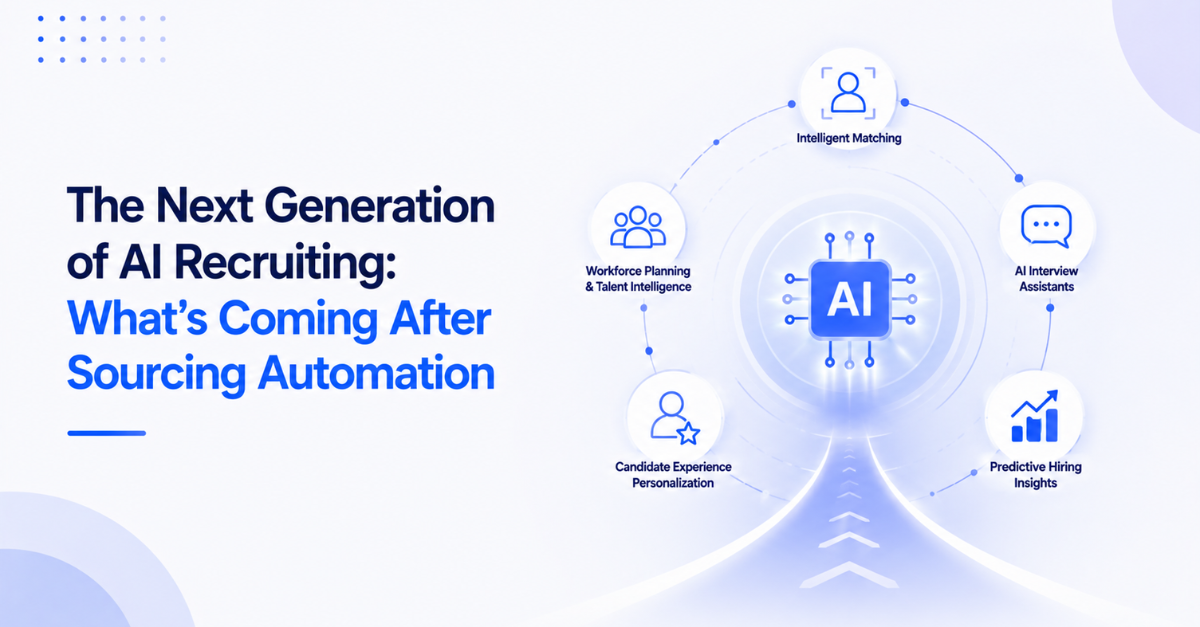
For the past decade, recruiting technology has focused on one primary challenge:
Finding candidates faster.
From resume databases and talent intelligence platforms to AI sourcing tools and automated search capabilities, recruiting software has dramatically improved candidate discovery.
But many hiring teams are discovering something important:
Finding candidates is rarely the biggest bottleneck in recruiting.
The real challenges often begin after sourcing.
Recruiters still spend significant amounts of time:
Engaging candidates
Managing follow-ups
Conducting qualification conversations
Coordinating interviews
Updating stakeholders
Moving candidates through hiring workflows
As a result, the industry is entering a new phase.
The next generation of AI recruiting isn't about finding more talent.
It's about helping recruiting teams execute hiring processes more efficiently, consistently, and autonomously.
How AI Recruiting Has Evolved So Far
To understand where recruiting technology is heading, it's helpful to understand how it evolved.
The ATS Era
The first generation of recruiting technology focused on organization.
Applicant Tracking Systems (ATS) helped teams:
Store candidate information
Track applications
Manage hiring workflows
Improve compliance and reporting
This phase digitized recruiting operations but left most recruiter work highly manual.
The Talent Intelligence Era
The next phase introduced data-driven recruiting.
Platforms began offering:
Skills intelligence
Market insights
Talent analytics
Workforce planning support
Recruiters gained better visibility into talent markets but still handled execution themselves.
The AI Sourcing Era
The current generation of recruiting technology focuses heavily on sourcing.
AI sourcing tools help recruiters:
Discover candidates faster
Identify matching profiles
Automate search workflows
Expand talent visibility
This has significantly improved recruiter efficiency.
But sourcing is only one stage of hiring.
Why Sourcing Automation Isn't Enough
Many recruiting leaders initially believed sourcing was the primary productivity challenge.
The reality is more complex.
Engagement Bottlenecks
A candidate discovered through AI still needs to respond.
Recruiters must:
Send outreach
Manage conversations
Build interest
Answer questions
Candidate engagement often determines hiring success more than sourcing itself.
Follow-Up Challenges
One of the largest hidden productivity drains in recruiting is follow-up management.
Candidates frequently require multiple touchpoints before responding.
Recruiters must remember:
When to follow up
How to personalize communication
Which candidates require attention
These activities consume significant recruiter bandwidth.
Growing Recruiting Workload
As hiring volumes increase, recruiters spend more time coordinating processes than finding candidates.
Many teams discover that sourcing improvements alone do not eliminate operational bottlenecks.
The Biggest Gaps in Today's Recruiting Process
Most recruiting workflows remain surprisingly manual.
Qualification
Finding candidates is not the same as determining:
Interest level
Availability
Salary expectations
Role fit
Relocation preferences
Qualification often requires significant recruiter effort.
Scheduling
Interview coordination remains one of the most repetitive tasks in recruiting.
Recruiters frequently manage:
Candidate availability
Hiring manager calendars
Rescheduling requests
Interview reminders
This administrative burden slows hiring velocity.
Workflow Management
Recruiting involves dozens of moving parts.
Without automation, recruiters become workflow managers instead of talent advisors.
What Comes After AI Sourcing?
The next phase of recruiting technology focuses on execution.
Instead of helping recruiters find candidates, AI will increasingly help recruiters move candidates through the hiring process.
Autonomous Execution
Future recruiting systems will automate operational activities such as:
Candidate outreach
Follow-up sequences
Qualification workflows
Scheduling coordination
Pipeline progression
The objective is not simply productivity.
The objective is consistent execution at scale.
AI Recruiting Agents
AI recruiting agents represent one of the most significant developments in talent acquisition.
Rather than acting as passive tools, these systems actively perform recruiting tasks.
Examples include:
Conducting initial candidate conversations
Answering candidate questions
Managing engagement workflows
Coordinating next steps
Workflow Orchestration
Recruiting increasingly requires orchestration rather than isolated automation.
Future systems will connect sourcing, engagement, qualification, scheduling, and reporting into unified workflows.
Understanding Agentic AI Recruiting
This evolution is giving rise to a new category:
Agentic AI Recruiting Infrastructure.
What It Means
Agentic AI recruiting refers to systems that actively execute recruiting activities rather than simply providing recommendations.
Instead of saying:
"Here are candidates you should contact."
The system can help:
"We've contacted candidates, qualified responses, scheduled interviews, and updated your pipeline."
Key Capabilities
Agentic recruiting systems may support:
Automated candidate engagement
Candidate qualification workflows
Follow-up management
Interview scheduling
Recruiting workflow execution
Process monitoring
Business Impact
The result is greater recruiter capacity.
Recruiters spend less time managing processes and more time focusing on:
Strategic hiring decisions
Stakeholder relationships
Candidate experience
Workforce planning
The Rise of Recruiting Operations Automation
One of the biggest shifts in recruiting technology is the growing importance of recruiting operations.
Candidate Engagement
Modern hiring success increasingly depends on:
Response rates
Candidate experience
Communication consistency
Automation helps maintain engagement across large candidate pipelines.
Pipeline Management
AI can help ensure candidates continue progressing through hiring stages without unnecessary delays.
Process Optimization
Automation provides:
Standardization
Visibility
Consistency
Operational efficiency
These factors often have a larger impact on hiring outcomes than sourcing alone.
How Recruiter Roles Will Change
A common concern surrounding AI is whether recruiters will eventually be replaced.
The evidence suggests a different future.
Strategic Hiring
Recruiters will continue making critical hiring decisions.
AI can provide support but cannot replace organizational judgment.
Relationship Building
Candidates still want human relationships during important career decisions.
Recruiters remain essential for:
Trust building
Negotiation
Career discussions
Hiring manager alignment
Human Oversight
As AI adoption increases, recruiters will play an even greater role in governance, oversight, and decision-making.
The future is not recruiter replacement.
It is recruiter augmentation.
The Recruiting Technology Stack of 2030
Recruiting technology is likely evolving toward a layered architecture.
AI Sourcing
Candidate discovery will remain important.
However, sourcing will become increasingly automated and standardized.
Recruiting Infrastructure
The next competitive advantage will come from systems that manage recruiting execution.
Autonomous Workflows
Future recruiting organizations will increasingly rely on AI-driven workflows that operate continuously across the hiring lifecycle.
The recruiting stack of 2030 may look like:
ATS → Agentic AI Recruiting Infrastructure → Recruiter
Rather than:
ATS → Sourcing Tool → Recruiter
This shift fundamentally changes recruiter productivity.
Preparing Your Team for the Next Generation of Recruiting
Forward-thinking recruiting leaders should begin preparing today.
Evaluate Technology Investments
Look beyond sourcing capabilities.
Assess how technology supports:
Engagement
Qualification
Scheduling
Workflow execution
Redesign Recruiting Processes
Technology alone does not create efficiency.
Process redesign remains essential.
Build AI Readiness
Organizations that successfully adopt AI typically:
Establish clear workflows
Define ownership
Measure outcomes
Maintain human oversight
These foundations will become increasingly important as recruiting automation expands.
Conclusion
The first generation of recruiting AI helped recruiters find talent.
The next generation will help recruiters move talent through the hiring process.
That distinction matters.
Most recruiting challenges today are not caused by a lack of candidates.
They are caused by operational bottlenecks.
By the end of this decade, recruiting teams will increasingly rely on systems that can:
Engage candidates automatically
Qualify talent efficiently
Coordinate interviews
Manage hiring workflows
Improve recruiter productivity
The future of recruiting is not simply smarter sourcing.
It is autonomous recruiting execution.
And that future is being shaped by Agentic AI Recruiting Infrastructure.
Frequently Asked Questions
What comes after AI sourcing automation?
The next phase of recruiting technology focuses on recruiting execution, including candidate engagement, qualification, scheduling, and workflow automation.
What is Agentic AI recruiting?
Agentic AI recruiting refers to AI systems that actively perform recruiting tasks such as engagement, qualification, follow-ups, and scheduling rather than simply providing recommendations.
How is AI changing recruiting?
AI is helping recruiters automate sourcing, engagement, qualification, workflow management, and recruiting operations.
Will AI replace recruiters?
No. AI is expected to augment recruiters by eliminating repetitive administrative work while allowing recruiters to focus on strategic hiring and relationship-building.
What are AI recruiting agents?
AI recruiting agents are systems capable of executing recruiting activities autonomously, including communication, qualification, and workflow management.
What is autonomous recruiting?
Autonomous recruiting refers to AI-driven systems that can independently execute portions of the recruiting process with human oversight.
What is recruiting workflow automation?
Recruiting workflow automation uses technology to automate candidate progression, communication, scheduling, and operational tasks throughout the hiring process.
How can AI improve recruiter productivity?
AI improves productivity by reducing manual effort across sourcing, engagement, qualification, follow-ups, and scheduling.
What is recruiting operations automation?
Recruiting operations automation focuses on streamlining recruiting workflows, improving process consistency, and reducing administrative burden.
What will recruiting look like in 2030?
Recruiting will likely combine human expertise with AI-powered systems that automate much of the operational work involved in hiring.
Ready for the Next Generation of Recruiting?
AI sourcing helped recruiters find candidates faster.
Huntlo helps recruiting teams automate what happens next.
From candidate engagement and qualification to follow-ups, scheduling, and workflow execution, Huntlo's Agentic AI Recruiting Infrastructure helps organizations scale hiring without scaling recruiter workload.
Book a demo to see how Huntlo is shaping the future of recruiting automation.
Related Topics
How AI Sourcing Tools Fit into the Future of Talent Acquisition
Will Every Recruiter Need an AI Sourcing Tool by 2027?
How AI Sourcing Tools Are Reshaping Recruitment Agency Business Models