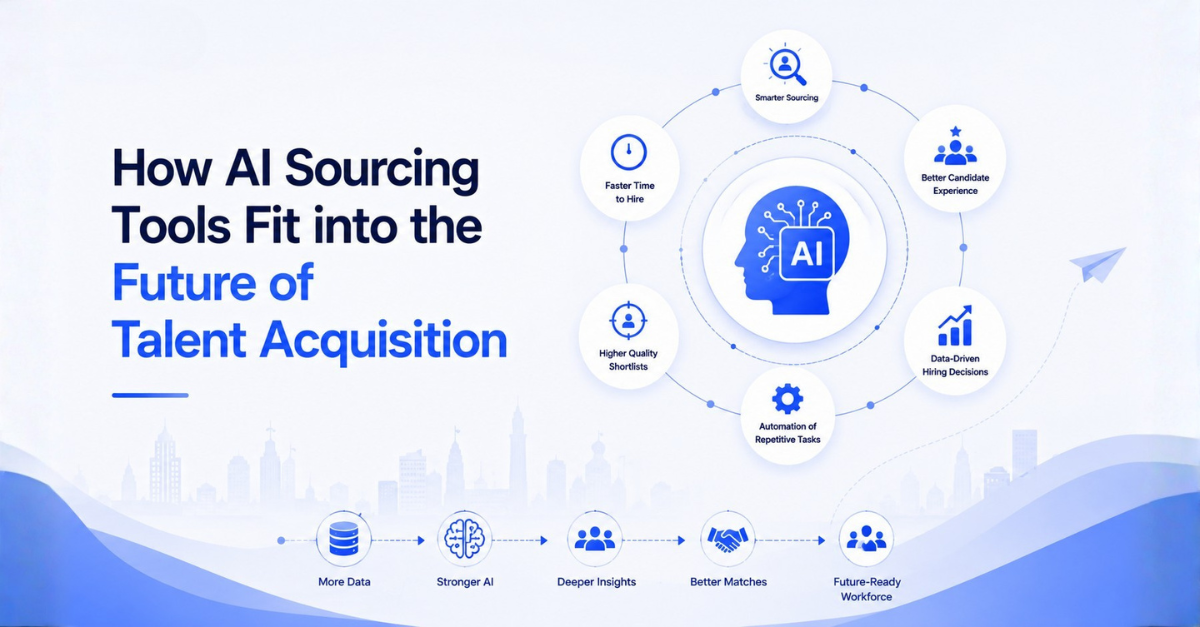
AI sourcing tools play an important role in the future of talent acquisition by helping recruiters identify candidates faster and more efficiently. However, sourcing alone is no longer enough. The future of hiring lies in AI-powered recruiting systems that automate candidate engagement, qualification, follow-ups, scheduling, and recruiting workflows to improve hiring outcomes at scale.
Recruiting technology is evolving rapidly. While AI sourcing has transformed candidate discovery, the next wave of innovation focuses on recruiting execution and operational efficiency across the entire hiring lifecycle.
Introduction
Talent acquisition is experiencing one of the most significant transformations in its history.
Organizations today face growing hiring complexity. Talent shortages continue to affect critical roles, candidate expectations are rising, and recruiters are expected to manage larger workloads without proportional increases in team size.
In response, AI sourcing tools have become one of the most widely adopted technologies in modern recruitment. These platforms help recruiters identify candidates faster, search larger talent pools, and reduce manual sourcing effort.
Yet candidate discovery is only one part of the hiring process.
Most recruiting teams spend far more time engaging candidates, screening applicants, coordinating interviews, managing follow-ups, and moving people through hiring workflows than they do searching for talent.
This creates an important shift in how talent acquisition leaders evaluate recruiting technology.
The future of talent acquisition is not simply about finding candidates faster. It is about creating intelligent systems that help recruiting teams execute hiring processes more efficiently from start to finish.
In this guide, we'll explore where AI sourcing fits within the future talent acquisition stack, where sourcing tools create value, where they fall short, and why Agentic AI Recruiting Infrastructure represents the next stage of recruiting technology.
Why Is Talent Acquisition Changing?
Hiring Complexity Is Increasing
Modern recruiting teams manage multiple hiring channels, distributed workforces, global talent pools, and increasingly specialized skill requirements.
A single recruiter may be responsible for:
Dozens of open roles
Hundreds of applicants
Multiple hiring managers
Various interview stages
Continuous candidate communication
Managing these processes manually creates operational bottlenecks.
Recruiter Productivity Pressures Are Growing
Recruiters are expected to deliver faster hiring outcomes while maintaining candidate experience and quality standards.
Common challenges include:
Administrative workload
Manual follow-ups
Scheduling coordination
Candidate nurturing
Pipeline management
These activities consume significant recruiter time.
Candidates Expect Faster Experiences
Candidates increasingly expect:
Rapid responses
Personalized communication
Clear hiring timelines
Consistent engagement
Organizations that fail to deliver these experiences often lose talent to competitors.
What Are AI Sourcing Tools?
AI sourcing tools help recruiters discover and identify potential candidates using technologies such as:
Artificial Intelligence
Machine Learning
Natural Language Processing (NLP)
Talent intelligence algorithms
What Sourcing Tools Do Well
Most AI sourcing platforms excel at:
Candidate discovery
Talent pool expansion
Resume analysis
Skills matching
Candidate recommendations
These capabilities reduce the manual effort traditionally associated with sourcing.
How Sourcing Has Evolved
Traditional sourcing relied heavily on:
Boolean search
Manual database queries
Resume screening
Job board searches
Modern AI sourcing tools automate much of this work by identifying relevant candidates based on skills, experience, education, certifications, and career history.
What Are the Benefits of AI Sourcing?
Faster Talent Discovery
AI significantly accelerates candidate search processes.
Instead of manually reviewing hundreds of profiles, recruiters can generate candidate shortlists in minutes.
Better Talent Visibility
AI sourcing tools often uncover candidates who may not appear in traditional searches.
This helps organizations:
Expand talent pipelines
Access passive candidates
Reduce talent blind spots
Reduced Manual Searching
Recruiters spend less time searching and more time engaging candidates.
This creates meaningful productivity gains.
Example
Consider a technology recruiter hiring software engineers.
Without AI:
Search LinkedIn manually
Review profiles individually
Build candidate lists manually
Repeat for every role
With AI sourcing:
Define hiring criteria
Generate candidate recommendations
Prioritize qualified talent
Begin outreach faster
Where Does AI Sourcing Reach Its Limits?
While sourcing is important, it represents only the beginning of the hiring process.
Candidate Engagement
Finding candidates does not guarantee responses.
Many recruiters discover that their biggest challenge is not sourcing but engagement.
Common issues include:
Low response rates
Delayed communication
Inconsistent follow-ups
Candidate Qualification
After sourcing, recruiters still need to determine:
Candidate interest
Availability
Compensation expectations
Relevant experience
Relocation preferences
These activities often remain manual.
Interview Scheduling
Scheduling remains one of the most time-consuming recruiting activities.
Recruiters frequently coordinate:
Candidate availability
Interview panels
Hiring manager calendars
Rescheduling requests
Pipeline Progression
Candidates must move through multiple stages before hiring decisions occur.
Without workflow automation, recruiters spend considerable time managing these transitions manually.
AI Sourcing vs Traditional Recruiting Workflows
Activity
Traditional Process
AI Sourcing Tools
Advanced Recruiting Automation
Candidate Discovery
Manual
Automated
Automated
Skills Matching
Manual
Automated
Automated
Candidate Outreach
Manual
Limited
Automated
Candidate Qualification
Manual
Limited
Automated
Follow-Ups
Manual
Limited
Automated
Interview Scheduling
Manual
Limited
Automated
Workflow Execution
Manual
Minimal
Automated
Recruiting Operations
Manual
Minimal
Automated
The table highlights a key reality:
Most recruiting work begins after sourcing.
What Is the Next Evolution of Talent Acquisition Technology?
The future of talent acquisition extends beyond sourcing and matching.
Automation-First Recruiting
Organizations increasingly seek systems that automate repetitive recruiting tasks.
These include:
Candidate outreach
Candidate screening
Follow-up sequences
Interview scheduling
Workflow coordination
Intelligent Workflows
Future recruiting platforms will manage hiring processes proactively.
Instead of requiring recruiters to initiate every action, systems will automatically trigger next steps based on candidate activity and workflow conditions.
Autonomous Recruiting Systems
Emerging recruiting technologies use AI agents capable of executing tasks independently.
Examples include:
Sending candidate communications
Collecting qualification data
Scheduling interviews
Managing hiring workflows
This significantly reduces recruiter workload.
AI Sourcing vs Agentic AI Recruiting
One of the most important distinctions emerging in recruiting technology is the difference between sourcing and execution.
Discovery vs Execution
AI Sourcing
Agentic AI Recruiting
Finds candidates
Moves candidates through hiring workflows
Focuses on search
Focuses on hiring outcomes
Generates talent lists
Executes recruiting processes
Improves sourcing efficiency
Improves operational efficiency
Helps recruiters discover talent
Helps recruiters hire talent
Intelligence vs Outcomes
Many recruiting platforms provide intelligence.
Fewer platforms actively help recruiters execute hiring processes.
The future of talent acquisition increasingly prioritizes outcomes over insights.
How Will Recruiting Teams Work in 2030?
Human-AI Collaboration
Recruiters will not disappear.
Instead, they will focus more on:
Relationship building
Strategic hiring decisions
Stakeholder management
Candidate experience
AI will handle routine operational tasks.
Recruiter Roles Will Evolve
Recruiters will increasingly act as:
Talent advisors
Hiring strategists
Workforce planners
Administrative work will decline significantly.
Productivity Gains Will Expand
Recruiters will manage larger hiring volumes without proportional increases in workload.
Expected improvements include:
Area
Current State
Future State
Candidate Outreach
Manual
Automated
Screening
Semi-manual
Automated
Follow-Ups
Manual
Automated
Scheduling
Manual
Automated
Pipeline Management
Recruiter-driven
AI-assisted
Workflow Coordination
Manual
Autonomous
What Should Talent Acquisition Leaders Automate Today?
Organizations do not need to wait until 2030 to begin benefiting from recruiting automation.
Candidate Outreach
Automated outreach can:
Improve response rates
Reduce recruiter workload
Increase pipeline velocity
Qualification Workflows
Automating qualification helps collect:
Candidate availability
Compensation expectations
Interest levels
Experience validation
before recruiter involvement.
Follow-Up Processes
Many opportunities are lost because follow-ups are inconsistent.
Automated follow-up systems ensure candidates remain engaged.
Interview Coordination
Interview scheduling remains one of the highest-value automation opportunities.
Automated scheduling reduces delays and administrative overhead.
Recruiting Operations
The greatest efficiency gains often come from automating:
Workflow progression
Candidate communication
Hiring coordination
Administrative processes
This is where modern recruiting infrastructure creates the most value.
How Can Organizations Prepare for the Future of Hiring?
Develop a Technology Strategy
Recruiting leaders should evaluate technology based on:
Scalability
Automation capabilities
Integration ecosystem
Operational impact
Improve Operational Readiness
Successful AI adoption requires:
Standardized hiring workflows
Defined recruiting processes
Clear automation opportunities
Measurement frameworks
Create an AI Adoption Roadmap
A practical roadmap may include:
Automate sourcing
Automate engagement
Automate qualification
Automate scheduling
Automate recruiting operations
This progression delivers incremental value while reducing implementation risk.
Conclusion
AI sourcing tools have fundamentally changed how recruiters discover talent.
They improve visibility, reduce manual search effort, and help organizations identify candidates more efficiently.
But sourcing alone does not solve the broader challenges facing modern talent acquisition.
The next phase of recruiting technology focuses on execution.
Organizations increasingly need systems that not only find candidates but also engage, qualify, coordinate, and move candidates through hiring workflows efficiently.
This is where recruiting automation, intelligent workflows, and Agentic AI Recruiting Infrastructure become increasingly important.
As talent acquisition continues to evolve, the organizations that gain the greatest advantage will be those that automate not only candidate discovery but the operational processes that turn candidates into hires.
If you're evaluating the future of recruiting technology, understanding how automation fits into your hiring process is the first step. Explore how Huntlo's Agentic AI Recruiting Infrastructure helps recruiting teams automate sourcing, engagement, screening, qualification, follow-ups, and recruiting workflow execution at scale.
Frequently Asked Questions
1. What is the future of talent acquisition?
The future of talent acquisition involves increased automation, AI-powered workflows, intelligent candidate engagement, and operational efficiency. Recruiting teams will rely on AI to handle repetitive tasks while recruiters focus on strategic activities.
2. How is AI changing recruiting?
AI helps recruiters identify candidates, automate outreach, screen applicants, schedule interviews, and manage hiring workflows more efficiently. This reduces manual work and improves productivity.
3. Will AI replace recruiters?
No. AI is more likely to augment recruiters than replace them. Recruiters will continue to play critical roles in relationship building, decision-making, and hiring strategy.
4. What are AI sourcing tools?
AI sourcing tools use artificial intelligence to identify potential candidates based on skills, experience, qualifications, and hiring criteria.
5. What recruiting tasks can AI automate?
AI can automate sourcing, outreach, candidate qualification, follow-ups, interview scheduling, workflow coordination, and recruiting operations.
6. What is recruiting workflow automation?
Recruiting workflow automation uses technology to automate repetitive recruiting processes such as candidate movement between stages, notifications, follow-ups, and interview coordination.
7. What is candidate engagement automation?
Candidate engagement automation helps recruiters maintain communication with candidates through automated outreach, follow-ups, reminders, and personalized messaging.
8. What is Agentic AI recruiting?
Agentic AI recruiting uses autonomous AI agents to execute recruiting tasks such as outreach, qualification, scheduling, and workflow management with minimal recruiter intervention.
9. How can recruiters improve productivity?
Recruiters can improve productivity by automating repetitive administrative work and focusing more time on relationship building and strategic hiring activities.
10. What technologies will define recruiting in the future?
AI sourcing, recruiting automation, workflow orchestration, conversational AI, intelligent screening, and Agentic AI Recruiting Infrastructure are expected to play major roles in future talent acquisition strategies.