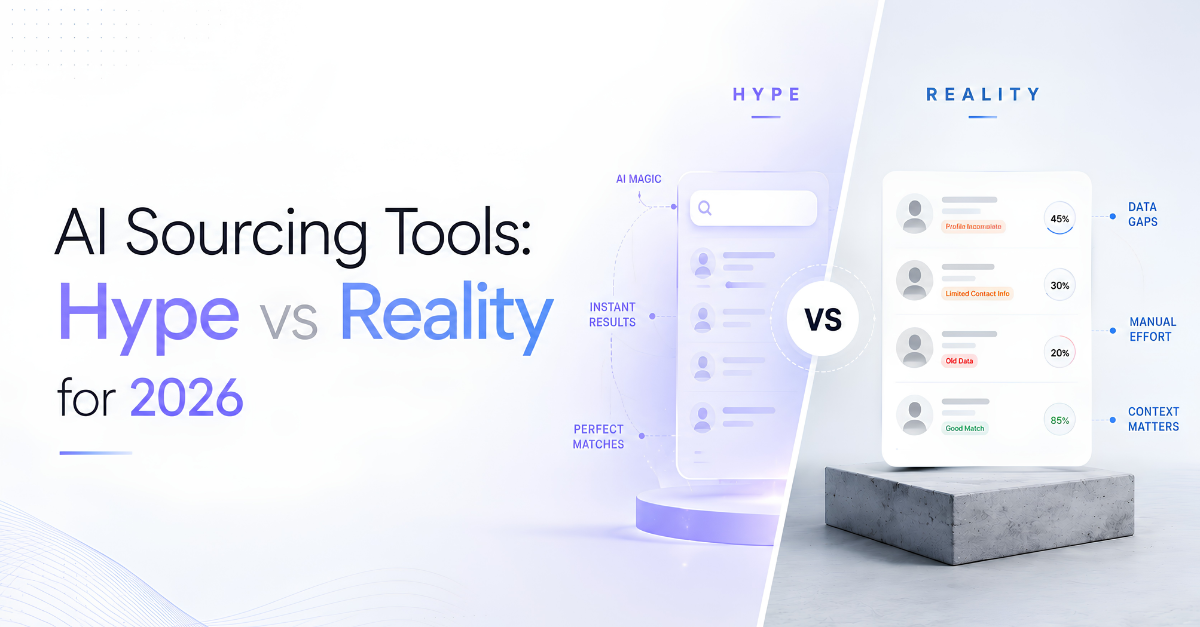
AI sourcing tools are becoming one of the most discussed technologies in recruiting. They promise faster candidate discovery, smarter matching, and automated hiring workflows. But the reality is more nuanced. AI can improve recruiter efficiency, but it does not replace human judgment, relationship building, or effective recruiting operations.
Recruiting technology has changed significantly.
Every year, more platforms introduce AI-powered sourcing, intelligent matching, and automated candidate discovery. From startups to enterprise talent teams, recruiters are evaluating how artificial intelligence can improve hiring speed and quality.
But with the rise of AI recruiting tools comes an important question:
What actually works, and what is just AI marketing?
In 2026, the conversation around AI sourcing is shifting.
The question is no longer:
"Can AI find candidates?"
The better question is:
"Where does AI create measurable recruiting impact?"
AI sourcing is useful. But sourcing is only one part of recruiting.
The future belongs to systems that can help recruiters discover, engage, qualify, and move candidates through the entire hiring process.
Why Is Every Recruiting Tool Talking About AI?
AI has become a major focus in talent acquisition.
Almost every recruiting platform now highlights:
AI-powered sourcing
Smart candidate recommendations
Intelligent matching
Automated talent discovery
This has created both excitement and confusion.
Some companies believe AI will completely transform hiring overnight.
Others believe AI is just another technology trend.
The reality sits somewhere in between.
AI is powerful at processing large amounts of information, identifying patterns, and automating repetitive tasks.
However, hiring decisions still require context, communication, and human judgment.
What Do AI Sourcing Tools Actually Do?
AI sourcing tools focus primarily on candidate discovery.
Their goal is to help recruiters identify potential candidates faster than traditional manual methods.
Candidate Discovery
AI sourcing platforms analyze candidate data to identify relevant profiles based on:
Skills
Experience
Job titles
Industries
Location
Career history
This reduces the amount of manual searching recruiters need to perform.
AI Candidate Matching
Many AI recruiting tools use machine learning models to rank candidates based on job requirements.
Instead of searching only for exact keywords, AI systems can analyze broader relationships between skills and experience.
For example:
A recruiter searching for a "cloud engineer" may discover candidates with related infrastructure, DevOps, or platform engineering experience.
Talent Intelligence
Modern AI sourcing software can also provide insights around:
Talent availability
Skill trends
Candidate movement
Market competition
This helps recruiters make better sourcing decisions.
AI Sourcing Reality: What Actually Works?
AI sourcing is not just hype.
There are real benefits when used correctly.
Reducing Manual Search Time
Recruiters traditionally spend hours:
Building searches
Reviewing profiles
Filtering candidates
Creating talent lists
AI can reduce this effort by quickly identifying relevant candidates.
Finding Hidden Candidates
AI can uncover profiles recruiters may not find through traditional searches.
This is especially useful for:
Specialized roles
Technical hiring
Competitive talent markets
Improving Recruiter Productivity
AI works best when it removes repetitive work.
Instead of spending hours searching, recruiters can focus more on:
Candidate conversations
Relationship building
Hiring strategy
AI Sourcing Hype: What Is Overpromised?
While AI creates value, many claims are exaggerated.
Understanding the limitations is important.
Can AI Replace Recruiters?
No.
AI can automate tasks, but recruiting involves more than matching profiles.
Recruiters still need to:
Understand hiring context
Build candidate relationships
Evaluate motivation
Manage stakeholders
Make hiring decisions
AI supports recruiters.
It does not replace the recruiting function.
Can AI Predict the Perfect Candidate?
AI can improve matching accuracy, but no system can guarantee hiring success.
A candidate who looks perfect on paper may not:
Fit the team culture
Accept the offer
Perform well in the role
Match business expectations
Hiring decisions involve factors beyond data.
Is Fully Autonomous Hiring Real?
Many AI solutions suggest complete automation.
But hiring is a complex workflow.
A complete hiring process includes:
Recruiting Stage
Human Involvement Needed
Candidate Discovery
Low
Candidate Matching
Medium
Candidate Engagement
High
Candidate Evaluation
High
Interview Decisions
High
Offer Decisions
High
The future is not removing humans.
It is removing repetitive work.
Why Is Sourcing Alone Not Enough?
Finding candidates is only the beginning.
A recruiter can discover hundreds of profiles, but those candidates still need to move through the hiring process.
After sourcing, teams still need to manage:
Outreach
Follow-ups
Qualification
Scheduling
Candidate experience
This is where many recruiting teams struggle.
The Post-Sourcing Problem
Imagine an AI tool helps a recruiter find 500 relevant candidates.
Now the recruiter needs to:
Contact them
Answer questions
Track responses
Schedule interviews
Maintain engagement
More candidates can create more operational workload.
Without workflow automation, sourcing improvements can create new bottlenecks.
AI Sourcing vs AI Recruiting Automation
AI sourcing and AI recruiting automation solve different problems.
Capability
AI Sourcing Tools
AI Recruiting Automation
Candidate Discovery
Yes
Yes
Candidate Matching
Yes
Yes
Outreach Automation
Limited
Yes
Follow-Up Automation
Limited
Yes
Candidate Qualification
Limited
Yes
Interview Coordination
Limited
Yes
Workflow Execution
No
Yes
The next generation of recruiting technology focuses on execution, not just discovery.
What Should Recruiters Look For in AI Tools in 2026?
Recruiters should evaluate AI based on business impact.
Not just features.
1. Workflow Impact
Does the tool reduce repetitive recruiting tasks?
2. Recruiter Productivity
Does it increase recruiter capacity?
3. Hiring Outcomes
Does it improve:
Time-to-hire
Candidate conversion
Hiring velocity
Quality of hire
4. Integration Capability
AI should work with existing recruiting workflows.
A smart tool inside a broken process still creates problems.
The Future: From AI Sourcing to Agentic AI Recruiting Infrastructure
The next evolution of recruiting AI is moving beyond sourcing.
Traditional AI tools assist recruiters.
Agentic AI Recruiting Infrastructure helps execute workflows.
This means AI systems can support:
Candidate discovery
Candidate engagement
Qualification conversations
Follow-ups
Interview coordination
Recruiting operations
The future is not:
"AI finds candidates."
The future is:
"AI helps recruiting teams operate at scale."
How Huntlo Fits Into This Future
Huntlo focuses on Agentic AI Recruiting Infrastructure.
Instead of only helping recruiters find candidates, Huntlo helps automate recruiting workflows across sourcing, engagement, qualification, and coordination.
The goal is simple:
Help recruiting teams spend less time managing repetitive processes and more time making better hiring decisions.
Final Verdict: AI Is Real, But The Hype Is Ahead Of The Reality
AI sourcing tools in 2026 are valuable.
They can improve candidate discovery, reduce manual effort, and increase recruiter productivity.
But AI sourcing is not the complete future of recruiting.
The biggest impact comes when AI moves beyond searching and starts executing recruiting workflows.
AI sourcing helps recruiters find talent.
Agentic AI Recruiting Infrastructure helps recruiters turn talent into hires.
Frequently Asked Questions
Are AI sourcing tools worth it?
Yes, AI sourcing tools can improve recruiter efficiency by reducing manual search work. Their real value increases when connected with broader recruiting automation.
What can AI sourcing tools actually do?
They help recruiters discover candidates, analyze profiles, improve matching, and build talent pipelines faster.
Is AI recruiting overhyped?
Some claims are exaggerated, especially around replacing recruiters or fully autonomous hiring. However, AI provides real value when applied to repetitive recruiting tasks.
Can AI replace recruiters?
No. AI can automate repetitive activities, but recruiters are still essential for communication, judgment, and decision-making.
What is the future of AI recruiting?
The future is moving from AI sourcing toward Agentic AI Recruiting Infrastructure that can automate complete recruiting workflows.