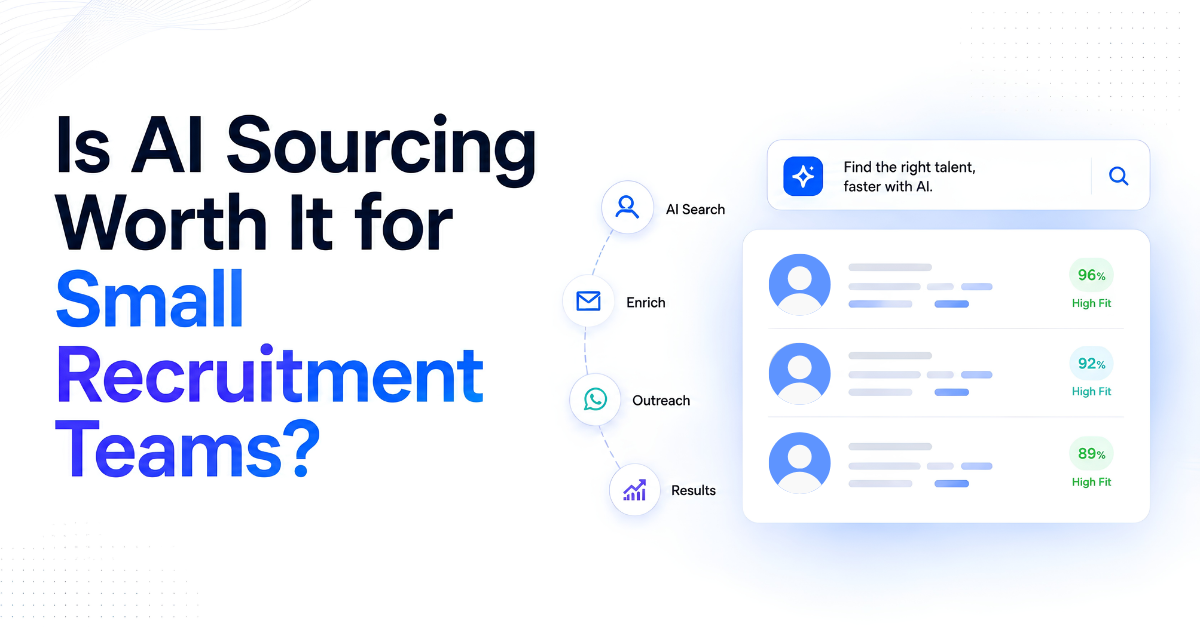
Yes, AI sourcing can be worth it for small recruitment teams, but not for the reason most vendors promote. While AI sourcing tools help recruiters find candidates faster, the biggest challenge for most small teams is managing engagement, follow-ups, screening, and coordination. The highest return on investment comes when sourcing is combined with recruiting workflow automation.
Recruiting technology has evolved significantly over the past few years. Today, recruiters have access to AI-powered sourcing platforms, talent intelligence software, candidate matching tools, and recruiting automation solutions designed to improve productivity.
For small recruitment teams, this sounds promising.
When a recruiter is handling multiple open roles, responding to clients, coordinating interviews, and managing candidate pipelines, any productivity gain feels valuable.
But there is a common misconception in the recruiting industry:
More candidates automatically lead to more hires.
In reality, candidate discovery is only one stage of the recruiting process.
The teams that consistently outperform others are not necessarily the ones that source the most candidates. They are the ones that can efficiently engage, qualify, coordinate, and move candidates through the hiring funnel.
That distinction matters when evaluating whether AI sourcing is actually worth the investment.
Why Small Recruitment Teams Are Considering AI Sourcing
Small recruiting teams operate under a unique set of constraints.
Unlike large enterprise talent acquisition organizations, they often lack dedicated sourcing specialists, recruiting coordinators, and operations teams.
As a result, recruiters are responsible for almost every stage of the hiring process.
Growing Hiring Demands
Many recruitment agencies, startup hiring teams, and lean talent acquisition functions are expected to fill more positions without increasing headcount.
This creates pressure to improve recruiter productivity.
Limited Recruiter Resources
Most recruiting teams are not struggling because candidate profiles don't exist.
They're struggling because recruiters spend too much time on repetitive operational tasks.
These include:
Candidate outreach
Follow-ups
Screening
Qualification
Interview scheduling
Stakeholder communication
This is why AI recruiting tools continue gaining popularity among small teams.
What AI Sourcing Tools Actually Do
Before evaluating ROI, it's important to understand what AI sourcing tools are designed to solve.
Their primary purpose is candidate discovery.
Candidate Discovery
AI sourcing platforms help recruiters identify potential candidates based on:
Skills
Experience
Job titles
Industry background
Location preferences
This reduces manual searching across multiple platforms.
Talent Matching
Most AI sourcing software uses machine learning to match candidates against role requirements.
This helps recruiters prioritize relevant profiles more efficiently.
Search Automation
Modern sourcing platforms often automate:
Candidate recommendations
Similar profile discovery
Talent pool generation
Search optimization
These capabilities save recruiters time during the sourcing stage.
The Benefits of AI Sourcing for Small Teams
AI sourcing delivers several legitimate advantages.
Faster Sourcing
Recruiters spend less time searching and more time engaging talent.
Larger Talent Pools
AI tools often uncover candidates recruiters may have missed through manual searches.
Reduced Manual Search Effort
Automated candidate discovery improves consistency and efficiency.
Benefit
Impact on Recruiters
Faster Candidate Discovery
Reduces sourcing time
Expanded Talent Reach
Increases candidate visibility
Automated Search
Reduces manual effort
Better Candidate Matching
Improves sourcing efficiency
Talent Recommendations
Accelerates pipeline creation
These benefits are real.
However, they only address one part of the recruiting workflow.
See How Recruitment Teams Automate More Than Sourcing With Huntlo
The most successful recruiting teams don't just automate candidate discovery. They automate engagement, qualification, follow-ups, scheduling, and recruiting workflows.
The Hidden Costs Recruiters Often Ignore
This is where many AI sourcing evaluations become incomplete.
More Candidates Create More Work
Imagine a recruiter who typically sources 50 candidates per week.
An AI sourcing platform helps them source 250.
On paper, productivity appears to improve dramatically.
But now that recruiter must:
Contact more candidates
Respond to more messages
Conduct more screenings
Schedule more interviews
Manage more follow-ups
The sourcing problem gets solved.
The workflow problem gets larger.
Managing Candidate Pipelines at Scale
Recruiting teams often discover that candidate management consumes significantly more time than candidate discovery.
Without automation, additional candidate volume can create operational bottlenecks rather than efficiency gains.
Where Small Recruitment Teams Actually Lose Time
Most recruiting leaders assume sourcing is the largest workload driver.
In practice, the majority of recruiter time is often spent elsewhere.
Candidate Engagement
Personalized outreach, candidate communication, and relationship building require ongoing effort.
Follow-Ups
Many recruiters spend hours following up with candidates and hiring managers.
Qualification
Every candidate must be evaluated against role requirements before moving forward.
Interview Coordination
Scheduling remains one of the most repetitive tasks in recruiting.
Recruiting Activity
Relative Time Consumption
Candidate Sourcing
Medium
Candidate Outreach
High
Follow-Ups
Very High
Qualification
High
Interview Scheduling
High
Stakeholder Coordination
High
This explains why sourcing automation alone rarely transforms recruiting performance.
Calculating the Real ROI of AI Sourcing
The true value of AI sourcing cannot be measured solely by time saved on search.
Time Saved Through Sourcing
A recruiter may save several hours each week by reducing manual sourcing activity.
Time Spent Executing Recruiting Workflows
However, additional candidates often create new responsibilities:
Outreach management
Candidate engagement
Screening conversations
Scheduling
Coordination
If these tasks remain manual, overall recruiter workload may not decrease.
Measuring Recruiter Productivity
The most important question is not:
"How many candidates can we find?"
The more important question is:
"How many candidates can we move through the hiring process successfully?"
Key metrics include:
Time-to-hire
Recruiter productivity
Candidate conversion rates
Hiring velocity
Cost-per-hire
Recruiter capacity
These metrics provide a more accurate picture of recruiting ROI.
The Biggest Recruiting Bottleneck Isn't Finding Candidates. It's Managing Them.
Many recruiting teams discover that candidate management—not candidate discovery—is the true operational challenge.
AI Sourcing vs Recruiting Automation
This distinction is becoming increasingly important.
Discovery Versus Execution
AI sourcing focuses on:
Finding candidates
Matching talent
Building pipelines
Recruiting automation focuses on:
Candidate engagement
Qualification
Follow-ups
Scheduling
Workflow execution
Search Automation Versus Workflow Automation
Capability
AI Sourcing Tools
Recruiting Automation
Candidate Discovery
Yes
Limited
Talent Matching
Yes
Limited
Candidate Outreach
Partial
Yes
Follow-Up Automation
Limited
Yes
Candidate Qualification
Limited
Yes
Scheduling Automation
Limited
Yes
Workflow Execution
No
Yes
Recruiting Operations Automation
No
Yes
Small teams often achieve greater efficiency gains through workflow automation than sourcing alone.
What Small Recruiting Teams Should Automate First
Recruiters frequently start automation initiatives in the wrong place.
Instead of focusing only on sourcing, evaluate where the most time is being spent.
Candidate Follow-Ups
Follow-ups are repetitive, time-consuming, and highly automatable.
Candidate Qualification
AI can assist with early-stage screening and information gathering.
Scheduling
Automated scheduling removes a major administrative burden.
Recruiting Operations
Workflow automation helps candidates move through hiring processes without constant recruiter intervention.
Recommended Automation Priorities
Candidate Follow-Ups
Candidate Qualification
Scheduling
Recruiting Workflow Management
Candidate Sourcing
This sequence often delivers the highest ROI for lean recruiting teams.
Final Verdict: Is AI Sourcing Worth It?
Yes, AI sourcing is worth it.
But sourcing alone is rarely enough.
Most small recruiting teams do not struggle because they cannot find candidates.
They struggle because they lack the operational capacity to engage, qualify, coordinate, and convert candidates efficiently.
AI sourcing helps recruiters discover talent.
Recruiting automation helps recruiters execute hiring workflows.
Agentic AI Recruiting Infrastructure extends automation beyond sourcing and into the operational work that actually drives hiring outcomes.
For small recruitment teams looking to scale without increasing headcount, that distinction matters far more than another candidate database or sourcing feature.
Frequently Asked Questions
Is AI sourcing worth the cost?
For many recruitment teams, yes. However, the highest ROI typically comes when sourcing automation is combined with recruiting workflow automation.
How much time does AI sourcing save?
The exact amount varies by organization, but AI sourcing can significantly reduce manual search effort and candidate discovery time.
Can AI sourcing replace recruiters?
No. AI can automate repetitive recruiting activities, but relationship building, hiring decisions, and stakeholder management still require human involvement.
What are the limitations of sourcing tools?
Most sourcing platforms focus on candidate discovery and provide limited automation for engagement, qualification, scheduling, and workflow execution.
How can small recruiting teams scale hiring?
The most effective strategy is combining sourcing automation with recruiting workflow automation to increase hiring capacity without increasing recruiter headcount.