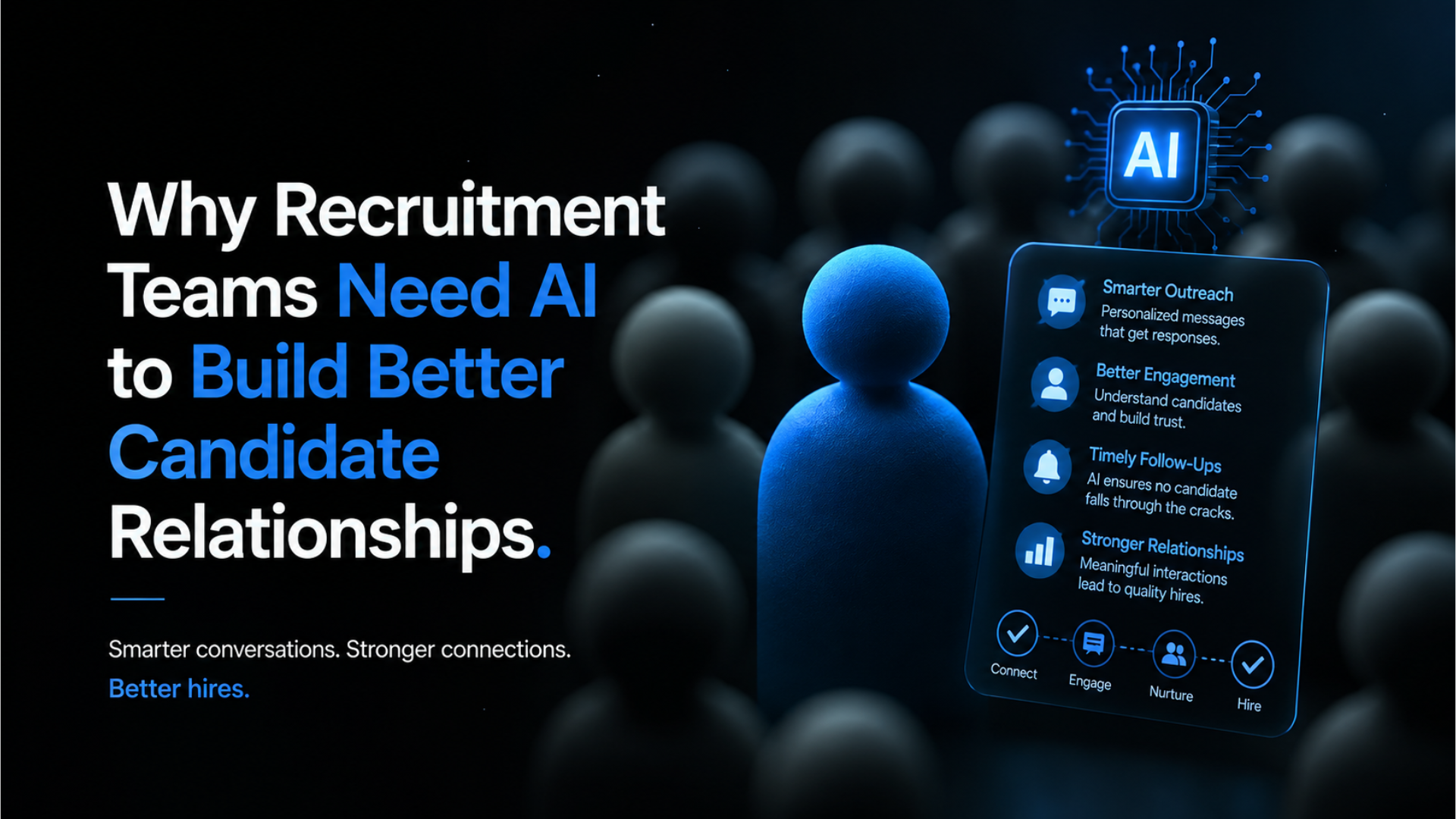
Priya manages a team of six recruiters at a B2B SaaS company growing from two hundred to four hundred employees. She knows that the recruiters who build the strongest candidate relationships produce the best hiring outcomes: higher response rates, better screening-to-interview conversion, faster offer acceptance, and lower early turnover among the candidates they place. She also knows that her recruiters cannot build those relationships for every candidate in their pipelines. Each recruiter manages thirty to forty active candidates across five to eight open roles. The operational demands of scheduling, screening, feedback collection, and offer management consume sixty to seventy percent of each recruiter's day. The remaining thirty
percent, the time available for actual relationship-building, is distributed unevenly across the pipeline. The five or six candidates closest to an offer receive deep, personalized attention. The remaining twenty-five to thirty-five candidates receive generic, delayed, or absent communication that erodes whatever relationship was established during the initial outreach. When Priya deployed an AI recruiting platform, the operational burden dropped dramatically. Automated scheduling, real-time candidate intelligence, and contextual engagement recommendations freed her recruiters to invest more time in the relational work that produces hires. Within one quarter, the team's offer acceptance rate climbed from sixty-one percent to eighty-three percent, and their candidate withdrawal rate dropped by forty percent. The AI did not replace the relationships. It made them possible at scale.
The recruiting profession has always been built on relationships. The best recruiters in every era, from the headhunters of the twentieth century to the talent acquisition specialists of today, have distinguished themselves not by their access to candidates or their knowledge of job requirements, but by their ability to build genuine, trust-based relationships with the candidates they engage. These relationships produce hiring outcomes that transactional recruiting cannot match, because a candidate who trusts their recruiter shares information that a transactional candidate withholds, including their real concerns about the role, their competing options, their true timeline for making a decision, and the specific conditions that would make them say yes. This information is strategically invaluable because it enables the recruiter to position the opportunity with precision, address concerns before they become deal-breakers, and time the process to match the candidate's decision-making rhythm. According to SHRM's talent acquisition research, candidates who rate their relationship with the recruiter as strong or very strong are three to four times more likely to accept an offer, thirty to forty percent faster in their decision timeline, and fifty percent less likely to withdraw during the process, compared to candidates who rate the relationship as weak or transactional. The challenge is not that recruiters do not understand the value of relationships. It is that the operational realities of modern recruiting make it structurally impossible to build them at scale through manual effort alone. Understanding the difference between AI sourcing and AI recruiting clarifies this point: sourcing can operate at scale because it is a volume activity, but the relationships that convert sourced candidates into hires are inherently individual and time-intensive. AI bridges this gap by handling the operational burden while the recruiter focuses on the relationship. Huntlo's platform is built on this principle, providing the intelligence and automation that make relationship-quality engagement achievable for every candidate in the pipeline, not just the few at the top of the recruiter's priority list.
The Operational Reality That Prevents Relationship-Building
The operational demands that prevent recruiters from building relationships are not a failure of individual recruiters. They are a structural consequence of the modern hiring process, which has become more complex, more multi-stakeholder, and more time-intensive without a corresponding increase in recruiting headcount. The average corporate recruiter now manages a pipeline that is two to three times larger than it was a decade ago, while the number of
hiring stakeholders, the interview rounds, the approval layers, and the coordination requirements have also increased. The result is a recruiter who is operationalized to the point where relationship-building, the activity that produces the best hiring outcomes, receives the smallest share of their time and attention. The specific operational tasks that consume the relationship-building time include candidate research and profile analysis, which is needed to prepare for meaningful conversations but can take twenty to thirty minutes per candidate; scheduling and rescheduling, which generates constant back-and-forth communication that adds no relational value; feedback collection from interviewers, which often requires multiple follow-ups with hiring managers who are slow to respond; and status updates and pipeline reporting, which serve organizational needs but do nothing to advance candidate relationships. Each of these tasks is necessary. Collectively, they create a workload that leaves the typical recruiter with only thirty to forty percent of their time available for the candidate-facing, relationship-building interactions that actually determine hiring outcomes. According to McKinsey's organizational insights, this operational overload is the single most cited reason recruiters give for being unable to deliver the quality of engagement they know candidates deserve, and it is the primary driver of recruiter burnout, which further reduces the organization's relationship-building capacity.
The operational burden also creates relationship inconsistency, which is arguably more damaging than having no relationship at all. A candidate who receives a thoughtful, personalized first message followed by a generic, delayed follow-up does not experience a partial relationship. They experience a broken promise, because the first message raised expectations that the subsequent interactions failed to meet. This inconsistency is not random. It follows a predictable pattern determined by the recruiter's workload and priorities. Candidates at the top of the recruiter's list receive consistent, high-quality engagement. Candidates further down receive progressively less. The candidates who receive the least engagement are often the ones who most need it, the passive candidates who require more touchpoints to convert, the cautious candidates who need more information to make a decision, and the high-caliber candidates who have multiple options and will not tolerate generic communication. The teams that accumulate more tools without addressing this fundamental capacity constraint often discover they have more tools but the same hiring problems, because each new tool adds its own operational overhead without reducing the underlying workload. Research on how many followups one hire actually needs underscores the relationship cost of this overload: the number of follow-ups that would maintain a strong candidate relationship is rarely achievable through manual effort, because the recruiter simply does not have the time to research, compose, and send high-quality follow-ups to every candidate. This is especially damaging when hiring for niche and technical roles, where the candidate pool is small and every lost relationship represents a significant setback that cannot be easily recovered by sourcing additional candidates.
How AI Enables Relationship Quality at Scale
AI enables recruiters to build better candidate relationships at scale by addressing the three operational constraints that prevent relationship-building: time, information, and consistency.
The time constraint is addressed by automating the operational tasks that consume the recruiter's day. AI-powered scheduling eliminates the back-and-forth coordination that generates communication volume without relational value. AI-powered candidate research eliminates the twenty to thirty minutes of manual profile review that precedes each candidate interaction. AI-powered feedback collection automates the follow-up with hiring managers, reducing the recruiter's time investment from multiple follow-ups to a single review of the AI's compiled summary. The information constraint is addressed by providing the recruiter with richer, more current, and more comprehensive candidate intelligence than manual research could produce. An AI system that monitors a candidate's professional activity over time, tracking their publications, projects, career moves, and engagement signals, gives the recruiter a depth of understanding that would require hours of manual research per candidate, and it delivers this understanding continuously rather than at a single point in time. According to LinkedIn's recruiting resources, recruiters who use AI-powered candidate intelligence prepare for candidate conversations in five to ten minutes instead of twenty to forty, and the quality of their preparation, measured by the candidate's assessment of the recruiter's understanding of their situation, is actually higher, because the AI provides more comprehensive and current information than manual research typically produces.
The consistency constraint is addressed by maintaining continuous awareness of every candidate's journey and providing the recruiter with timely prompts and recommendations that prevent the communication gaps that damage relationships. In a manual process, the recruiter remembers to follow up with the candidates at the top of their priority list while the candidates further down fall silent until the recruiter has time to circle back, which may be days or weeks. AI eliminates this inconsistency by monitoring every candidate's journey stage, engagement level, and communication history, and alerting the recruiter when a candidate needs attention, regardless of where they rank in the recruiter's conscious priority list. The result is a pipeline where every candidate receives consistent, informed engagement, not just the ones the recruiter has time to prioritize manually. The recruiters asking whether AI will replace their jobs should recognize that this consistency amplification makes their relationship-building skills more valuable, not less, because those skills can now be applied to every candidate rather than being rationed to a select few. An agentic AI recruiting platform like Huntlo takes this further by not just monitoring and alerting but actively recommending engagement actions based on each candidate's specific context, the stage of their journey, their engagement signals, and their prior conversations with the recruiting team. The recruiter reviews these recommendations, applies their own judgment and relationship knowledge, and delivers the interaction with the authenticity and empathy that build genuine trust. The AI provides the intelligence. The recruiter provides the relationship. Together, they produce the kind of candidate experience that converts interest into hires.
What Better Candidate Relationships Actually Look Like
A better candidate relationship, enabled by AI, is characterized by four qualities that distinguish it from the transactional interactions that define most recruiting. The first quality is
depth. A deep relationship means the recruiter understands not just the candidate's current role and skills but their career aspirations, their motivations for exploring a move, the specific circumstances that would accelerate or delay their decision, and their concerns about potential roles. This depth of understanding enables the recruiter to position opportunities with precision and to address concerns before they become objections. The second quality is continuity. A continuous relationship means the candidate experiences consistent engagement throughout the hiring process, with no gaps that create doubt about the organization's interest. The candidate's experience flows seamlessly from one stage to the next, because the recruiter maintains context from prior interactions and builds on them rather than starting over at each stage. The third quality is reciprocity. A reciprocal relationship means the candidate perceives value in the interaction itself, not just in the opportunity being presented. The recruiter shares relevant market intelligence, provides genuine career insight, and offers perspective that the candidate finds useful regardless of whether they pursue the specific role. According to Gartner's HR trends research, candidates who experience these four qualities in their recruiter relationship are fifty to seventy percent more likely to accept an offer and thirty percent less likely to withdraw during the process, because the relationship has created a foundation of trust and mutual understanding that makes the hiring decision feel safe and well-informed rather than risky and uncertain.
The fourth quality is scalability, which is the quality that AI makes possible. Without AI, a recruiter can build deep, continuous, and reciprocal relationships with perhaps ten to fifteen candidates at a time. With AI support, that number expands to thirty to fifty, because the AI handles the operational and informational preparation that makes each relationship possible, while the recruiter focuses on the relational delivery that makes each interaction meaningful. The practical impact of this scalability is that the organization can now build relationship-quality engagement with every candidate in the pipeline, not just a select few, which dramatically improves conversion rates at every stage. The quality of the candidate data that feeds these relationships is foundational. Teams that have encountered outdated candidate data in AI tools understand that a relationship built on stale information will feel shallow regardless of the recruiter's skill, because the candidate will sense that the recruiter's questions do not reflect their current reality. When evaluating platforms, use the framework for evaluating an AI sourcing tool before buying to ensure that data freshness and contextual depth are core capabilities that support relationship-building rather than undermining it. Research consistently confirms that referred candidates produce the best hiring outcomes, and data shows that referrals outperform cold outreach because the referring relationship provides the depth, continuity, and reciprocity that formal recruiting often lacks. AI enables recruiters to provide this referral-quality relationship to every candidate, transforming the pipeline from a collection of transactional interactions into a network of genuine professional relationships. Huntlo's platform delivers this capability by providing the continuous intelligence, operational automation, and consistency enforcement that make relationship-quality engagement achievable at any scale.
The Team-Level Transformation: From Individual Skill to Organizational Capability
Historically, candidate relationship quality has been a function of individual recruiter skill. Some recruiters are naturally gifted relationship-builders. Others are not. Organizations that were lucky enough to have gifted relationship-builders on their teams achieved better hiring outcomes than those that did not, and the primary recruiting strategy was to hire and retain these rare individuals. This individual-skill model creates significant organizational risk, because the quality of the team's candidate relationships depends on the specific people who happen to be on the team at any given time. When a strong relationship-builder leaves, the relationships they built leave with them, and the candidates they were managing often disengage or withdraw. AI transforms candidate relationship quality from an individual skill into an organizational capability, because the intelligence, consistency, and operational support that AI provides ensure that every recruiter on the team, not just the naturally gifted ones, can deliver relationship-quality engagement. According to Deloitte's talent research, organizations that deploy AI-powered engagement platforms see the performance gap between their strongest and weakest recruiters narrow by forty to fifty percent within six months, because the AI provides a consistent quality floor that raises the performance of every recruiter while still allowing the strongest to excel through their individual relationship skills. This capability-level approach is more resilient, more scalable, and more predictable than the individual-skill approach, because it does not depend on the specific composition of the recruiting team.
The team-level transformation also changes how recruiting leaders manage their teams. In the individual-skill model, the leader's primary lever is hiring and training, finding people with natural relationship ability and developing those skills over time. In the capability model, the leader's primary lever is technology deployment and process design, ensuring that every recruiter has the AI-powered tools and the operational support they need to deliver relationship-quality engagement consistently. This shift does not eliminate the importance of hiring and training, but it changes their focus from developing raw relationship ability to developing the judgment, empathy, and strategic thinking that enable recruiters to make the most of the AI-powered support they receive. According to EY's technology insights, the recruiting organizations that are building the strongest talent acquisition capabilities are the ones that treat AI as a relationship-enabling platform rather than a sourcing or workflow tool, investing in the intelligence infrastructure that makes every recruiter a relationship-builder. Huntlo delivers this platform, providing the continuous candidate intelligence, automated operational support, and consistency enforcement that transform candidate relationship quality from an individual skill into an organizational capability. Recruitment teams do not just need AI to work faster. They need AI to build better relationships. Huntlo makes both possible. Start building better candidate relationships with Huntlo.