A recruiter searches for a senior engineer.
An AI sourcing tool finds a candidate who appears almost perfect.
The profile says the person works at a target company.
The candidate has the right title.
The system identifies several relevant skills.
A match score places the person near the top of the results.
The recruiter begins outreach.
The message refers to the candidate’s current role.
The candidate replies.
They left that company eight months ago.
The title is outdated.
One of the listed skills came from a previous position.
The work email no longer exists.
The AI search was fast.
The candidate data was not current.
This creates an obvious question.
If artificial intelligence can understand complex job requirements, search enormous professional datasets, rank candidates, and generate personalized outreach, why can it not simply know where a candidate works today?
The answer is that AI intelligence and data freshness are different problems.
A model can be excellent at interpreting information that is wrong.
It can rank stale profiles intelligently.
It can summarize outdated employment history clearly.
It can generate convincing outreach from incorrect context.
It can make an old record look more useful without making the record more current.
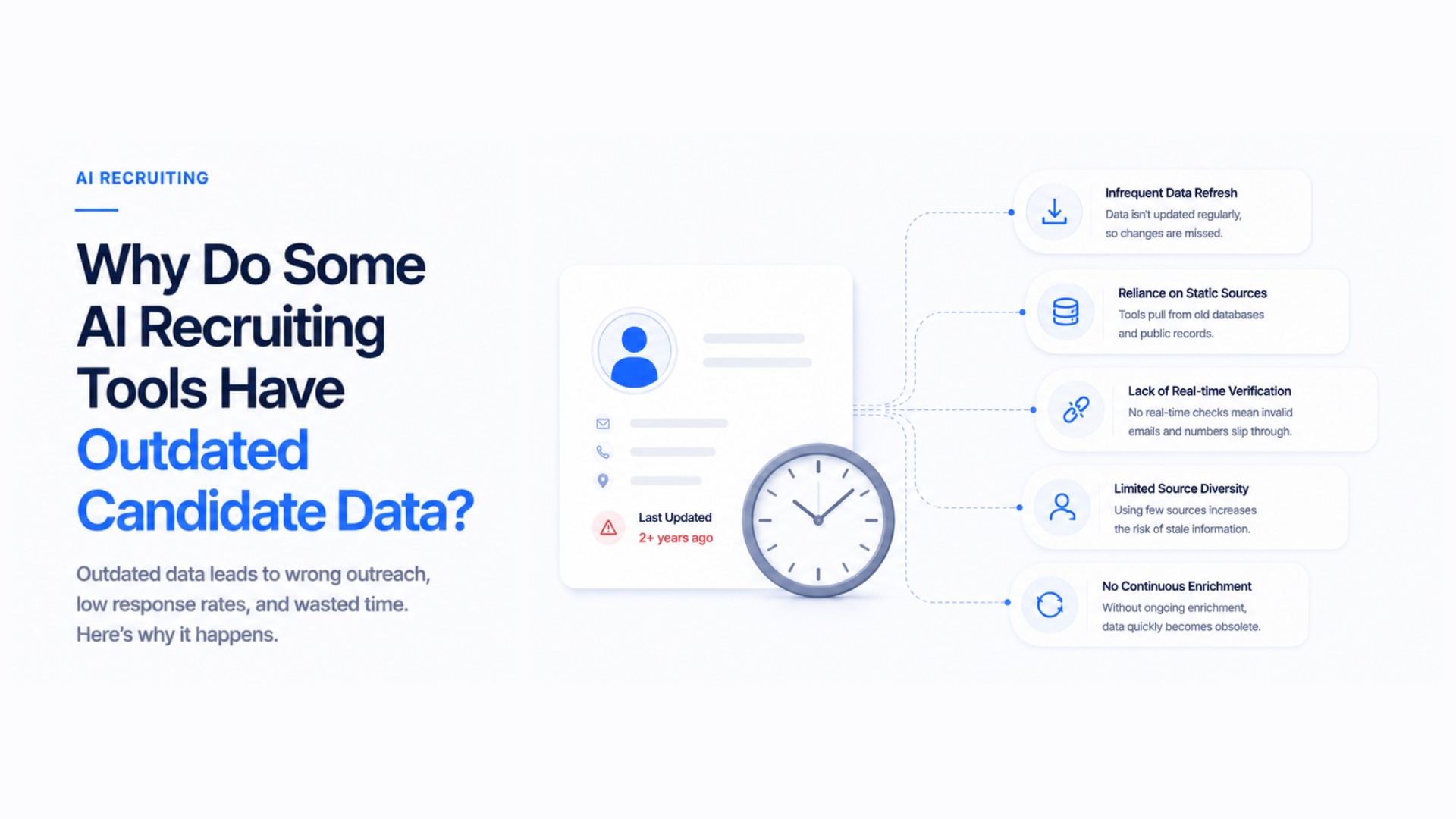
Some AI recruiting tools have outdated candidate data because professional information changes continuously while recruiting databases refresh at different speeds and from different sources. Candidates update profiles inconsistently, contact details decay, platforms rely on cached or aggregated records, identity matching can create errors, and AI may infer information that has not been directly verified.
This does not mean every outdated profile proves that the platform is poor.
No large candidate database can know every professional change at the exact moment it happens.
The more useful question is how the platform manages freshness.
How often is candidate information refreshed?
Which fields are current?
Which are historical?
Which are inferred?
When was the profile last checked?
What happens when different sources disagree?
Can recruiters verify important information?
Can candidates correct errors?
Does the system refresh data before outreach?
The answers determine whether stale information becomes a minor inconvenience or a serious recruiting problem.
Professional Data Starts Becoming Old Almost Immediately
Candidate data is unusual because the subject of the data is always changing.
People change employers.
They receive promotions.
They move from individual-contributor roles into management.
They relocate.
They complete new qualifications.
They stop using old email addresses.
They change phone numbers.
They develop new technical skills.
They leave the workforce temporarily.
They start companies.
They move into consulting.
They return to previous industries.
A candidate profile can be accurate today and incomplete tomorrow.
This is the first reason recruiting platforms struggle with data freshness.
The database is not storing a permanent fact.
It is storing a snapshot of a moving career.
A university degree may remain accurate for decades.
A current job title may remain accurate for three months.
A work email may stop functioning the day the candidate changes companies.
A candidate’s willingness to consider a new opportunity can change within a week.
Different fields have different rates of decay.
A sourcing tool may therefore contain a profile that is partly current and partly outdated.
The candidate’s education is correct.
Their previous employment is correct.
Their current employer is wrong.
Their location is probably correct.
Their work email is dead.
Their personal email still works.
Calling the entire profile accurate or inaccurate hides this complexity.
Data freshness needs to be evaluated field by field.
AI Does Not Automatically Create Fresh Data
The word AI can create unrealistic expectations.
A buyer sees an AI-powered sourcing platform and assumes the system knows more than a traditional candidate database.
It may understand more.
That is not the same as knowing something more recently.
AI can help interpret a candidate’s career.
It can identify related skills.
It can understand natural-language job requirements.
It can rank profiles.
It can summarize professional experience.
It can identify patterns.
None of these capabilities automatically tell the system that the candidate changed jobs last Tuesday.
For that, the platform needs a new signal.
A source needs to change.
A record needs to be refreshed.
An integration needs to provide an update.
The platform needs to detect the change.
The new information needs to be connected with the correct person.
The old information needs to be replaced or preserved as historical data.
The AI can then work with the new record.
Without that process, a more advanced model may simply reason more effectively over stale information.
This distinction is essential when evaluating AI recruiting software.
Model intelligence cannot compensate for permanently outdated data.
Candidate Profiles Come From Different Sources
AI sourcing platforms do not all build candidate databases in the same way.
Some rely heavily on professional profile information.
Some aggregate public professional data from multiple sources.
Some connect with customer ATS or CRM records.
Some use third-party data providers.
Some combine several approaches.
Some enrich a candidate only when a recruiter opens the profile.
Others maintain large prebuilt databases.
Each method creates different freshness problems.
A prebuilt database may provide very fast search.
The records need to be refreshed continuously.
An on-demand enrichment system may retrieve newer information.
The search experience may depend on what can be found at that moment.
An ATS integration may contain valuable candidate history.
The record may not have been updated since the person applied three years ago.
A multi-source system may have broader coverage.
Different sources may disagree.
The question is therefore not simply where the data comes from.
It is how the platform manages information after collection.
Huntlo’s AI Sourcing Tool Comparison Framework: 10 Criteria That Matter identifies data freshness, contact accuracy, profile completeness, and talent coverage as separate evaluation factors because a large database creates little value when recruiters cannot trust the records inside it.
The source matters.
The refresh process matters just as much.
Candidates Do Not Update Every Profile at the Same Time
Imagine a candidate changes jobs.
They update one professional network immediately.
Their personal website remains unchanged.
A public speaker biography still lists the previous employer.
An old conference page remains online.
A code repository contains the old company email.
The ATS still contains the resume they submitted two years ago.
A data provider has not yet detected the new role.
Which source is correct?
Several may contain historically accurate information.
Only one reflects the current situation.
This is a major challenge for recruiting databases.
Candidates do not maintain one universal professional record.
They leave information across the internet.
Different sources update at different speeds.
Some never update.
A sourcing platform needs to determine which information is current.
The problem becomes more difficult when the candidate does not update any public source.
The person may change jobs and remain publicly associated with the previous employer for months.
The recruiting tool cannot observe a change that has produced no available signal.
This is one reason a platform can have sophisticated AI and still display outdated employment information.
The missing piece is not intelligence.
It is evidence.
Large Databases Are Difficult to Refresh Continuously
A sourcing platform may advertise access to millions or hundreds of millions of professional profiles.
Scale creates value.
It also creates a maintenance problem.
Every record can change.
Refreshing every field for every person continuously requires enormous data infrastructure.
The platform needs to decide what to refresh.
How often.
From which source.
At what cost.
A candidate who has not appeared in a search for years may receive lower refresh priority than an actively viewed profile.
A person in a rapidly changing market may need more frequent updates.
A work email may require different verification from employment history.
Different vendors make different choices.
This creates an important trade-off.
Database size is easy to market.
Data freshness is harder to demonstrate.
A platform may have more profiles while another has fewer but more frequently refreshed records.
The larger number does not automatically create better sourcing outcomes.
This is why buyers should not treat database size as a complete measure of candidate coverage.
A profile that exists but cannot be trusted creates limited value.
Batch Refreshing Creates a Freshness Gap
Some databases refresh information in batches.
A profile is collected.
It remains unchanged for a period.
The platform later checks for updates.
This creates a freshness gap.
Suppose a record was refreshed in January.
The candidate changes jobs in February.
The next platform refresh happens in May.
For several months, the database is technically operating as designed.
The information is still wrong.
The length of this gap depends on the vendor’s infrastructure and refresh strategy.
Some records may update more frequently.
Others may remain unchanged for much longer.
The buyer should therefore be cautious when a vendor says the database is “regularly refreshed.”
Regularly could mean many things.
The more useful questions are specific.
How often are employment records checked?
Are popular or recently viewed profiles refreshed more frequently?
Does opening a candidate trigger a new lookup?
Can recruiters see when important information was last verified?
What happens before automated outreach begins?
Freshness is not a marketing adjective.
It is an operational process.
Cached Data Makes Search Faster but Can Preserve Old Information
Search systems often use stored data because retrieving everything from the original source in real time would be slow, expensive, unreliable, or technically impossible.
Cached information makes the product responsive.
The recruiter enters a search.
Results appear quickly.
The system does not rebuild millions of candidate profiles from zero.
This creates a trade-off.
Stored data improves speed.
Stored data can become stale.
The best platforms need a strategy for balancing search speed with profile freshness.
One possible approach is to search a stored index and refresh the candidate when the recruiter opens or saves the profile.
Another is to refresh high-value records more frequently.
Another is to combine stored information with newer enrichment signals.
No approach guarantees perfect freshness.
The buyer should understand where the platform sits on the spectrum.
A fast search result may be a discovery signal.
It should not automatically be treated as a verified current profile.
Contact Information Decays Differently From Career Information
Candidate contact data creates another problem.
A person can remain at the same employer while changing email addresses.
A company may change its email format.
An inbox may be disabled.
A personal email may remain valid for years.
A phone number may be reassigned.
A work email can disappear immediately after the candidate leaves.
This means contact freshness needs its own verification process.
A platform may have accurate career information and poor contact data.
Another may find excellent email addresses while displaying incomplete professional history.
Recruiters should test the capabilities separately.
Huntlo’s guide to How Do AI Recruiting Tools Find Verified Contact Details? explains why candidate discovery and contact verification are different technical problems, even when they appear inside the same recruiting interface.
This distinction matters during outreach.
A relevant candidate with a dead email is not fully actionable.
A valid email attached to outdated career context can produce an embarrassing message.
Both professional data and contact data need to be sufficiently current.
ATS and CRM Records Often Become Stale
Not all outdated candidate data comes from external sourcing platforms.
Recruiting teams already own large amounts of stale information.
A candidate applied three years ago.
Their resume entered the ATS.
The company rejected them.
The record remained.
The candidate changed jobs twice.
They developed new skills.
They moved location.
The ATS still represents the person they were three years ago.
A recruiting CRM can have the same problem.
The team builds a talent pool.
Recruiters add notes.
The relationship becomes inactive.
The record stops changing.
Years later, the company searches the database.
The candidate appears under old titles and skills.
This creates an important opportunity for AI recruiting.
Candidate rediscovery can be extremely valuable.
The existing database may contain people who are now stronger fits.
The system needs updated information.
Huntlo’s guide to What Is a Recruiting CRM? Definition and Key Features explains why candidate relationship systems need to preserve history while helping recruiters understand current candidate context.
Historical information is valuable.
The problem begins when historical information is presented as current.
Data Integration Can Create Conflicting Versions of the Same Candidate
A recruiter may have one candidate record in the ATS.
Another in the CRM.
A third from a sourcing platform.
A fourth from a contact enrichment provider.
The records do not match.
One says the candidate works at Company A.
Another says Company B.
One uses a personal email.
Another uses an old work email.
One has a new location.
Another has the location from a previous application.
The recruiting system now needs to decide which information to trust.
This is an identity-resolution problem.
The platform needs to determine whether the records belong to the same person.
Then it needs to determine which fields are most current.
Errors can happen at both stages.
Two different people can be merged.
One person can remain split across several profiles.
An old record can overwrite a newer one.
A low-confidence source can be treated as authoritative.
The more sources a platform uses, the more important its data reconciliation process becomes.
More data is not automatically better data.
Identity Matching Is Harder Than It Looks
Consider two professionals with the same name.
They work in the same industry.
They live in the same city.
One changes employers.
A data system finds a new professional record.
Does it belong to the first person or the second?
Now consider one person whose name appears differently across sources.
A full name.
An abbreviated name.
A maiden name.
A transliterated version.
A nickname.
The system needs to determine whether these records represent one person.
This process is often called entity resolution or identity resolution.
AI can improve matching.
The problem cannot always be solved with certainty.
A wrong merge can create a profile containing information from two different people.
A missed merge can leave the current role separated from the older candidate record.
Recruiters may see incomplete or contradictory information.
These errors can be especially difficult to notice because the combined profile may still look plausible.
The more confidently the AI summarizes it, the more dangerous the mistake becomes.
AI Inference Can Look Like Current Data
This is one of the most important problems.
A candidate profile does not explicitly list a skill.
The AI infers it from the person’s role and projects.
The inference may be useful.
The interface displays the skill next to verified information.
The recruiter assumes it is a fact.
A candidate works at a company known for a certain technology.
The system infers likely exposure.
The recruiter assumes deep expertise.
A person has a career pattern associated with a particular seniority level.
The system assigns the level.
The candidate’s actual responsibilities differ.
Inference is not automatically bad.
AI sourcing becomes more useful when it can identify reasonable relationships that exact keyword search misses.
The problem is presentation.
The recruiter should understand the difference between:
The candidate explicitly lists this skill.
The candidate’s experience strongly suggests this skill.
The AI considers this skill plausible.
These are different levels of evidence.
Huntlo’s guide to How Does AI Candidate Matching Actually Work? explains why candidate matching should connect recommendations with underlying professional evidence instead of presenting a score as unquestionable truth.
The same principle applies to data quality.
Inference should not silently become fact.
AI Can Make Outdated Data More Convincing
Traditional stale data may look obviously old.
A resume has a date.
A profile shows an old employer.
The recruiter notices.
AI changes the presentation.
The system creates a polished candidate summary.
It explains why the person fits.
It generates a personalized message.
The output feels current.
The underlying record may still be old.
This creates what could be called a confidence problem.
Good language makes weak data feel stronger.
The recruiter sees a complete narrative rather than a collection of uncertain fields.
They become less likely to question the source.
This is why AI recruiting systems need good evidence design.
Important claims should be traceable.
Recruiters should be able to see where information came from.
When it was last updated.
Whether it is explicit or inferred.
AI should help the recruiter understand uncertainty.
It should not hide uncertainty behind fluent writing.
Outdated Data Damages Candidate Matching
Suppose a candidate moved from a general engineering role into cybersecurity.
The sourcing platform still shows the previous position.
A company searches for a security specialist.
The candidate never appears.
This is a false negative.
Now imagine the opposite.
A candidate previously worked in cybersecurity.
They moved into a different function.
The old information remains prominent.
The system ranks them highly for a security role.
This is a false positive.
Outdated data can therefore damage sourcing in two directions.
It can surface the wrong people.
It can hide the right people.
The second problem is harder to detect.
A recruiter notices when an irrelevant candidate appears.
They do not know which strong candidate never appeared.
This is why data freshness affects more than outreach accuracy.
It affects the composition of the entire candidate pool.
Outdated Data Can Damage Personalized Outreach
AI-personalized outreach depends on candidate context.
The system identifies the current role.
It references a project.
It connects the person’s experience with the opportunity.
When the data is correct, the message can feel relevant.
When the data is stale, the error becomes personal.
“I saw that you currently lead engineering at Company A.”
The candidate left Company A last year.
“Your recent work in fintech looks highly relevant.”
The candidate has moved into healthcare.
“Your experience with this technology makes you a strong fit.”
The candidate has never used it.
The recruiter may have done nothing manually wrong.
The candidate sees the message as careless.
This is one reason data quality becomes more important as outreach becomes more automated.
Manual recruiters make errors one candidate at a time.
Automation can repeat the same error at scale.
Huntlo’s guide to Do Candidates Respond Better to AI-Personalized Outreach? explains why personalization creates value only when it is based on credible, relevant candidate context.
Incorrect personalization can be worse than a simple message.
Outdated Data Wastes Recruiter Time
The obvious cost is the failed email.
The larger cost is the complete chain of wasted work.
The AI finds the candidate.
The recruiter reviews the profile.
The system enriches the record.
Outreach begins.
A follow-up is sent.
The candidate responds.
The recruiter discovers the information is wrong.
Every previous step consumed time or system resources.
The same problem can happen later.
A candidate appears qualified.
They enter screening.
The recruiter discovers that the relevant experience ended years ago.
The hiring manager reviews the profile.
They reject it immediately.
Outdated information creates friction throughout the workflow.
This is why data quality should be evaluated through recruiting outcomes.
Not only field-level accuracy.
The practical question is how often stale information causes wasted recruiter actions.
Data Freshness and Data Accuracy Are Not the Same
A record can be fresh and wrong.
A platform checks the candidate today.
The source itself contains incorrect information.
A record can be old and still correct.
The candidate has remained in the same role for five years.
The platform last refreshed the profile six months ago.
Nothing has changed.
This distinction matters.
Freshness measures how recently information was checked or updated.
Accuracy measures whether the information is correct.
The two are related.
They are not identical.
Recruiters should therefore avoid simplistic claims.
“This data was updated yesterday, so it must be accurate.”
Not necessarily.
“This profile is six months old, so it must be wrong.”
Not necessarily.
A strong system should combine freshness signals, source reliability, verification, and uncertainty.
Profile Completeness Is Another Separate Problem
A candidate profile can be current but incomplete.
The current employer is correct.
The title is correct.
Several important skills are missing.
The candidate has not described recent projects.
The AI has limited evidence.
This can affect matching.
A strong candidate may rank poorly because the profile contains too little information.
The system may attempt to infer the missing pieces.
That can improve discovery.
It can also create errors.
Recruiters should therefore evaluate three separate questions.
Is the data current?
Is the data correct?
Is the profile complete enough for the hiring use case?
A platform can perform well on one and poorly on another.
This is why candidate data quality is difficult to reduce to one percentage.
Some Markets Have Better Data Coverage Than Others
AI recruiting tools do not perform equally in every geography, industry, or profession.
Software professionals may have rich public information.
They may maintain professional profiles.
Contribute to public projects.
Write technical content.
Speak at events.
Other workers may have much less visible data.
A platform may have strong coverage in one country and weaker coverage elsewhere.
A job title may be standardized in one market and inconsistent in another.
Local professional networks may differ.
Contact verification may work differently across regions.
A tool that performs well for US technology hiring may not perform equally well for manufacturing roles in India or healthcare recruitment in the Gulf.
This is why data quality should be tested using the team’s real hiring markets.
Huntlo’s guide to Best AI Recruiting Tools for Hiring in India vs Global Markets explains why candidate coverage, communication channels, data expectations, and workflow needs can vary significantly between markets.
Global database size is not the same as local data quality.
Data Freshness Costs Money
This point is rarely discussed.
Collecting candidate data costs money.
Processing it costs money.
Storing it costs money.
Refreshing it costs money.
Verifying contact information costs money.
Resolving conflicting records costs money.
Running enrichment on demand costs money.
A platform offering extremely cheap access to a huge candidate database still needs to make economic choices.
How frequently can it refresh every profile?
Which fields receive the most attention?
Does it depend on third-party data?
Does it verify information only after a recruiter requests it?
Pricing does not automatically predict quality.
Expensive platforms can have stale records.
Cheap platforms can be excellent in specific markets.
The buyer should understand that freshness is infrastructure.
It is not a cosmetic feature.
Huntlo’s guide to AI Sourcing Tool Pricing: What's Actually Worth Paying For explains why the value of sourcing software depends on candidate relevance, data quality, actionability, and recruiter work rather than subscription price alone.
A low-cost profile that wastes recruiter time can be expensive in practice.
More Data Sources Can Improve Freshness and Increase Complexity
A platform that uses several sources may detect changes faster.
One source updates the candidate’s employer.
Another provides new contact information.
A third adds recent technical activity.
The combined profile becomes richer.
The same architecture creates conflicts.
Which source is newest?
Which is most reliable?
Are two records referring to the same person?
Should an old field be deleted or preserved?
Does a new title represent a promotion or a different candidate?
The quality of a multi-source platform depends on how well it reconciles information.
Simply collecting more data does not solve the problem.
The system needs rules for confidence, chronology, identity, and conflict resolution.
Recruiters rarely see this infrastructure.
They experience the result.
A clean profile or a confusing one.
Why Real-Time Candidate Data Is Harder Than It Sounds
Vendors sometimes use the phrase real-time data.
Recruiters should understand what it means.
Does the system retrieve information when the recruiter opens the profile?
Does it receive continuous updates from one source?
Does it verify contact information immediately before use?
Does it refresh the entire candidate record?
A professional career does not exist in one universal live database.
The platform can only update from available signals.
If the candidate has not published the change anywhere accessible to the system, there is nothing to retrieve.
Real-time processing can make the platform faster at detecting available information.
It cannot make private or nonexistent information appear.
This is why buyers should ask specific questions rather than relying on broad freshness language.
Why Candidate Self-Reported Data Is Not Automatically Perfect
A candidate is often the best source of information about their own career.
Self-reported data can still be incomplete.
Profiles are written for different purposes.
Candidates emphasize certain skills.
They omit others.
They forget to update dates.
They simplify titles.
They use internal titles that do not translate well outside the company.
They leave old information online.
Some profiles are intentionally broad.
This means a recruiting system cannot solve every data-quality problem by finding the candidate’s own profile.
The source needs interpretation.
The recruiter may still need verification.
This is another reason AI sourcing should support human judgment rather than create false certainty.
How Recruiters Should Evaluate Data Freshness Before Buying
The best test uses real candidates.
Select several difficult roles.
Run searches.
Take a sample of relevant profiles.
Verify the current employer.
Current title.
Location where relevant.
Employment dates.
Important skills.
Contact details.
Do not check only the best-looking profiles.
Include candidates from different industries and markets.
Record the error patterns.
How many profiles are outdated?
Which fields are most commonly wrong?
How old are the errors?
Does opening the candidate trigger a refresh?
Does the platform show when information was last checked?
Then continue the workflow.
Send appropriate outreach to a sample.
Measure email bounce.
Watch for candidate corrections.
Track how often recruiters discover stale information later.
This produces a much more useful evaluation than asking the vendor for one overall accuracy percentage.
Huntlo’s guide to What's the Best Way to Evaluate an AI Sourcing Tool Before Buying? explains why sourcing technology should be tested on real roles, real recruiters, and real downstream outcomes rather than polished demonstrations.
Data freshness should be part of that pilot.
Ask When Each Important Field Was Last Verified
A single profile update date may not be enough.
Different fields can come from different sources.
The employer may have been refreshed recently.
The email may be older.
The location may come from a historical resume.
The skills may be inferred.
A sophisticated platform may not expose every technical detail.
The recruiter should still understand the general model.
Which information is direct?
Which is enriched?
Which is inferred?
Which contact fields are verified?
How recently?
This becomes especially important before automation.
A recruiter manually reviewing one profile can notice uncertainty.
An AI agent sending hundreds of messages needs stronger controls.
Test Data Freshness on Recently Changed Candidates
One useful evaluation method is to create a known test set.
Find people whose careers changed recently.
A candidate who started a new job.
Someone who received a promotion.
A person who moved location.
A professional who changed industries.
Search for them in the platform.
What does the system show?
How quickly did the change appear?
This does not provide a complete accuracy measure.
It reveals refresh behavior.
The test can also be repeated during the trial.
A buyer may discover that one platform updates common profiles quickly while another has broader coverage but slower refresh cycles.
The correct choice depends on the recruiting use case.
Evaluate the Platform’s Correction Process
Outdated data is inevitable.
The correction process matters.
Can recruiters report an error?
Can candidates request a correction?
How quickly does the vendor investigate?
Can incorrect information continue to appear after being flagged?
Can the recruiter override a field inside the customer workflow?
Does the original record return during the next refresh?
A platform should not be evaluated only by how rarely it fails.
It should be evaluated by what happens after failure.
Huntlo’s guide to What Happens If an AI Sourcing Tool Gets a Candidate's Data Wrong? explores why recruiting teams need correction paths, human review, and accountability when inaccurate information enters an AI-powered workflow.
Good error recovery is part of data quality.
Do Not Automate High-Risk Outreach From Low-Confidence Data
Automation increases the importance of confidence thresholds.
Suppose the system is uncertain about the candidate’s current employer.
A recruiter can still contact the person.
The message should not confidently reference the uncertain fact.
Suppose a technical skill is inferred.
The outreach should not say:
“Your deep expertise in this technology makes you perfect.”
A safer message may focus on broader, directly supported experience.
This is a practical principle for AI recruiting.
The more uncertain the data, the less specific the automated action should become.
The system can still use uncertain information for discovery.
It should be more careful when turning that information into candidate-facing communication.
Refresh the Candidate Before Important Actions
A candidate may have entered the database months ago.
They are now selected for outreach.
This is a logical point for refresh.
The system can check important information before the recruiter acts.
Current employer.
Current title.
Contact validity.
Recent professional changes where available.
The same principle can apply later.
Before screening.
Before submitting the candidate to a hiring manager.
Before re-engaging someone from an old talent pool.
Not every field needs continuous real-time updating.
Important fields should be sufficiently current when they influence an important action.
This event-driven approach can sometimes be more useful than attempting to refresh every record constantly.
Keep Historical Data Without Confusing It With Current Data
Old information is not useless.
A candidate’s previous employer matters.
Their earlier role matters.
Past skills matter.
Previous recruiter conversations matter.
The problem is not historical data.
The problem is poor chronology.
A recruiting system should preserve career history while making current status clear.
This helps AI matching too.
A candidate may no longer use one technology every day.
Their previous deep experience may still be relevant.
The recruiter needs to understand when the experience happened.
A flat list of skills loses this context.
Good candidate data is not only a collection of facts.
It is a timeline.
Measure the Business Impact of Stale Data
Recruiting teams should not become obsessed with achieving perfect databases.
Perfect data is unrealistic.
The goal is reducing meaningful errors.
Track practical consequences.
Email bounce rates.
Candidate corrections.
Hiring-manager rejection caused by outdated information.
Recruiter time spent verifying profiles.
Duplicate records.
Failed personalization.
Candidates incorrectly excluded from searches.
Talent-pool records that cannot be reused.
The most important data-quality problem is the one affecting recruiting outcomes.
A field can be imperfect without mattering.
Another can create repeated workflow failure.
Prioritize accordingly.
Why Better AI Can Sometimes Reveal More Data Problems
An interesting thing happens when search improves.
Recruiters discover more candidates.
They also encounter more data.
Weak records become more visible.
The team may conclude that the new AI tool created the problem.
The old process may simply have hidden it.
The same can happen when an organization searches its ATS more effectively.
Thousands of old profiles become discoverable.
The company realizes the database is stale.
Better intelligence does not automatically create better underlying records.
Sometimes it exposes how much maintenance the data needs.
This is why AI implementation and data strategy should not be separated.
The quality of the model and the quality of the information both matter.
Where Huntlo Fits Into Candidate Data Freshness
Huntlo approaches candidate information as part of a connected recruiting workflow.
The objective is not simply to return a large list of profiles.
AI-powered sourcing helps identify relevant candidates across multiple sources.
Candidate matching helps recruiters understand why a person may fit the requirement.
Profile and contact enrichment help make the candidate more actionable.
The workflow can then continue into outreach, follow-ups, qualification, and screening.
This wider workflow makes data quality especially important.
Incorrect candidate information does not remain inside a search result.
It can influence who is ranked.
What the outreach says.
Which contact route is used.
How the candidate is screened.
What information reaches the recruiter.
For this reason, Huntlo or any other AI recruiting platform should be evaluated on the complete path from data to action.
How current is the candidate information?
Which claims are directly supported?
Can recruiters review important evidence?
Are contact details usable?
What happens when information is wrong?
Does the workflow allow human intervention before consequential actions?
The strongest AI recruiting system is not the one that pretends candidate data is perfect.
It is the one that manages uncertainty without forcing recruiters to manually verify everything from zero.
Common Mistakes Recruiters Make With Candidate Data
The first mistake is assuming AI-generated information must be current.
The second is treating one profile as the complete truth about a candidate.
The third is assuming a recently refreshed record must be accurate.
The fourth is treating inferred skills as verified facts.
The fifth is assuming database size predicts freshness.
The sixth is evaluating professional data and contact data as one capability.
The seventh is automating personalized outreach from uncertain information.
The eighth is ignoring old ATS and CRM records while blaming external sourcing platforms.
The ninth is failing to test recently changed candidates during a product trial.
The tenth is accepting vague claims that data is “regularly updated.”
The eleventh is ignoring the correction process.
The twelfth is removing historical data instead of organizing it correctly.
The thirteenth is measuring field accuracy without measuring workflow impact.
The final mistake is expecting AI to know about a career change that has produced no available signal.
Conclusion: AI Can Only Be as Current as the Information It Can Access and Refresh
Some AI recruiting tools have outdated candidate data because careers change faster than databases can perfectly observe them.
Candidates change jobs.
They update different profiles at different times.
Some do not update public information at all.
Contact details stop working.
Large databases refresh records at different intervals.
Cached information becomes stale.
Multiple sources conflict.
Identity matching creates errors.
ATS and CRM records age.
AI infers missing information.
The result is unavoidable uncertainty.
The important distinction is how the platform manages it.
A weak system presents old and inferred information with complete confidence.
A stronger system refreshes important records, separates evidence from inference, verifies actionable data, preserves chronology, allows correction, and gives recruiters enough context to make good decisions.
Recruiters should not ask whether an AI sourcing platform has any outdated data.
Every sufficiently large professional database will contain some.
They should ask better questions.
How frequently is important information refreshed?
Which fields are verified?
When was the data last checked?
What happens when sources disagree?
Can recruiters see the evidence?
How does the system correct errors?
Does stale data repeatedly damage outreach, candidate matching, or hiring-manager acceptance?
Those questions reveal the real quality of the platform.
AI can make candidate discovery faster.
It can make matching more intelligent.
It can make outreach more personalized.
It cannot make an old fact new simply by processing it with a better model.
Fresh recruiting intelligence requires both.
Good AI.
And data that is current enough to trust when the next action happens.
Frequently Asked Questions
Why is candidate data outdated in AI recruiting tools?
Candidate information changes continuously, while platforms refresh profiles at different intervals and from different sources. Candidates may also update some professional records while leaving others unchanged.
Does outdated candidate data mean an AI recruiting tool is bad?
Not necessarily. No large professional database can remain perfectly current at every moment. The important factors are refresh frequency, error rates, verification, transparency, correction processes, and the impact on recruiting outcomes.
Can AI automatically update candidate profiles?
AI can help detect, merge, interpret, and organize new information, but the system still needs access to a new signal. AI cannot know about a career change that has not appeared in any accessible data source.
Why are candidate contact details often outdated?
Work emails can stop functioning when candidates leave companies, personal contact information can change, and different verification systems update at different speeds. Contact freshness should be evaluated separately from profile accuracy.
What is the difference between data freshness and data accuracy?
Freshness refers to how recently information was checked or updated. Accuracy refers to whether the information is correct. A fresh record can still be wrong, and an older record can still be accurate.
Why does AI sometimes list skills candidates do not have?
Some systems infer skills from job titles, employers, projects, or related experience. These inferences may be useful for discovery but should not be presented as directly verified facts.
How can recruiters test candidate data freshness?
Use real searches, verify a sample of profiles manually, test recently changed candidates, check employment and contact details, track email bounce, and measure how often candidates correct the information.
Should recruiters verify every AI-sourced candidate manually?
Not every field needs the same level of verification. Important information should receive stronger review before candidate-facing communication or consequential hiring decisions.
Can outdated ATS data be refreshed?
Yes. Organizations can use enrichment and data-refresh processes to update old candidate records, although historical information should be preserved and clearly separated from current information.
What should buyers ask AI recruiting vendors about data freshness?
Ask how frequently profiles are refreshed, which fields are verified, whether profiles update on demand, how sources are reconciled, how inferred data is labeled, and how errors are corrected.
Related Topics
Understand how one incorrect candidate record can spread through matching, outreach, and screening in What Happens If an AI Sourcing Tool Gets a Candidate's Data Wrong?.
Learn how professional and contact information become actionable during candidate discovery in How Do AI Recruiting Tools Find Verified Contact Details?.
See how to test profile freshness and data accuracy before signing a software contract in What's the Best Way to Evaluate an AI Sourcing Tool Before Buying?.
Explore why sourcing platforms with similar feature lists can produce very different data quality and recruiter outcomes in AI Sourcing Tools Are Not All the Same: What Recruiters Should Know.