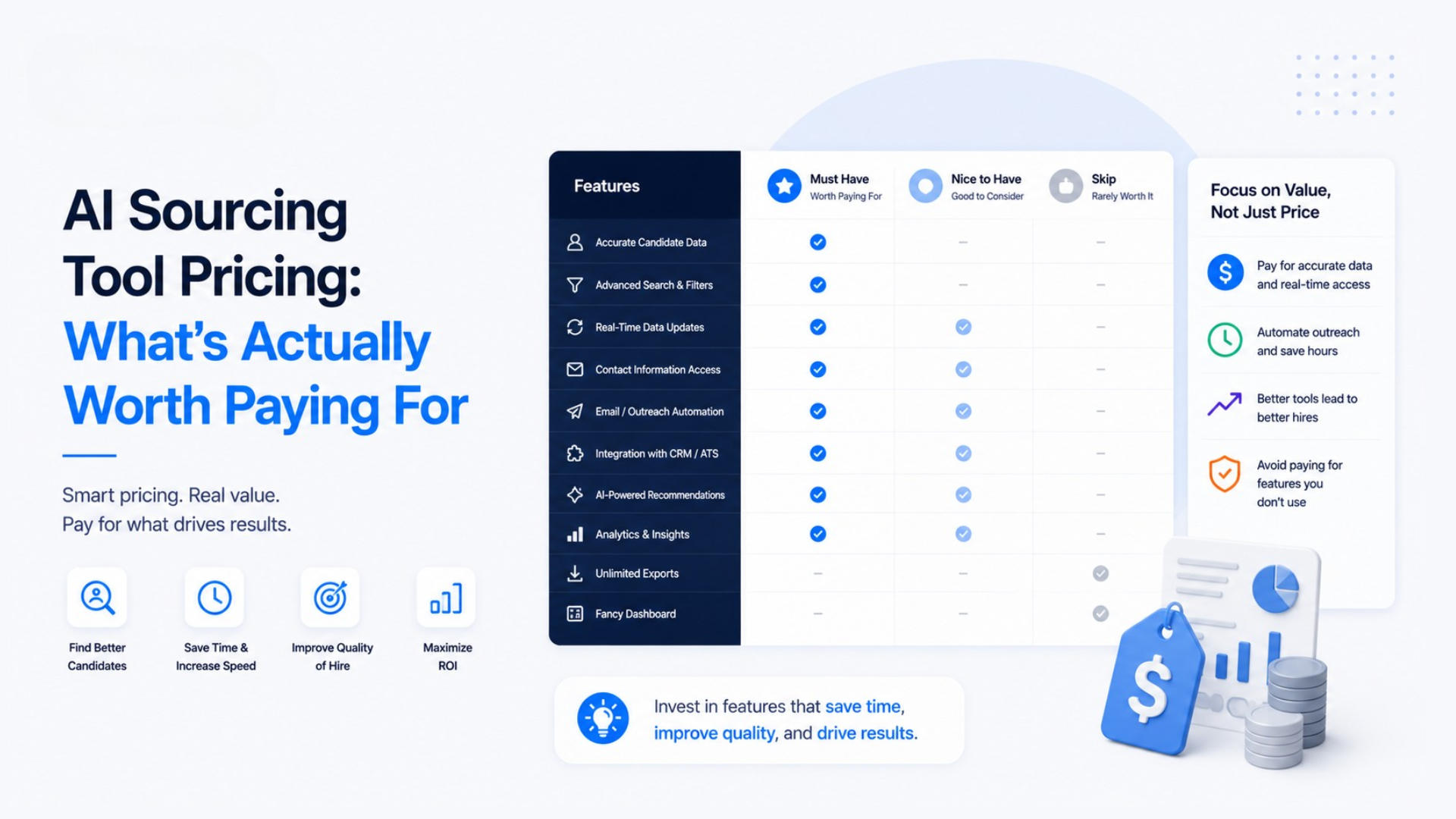
AI sourcing tools now span a wider price range than almost any other category in recruiting software — from genuinely free tiers up to enterprise contracts north of $200,000 a year, according to a 2026 roundup of sourcing platforms from Pin's sourcing tools guide. That spread would be easier to navigate if price tracked capability in a straight line, but it doesn't. A cheap tool with a shallow candidate database can cost a team more in wasted recruiter hours than an expensive one that actually finds the right people, and an expensive tool bought for its headline database size can sit unused if nobody on the team can get a usable response rate out of it. Truffle's guide to recruiting software pricing puts the real question well: price isn't the point, throughput is — a higher cost per candidate can still lower total cost to hire if it gets a recruiter to the right conversation faster.
This guide breaks down how AI sourcing tools are actually priced in 2026, what specific platforms charge, and — more usefully than either of those — which parts of a sourcing tool's price tag tend to correlate with real hiring outcomes and which ones are mostly marketing.
How AI Sourcing Tools Are Priced
Sourcing-specific tools tend to cluster around a slightly different set of pricing models than full recruiting suites, because the core product is access to a candidate database plus some layer of outreach automation on top of it.
Per-seat pricing is the oldest model in the category and still dominates at the high end. Pin's comparison guide notes that per-seat plans, LinkedIn Recruiter chief among them, scale linearly with team size — adding a third recruiter simply triples the cost, with no volume discount built in unless it's separately negotiated.
Flat platform pricing charges a single monthly fee regardless of team size, usually with a database-access ceiling or outreach-volume cap attached. Pin's own guide to the category reports its Starter plan at a flat $100 a month, positioned specifically against LinkedIn Recruiter's per-seat model.
Usage or credit-based pricing meters cost against contacts unlocked, credits spent, or candidates contacted rather than seats or a flat fee — the model used by contact-lookup tools like Lusha and by several mid-market sourcing platforms.
Enterprise contracts dominate the top end of the market, where sourcing gets bundled into a broader talent-intelligence or workforce-planning platform. Pin's guide notes that platforms like Phenom and Entelo require custom contracts that routinely run into six figures annually once implementation is included.
What Real Vendors Actually Charge
The published numbers in this category vary more than in almost any adjacent one, largely because "AI sourcing tool" covers everything from a lightweight contact-lookup add-on to a full talent-intelligence platform. On the budget end, Pin's 2026 pricing roundup lists Manatal at $15 per user per month as the cheapest credible option for teams that need broad ATS-plus-sourcing functionality rather than deep passive-candidate reach, while a separate guide to startup-focused sourcing tools from Wellfound notes that Manatal's sourcing depth is functional but shallow at that price point — a reasonable fit for teams that need an ATS with sourcing bolted on, but one that hits a ceiling quickly for teams whose main problem is finding hard-to-reach passive candidates.
Dedicated sourcing platforms in the low-to-mid range include Wellfound Reach, which the same startup-focused guide lists starting at $115, and Juicebox, listed at a range from free to $199 per seat. Pin's own guide lists its paid plans starting at $100 a month with a free tier available with no credit card required, positioned as a direct alternative to LinkedIn Recruiter's Lite tier, which SitePoint's 2026 sourcing tools roundup puts at $170 a month, or $8,999 per seat per year for the Corporate tier — a figure that climbs further once InMail credits, Talent Insights, and promoted listings are added on top.
Moving into mid-market and specialist tools, a comparison from TheHireHub's AI sourcing tools guide lists platforms in the $1,500 to $12,000-a-month range depending on database depth and specialization — tools built around 800 million-plus profiles with deep skills analysis and multi-language support for hard-to-fill technical roles tend to sit at the top of that range, while platforms optimized for pipeline nurturing and candidate journey mapping rather than raw discovery volume tend to sit lower. At the enterprise end, Pin's comparison guide estimates Phenom's talent-experience platform starting around $10,000 a month for organizations with 5,000 or more employees, with third-party consultants typically required for implementation given the scope of what's being deployed — workforce planning, skills intelligence, and internal mobility tools layered on top of core sourcing.
The Add-On Stacking Problem
One pattern worth calling out specifically because it's easy to miss at the point of purchase: several platforms advertise an attractively low base price, then require paid add-ons to reach functional parity with a competitor's single price. Pin's platform comparison lays out a concrete example: a mid-market ATS-plus-sourcing platform base plan runs $299 a month, but texting costs an additional $79 a month, video adds $99, and assessments add another $59 — meaning a team that needs all four modules is actually looking at $536 a month before any headcount-based scaling is applied. That's not necessarily a bad deal on its own merits, but it's a materially different number than the one on the homepage, and it's exactly the kind of gap Truffle's broader pricing guide has in mind when it warns that a $100-a-month tool with built-in outreach and scheduling often ends up cheaper overall than a $170-a-month tool that needs three additional subscriptions to actually function as a complete workflow.
The practical fix is the same one that applies to recruiting software generally: price out the full workflow you actually need — discovery, outreach, and scheduling at minimum — rather than comparing base prices across vendors that bundle those pieces differently.
The LinkedIn Recruiter Question
Because LinkedIn Recruiter remains the default sourcing tool at a large share of companies, most AI sourcing tool comparisons in 2026 are implicitly framed against it, and the economics are worth stating plainly. At $8,999 per seat per year for the Corporate tier, per SitePoint's roundup, a five-recruiter team is looking at roughly $45,000 a year before InMail credit overages, Talent Insights, or promoted job listings are added — a real number, and one that scales linearly with every recruiter added, since there's no volume efficiency built into the per-seat structure.
The core limitation driving newer platforms' pitch against LinkedIn isn't really price, though — it's reach. SitePoint's guide notes that LinkedIn limits sourcing to its own network by definition, while AI-native platforms are built to search across the web more broadly, aggregating GitHub, professional community platforms, and other public sources alongside standard LinkedIn-style profile data. Whether that broader reach is worth paying for depends heavily on the roles being filled — it matters far more for specialized technical or niche roles where a meaningful share of the right candidates simply aren't active or reachable on LinkedIn, and matters less for high-volume standard roles where LinkedIn's existing reach is already close to sufficient.
What Actually Predicts Results (And What Doesn't)
Database size is the number sourcing vendors lead with most often, and it's also the number least correlated with actual hiring outcomes on its own. A platform claiming 850 million profiles isn't automatically more useful than one claiming 200 million, if the larger database is weighted toward regions, industries, or seniority levels that don't match what a given team is actually hiring for. TheHireHub's sourcing comparison guide is direct about where the real differentiator sits instead: AI sourcing tools that use semantic understanding — recognizing that "Django engineer" is relevant to a Python role, or that "5 years backend development" implies a senior-level candidate — consistently outperform tools still relying on keyword and Boolean matching, regardless of which database is larger.
Response rate is a more useful number to weigh than raw database size, precisely because it measures whether the database actually converts into real conversations. Pin's own materials report a 48% response rate on automated outreach and a claimed 5x improvement over industry baseline response rates — a number worth treating with appropriate skepticism given it comes from the vendor's own marketing, but directionally consistent with the broader industry finding that personalized, well-timed outreach meaningfully outperforms templated contact regardless of which platform sends it.
Workflow consolidation is the third factor worth weighing seriously, and it's the one most directly tied to the add-on stacking problem described above. SitePoint's 2026 roundup frames this as the biggest shift in the category this year: the industry is moving away from stitching together separate tools for sourcing, outreach, and scheduling, toward full-stack platforms that handle all three in a single workflow — a shift driven less by any single tool getting cheaper and more by the realization that the real cost of a fragmented stack was never the sum of the subscription fees, it was the recruiter hours spent manually passing candidates between disconnected tools.
Matching Spend to Hiring Volume
The same volume logic that applies to full recruiting suites applies even more sharply to dedicated sourcing tools, because sourcing spend is the line item most likely to be either badly underused or genuinely necessary depending on how much passive-candidate reach a given hiring motion actually requires. Wellfound's startup-focused guide is specific about where the ceiling sits for lean teams: standalone AI-sourcing platforms built for volume are excellent tools once an organization is making meaningful hires through passive outreach regularly, but for a team hiring occasionally and mostly through inbound applications, a recruiter's own time paired with a lighter-weight tool typically covers the gap at a fraction of the cost. TheHireHub's broader sourcing comparison echoes the same point from the other direction: AI sourcing tools find roughly ten times more qualified candidates in a tenth of the time compared to fully manual sourcing, a gap that matters enormously for a team running dozens of searches a month and considerably less for a team running two or three.
Contact Data and Enrichment: The Pricing Layer Underneath Sourcing
A layer of the market sits underneath full sourcing platforms and is easy to overlook when comparing top-line prices: contact-lookup and enrichment tools, which unlock verified email addresses and phone numbers for candidates a recruiter has already identified elsewhere. These tend to run on credit-based pricing rather than seats — Althire's pricing guide lists Lusha's credit-based model at roughly $37.45 a month for 4,800 annual credits, a meaningfully different cost structure than a flat sourcing subscription, since the actual cost scales with how many candidates a recruiter is actively trying to reach rather than with team size.
For teams already running an ATS or a broader sourcing platform, this layer is worth pricing out separately rather than assuming it's bundled in. Several full-stack sourcing platforms include enrichment as part of the base subscription; others treat it as a metered add-on similar to the texting and video modules described above. The distinction rarely shows up clearly on a pricing page and is worth a direct question during any sales conversation: does verified contact data come included, or does it draw down a separate credit pool that can run out mid-campaign.
Compliance Costs Are Becoming Part of the Price Conversation
Sourcing tools carry a compliance dimension that pure ATS or scheduling software mostly doesn't, because sourcing platforms are, by definition, collecting and processing personal data about people who haven't applied for anything and may not know they've been found. TheHireHub's sourcing tools comparison guide flags this directly: legitimate AI sourcing platforms need to be GDPR and CCPA compliant, obtaining candidate contact data through legal channels rather than scraping it indiscriminately, and checking a vendor's certifications before signing is a real part of due diligence rather than a formality.
That compliance posture is starting to show up as a genuine pricing differentiator rather than just a checkbox. SitePoint's 2026 roundup notes that with the EU AI Act now in effect and U.S. jurisdictions tightening AI hiring rules, sourcing tools increasingly need documented guardrails against algorithmic bias built into the product rather than added afterward — and vendors that have invested in that documentation upfront tend to sit at a different price point than ones that haven't, since retrofitting compliance into an existing platform is a nontrivial engineering cost that eventually gets passed to the buyer either through price or through risk.
A Practical Checklist Before Signing
Given how unevenly this category prices comparable functionality, a short evaluation pass before committing to any sourcing tool saves more money than negotiating the sticker price down after the fact. A few questions worth asking directly, drawn from the patterns across this guide: What does the base price actually include, and what's a paid add-on — specifically outreach, texting, video, and contact enrichment? Is pricing per seat, flat, or usage-based, and which of those actually matches how the hiring volume fluctuates month to month? What's the vendor's actual response rate data, and is it independently reported or self-published? How is candidate contact data sourced, and can the vendor document GDPR or CCPA compliance directly rather than in general terms? And finally, how many separate tools does this platform genuinely replace, versus how many it still requires alongside it to function as a complete sourcing-to-outreach workflow?
None of these questions require a demo to answer — a vendor unwilling to answer them directly, in writing, before a sales call is itself a useful data point.
Beyond the platforms named above, the same TheHireHub comparison catalogs several tools sitting in adjacent tiers worth knowing by name if you're actively shortlisting: AmazingHiring, built specifically for technical hiring with deep GitHub and Stack Overflow signal integration; Gem, positioned as a broader all-in-one platform combining sourcing with rediscovery of past applicants and analytics; and Ashby, marketed specifically as a consolidation play for startups looking to replace several point tools with one platform. None of these publish a single universal price — most quote based on team size and module selection — but their positioning is a useful signal in itself: the market is visibly splitting between specialist tools optimized for one hiring motion (technical sourcing, high-volume conversational screening, enterprise workforce planning) and generalist platforms betting that most teams would rather pay one vendor for a merely-good version of everything than three vendors for excellent versions of each piece.
Budget Bands by Hiring Motion
Because sourcing spend depends so heavily on what a team is actually sourcing for, a useful way to sanity-check a quote is against the hiring motion it's meant to serve rather than against company size alone. A lean team hiring occasionally through mostly inbound channels, per Wellfound's startup guide, is well served by something in the free-to-$200-a-month range — Juicebox, Wellfound Reach, or Manatal all fit that band, with the tradeoff being shallower passive-candidate reach. A team running regular passive sourcing for standard commercial roles sits more naturally in the $100-to-$650-a-month range once outreach and scheduling modules are added, which is where Pin and Workable's fuller configurations land. Specialist technical or executive sourcing, where candidate scarcity is the core problem rather than volume, is where the $1,500-to-$12,000-a-month tier described in TheHireHub's guide becomes justifiable — the premium there is paying for depth of coverage in a narrow, hard-to-reach segment rather than breadth across a general candidate pool. And enterprise workforce-planning deployments bundling sourcing into a broader talent-intelligence platform are the only tier where a five- or six-figure annual contract is a reasonable starting point, and even then, per Pin's comparison, third-party implementation cost should be budgeted as a separate line item from the start rather than a possible add-on.
Where a Tool Like Huntlo Fits
Most of the pricing complexity in this category traces back to the same structural issue described above: sourcing, outreach, and scheduling are usually priced, and often built, as three separate products, which means the real cost of "cheap" sourcing software is frequently the recruiter hours spent manually connecting it to whatever handles outreach and follow-up next. That's the specific gap Huntlo is built around.
Rather than pricing database access and outreach automation as separate line items, Huntlo's agentic AI continuously sources and re-scores candidates across 50+ public platforms against a described ideal profile, then runs personalized outreach and follow-up autonomously across email, WhatsApp, and AI voice — as one continuous workflow rather than a database subscription that still requires a recruiter to manually draft, send, and track outreach afterward. Measured against the framework in this guide, that's the comparison worth running before choosing a tool by database size or sticker price alone: not which platform claims the largest candidate pool, but which one gets a recruiter to a real, qualified conversation with the fewest manual steps in between. Huntlo's free trial is built to let a team test that directly against a real open role rather than a demo database.
Frequently Asked Questions
Is a bigger candidate database always worth paying more for? Not on its own. A larger database only helps if it's weighted toward the regions, industries, and seniority levels a team actually hires for, and if the matching underneath it understands context and skill adjacency rather than relying on keyword search. Response rate and match relevance are better indicators of value than raw database size.
When does it make sense to drop LinkedIn Recruiter for an AI-native sourcing tool? The strongest case is for specialized or niche technical roles, where a meaningful share of the right candidates aren't very active or reachable through LinkedIn alone. For high-volume, standard roles where LinkedIn's existing reach is already close to sufficient, the case for switching is weaker and often comes down to cost rather than reach.
How do I avoid the "cheap base price, expensive add-ons" trap? Ask for the full price of the workflow you actually need — sourcing, outreach, and scheduling at minimum — rather than comparing base prices across vendors that bundle those modules differently. A vendor quoting one all-in number is easier to evaluate honestly than one quoting a low base price with several required add-ons.
What hiring volume justifies a dedicated AI sourcing tool over manual sourcing? There's no fixed threshold, but the pattern across multiple guides is consistent: teams running frequent passive-candidate searches see a large return from dedicated sourcing tools, while teams hiring occasionally and mostly through inbound applications often get comparable results from a recruiter's time paired with a lighter-weight tool, at a fraction of the cost.
Does outreach automation actually improve response rates, or is that mostly marketing? Vendor-reported response rate figures should be read with some skepticism since they come from the vendor's own data, but the underlying pattern — personalized, well-timed outreach outperforming templated contact — holds up across independent research on candidate engagement generally, regardless of which specific platform sends it.
The Bottom Line
AI sourcing tool pricing in 2026 spans from free to well over $200,000 a year, and very little of that range tracks cleanly with which tool will actually work best for a given team. Database size is the number vendors lead with and the one least correlated with outcomes on its own; response rate, match relevance, and how many separate tools a workflow actually requires are better predictors of whether a price tag is worth paying. The add-on stacking pattern common across mid-market platforms means the number on the pricing page is frequently not the number a fully functional workflow ends up costing, so the honest comparison is always full-workflow cost against full-workflow cost, not base price against base price.
If the real cost worth reducing is the number of separate tools and manual handoffs between sourcing, outreach, and follow-up, Huntlo's agentic AI sourcing platform is built to run that as one workflow — worth testing directly against a real open role with the free trial before comparing it to any other vendor's base price.
Related Reading on the Huntlo Blog
Passive Candidate Sourcing Signals That Actually Predict a Job Move
What LinkedIn Recruiter Doesn't Cover (And What Replaces It)