Elena Voss, a recruiting coordinator at a midsize consulting firm in Chicago, started her Monday morning the same way she had started every Monday for three years: with a scheduling spreadsheet open on her left monitor and her email inbox filling on the right. Twenty-seven interviews needed confirmation or coordination this week. Four hiring managers had changed their availability since Friday. Two candidates had requested reschedules over the weekend. A senior partner had added a mandatory all-hands meeting on Wednesday that conflicted with three scheduled panels. Elena spent the first two hours of her Monday sending emails, checking responses, updating the spreadsheet, and identifying conflicts. By ten thirty, she had confirmed nine interviews, identified five conflicts that required follow-up, and received three new scheduling requests from recruiters who had just advanced candidates to the next round. Her queue was longer at ten thirty than it had been at eight. Elena was good at her job. She was organized, responsive, and meticulous. But she was also caught in a system that treated scheduling as an administrative task to be performed by humans, when the complexity and volume of the work had long since exceeded what any human could manage efficiently. The spreadsheet approach that had worked when the firm hired fifty people a year was breaking down now that they were hiring two hundred.
The Era of Manual Calendar Coordination
Elena Voss, a recruiting coordinator at a midsize consulting firm in Chicago, started her Monday morning with a spreadsheet open on one monitor and her email inbox filling on the other. The spreadsheet tracked twenty-seven interviews scheduled for the week, each with a different combination of hiring manager, panelists, candidate, and time zone. Her job was to make sure every interview happened at the right time with the right people in the right room.
This meant sending emails to confirm availability, cross-referencing responses against the spreadsheet, identifying conflicts, proposing new times, and repeating the cycle until every interview was confirmed. She estimated that she spent roughly seventy percent of her workweek on scheduling logistics, a figure that aligned with industry benchmarks published by SHRM on recruiting coordinator workload distribution. Elena was not unusual. Across the industry, recruiting coordinators have long borne the brunt of interview scheduling, a task that is labor-intensive, error-prone, and ultimately unscalable. The entire system was built on an assumption that scheduling is an administrative task that requires human judgment and personal coordination. That assumption was about to be challenged by a fundamental shift in how organizations approach recruiting operations.
Manual calendar coordination worked, to a limited degree, when hiring volumes were modest, interview panels were small, and all participants operated in the same time zone. A recruiter could manage ten to fifteen interviews per week with a combination of email, phone calls, and calendar blocks. The process was slow, often requiring five to ten business days to schedule a single panel interview, but it was functional. However, as organizations grew, hiring volumes increased, panel sizes expanded, and distributed work became the norm, the manual approach began to collapse under its own weight. The fundamental limitation was that manual coordination is sequential: each participant must respond before the next step can proceed, and every conflict requires restarting the cycle. In a three-person panel, this means three sequential communication rounds minimum, often more when conflicts arise. In a six-person panel across two time zones, the sequential rounds can easily reach double digits, stretching scheduling timelines to two or three weeks. The recruiter or coordinator managing this process becomes a bottleneck, not because they are slow or unskilled, but because the sequential nature of the task makes it fundamentally unscalable regardless of how capable the person performing it may be.
The costs of manual scheduling extend far beyond the coordinator time it consumes. Hiring managers spend hours reviewing availability and responding to scheduling emails. Candidates wait days or weeks for confirmed interview times, during which their enthusiasm erodes and competing offers arrive. Panelists waste time preparing for interviews that get rescheduled at the last minute because of conflicts that manual coordination failed to detect. The cumulative effect is a hiring process that is slow, expensive, and frustrating for every participant. Organizations tolerated these costs because there was no alternative. Calendar coordination was simply how scheduling was done, and the costs were accepted as an unavoidable part of hiring. The emergence of scheduling technology began to change this assumption, but the earliest tools did not fundamentally alter the coordination model. They simply digitized it, replacing email threads with slightly more structured interfaces while preserving the same sequential, manual approach. The real transformation would come later, when scheduling evolved from digitized coordination to AI-driven orchestration, a shift that an agentic AI recruiting platform represents in its fullest form. Understanding this evolution is essential for recruiting leaders who want to evaluate where their organization stands and what the next generation of scheduling technology can deliver.
The First Wave: Digitized Coordination Tools
The first generation of scheduling tools attempted to solve the manual coordination problem by digitizing the communication flow. Tools like Calendly, Doodle, and early recruiting-specific schedulers allowed participants to view available time slots and select preferences, reducing the back-and-forth email cycle to a structured selection process. This was a meaningful improvement over pure manual coordination. Scheduling times that previously took ten business days could sometimes be compressed to five or six. Recruiters could share availability links with candidates rather than composing individual emails. The tools were simple, inexpensive, and easy to adopt, which drove rapid initial uptake across the industry. However, research from McKinsey on the evolution of HR technology has documented that first-wave scheduling tools delivered only incremental improvements because they addressed the communication format without addressing the underlying coordination complexity. The tools still required sequential input from each participant, still broke down when conflicts arose, and still could not handle the multi-variable optimization required for panel interviews, cross-time-zone coordination, or policy enforcement.
The limitations of first-wave tools became apparent as organizations tried to scale their use. A self-service scheduling link works well for a one-on-one screening call between a recruiter and a candidate. It fails when the interview requires four panelists in three time zones with specific compliance requirements about who must be present. The tool cannot evaluate overlapping availability across all participants simultaneously. It cannot enforce organizational policies about minimum notice periods or buffer times. It cannot handle the dynamic complexity of schedules that change between the time a slot is proposed and the time it is confirmed. For niche or technical roles where interview panels must include specific technical experts whose availability is severely limited, first-wave tools often produced worse outcomes than manual coordination because the structured format made it harder to accommodate the exceptions and special arrangements that technical hiring frequently requires. The tool constrained the process rather than enabling it, replacing the flexibility of human coordination with the rigidity of a simple selection interface.
The organizational response to these limitations was predictable and counterproductive. When first-wave tools failed to handle scheduling complexity, organizations responded by adding more tools to the stack: a scheduling tool for initial screens, a different tool for panel interviews, a calendar integration for hiring managers, a separate communication platform for candidate reminders. Each tool addressed a specific limitation of the original scheduling approach, but none of them solved the fundamental problem because none of them operated as an integrated system. Recruiters now had to manage multiple scheduling platforms, each with its own interface, data model, and integration points. The total coordination effort increased rather than decreased, because the overhead of managing the tool stack was added on top of the underlying scheduling complexity. This pattern, where adding tools to solve a problem actually increases the total work required, is one of the most common failure modes in recruiting technology adoption, and it is a direct consequence of treating scheduling as a coordination problem to be digitized rather than a workflow to be orchestrated.
The Second Wave: Automated Scheduling Systems
The second generation of scheduling technology introduced automation that went beyond digitized coordination. These systems connected directly to participant calendars, evaluated availability automatically, and proposed time slots that worked for all participants without requiring manual comparison. This was a significant advance over first-wave tools because it addressed the sequential communication bottleneck that made both manual coordination and first-wave tools slow. Instead of waiting for each participant to respond before evaluating availability, the system could read all calendars simultaneously and present optimized options immediately. According to LinkedIn talent solutions research, second-wave automated scheduling systems reduced average time-to-schedule from five to ten business days to two to four business days for standard interviews, a dramatic improvement that fundamentally changed the candidate experience. Candidates who had grown accustomed to waiting a week or more for a confirmed interview time now received options within hours of expressing interest. This speed improvement had measurable effects on candidate engagement, withdrawal rates, and employer brand perception.
However, second-wave automation still operated within a narrow definition of what scheduling means. These systems automated calendar matching, but they did not automate the broader workflow that surrounds the interview. When a conflict arose, the system could detect it but often could not resolve it autonomously, requiring the recruiter to intervene and manually propose alternatives. When a candidate needed to reschedule, the system could process the request but could not automatically re-evaluate all panelist availability and confirm a new time without recruiter involvement. When managing follow-up scheduling between interview rounds, the system treated each round as a separate scheduling event rather than part of a connected hiring workflow, losing the context and urgency that should inform scheduling decisions between rounds. The system automated individual tasks, but it did not orchestrate the overall process. Research on why referrals outperform cold outreach has shown that candidate perception of scheduling quality is influenced not just by the speed of the initial scheduling event but by the consistency and professionalism of the entire scheduling experience across all touchpoints. Second-wave tools improved the first touchpoint but often failed to maintain that quality across the full hiring journey.
The gap between automated scheduling and true scheduling intelligence became most visible in complex scenarios: multi-panel interviews, cross-time-zone coordination, enterprise hiring with approval workflows, and high-volume hiring programs with hundreds of concurrent scheduling streams. In these scenarios, the automation would handle the basic calendar matching but fail when the situation required judgment, adaptation, or multi-step problem-solving. A panelist becomes unavailable and the system cannot identify a qualified replacement. A time zone conflict requires a creative format adjustment that the system cannot propose. An organizational policy requires a specific approval sequence that the system cannot enforce. These failures drove recruiters back to manual intervention, creating a hybrid model where the automated system handled straightforward cases and recruiters handled everything else. This hybrid model was an improvement over pure manual coordination, but it was far
from the vision of intelligent scheduling that the technology promised. The distinction between automating a task and orchestrating a workflow is the same distinction explored in analyses of the difference between AI sourcing and AI recruiting, where the most impactful systems are those that manage entire processes end-to-end rather than optimizing individual steps in isolation.
The Third Wave: AI-Orchestrated Scheduling
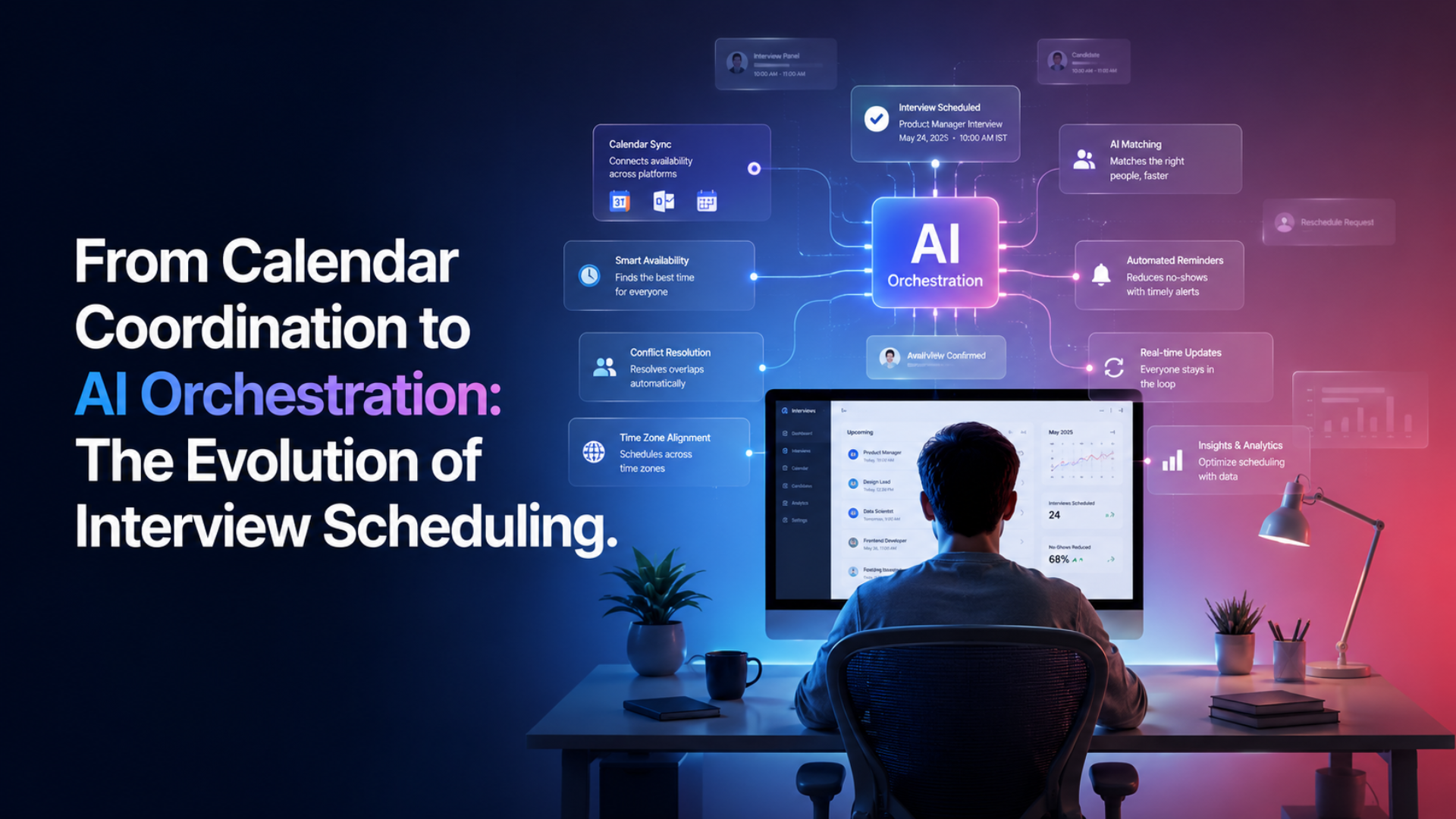
The current generation of scheduling technology represents a qualitative leap from automation to orchestration. AI-orchestrated scheduling systems do not simply match calendars. They manage the entire scheduling workflow as an intelligent, adaptive process that responds to changing conditions, resolves conflicts autonomously, enforces organizational policies, and optimizes outcomes across the full hiring journey. The technical foundation is real-time data integration with every connected system: calendars, applicant tracking systems, human resource information systems, and communication platforms. The AI maintains a continuously updated model of the entire hiring operation, enabling it to make scheduling decisions based on current, complete information rather than the stale, partial data that second-wave systems relied on. According to Gartner research on the evolution of HR AI, the shift from automated task execution to intelligent workflow orchestration is the defining characteristic of third-wave recruiting technology, and it is producing step-function improvements in scheduling performance that far exceed the incremental gains of earlier generations.
The practical capabilities of AI-orchestrated scheduling go well beyond what second-wave systems could achieve. The system handles multi-constraint optimization, evaluating thousands of potential time slots against dozens of constraints including time zones, working hour norms, organizational policies, candidate preferences, panelist expertise requirements, and room or resource availability. It resolves conflicts autonomously by evaluating alternative panel compositions, format adjustments, or rescheduling options and presenting ranked recommendations to the recruiter or hiring manager. It enforces governance requirements such as panel approval workflows, compliance checks, and audit trail generation without manual intervention. It manages communication sequences, sending contextual reminders, preparation guides, and logistical information at optimized times for each participant. It learns from patterns in scheduling data, identifying bottlenecks, predicting conflicts, and recommending process improvements. When organizations evaluate these systems, guidance on how to evaluate an AI sourcing tool before buying emphasizes the importance of assessing orchestration depth, the extent to which the system manages the full scheduling workflow autonomously versus requiring human intervention at decision points. The systems that deliver the highest ROI are those that handle the widest range of scheduling scenarios without recruiter involvement, freeing recruiting teams to focus on candidate engagement and strategic advisory work.
A critical capability that distinguishes AI-orchestrated scheduling from earlier generations is its ability to operate with real-time, accurate data rather than relying on periodic synchronization. When scheduling systems depend on outdated candidate or interviewer data to make decisions, every proposed time slot carries the risk of being invalid by the time it reaches the
participants. This data staleness problem was a major limitation of second-wave systems that connected to calendars through batch synchronization rather than real-time APIs. AI-orchestrated systems maintain continuous, bi-directional synchronization with every connected calendar and data source, ensuring that every scheduling decision reflects the current state of every participant schedule. This real-time capability is what enables the autonomous conflict resolution, instant rescheduling, and dynamic optimization that define the third wave. Without it, the system is making decisions based on a snapshot of reality that may no longer be accurate, and the intelligence of the optimization algorithm is undermined by the quality of the data it operates on.
What AI Orchestration Means for the Future of Hiring
The evolution from calendar coordination to AI orchestration is not merely a technology upgrade. It is a fundamental shift in how organizations think about the scheduling function in recruiting. In the coordination era, scheduling was an administrative burden that consumed recruiter time without generating strategic value. In the automation era, scheduling became more efficient but remained a tactical function that required significant human oversight. In the orchestration era, scheduling is becoming a strategic capability that directly influences hiring outcomes: candidate experience, time-to-hire, offer acceptance rates, and employer brand perception. Organizations that have made this transition report that scheduling is no longer a topic of complaint in candidate satisfaction surveys or hiring manager feedback. It has become an invisible enabler of a fast, professional hiring process that reflects well on the organization and allows every participant to focus on the decisions that matter. Deloitte analysis of recruiting process maturity has found that organizations with AI-orchestrated scheduling consistently rank in the top quartile of hiring process efficiency and candidate satisfaction, because orchestration eliminates the scheduling friction that creates negative experiences in less mature organizations.
For recruiting leaders evaluating the transition to AI-orchestrated scheduling, the practical implications are significant. Recruiter roles change: instead of spending sixty to seventy percent of their time on scheduling logistics, recruiters can dedicate the majority of their time to candidate engagement, hiring manager advisory, and strategic workforce planning. Hiring manager experience improves: instead of receiving scheduling emails that require action, managers receive confirmed interview details with one-click confirmation options. Candidate experience transforms: instead of waiting days for a confirmed time, candidates receive interview options within hours and can reschedule effortlessly if conflicts arise. These improvements compound over time as the organization develops a reputation for efficient, respectful hiring that attracts higher-quality applicants. EY research on the future of recruiting operations predicts that AI-orchestrated scheduling will become a baseline expectation within three to five years, and that organizations still relying on manual or semi-automated scheduling will face increasing difficulty attracting top talent in competitive markets. The question is not whether to make the transition, but how quickly it can be accomplished.
For Elena, the recruiting coordinator who started her Mondays with a scheduling spreadsheet
and spent seventy percent of her week on calendar coordination, the evolution from coordination to orchestration represents a fundamental change in her professional role. With AI-orchestrated scheduling handling the logistics that consumed her days, Elena has been able to transition into a recruiting operations analyst role, using the scheduling data and analytics generated by the AI system to identify process improvements, optimize hiring workflows, and advise recruiting leaders on strategy. Her experience illustrates a truth that is consistent across the research on recruiting automation: the technology does not eliminate the need for skilled recruiting professionals. It elevates them. A common concern among recruiters observing this evolution is whether AI orchestration will eventually make their roles redundant. Analysis of whether recruiters should worry about AI replacing their jobs consistently demonstrates that the opposite is true: the recruiters who thrive in the orchestration era are those who leverage AI to handle operational complexity and focus their own time on the relationship-building, strategic thinking, and human judgment that AI cannot replicate. The evolution from calendar coordination to AI orchestration is not a story about technology replacing people. It is a story about technology enabling people to do the work that only people can do, by eliminating the scheduling logistics that have consumed recruiting capacity for decades.