A recruiter creates a candidate outreach sequence.
The first email goes out on Monday.
If the candidate does not reply, the second message goes out three days later.
If there is still no response, a final follow-up is sent.
The recruiter does not need to remember each message.
The software handles the sequence.
This is automation.
Now imagine a different system.
The recruiter gives the platform a hiring objective.
Find experienced backend engineers with specific technical experience, engage the strongest candidates, determine whether they are open to the role, collect several qualification details, and move suitable candidates toward an interview.
The system interprets the requirement.
It searches for candidates.
It evaluates evidence.
It decides which people are worth contacting.
It chooses relevant context for outreach.
It sends a message.
One candidate does not respond, so the system follows up.
Another asks about remote work, so the system uses approved information to respond.
A third says the timing is bad but may be interested later, so the workflow changes.
A fourth expresses interest, so the system collects missing qualification information.
A fifth gives an ambiguous answer, so the case is escalated to a recruiter.
The system is no longer simply executing the same predefined sequence for everyone.
It is working toward an objective.
That is the basic idea behind agentic recruiting.
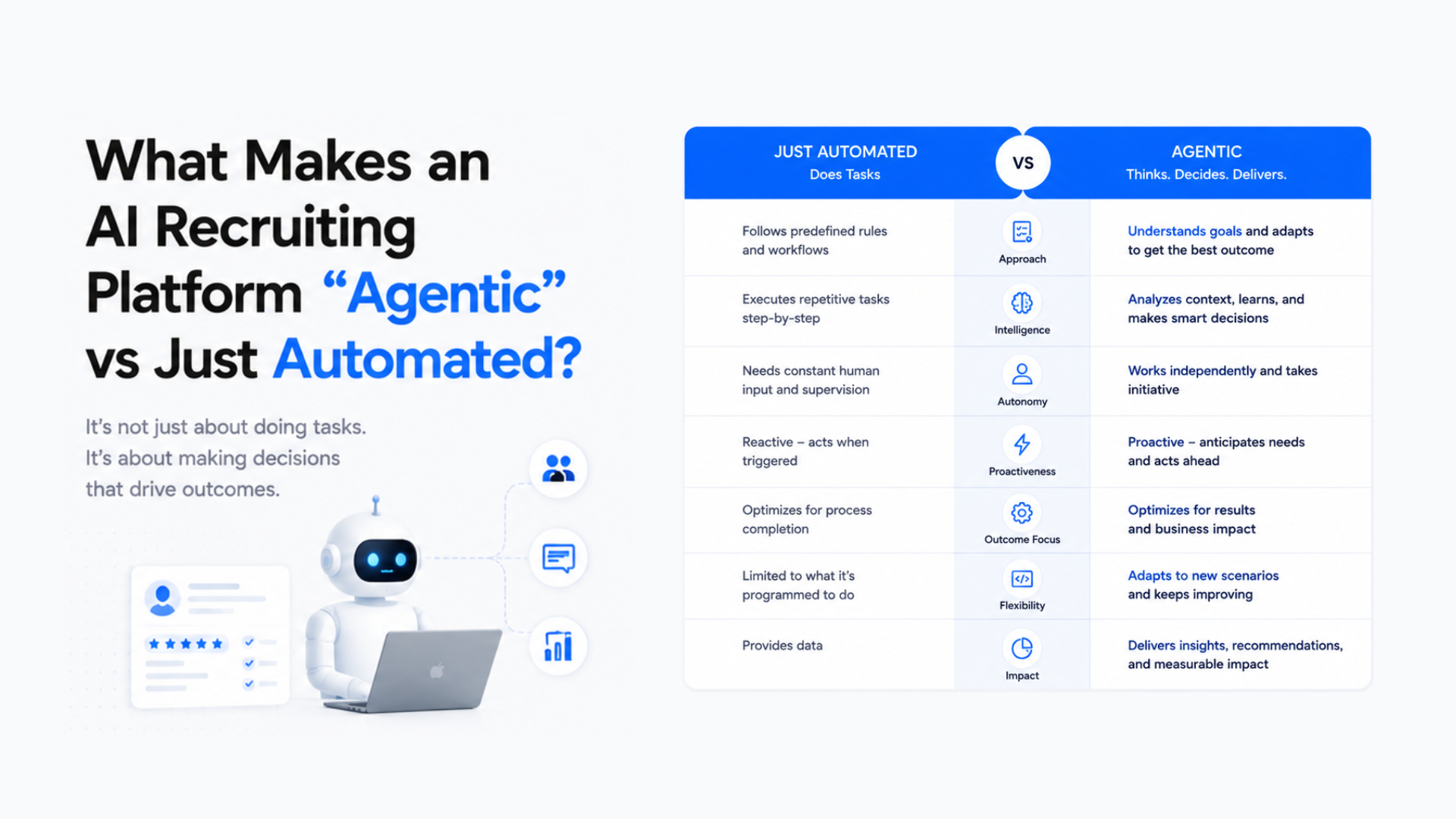
An AI recruiting platform becomes agentic when it can pursue a recruiting goal across multiple steps, reason about what should happen next, use tools to take action, observe the result, and adapt the workflow within defined boundaries. Traditional automation executes predefined instructions. Agentic AI has more responsibility for deciding how the objective should be achieved.
This does not mean every platform using the word agentic is truly autonomous.
It does not mean agents operate without rules.
It does not mean recruiters should surrender every hiring decision.
The term is increasingly used loosely.
A chatbot may be described as an agent.
A workflow with AI-generated text may be described as agentic.
A sourcing tool that runs one search may be described as autonomous.
The useful question is not what the vendor calls the software.
It is how the system behaves.
Does it only perform the action a human explicitly configured?
Or can it determine the next action based on the goal and what has happened so far?
That is where the real difference begins.
Traditional Recruiting Automation Follows a Predefined Path
Recruiting automation is not new.
Applicant tracking systems have used automated rules for years.
When a candidate applies, send a confirmation email.
When an interview is scheduled, send a reminder.
When a recruiter changes the candidate stage, trigger a notification.
When three days pass without a reply, send a follow-up.
These workflows can be extremely useful.
They remove repetitive work.
They create consistency.
They reduce the need for recruiters to remember routine actions.
The logic is usually designed in advance.
If this happens, do that.
The system does not need to understand the larger recruiting objective.
It only needs to recognize the trigger and execute the configured action.
Consider a basic outreach sequence.
Day one: send message A.
Day four: if there is no reply, send message B.
Day eight: if there is no reply, send message C.
The workflow may use AI to write each message.
That still does not automatically make it agentic.
The AI generates content.
The automation determines the sequence.
The candidate follows the path the recruiter designed in advance.
This is useful automation.
It should not be confused with autonomy.
Agentic Recruiting Starts With a Goal
An agent works differently.
Instead of receiving only a specific action, it receives an objective.
A recruiter might say:
Build a qualified pipeline for this role.
Find twenty relevant passive candidates.
Engage suitable people and identify who is genuinely interested.
Re-engage previous candidates who may now fit the requirement.
Move qualified candidates toward interviews.
The system then needs to determine how to make progress.
What information is required?
Which candidates should be considered?
Which tools should be used?
What should happen first?
What should happen after a candidate responds?
When should the system continue?
When should it stop?
When should a recruiter become involved?
This shift from action-based instructions to goal-based execution is one of the clearest signs of agentic behavior.
A traditional workflow is told what to do.
An agentic workflow is told what outcome to pursue.
This broader distinction is consistent with current enterprise definitions of agentic AI. EY describes agentic systems as moving beyond analysis toward autonomous action around specific goals, with agents capable of completing tasks and adapting based on outcomes without step-by-step human direction.
The same principle applies to recruiting.
The more responsibility the system has for determining the path between the objective and the outcome, the more agentic the workflow becomes.
Automation Executes Steps; Agents Decide Between Steps
Imagine a candidate replies to an outreach message.
“I might be interested, but I would only consider the role if it is remote and the compensation is above my current package.”
A traditional automation may recognize that a reply occurred.
It stops the follow-up sequence.
It alerts the recruiter.
Its work is complete.
An agentic system may have more options.
It identifies that the candidate has asked two questions.
It checks whether approved remote-work information is available.
It checks whether compensation guidance can be shared.
It determines whether the candidate still appears viable.
It responds where permitted.
It asks a relevant follow-up question.
It updates candidate status.
It continues the conversation.
Or it decides the situation requires human judgment and escalates it.
The important difference is not that the system generated better text.
The difference is that it selected the next action.
This decision layer is central to agentic AI.
Agentic Systems Need to Observe What Happened
Automation can often work without deeply interpreting the result.
The message was sent.
The task is complete.
An agent needs feedback.
What happened after the action?
Did the candidate reply?
Was the email delivered?
Did the contact detail fail?
Did the candidate answer the question?
Did the candidate express interest?
Did they ask for information?
Did they decline?
Did they provide a referral?
Did the screening conversation reveal a missing requirement?
The agent observes the result.
Then it decides what should happen next.
This creates a loop.
Understand the current state.
Choose an action.
Use a tool.
Observe the result.
Update the state.
Choose the next action.
The loop continues until the objective is achieved, the system reaches a stopping condition, or human intervention becomes necessary.
A 2026 academic overview of agentic AI describes this broader architecture through capabilities such as perception, reasoning, planning, action, tool use, and collaboration, while also highlighting risks including hallucinated actions and uncontrolled loops.
Recruiting agents need the same basic structure.
They need to know what is happening.
Not simply what was originally configured.
Agentic Recruiting Is Usually Multi-Step
A single AI action is not enough.
The recruiter asks the system to write an email.
The AI writes it.
This is generative AI assistance.
The recruiter asks the system to summarize a resume.
The AI summarizes it.
This is AI assistance.
The recruiter asks the system to rank candidates.
The AI produces a list.
This may be AI-powered matching.
Agentic behavior becomes more visible when the system owns a sequence of connected work.
Interpret the hiring requirement.
Search.
Evaluate.
Enrich.
Engage.
Observe.
Follow up.
Qualify.
Screen.
Schedule.
Escalate.
The system does not need to perform every stage to qualify as agentic.
The key is whether it can manage a multi-step objective rather than waiting for a human prompt before every action.
Huntlo’s guide to The Next Generation of AI Recruiting: What's Coming After Sourcing Automation explores this shift from isolated AI features toward autonomous recruiting workflows that continue working after the first candidate search is complete.
The candidate search is no longer the final output.
It is one action inside a larger objective.
A Chatbot Is Not Automatically an Agent
This is one of the most common sources of confusion.
A recruiter opens a chat interface.
They type:
Find candidates for this role.
The AI returns candidates.
The vendor calls the experience agentic.
Maybe it is.
Maybe it is not.
A chat interface does not prove agency.
The system may simply translate natural language into a traditional search.
The recruiter still needs to decide what happens next.
Select candidates.
Find contact information.
Start outreach.
Review replies.
Trigger screening.
Schedule interviews.
The chatbot made one task easier.
It did not own the workflow.
A true agent needs some ability to continue beyond the first response.
It should be able to act.
Observe.
Decide.
Continue.
The difference is important because conversational interfaces can make ordinary software feel more intelligent than it actually is.
Natural-language control is useful.
Agency is about what happens after the conversation.
AI-Generated Content Does Not Make a Workflow Agentic
Suppose a recruiting platform uses AI to generate personalized outreach.
The workflow is:
Recruiter selects candidates.
Recruiter starts campaign.
AI writes message.
System sends message.
Three days later, system sends follow-up.
This is AI-powered automation.
It may be excellent.
It is not necessarily agentic.
Now consider a different workflow.
The system evaluates the candidate.
Chooses which evidence is relevant.
Selects an approved engagement approach.
Sends the message.
Interprets the reply.
Changes the next action based on candidate intent.
Collects missing information.
Escalates negotiation questions.
Stops when the candidate declines.
This is much closer to agentic execution.
The presence of AI-generated text is not the distinction.
The amount of decision responsibility is.
Agents Need Tools, Not Just Intelligence
An AI model can reason about recruiting.
It cannot create a recruiting outcome unless it can do something.
This is why tool use matters.
A recruiting agent may need access to:
Candidate search.
Profile data.
Contact enrichment.
Email.
WhatsApp.
Voice.
Calendar systems.
ATS records.
Recruiting CRM history.
Job requirements.
Approved company information.
Interview availability.
The AI uses these tools to act.
Without tool access, the system may provide advice.
It can say:
“You should follow up with this candidate.”
The recruiter still performs the action.
An agent can follow up.
The difference between recommendation and execution is significant.
Agentic systems are action systems.
The AI is connected to an environment where its decisions can create changes.
That is also why governance becomes more important.
A system that can only suggest has limited operational risk.
A system that can send messages, update records, and move candidates needs stronger controls.
Memory Is Important for Agentic Recruiting
A recruiting workflow unfolds over time.
The candidate was contacted two weeks ago.
They said the timing was poor.
They asked to reconnect in July.
The recruiter previously discussed compensation.
The candidate prefers WhatsApp.
They were already considered for another role.
An agent needs context.
Without memory, every interaction begins from zero.
The system may repeat questions.
Send irrelevant outreach.
Contact the same candidate twice.
Ignore previous objections.
Agentic recruiting therefore requires more than an AI model.
It requires a persistent understanding of the candidate and workflow state.
What has happened?
What information has already been collected?
What promises were made?
What should happen next?
This does not mean the AI should remember everything without limits.
Recruiting data can be sensitive.
Organizations need clear retention, access, privacy, and governance rules.
The point is operational.
An agent cannot manage a long-running recruiting process if it has no reliable memory of the process.
An Agent Should Adapt When Reality Changes
Traditional automation works best when the world follows the expected path.
Candidate does not reply.
Send follow-up.
Candidate replies.
Stop sequence.
Agentic workflows are designed for more variation.
The candidate asks an unexpected question.
The contact information fails.
The candidate refers someone else.
The role requirements change.
The hiring manager pauses the search.
The candidate passes the first screen but needs a different interview path.
The agent should be able to adapt within its allowed boundaries.
This is not unlimited improvisation.
The system should not invent company policies.
It should not negotiate compensation without authorization.
It should not change hiring criteria secretly.
Adaptation should happen inside controlled rules.
This balance is essential.
An agent needs enough freedom to handle variation.
The organization needs enough control to prevent unacceptable actions.
The Difference Is a Spectrum, Not a Binary Label
Recruiting software is not divided neatly into automated and agentic.
There are levels.
At one end is manual software.
The recruiter performs every action.
Next is rule-based automation.
The system executes predefined steps.
Next is AI-assisted automation.
AI generates or ranks information inside the workflow.
Next is adaptive automation.
The workflow changes based on interpreted events.
Further along is agentic execution.
The system pursues a broader objective across multiple steps.
At the far end is high autonomy.
The system has substantial responsibility for planning and execution with limited human intervention.
Most practical recruiting platforms sit somewhere in the middle.
That is reasonable.
Complete autonomy is not automatically better.
A platform should have the level of agency appropriate for the task.
Sending a routine interview reminder may need no AI reasoning.
Handling a complex candidate negotiation should not be delegated entirely to an autonomous agent.
The goal is not maximum autonomy.
It is useful autonomy.
A Predefined Workflow Can Still Contain Agentic Components
Consider an outbound recruiting process.
The overall workflow may be defined.
Source candidates.
Engage them.
Qualify interest.
Screen suitable people.
Schedule interviews.
Inside that structure, agents may make local decisions.
The sourcing agent decides which search strategy to use.
The outreach agent decides which candidate context is relevant.
The engagement agent interprets replies.
The screening agent decides which approved follow-up question is needed.
The scheduling agent coordinates available times.
The workflow has boundaries.
The execution inside those boundaries is adaptive.
This hybrid model is likely to be more practical than giving one AI system unlimited control over the entire hiring process.
Agentic does not mean unstructured.
Some of the strongest systems may combine deterministic workflow logic with AI reasoning.
The rules provide reliability.
The agent provides flexibility.
Agentic Sourcing Goes Beyond Running a Search
Traditional sourcing software waits for a recruiter.
The recruiter enters keywords.
Adjusts filters.
Reviews results.
Runs another search.
An AI sourcing assistant may allow natural language.
“Find senior machine-learning engineers in Bengaluru with experience building recommendation systems.”
The system interprets the request.
That is useful.
An agentic sourcing system goes further.
It may inspect the role.
Identify ambiguous requirements.
Develop several search strategies.
Look for direct and adjacent experience.
Evaluate the results.
Refine the search.
Identify gaps in the candidate pool.
Continue until the objective is reached or the market appears exhausted.
The recruiter does not manually construct every query.
The system is responsible for progressing toward the sourcing objective.
Huntlo’s guide to What Is Candidate Sourcing Automation? explains how software can already reduce manual candidate discovery, while the agentic layer adds more responsibility for deciding how the search should evolve.
The distinction is subtle but important.
Automation runs the search.
An agent manages the search problem.
Agentic Outreach Goes Beyond Scheduled Sequences
Traditional outreach automation is powerful.
Recruiters create a sequence.
Candidates enter.
Messages are sent.
Follow-ups happen.
The sequence stops when the candidate replies.
Agentic outreach adds interpretation.
The system may determine that one candidate should receive a different message from another.
It may change the follow-up based on the candidate’s context.
It may interpret a response.
It may answer an approved question.
It may ask for missing information.
It may recognize that the candidate is not interested in this role but could fit another.
It may escalate a sensitive situation.
The objective is not simply to send the sequence.
The objective is to create a relevant recruiting conversation.
This is also where agentic systems can create risk.
If the system has poor candidate data, it can personalize incorrectly.
If it misinterprets a reply, it can continue when it should stop.
If it optimizes too aggressively for response, it can become intrusive.
Huntlo’s article on Over-Automating Outreach: When AI Sourcing Hurts Your Brand explains why more automation does not automatically create better candidate engagement.
An agent needs boundaries.
Not only intelligence.
Agentic Screening Goes Beyond Asking the Same Questions
A basic screening bot asks every candidate the same questions.
The workflow is predefined.
Question one.
Question two.
Question three.
The answers are recorded.
An agentic screening system can be more adaptive.
It understands which information is already available.
It asks only for missing evidence.
A candidate gives an incomplete answer.
The system asks a relevant follow-up.
Another candidate has already demonstrated the requirement.
The system does not repeat the question unnecessarily.
The system identifies uncertainty.
It requests clarification.
It summarizes the evidence.
It escalates situations requiring recruiter judgment.
This is closer to how a human interviewer manages a conversation.
The risk also increases.
An adaptive system can ask a better question.
It can also ask an inappropriate one.
The organization therefore needs controls over what the agent is allowed to ask and how screening outputs are used.
Huntlo’s guide to What Is AI Candidate Screening and How Accurate Is It? explains why screening quality depends on job criteria, candidate evidence, system design, and human oversight rather than AI capability alone.
Agency increases the need for governance.
Agentic Systems Should Know When to Stop
A system that continues acting forever is not useful.
Recruiting agents need stopping conditions.
The candidate declines.
Stop outreach.
The contact detail repeatedly fails.
Stop and request another route.
The candidate asks for a human.
Escalate.
The role closes.
Stop sourcing.
The hiring criteria change materially.
Pause and request confirmation.
The agent reaches an uncertain situation.
Do not guess.
The objective is complete.
End the workflow.
Knowing when not to act is one of the most important agent capabilities.
A system that sends more messages is not more agentic.
A system that understands when further action is inappropriate may be more intelligent.
This matters because agentic systems can create errors at scale.
A badly designed automation repeats the configured mistake.
A badly designed agent may create new mistakes while attempting to solve the problem.
Human Oversight Does Not Make a System Less Agentic
Some people assume that a truly agentic platform must operate without humans.
That is not necessary.
A recruiter can remain in the loop.
The agent may source candidates autonomously.
The recruiter approves the shortlist.
The agent may draft and execute routine outreach.
The recruiter handles complex replies.
The agent may conduct structured screening.
The recruiter reviews uncertain cases.
The agent may coordinate interviews.
The hiring team makes the hiring decision.
This can still be agentic.
The system has autonomy within a defined scope.
Human oversight is part of the operating model.
A 2026 practical framework for organizational adoption of agentic AI emphasizes human-in-the-loop models where people orchestrate multiple agents while maintaining oversight, adaptability, and control.
This model is especially relevant to recruiting because hiring decisions affect people directly.
The useful question is not whether humans exist in the process.
It is where human judgment is required.
Agentic Does Not Mean the AI Makes the Hiring Decision
This distinction should be explicit.
A recruiting agent can perform work.
It can source.
Engage.
Collect information.
Summarize.
Prioritize.
Schedule.
It should not automatically become the final authority over who deserves employment.
Hiring decisions involve incomplete information.
Legal requirements.
Ethical considerations.
Organizational context.
Human accountability.
An agent may support the decision.
The organization should define who owns it.
This is particularly important because vendors sometimes use autonomy as a sign of product sophistication.
More decision power is not always a better product.
The correct level of autonomy depends on the consequence of the action.
Sending a reminder is low risk.
Rejecting a candidate is higher risk.
The governance should reflect the difference.
Agentic Recruiting Requires Permissions
An agent needs authority to act.
That authority should be limited.
Can the system search candidates?
Yes.
Can it access all company data?
Probably not.
Can it send messages?
Under which identity?
Can it use email?
WhatsApp?
Voice?
Can it answer compensation questions?
Can it schedule interviews?
Can it move candidates between stages?
Can it reject candidates?
Can it share candidate information externally?
Each capability needs permission boundaries.
This is one reason agentic software is more than an AI model.
The surrounding infrastructure matters.
Identity.
Access control.
Audit logs.
Approvals.
Escalation.
Data governance.
The agent should know what it can do.
The organization should know what it did.
Auditability Becomes More Important as Autonomy Increases
With traditional automation, the workflow is usually predictable.
The team configured the rule.
The system executed it.
With an agent, the path may vary.
Why was this candidate contacted?
Why did the agent send this message?
Why did it ask that question?
Why did it stop following up?
Why was the recruiter alerted?
Why did the candidate move to the next stage?
The system should preserve enough information to answer these questions.
This does not mean every internal reasoning process needs to be exposed.
The operational evidence should be understandable.
Action taken.
Information used.
Rule or objective involved.
Outcome.
Human intervention.
Auditability supports trust.
It also helps teams improve the workflow.
If the agent repeatedly makes the same poor decision, the organization needs to see the pattern.
Agentic Recruiting Can Fail Differently From Automation
Automation usually fails predictably.
The wrong rule is configured.
The same mistake repeats.
An agent can fail in more complex ways.
It may misunderstand the objective.
Choose the wrong tool.
Act on outdated data.
Interpret a candidate reply incorrectly.
Continue too long.
Stop too early.
Create an unexpected sequence of actions.
This does not mean agents are inherently unsafe.
It means the failure surface is larger.
As systems become more autonomous, enterprise discussions are increasingly focused on safeguards, permissions, recovery mechanisms, and ways to stop harmful behavior rather than relying on human observation alone.
Recruiting teams should apply the same principle.
A platform should not be called advanced merely because it can act independently.
It should be evaluated on whether its independence is controlled.
The Best Agentic Systems May Be Less Visible to Recruiters
Traditional recruiting software demands attention.
Open the platform.
Run the search.
Export the candidates.
Open another platform.
Start outreach.
Check replies.
Update the ATS.
The recruiter manages the tools.
An agentic platform should reduce the amount of tool management.
The recruiter defines the objective.
The system works.
The recruiter receives progress, decisions requiring approval, exceptions, and outcomes.
This is a major shift.
The interface may become less important than the workflow.
The recruiter does not need to watch the agent perform every step.
They need confidence that the system is working within the correct boundaries.
This is why agentic recruiting is closely connected with the idea of an AI Hiring OS.
The value comes from coordinating work across the hiring process rather than adding one more isolated AI feature.
An AI Hiring OS Can Be Agentic Without Being Fully Autonomous
A hiring operating system connects multiple stages.
Sourcing.
Candidate data.
Outreach.
Screening.
Scheduling.
Workflow state.
An agentic layer can coordinate these capabilities.
The sourcing agent finds candidates.
The engagement agent begins outreach.
The system interprets responses.
Interested candidates move toward screening.
Screening results are summarized.
Suitable candidates move toward interviews.
The recruiter supervises the workflow.
This is different from a stack of disconnected automation tools.
In a fragmented stack, the recruiter often becomes the integration layer.
They move information.
Trigger the next system.
Resolve context gaps.
In an agentic system, the software has more responsibility for maintaining continuity.
Huntlo’s guide to How Does an AI Hiring OS Connect Sourcing, Screening, and Interviews? explains why the value of a connected recruiting system comes from moving context and action across stages rather than automating each stage separately.
The agentic layer is what can turn connected tools into active workflow execution.
How to Tell Whether a Recruiting Platform Is Actually Agentic
Ignore the product label for a moment.
Give the vendor a realistic recruiting objective.
Then ask what happens.
Does the system only return a recommendation?
Does it wait for the recruiter to trigger every step?
Does it follow one predefined path?
Or can it choose among several actions based on what happens?
Ask whether the platform can:
Work from a goal rather than only a command.
Plan multiple steps.
Use different recruiting tools.
Maintain workflow state.
Observe outcomes.
Interpret candidate responses.
Adapt the next action.
Handle exceptions.
Escalate uncertainty.
Stop when conditions change.
Explain important actions.
Operate within permissions.
These are stronger signs of agentic behavior.
A platform does not need every capability.
The more of these responsibilities it owns, the more agentic it becomes.
Questions Buyers Should Ask Vendors
Recruiting teams evaluating agentic platforms should ask practical questions.
What objective can the agent own from beginning to end?
Which actions can it take without recruiter approval?
Which actions always require approval?
How does it decide what happens next?
What information does it remember?
Which tools can it use?
How does it handle candidate replies?
What happens when the data is uncertain?
What happens when the candidate asks something outside the approved information?
Can the agent stop itself?
Can a recruiter stop it?
Can actions be reviewed later?
How are mistakes corrected?
Does the system adapt from outcomes?
What happens when the role changes?
The answers matter more than the word agentic on the website.
A polished chat interface can hide a basic workflow.
A less dramatic interface may support genuinely autonomous execution.
Evaluate behavior.
Not branding.
Where Huntlo Fits Into Agentic Recruiting
Huntlo positions itself as agentic AI recruiting infrastructure because the objective extends beyond helping recruiters perform isolated tasks.
The workflow can begin with a hiring requirement.
AI-powered sourcing helps identify relevant passive candidates.
Candidate data and contact enrichment make those candidates actionable.
Outreach can run across email and WhatsApp.
Follow-ups can continue without relying entirely on recruiter memory.
AI voice screening can collect structured candidate information.
Suitable candidates can move toward interviews.
The important distinction is continuity.
The system is not useful only because each stage contains AI.
The value comes from reducing the number of times a recruiter needs to manually connect one stage with the next.
A sourcing tool that returns candidates can be AI-powered.
An outreach tool that sends scheduled sequences can be automated.
A screening tool that asks questions can be automated.
An agentic recruiting platform attempts to coordinate these actions around the broader objective of creating qualified hiring conversations.
That does not mean every action should be autonomous.
Recruiters should remain involved where judgment, trust, negotiation, uncertainty, and accountability matter.
The purpose of agentic infrastructure is not to remove humans from hiring.
It is to reduce the amount of repetitive orchestration humans need to perform personally.
What Agentic Recruiting Should Not Become
The industry should be careful about one possible future.
A company creates a hiring objective.
An AI agent finds candidates.
Another agent sends messages.
Another interviews them.
Another scores them.
Another rejects them.
No person understands the complete process.
The candidate cannot reach a human.
The hiring manager trusts the system because the output looks scientific.
This would be automation without accountability.
Agentic recruiting should not mean removing human responsibility.
It should mean delegating appropriate work while preserving control.
The best systems should make recruiters more capable of managing complex workflows.
Not less aware of what the workflow is doing.
The Real Value Is Workflow Ownership
The biggest difference between agentic and automated recruiting is not intelligence.
It is ownership.
Automation owns a step.
Send the email.
Update the record.
Schedule the reminder.
An agent owns progress toward an objective.
Build the pipeline.
Engage the candidate.
Collect the missing information.
Move the process forward.
This is why agentic AI has the potential to change recruiting software more significantly than another generation of AI features.
Recruiters currently spend large amounts of time managing transitions.
Search completed.
Now export.
Contact enriched.
Now upload.
Reply received.
Now update.
Screen completed.
Now schedule.
The recruiter becomes the person responsible for keeping the machine moving.
An agentic system can take on some of that responsibility.
The recruiter moves from operating every step toward supervising the outcome.
Conclusion: Agentic Recruiting Is About Controlled Autonomy
An automated recruiting platform follows instructions.
An agentic recruiting platform pursues objectives.
Automation knows the next step because a human defined it in advance.
An agent determines the next step from the goal, the current state, the available tools, and what happened previously.
That is the fundamental difference.
Agentic recruiting requires more than a chatbot.
More than AI-generated messages.
More than candidate ranking.
More than a workflow builder.
A genuinely agentic platform needs some combination of goal orientation, planning, reasoning, tool use, memory, action, observation, adaptation, stopping conditions, escalation, and governance.
The system should be able to continue working without a recruiter prompting every individual step.
It should also know where its authority ends.
This is why the best agentic recruiting platform is not the one with the most autonomy.
It is the one with the right autonomy.
Routine actions can happen automatically.
Complex situations can be escalated.
Important decisions can remain human.
Candidate context can move across stages.
The system can continue working toward the objective without forcing the recruiter to become the manual connection between every tool.
Recruiting automation has already removed many repetitive actions.
Agentic AI goes further.
It attempts to remove repetitive orchestration.
That is a much bigger change.
The recruiter no longer needs to tell the software every step.
The recruiter defines the goal, sets the boundaries, reviews important decisions, and intervenes when human judgment creates more value.
The system handles more of the work between those moments.
That is what makes an AI recruiting platform agentic rather than just automated.
Frequently Asked Questions
What is agentic AI recruiting?
Agentic AI recruiting uses AI systems that can pursue hiring objectives across multiple steps, choose actions, use recruiting tools, observe outcomes, and adapt the workflow within defined boundaries.
What is the difference between agentic AI and recruiting automation?
Recruiting automation follows predefined rules and sequences. Agentic AI has more responsibility for deciding which action should happen next based on the goal and current situation.
Is an AI chatbot an agent?
Not automatically. A chatbot may only answer questions or trigger individual tasks. An agent should be able to take actions, observe results, and continue working toward an objective.
Does AI-generated outreach make a platform agentic?
No. AI-generated text can exist inside a traditional automated workflow. Outreach becomes more agentic when the system can interpret responses, choose next actions, adapt the workflow, and escalate exceptions.
Can agentic AI source candidates autonomously?
Yes, within defined limits. An agent may interpret requirements, create search strategies, evaluate results, refine searches, and continue until a sourcing objective is reached.
Does agentic recruiting remove recruiters?
Not necessarily. The strongest model is usually controlled autonomy, where agents handle repetitive execution while recruiters own judgment, candidate trust, stakeholder management, negotiation, and important decisions.
Should an AI agent reject candidates automatically?
High-impact hiring decisions require careful governance and human accountability. The appropriate level of autonomy depends on the action, legal context, evidence quality, and organizational policy.
What capabilities make recruiting software agentic?
Important capabilities include goal orientation, multi-step planning, tool use, memory, action, observation, adaptation, exception handling, stopping conditions, escalation, and permissions.
Is agentic AI always better than traditional automation?
No. Simple predictable tasks may be better handled by deterministic automation. Agentic AI is most useful when the workflow contains variation and requires decisions between multiple possible actions.
How can buyers tell whether a platform is truly agentic?
Ask what complete objective the system can own, which decisions it makes independently, how it reacts when conditions change, what tools it can use, how it handles uncertainty, and where human approval is required.
Related Topics
Explore where recruiting software is moving after isolated candidate-search automation in The Next Generation of AI Recruiting: What's Coming After Sourcing Automation.
Understand the foundation that agentic sourcing builds upon in What Is Candidate Sourcing Automation?.
See how connected recruiting infrastructure moves candidate context across multiple hiring stages in How Does an AI Hiring OS