Recruiting teams rarely struggle because they have no technology. Most already use several systems across the hiring process. Candidate discovery happens in a sourcing platform. Outreach happens through email or another engagement tool. Screening takes place through recruiter calls, forms, assessments, or AI interview software. Interviews are scheduled through calendars, and candidate records eventually need to be updated inside an applicant tracking system.
Each stage may work reasonably well on its own.
The problem appears between the stages.
A sourcing tool finds a strong candidate, but the recruiter needs to move the profile into an outreach system. The candidate responds, but the reply does not automatically update the rest of the workflow. A screening conversation happens somewhere else, and the recruiter needs to summarize the result. The candidate qualifies, but interview scheduling requires another set of manual actions.
The recruiter becomes responsible for maintaining continuity.
This is the problem an AI Hiring OS attempts to solve.
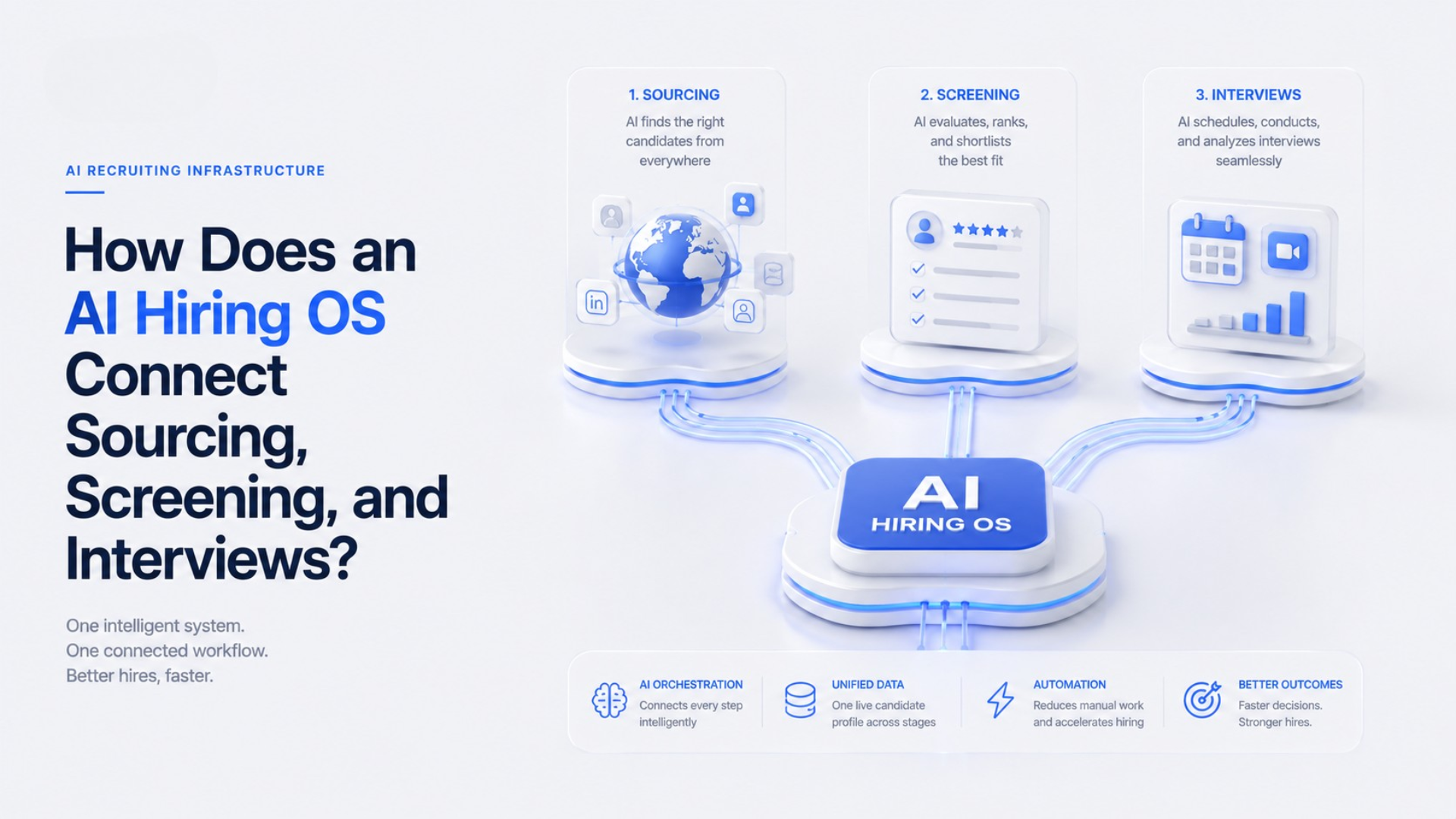
An AI Hiring OS connects sourcing, screening, and interviews by allowing candidate information and actions at one stage to influence what happens next. A candidate discovered through AI sourcing can move toward engagement. A positive response can trigger qualification. Screening evidence can determine whether human review is needed or whether the candidate should move toward an interview. Qualified candidates can enter scheduling without requiring the recruiter to manually restart the workflow at every stage.
The value is not simply that artificial intelligence appears in several parts of recruiting.
A company can use AI sourcing, AI outreach, AI screening, and AI scheduling tools while still operating a fragmented process.
The difference is connection.
An AI Hiring OS treats the hiring process as a continuous workflow rather than a collection of independent software features.
Understanding these connections is important because the recruiting technology market is rapidly filling with AI products. Many can generate impressive results inside one narrow task. The larger operational question is what happens after that task is complete.
A list of candidates is not a recruiting outcome.
A response is not a qualified candidate.
A screening score is not an interview.
The value of an AI Hiring OS appears in the movement between these stages.
Why Recruiting Workflows Become Fragmented
The modern recruiting stack developed one problem at a time.
Applicant tracking systems were created to manage applications and hiring stages. Sourcing platforms helped recruiters find people outside the applicant pool. Recruiting CRMs helped teams maintain candidate relationships. Outreach software made communication more scalable. Scheduling tools reduced calendar coordination. Interview platforms added structure to candidate evaluation.
Each category solved a real problem.
Over time, however, recruiting teams accumulated a large number of specialized systems.
The recruiter now moves between them.
A candidate may exist as a profile in a sourcing database, a contact in an outreach campaign, a record in a CRM, an applicant in the ATS, and an event on several calendars.
These systems do not always understand the same candidate in the same way.
One platform knows that the candidate received a message.
Another knows that the person replied.
Another contains screening notes.
Another knows the interview status.
The recruiter carries the complete context.
This creates manual work, but it also creates decision delays. The next stage cannot begin until someone notices that the previous stage has finished.
A candidate replies positively at 8 p.m.
The recruiting workflow may wait until the recruiter opens the inbox the following morning.
A candidate completes screening.
The result may wait until someone reviews the dashboard and manually begins scheduling.
The problem is not that the individual tools are slow.
The handoffs are slow.
An AI Hiring OS is designed around these handoffs.
What Makes an AI Hiring OS Different From a Collection of AI Tools?
A collection of AI recruiting tools can automate several tasks without creating one connected workflow.
An AI sourcing tool may generate candidates.
An AI writing tool may create outreach messages.
An AI screening tool may score interviews.
An AI scheduling assistant may coordinate calendars.
The recruiter still needs to decide when to open each tool and what information should move between them.
An AI Hiring OS attempts to create an operating layer across these activities.
The candidate has a state.
They may be newly discovered, approved for outreach, contacted, interested, screening, qualified, awaiting review, or ready for an interview.
Actions change that state.
If the candidate responds positively, the workflow should understand that something meaningful happened.
If the candidate declines, the system should not continue sending follow-ups.
If screening reveals that a mandatory requirement is missing, the next action should reflect that information.
If the candidate qualifies, interview coordination can begin.
This is the core idea behind Huntlo’s guide to what an AI Hiring OS is and how it works. The operating-system concept is less about having every possible recruiting feature and more about coordinating the workflow around candidate and recruiter actions.
The difference becomes visible when something changes.
Disconnected tools continue executing their own instructions.
A connected system adapts the next action.
The Workflow Begins With the Hiring Requirement
Before sourcing can begin, the system needs to understand what the company is hiring for.
This sounds simple because most companies already have a job description.
The problem is that job descriptions are not always useful sourcing instructions.
A description may contain mandatory requirements, preferences, generic responsibilities, employer-brand language, and outdated expectations. If the AI treats every sentence equally, the candidate search may become too narrow or focus on the wrong signals.
A connected hiring workflow therefore begins by translating the requirement into something operational.
What does the candidate genuinely need?
Which skills are essential?
Which experiences are transferable?
What seniority is appropriate?
Where can the person work?
Which requirements are flexible?
What evidence would make the recruiter believe the candidate deserves a conversation?
These decisions influence every later stage.
The sourcing system uses them to identify potential candidates.
The outreach process uses them to explain why a person is relevant.
The screening stage uses them to create qualification questions.
The interview process uses them to understand what still needs deeper evaluation.
This shared foundation is important.
In a fragmented workflow, every tool may interpret the role separately.
The sourcing platform searches around one set of criteria.
The screening form asks different questions.
The interview scorecard evaluates something else.
The hiring team believes it is running one process, but each stage has a different definition of a good candidate.
An AI Hiring OS can reduce this inconsistency by allowing the hiring requirement to inform the workflow from discovery onward.
How AI Sourcing Creates the First Candidate Pool
The first major stage is candidate discovery.
Traditional sourcing often requires recruiters to translate a hiring requirement into titles, keywords, companies, skills, locations, and Boolean logic.
The recruiter searches.
Profiles are reviewed.
The search is adjusted.
The process repeats.
AI sourcing can make this stage more flexible by interpreting meaning rather than depending entirely on exact keyword matches.
A candidate may have a different job title but perform relevant work.
Another may describe a skill using different language.
A professional from an adjacent industry may have experience that transfers to the new role.
AI can help surface these relationships.
The system may interpret the requirement, discover candidates, compare available evidence, and rank people according to estimated relevance.
Huntlo’s guide to how AI candidate matching actually works explains how candidate profiles can be compared with hiring criteria using signals such as skills, titles, experience, seniority, location, and professional context.
Inside an AI Hiring OS, however, matching is not the final output.
The candidate list is the beginning of the workflow.
The important question is what happens to the relevant candidates next.
Recruiter Review Remains an Important Decision Point
A connected workflow does not mean every candidate discovered by AI should immediately receive a message.
Recruiter review can remain an important control point.
The AI may surface candidates based on the available evidence, but profiles are incomplete. A recruiter may recognize that one person has relevant adjacent experience while another technically matches the keywords but is clearly wrong for the opportunity.
The recruiter can approve, reject, or refine.
This feedback may improve the active search.
More importantly, approval changes the candidate’s workflow state.
The candidate is no longer simply a search result.
They are someone the recruiting team has decided may deserve engagement.
This distinction matters because AI systems can generate large numbers of possible candidates. If every match automatically enters outreach, the company may create high-volume communication without sufficient relevance.
The best workflow preserves human judgment at the point where it adds value.
AI expands discovery.
The recruiter validates relevance.
The system then handles more of the repetitive execution that follows.
This is different from making the recruiter manually export every approved profile, upload it elsewhere, rebuild the campaign, and restart the process.
The decision remains human.
The administrative consequences of the decision can be automated.
How Sourced Candidates Move Into Outreach
Once candidates are approved, the next stage is engagement.
In a disconnected process, this handoff can involve several manual steps.
Candidate information is exported.
Contact details are found or verified.
A campaign is created.
Messages are written.
Candidates are added to a sequence.
The recruiter then monitors responses somewhere else.
A connected workflow can reduce these handoffs.
The candidate’s relevance to the role is already known.
That context can help inform outreach.
Instead of sending a generic message about an “exciting opportunity,” the system can help explain why the candidate was identified and which part of their experience appears connected with the role.
The objective is not to automate maximum message volume.
It is to turn candidate relevance into a relevant conversation.
This distinction is particularly important for passive candidates.
A person who did not apply has no existing reason to engage with the company. The outreach needs to create that reason.
Huntlo’s guide to sourcing passive candidates who are not job-searching explains why candidate discovery and candidate interest are separate problems.
An AI Hiring OS connects the two stages.
It does not assume they are the same stage.
Candidate Responses Become Workflow Signals
The response is one of the most important events in outbound recruiting.
A candidate may express interest.
They may ask a question.
They may decline.
They may request contact at a later date.
They may provide a response that requires recruiter attention.
In a disconnected stack, the message may simply arrive in an inbox.
The recruiter reads it and decides what to do.
The next stage begins manually.
A connected workflow treats the response as information that changes candidate state.
A positive response can stop the original outreach sequence.
A decline can prevent unnecessary follow-ups.
A request to reconnect later can become future relationship context.
A question may be surfaced to the recruiter.
Interest can move the candidate toward qualification.
This is where workflow continuity becomes more valuable than simple message automation.
An outreach tool that sends 1,000 messages may create more work if the recruiter needs to manually classify every response and update every other system.
The AI Hiring OS should understand enough about the candidate’s action to support the next appropriate step.
This principle is central to effective multi-channel recruiting outreach. Communication across email, WhatsApp, and other appropriate channels should operate as one candidate conversation rather than several independent sequences.
Why Outreach Must Stop When Screening Begins
One of the clearest signs of a disconnected recruiting workflow is inappropriate automation continuing after the candidate has moved forward.
A candidate replies positively.
They begin a screening conversation.
The original outreach system still sends another follow-up.
The candidate now receives a message asking whether they are interested in a role they are already discussing.
This creates a poor experience.
It also reveals that the company’s systems do not share candidate context.
An AI Hiring OS should understand stage transitions.
Once a candidate becomes engaged, cold outreach is no longer appropriate.
Once screening begins, the communication should reflect the new relationship.
The workflow needs to know what has already happened.
This may sound like a basic operational requirement, but it becomes increasingly important as companies add more automation.
Every automated system can create activity.
Without shared state, the systems can create contradictory activity.
The more recruiting automation a company uses, the more important coordination becomes.
How Interested Candidates Move Into Screening
Candidate interest does not automatically mean candidate qualification.
A person may be curious about the opportunity but lack an essential requirement.
Another may appear highly relevant based on a profile but reveal different experience during conversation.
Screening exists to collect additional evidence.
In a connected workflow, the transition from interest to screening can happen without forcing the recruiter to rebuild candidate context.
The system already knows the role.
It knows why the candidate was sourced.
It knows the available profile information.
It knows that the candidate expressed interest.
The screening stage can build on this information.
This is more efficient than beginning again with a completely generic questionnaire.
The AI may support an initial screening conversation through text or voice.
The candidate can answer questions connected with the hiring requirement.
Mandatory qualifications can be checked.
Relevant experience can be explored.
Availability, expectations, and other appropriate information can be collected.
The result becomes structured evidence inside the same candidate workflow.
The candidate is not transferred into another disconnected process.
Their context moves with them.
How AI Screening Creates New Candidate Evidence
Candidate sourcing works primarily with existing information.
A profile may show job titles, employers, skills, education, and career history.
Screening creates new information.
The candidate can explain what they actually did.
They can clarify the scale of their work.
They can describe their personal contribution.
They can answer questions that the profile could not answer.
This means screening should update the system’s understanding of the candidate.
A person who appeared highly relevant during sourcing may become less relevant after qualification.
Another candidate may become more interesting because the screening reveals experience that was missing from the profile.
The workflow should reflect this new evidence.
Huntlo’s guide to how AI interview screening scores candidates explains how structured questions, candidate responses, evidence extraction, role criteria, and weighting can contribute to an AI-supported screening recommendation.
Inside an AI Hiring OS, the screening result should not become an isolated score.
It should influence what happens next.
Screening Scores Should Guide the Next Action
A screening system may produce a score, recommendation, summary, or set of structured criteria.
The value depends on how the result is used.
A strong candidate may be ready to move toward an interview.
A candidate with unclear evidence may need recruiter review.
Someone may meet most requirements but have one issue that requires a human decision.
Another person may not meet a genuine mandatory criterion.
The workflow should distinguish between these situations.
A simplistic system may use one score threshold.
Above 80, move forward.
Below 80, reject.
This can create problems because hiring decisions are more contextual.
A candidate may receive a lower overall score because of a flexible preference while demonstrating exceptional strength in the most important part of the role.
Another may score highly across several minor criteria but lack one essential requirement.
The AI Hiring OS should help structure the evidence.
Recruiter judgment should remain available where the decision is uncertain or important.
The goal is not to remove people from the process.
It is to ensure that human attention is used where it is needed.
How Qualified Candidates Move Toward Interviews
Once a candidate qualifies, another handoff begins.
Traditional recruiting workflows often slow down here.
The recruiter needs to notify the candidate.
Availability is requested.
Interviewer calendars are checked.
Several messages are exchanged.
An invitation is created.
The ATS is updated.
The hiring manager is informed.
A connected workflow can reduce this coordination.
The candidate’s qualification state can trigger the appropriate interview process.
Depending on the company’s rules, the candidate may receive scheduling options, the recruiting team may be asked to approve the next stage, or the hiring manager may receive structured candidate information before the interview is confirmed.
The important point is that screening completion creates a next action.
The result does not wait in a separate dashboard until someone remembers to check it.
This can reduce one of the most common causes of hiring delay.
Strong candidates frequently wait not because the company needs more time to make a difficult decision, but because the workflow is waiting for manual coordination.
An AI Hiring OS can reduce these operational gaps.
The Interviewer Should Receive the Right Context
Connecting screening with interviews is not only about scheduling.
It is also about information.
The interviewer should understand why the candidate is in the process.
What experience made the person relevant?
What did the initial screening confirm?
Which questions remain unanswered?
Where should deeper evaluation happen?
In a fragmented workflow, interviewers may receive only a resume and job description.
The candidate then repeats information already provided during sourcing and screening.
The company wastes interview time.
A connected system can make earlier evidence available to the appropriate people.
The interview can focus on what still needs to be learned.
This creates a more intelligent progression.
Sourcing asks whether the person may be relevant.
Screening asks whether the available evidence supports basic qualification.
The interview explores the areas that require deeper human evaluation.
Each stage should add information.
The candidate should not restart from zero every time they meet someone new.
Interview Outcomes Should Return to the Workflow
The connection does not end when the interview is scheduled.
An interview creates another decision.
The candidate may move forward.
Another interview may be required.
Additional information may be needed.
The candidate may leave the process.
The company may want to maintain the relationship for a future role.
These outcomes should update candidate state.
In a disconnected system, the recruiter again becomes responsible for translating the outcome into several actions.
Feedback is collected.
The candidate is updated.
Another interview is arranged.
The ATS stage changes.
Follow-up communication begins.
A connected workflow can reduce more of this repetitive execution.
The interviewer or hiring team still makes the decision.
The workflow handles more of what happens after the decision.
This principle appears throughout an AI Hiring OS.
Human judgment determines direction.
Automation reduces the manual coordination required to move in that direction.
Candidate Context Should Survive Every Handoff
The most important connection across sourcing, screening, and interviews is context.
A candidate is one person.
Recruiting technology often treats them as several records.
The sourcing tool knows one version.
The outreach system knows another.
The screening platform creates another.
The ATS stores another.
An AI Hiring OS should help preserve the relationship between these events.
The system should know how the candidate entered the process.
It should know why they were considered relevant.
It should understand whether they responded.
It should preserve screening evidence.
It should show the current stage.
This reduces repetitive work for recruiters.
It can also improve the candidate experience.
Candidates should not need to answer the same basic questions repeatedly because the company failed to preserve information from earlier conversations.
The workflow should become more informed as the candidate moves forward.
How an AI Hiring OS Reduces Recruiter Work
The largest operational benefit comes from reducing manual orchestration.
Recruiters currently perform many small actions between major recruiting activities.
They move candidate data.
They monitor responses.
They stop sequences.
They start screening.
They write summaries.
They update records.
They coordinate calendars.
They remind people.
They check what happened.
Each task may require only a few minutes.
Across hundreds of candidates, the workload becomes significant.
Huntlo’s guide to reducing recruiter burnout with workflow automation explains how these repetitive loops consume recruiter attention.
An AI Hiring OS reduces work by making the next predictable action part of the workflow.
The recruiter does not disappear.
The recruiter stops being the manual integration layer.
This creates more capacity for work that requires real judgment.
Understanding the hiring market.
Evaluating unusual candidates.
Building relationships.
Influencing hiring managers.
Solving difficult searches.
These are stronger uses of recruiter attention than copying information between systems.
How Workflow Connection Reduces Time-to-Hire
Time-to-hire is often treated as a sourcing problem.
Companies assume they need to find candidates faster.
Sometimes they do.
In many cases, however, the larger delays happen between stages.
A candidate waits for someone to notice a reply.
Screening waits for recruiter availability.
A completed screening waits for review.
A qualified candidate waits for scheduling.
Interview feedback waits for a reminder.
The process contains several small delays.
Together, they become weeks.
A connected workflow can reduce these gaps.
Candidate activity can create the next action more quickly.
Interested people can move toward qualification.
Qualified people can move toward interviews.
Human attention can be requested when a real decision is needed.
Huntlo’s guide on reducing time-to-hire with AI sourcing and screening explains why faster candidate discovery creates limited value when the rest of the process remains slow.
The AI Hiring OS addresses the spaces between the stages.
That is often where the largest operational improvement exists.
Why Agentic AI Is Important to the Connection
Traditional automation usually follows predefined instructions.
Send a message after three days.
Move a candidate when a recruiter changes a status.
Send a reminder before an interview.
These automations are useful.
They are also limited.
Agentic AI introduces the possibility of more context-aware workflow execution.
The system can support a multi-step objective.
Find relevant candidates.
Help engage approved people.
Understand candidate responses.
Move interested candidates toward qualification.
Structure screening evidence.
Support the transition of qualified candidates toward interviews.
The recruiter remains involved at important decision points.
The difference is that the workflow does not need to stop after every individual AI task.
This broader shift is explored in Huntlo’s guide to agentic recruiting.
Agentic recruiting matters because the future of hiring automation is unlikely to be defined by one perfect AI feature.
The larger opportunity is coordination across several stages.
Where Huntlo Fits Into the Connected Hiring Workflow
Huntlo approaches recruiting as a connected workflow rather than a series of isolated AI tasks.
Candidate discovery can begin through AI sourcing and matching.
Relevant candidates can move toward engagement through channels including email and WhatsApp.
Candidate responses can influence what happens next.
Interested people can move toward qualification.
AI voice capabilities can support initial screening conversations.
Qualified candidates can move toward interview scheduling.
The recruiter remains responsible for important judgment and control points.
The objective is not to automate hiring decisions.
It is to reduce the manual work required to move from one recruiting stage to another.
This distinction is important.
Many recruiting tools can help a recruiter find candidates.
Others can send messages.
Others can conduct screening.
The operational problem is connecting the output of one stage with the input of the next.
Huntlo’s AI Hiring OS model focuses on this continuity.
A candidate should not become another export file every time the workflow changes.
The context created during sourcing should support outreach.
The response to outreach should influence screening.
Screening evidence should inform interview progression.
The candidate journey becomes one workflow.
What an AI Hiring OS Should Not Automate
Connection does not mean every decision should happen automatically.
Recruiters and hiring managers still need to define the role.
They need to decide which requirements genuinely matter.
They need to review complex candidates.
They need to handle sensitive conversations.
They need to make final hiring decisions.
A senior candidate considering a major career move may need a personal conversation.
An unusual candidate may deserve deeper review even when the available profile is incomplete.
A hiring manager may need to be challenged when the search criteria are unrealistic.
These situations require judgment.
The AI Hiring OS should create more room for them.
The best automation removes repetitive coordination.
It does not remove responsibility.
Common Mistakes When Connecting the Hiring Workflow
The first mistake is automating a poorly defined hiring requirement. Every later stage then operates around the wrong criteria.
The second mistake is allowing every AI tool to maintain a separate version of the candidate.
The third mistake is automating outreach without response awareness. Candidates continue receiving messages after they engage.
The fourth mistake is treating a screening score as a final decision rather than structured evidence.
The fifth mistake is moving candidates quickly without preserving context for the interviewer.
The sixth mistake is automating activity rather than outcomes. More profiles, messages, and screens do not automatically create more qualified interviews.
The seventh mistake is removing recruiter control from decisions that require judgment.
The final mistake is adding another platform without removing manual handoffs.
An AI Hiring OS should simplify the workflow.
If recruiters need to manage more dashboards and more exceptions, the system has not solved the underlying problem.
How to Measure Whether the Connection Is Working
Recruiting teams should measure the movement between stages.
How long does it take an approved candidate to enter outreach?
How quickly does a positive response receive the right next action?
How long does an interested candidate wait for screening?
How long does a qualified candidate wait for an interview?
How many manual actions does the recruiter perform between these stages?
The team should also measure quality.
Are sourced candidates genuinely relevant?
Do positive responses convert into qualified conversations?
Do screening recommendations align with later recruiter review?
Do qualified candidates perform well in interviews?
Candidate experience matters as well.
Are people receiving contradictory messages?
Do they need to repeat information?
Are next steps clear?
A connected workflow should improve more than speed.
It should improve continuity.
Conclusion: The Value of an AI Hiring OS Exists Between the Stages
Recruiting technology has already automated many individual tasks.
AI can find candidates.
AI can help write outreach.
AI can support screening.
Software can schedule interviews.
The larger problem is that these activities often remain disconnected.
Recruiters still move information between systems.
They still notice responses manually.
They still restart workflows.
They still coordinate the handoffs.
An AI Hiring OS connects sourcing, screening, and interviews by allowing candidate information and actions at one stage to influence what happens next.
The hiring requirement informs sourcing.
Sourcing creates relevant candidate possibilities.
Recruiter approval can move candidates toward engagement.
Candidate responses change the workflow.
Interest can lead toward screening.
Screening creates new evidence.
Qualification can lead toward interviews.
Interview outcomes update the candidate journey.
The system becomes more informed as the candidate moves forward.
This is the real difference between adding AI features and redesigning the hiring workflow around AI.
The future of recruiting automation will not be decided only by which platform finds the most candidates or generates the best message.
It will be decided by how effectively the system turns candidate discovery into qualified conversations and qualified conversations into interviews.
The value is in the connection.
A candidate should not need to restart at every stage.
A recruiter should not need to manually connect every tool.
An AI Hiring OS creates the possibility of a hiring process where information, decisions, and next actions move through one continuous workflow.
Frequently Asked Questions
What is an AI Hiring OS?
An AI Hiring OS is a recruiting operating layer designed to connect activities such as candidate sourcing, engagement, screening, and interview movement inside a coordinated workflow.
How does an AI Hiring OS connect sourcing and screening?
Relevant candidates discovered during sourcing can move toward outreach. Candidate responses can influence the next action, and interested people can move toward screening without requiring recruiters to manually rebuild the workflow.
How does AI screening connect with interviews?
Screening creates structured candidate evidence. Qualified candidates can then move toward the appropriate interview process, while unclear cases can be surfaced for recruiter review.
Is an AI Hiring OS the same as an ATS?
No. An ATS primarily manages applications and hiring stages. An AI Hiring OS focuses more broadly on coordinating AI-supported recruiting workflows across candidate discovery, engagement, qualification, and progression.
Does an AI Hiring OS replace recruiters?
No. Recruiters remain important for defining hiring requirements, reviewing complex candidates, building relationships, influencing hiring managers, and making important decisions.
Can an AI Hiring OS reduce time-to-hire?
It can reduce delays between stages by helping candidate responses, screening completion, qualification, and other events create clearer next actions.
What is the difference between an AI Hiring OS and separate AI recruiting tools?
Separate tools may automate individual tasks. An AI Hiring OS attempts to connect those tasks so candidate information and workflow state can continue across stages.
Can an AI Hiring OS automate candidate interviews?
AI can support initial screening and interview coordination, but deeper interviews and important hiring decisions may still require human judgment depending on the role and process.
What role does agentic AI play in an AI Hiring OS?
Agentic AI can support multi-step workflows where candidate actions influence what happens next, reducing the need for recruiters to manually restart the process after every task.
How should companies evaluate an AI Hiring OS?
Companies should examine sourcing quality, workflow integration, candidate-state awareness, screening transparency, interview progression, recruiter control, candidate experience, and the reduction of manual handoffs.
Related Topics
Start with the broader definition of the category in What Is an AI Hiring OS? Definition and How It Works.
Learn how candidate relevance is estimated before outreach begins in How Does AI Candidate Matching Actually Work?.
Explore how candidate answers become structured screening evidence in How Does AI Interview Screening Score Candidates?.