Recruiters have always spent a large amount of time searching for people who may never apply.
A hiring team can publish a job and wait for applications, but the strongest candidate may not be looking at job boards. They may already be employed, reasonably satisfied, and open to a better opportunity only if the right company reaches them at the right time.
Finding those people has traditionally required significant manual work.
A recruiter studies the role, translates the requirement into keywords and filters, searches professional networks and databases, opens profiles one by one, compares experience, builds a shortlist, finds contact information, moves candidates into another system, and begins outreach. When the search results are poor, the recruiter adjusts the criteria and repeats the process.
Candidate sourcing automation is designed to reduce that repetitive work.
At its simplest, candidate sourcing automation is the use of software, artificial intelligence, and automated workflows to help find, evaluate, prioritize, and organize potential candidates for open roles. More advanced systems can also connect candidate discovery with enrichment, outreach, follow-ups, and the next stages of the recruiting process.
The goal is not merely to make recruiters search faster.
It is to reduce how much of the sourcing workflow must be operated manually.
What Is Candidate Sourcing Automation?
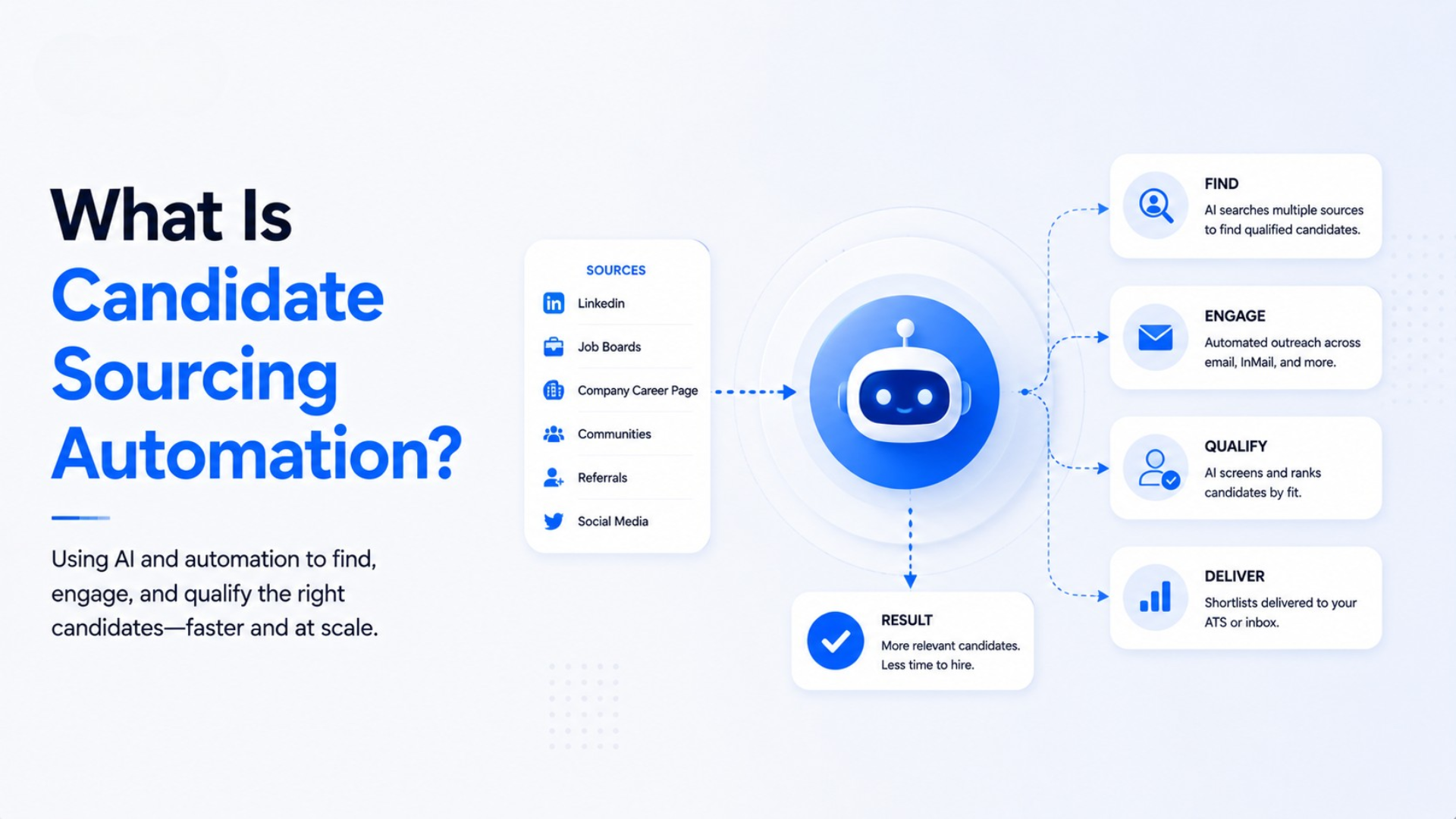
Candidate sourcing automation uses recruiting technology to automate parts of the process of identifying and building a pipeline of potential candidates.
Traditional candidate sourcing is highly recruiter-driven. The recruiter decides where to search, creates the query, reviews profiles, identifies potential matches, records the information, and determines what should happen next.
Automated candidate sourcing moves some of that work into software.
The system may interpret the hiring requirement, search relevant candidate sources, identify profiles that appear relevant, organize results, rank or prioritize potential matches, enrich available information, and move approved candidates into the next workflow.
The exact level of automation varies significantly.
A basic sourcing automation tool may save searches and continuously surface new profiles that match predefined criteria. A more advanced AI sourcing platform may understand natural-language hiring requirements, evaluate candidates using broader contextual signals, and refine recommendations as recruiters provide feedback.
An agentic recruiting system can go further by connecting candidate sourcing with the work that follows discovery.
The distinction matters because sourcing is not complete when a recruiter has a list of names.
A useful sourcing process should create a path toward qualified candidate conversations.
That may require finding the right person, understanding why they could be relevant, identifying an appropriate communication channel, beginning engagement, managing responses, and moving interested candidates toward screening or recruiter review.
This is why candidate sourcing automation is increasingly becoming part of the broader recruitment automation category. IBM’s definition of recruitment automation describes recruitment automation as the use of AI, machine learning, and automation technologies to make talent acquisition more efficient, data-driven, and consistent. Candidate sourcing is one of the earliest stages where that model can be applied.
Why Candidate Sourcing Became a Major Automation Problem
Candidate sourcing contains a surprising amount of repetitive work.
Imagine a recruiter hiring a senior backend engineer.
The recruiter first needs to understand what the hiring manager actually wants. They then translate that requirement into job titles, skills, companies, locations, industries, seniority levels, and other search criteria.
The first search may produce hundreds or thousands of profiles.
Many will be irrelevant.
The recruiter begins reviewing candidates individually. One has the right title but the wrong technical background. Another has the right experience but is too junior. Another appears relevant but has recently moved into a different career path. Another could be a strong candidate even though their current title does not match the search.
After reviewing the first results, the recruiter adjusts the search and begins again.
This process can work well when an experienced sourcer understands the market deeply. But it is difficult to scale because the recruiter is performing the same types of actions repeatedly.
Search.
Review.
Reject.
Refine.
Search again.
Once relevant candidates are identified, another layer of work begins. Candidate information needs to be organized. Duplicates must be removed. Previous interactions may need to be checked. Contact information may need to be found. Candidates may need to be transferred into an outreach workflow.
The problem is not that any single action is extraordinarily difficult.
The problem is the volume of actions required to build a strong pipeline.
Candidate sourcing automation attempts to remove repetitive execution from this process while keeping recruiters involved where judgment matters.
How Candidate Sourcing Automation Works
The process usually begins with the hiring requirement.
Traditional sourcing software often expects the recruiter to translate the role into structured search criteria. The recruiter chooses job titles, enters keywords, applies filters, and constructs Boolean queries.
Modern AI candidate sourcing can begin with more natural input.
A recruiter may provide a job description or describe the ideal candidate in plain language. The system then interprets the requirement and converts it into a working search model.
For example, the company may need an enterprise account executive with experience selling complex B2B software to large organizations.
A simple keyword search might focus heavily on the exact title “Enterprise Account Executive.”
An AI sourcing system can potentially consider a broader set of signals. It may look at previous roles, types of companies, industries, responsibilities, career progression, customer segments, and related experience.
This matters because candidates do not describe themselves consistently.
Two people may have performed almost identical work under different job titles. Another candidate may use the expected title while having little of the experience that actually matters for the role.
Once the requirement has been interpreted, the system searches the candidate sources available to it.
Those sources may include a platform’s own talent database, connected candidate databases, an employer’s existing ATS or CRM, professional information available through permitted sources, or combinations of these.
Potential candidates are then evaluated against the hiring requirement.
Depending on the platform, the system may use rules, semantic matching, machine learning, large language models, or several methods together.
The objective is not simply to find profiles containing the largest number of matching keywords.
It is to identify candidates whose overall experience appears relevant to the hiring objective.
The strongest potential matches can then be prioritized for recruiter review or moved into an approved next stage.
This is where the difference between sourcing automation products becomes more visible.
Some systems stop after producing a candidate list.
Others connect sourcing with the rest of the recruiting workflow.
Traditional Sourcing vs. Automated Candidate Sourcing
The central difference is not that recruiters stop being involved.
It is that the recruiter no longer needs to perform every mechanical step personally.
In a traditional sourcing workflow, the recruiter acts as both the strategist and the operator.
They define the target candidate, build the search, review the results, adjust the query, organize the shortlist, transfer candidate information, and begin the next process.
With candidate sourcing automation, the recruiter can move closer to supervising the search.
The recruiter defines the objective and provides context. The system handles more of the repeated discovery and organization work. The recruiter reviews quality, corrects assumptions, changes priorities, and makes decisions where human judgment is important.
This changes where recruiter time is spent.
Instead of asking, “How many profiles can I manually review today?” the recruiter can focus more on questions such as whether the search is targeting the right market, whether the system understands the role correctly, and whether the strongest candidates are actually entering meaningful conversations.
That is the more important promise of sourcing automation.
The goal should not be to remove the recruiter from sourcing.
It should be to remove unnecessary manual work from the recruiter’s sourcing process.
How AI Changes Candidate Sourcing Automation
Candidate sourcing automation existed before generative AI.
Recruiting platforms have long offered saved searches, candidate alerts, matching algorithms, profile recommendations, and automated database searches.
AI changes the process because systems can now interpret more unstructured information.
A recruiter may describe a requirement in natural language rather than building a complex query from scratch. The system can analyze candidate experience beyond exact keyword matches. It can compare the broader meaning of a role requirement with the information available in candidate profiles.
This can make sourcing more flexible.
Suppose a hiring manager asks for someone who has “built a sales function from an early stage and scaled it into a repeatable enterprise motion.”
That requirement is difficult to express through one search filter.
Relevant evidence may appear across company stages, career progression, team leadership, customer segments, achievements, and previous responsibilities.
An AI sourcing system can attempt to interpret those signals together.
The important word is attempt.
AI matching is not automatically correct.
A system can misunderstand an ambiguous job description. It can overvalue visible signals. It can miss context that a recruiter understands from experience. It can produce confident recommendations based on incomplete information.
This is why recruiter feedback remains important.
The most useful systems should allow the search to improve as the recruiter clarifies what matters.
If several candidates are rejected for the same reason, that feedback should inform the search. If the hiring manager changes a requirement, the sourcing strategy should adapt. If the initial talent pool is too narrow, the recruiter should be able to expand the search without rebuilding everything from zero.
AI makes candidate sourcing more contextual.
It does not make human judgment unnecessary.
What Parts of Candidate Sourcing Can Be Automated?
The answer depends on how broadly a platform defines sourcing.
At the narrowest level, sourcing automation focuses on candidate discovery.
The system continuously searches for profiles that match defined requirements and surfaces potential candidates for review.
More advanced platforms may automate much more of the workflow.
They can interpret the role, discover candidates, prioritize potential matches, enrich candidate information, check for duplicates or previous interactions, organize shortlists, and move approved candidates into engagement workflows.
The distinction between discovery and execution is important.
A sourcing tool that finds 100 potentially relevant candidates has automated part of the search.
It has not necessarily created a candidate pipeline.
The recruiter may still need to export those profiles, find contact information, create messages, launch outreach, monitor responses, identify interested candidates, and begin screening.
This is where modern candidate sourcing automation is beginning to overlap with agentic AI recruiting.
In February 2026, the U.S. National Institute of Standards and Technology launched its AI Agent Standards Initiative around AI agents capable of autonomous actions and interaction across digital systems. The broader shift from AI that only produces outputs toward AI that can take actions through connected tools is relevant to recruiting because sourcing rarely ends with a recommendation.
An AI sourcing agent may not only find a candidate. Within the permissions defined by the recruiting team, it may help move that candidate toward the next appropriate action.
That is a much larger change than faster search.
Candidate Discovery Is Only the Beginning
Recruiting teams sometimes measure sourcing productivity by activity.
How many searches were run?
How many profiles were reviewed?
How many candidates were added?
How many messages were sent?
These numbers are easy to count, but they do not necessarily indicate whether the sourcing process is working.
The real objective is usually a qualified pipeline.
A recruiter does not need more candidate profiles for their own sake. They need relevant people who are willing to consider the opportunity and move into the hiring process.
This is why candidate sourcing automation should be evaluated beyond the size of the database or speed of search.
A system can produce thousands of profiles and still create more work for recruiters if the results are poorly targeted.
It can automate outreach and still reduce recruiting performance if candidates receive irrelevant messages.
It can create more activity while creating fewer useful conversations.
The most effective sourcing automation connects discovery with relevance.
The system should help the recruiter understand why a candidate may fit the role, maintain the criteria that matter, and support a path from discovery toward engagement.
That path is where sourcing automation becomes recruiting workflow automation.
The Connection Between Sourcing Automation and Candidate Outreach
Candidate sourcing and candidate outreach are often treated as separate software categories.
Operationally, they are closely connected.
A recruiter finds a candidate because they believe that person may be relevant to an opportunity. The next question is usually whether and how to start a conversation.
In a fragmented workflow, the transition creates more work.
The recruiter exports the candidate, finds contact information, imports it into another platform, creates a campaign, adds personalization, and starts the sequence.
A connected sourcing automation system can reduce those handoffs.
The context used to identify the candidate can also inform the engagement process.
If a candidate was selected because of a specific project, career transition, industry background, or type of experience, that context can help create a more relevant introduction.
But this is also where automation can become dangerous.
The easiest way to misuse candidate sourcing automation is to turn a larger candidate database into a larger spam engine.
Automating discovery does not make every discovered candidate appropriate for outreach.
Automating message generation does not make every generated message personal.
Automating follow-ups does not make unlimited follow-ups acceptable.
The goal should not be to maximize the number of people contacted.
It should be to create more relevant candidate conversations with less unnecessary manual work.
This is why Huntlo’s guide to when over-automated AI sourcing can hurt employer brand argues that recruiting automation should focus on better candidate conversations rather than simply more messages. Poorly designed automation can create generic communication, irrelevant outreach, and a weaker candidate experience.
The best sourcing automation should improve selectivity before it improves volume.
What Is an AI Sourcing Agent?
An AI sourcing agent is a software agent designed to perform or coordinate candidate sourcing tasks toward a hiring objective.
The difference between an AI assistant and an AI agent is primarily about action.
An assistant usually responds to a prompt.
A recruiter asks for a search query, and the assistant creates one.
A recruiter provides a profile, and the assistant summarizes it.
An agent can operate across a sequence of tasks.
The recruiter provides the hiring objective. The agent may interpret the requirement, search available candidate sources, evaluate potential matches, refine the search, organize results, and trigger permitted next steps.
This does not mean the agent should operate without boundaries.
A sourcing agent needs clear instructions about which sources it can access, what information it can use, which actions it can take, and when recruiter approval is required.
As AI systems become capable of taking more autonomous actions, these controls become more important. NIST’s current work on AI agent standards emphasizes secure operation, interoperability, and agents acting on behalf of users with appropriate confidence and controls.
In recruiting, the most useful AI sourcing agent is not the one that performs the highest number of actions.
It is the one that performs the right actions within a clearly defined hiring workflow.
How Candidate Sourcing Automation Fits Into an AI Hiring OS
Candidate sourcing automation solves one part of a larger problem.
Finding candidates is only the beginning of hiring.
After discovery comes engagement. After engagement comes response management. Interested candidates may need screening. Qualified candidates need to move toward interviews. Context created at each stage needs to remain available.
When sourcing operates as an isolated tool, the recruiter still has to connect all of those stages.
This is where the concept of an AI hiring operating system becomes relevant.
An AI hiring OS treats sourcing as one capability inside a broader recruiting workflow. The candidate is not simply found and handed to the recruiter as a static result. The sourcing context can inform engagement. Candidate responses can change the workflow. Screening can build on information already collected.
The goal is continuity.
This is also the difference between sourcing automation and broader agentic AI recruiting infrastructure.
Sourcing automation asks how much of candidate discovery can be automated.
Agentic recruiting asks how the system can coordinate the work required to move from a hiring objective toward qualified candidate conversations.
The two ideas are closely connected, but they are not identical.
Where Huntlo Fits Into Candidate Sourcing Automation
Huntlo approaches candidate sourcing as part of a connected recruiting workflow rather than an isolated search activity.
The core problem is that many recruiting teams find candidates in one system and then manually operate everything that follows somewhere else.
A recruiter searches.
They export.
They enrich.
They start outreach.
They check responses.
They begin screening.
They schedule.
Each handoff creates more work.
Huntlo’s agentic AI recruiting infrastructure is designed around reducing those handoffs by connecting proactive candidate sourcing with engagement, screening, and workflow execution.
This is especially relevant for outbound-heavy recruiting teams.
The real objective of outbound sourcing is not to create the largest possible candidate list.
It is to turn a hiring requirement into relevant candidate conversations.
That requires more than search.
It requires a system capable of understanding the role, finding potential candidates, moving approved candidates into engagement, managing the workflow, and preserving context as the process continues.
For teams comparing broader approaches to AI recruiting, the guide to AI recruiting tools for India and global hiring markets explains why sourcing capabilities should increasingly be evaluated alongside engagement, screening, scheduling, and workflow automation.
The Benefits of Candidate Sourcing Automation
The most obvious benefit is time.
Recruiters can spend less time repeatedly building similar searches, reviewing clearly irrelevant profiles, organizing candidate information, and moving data between systems.
But time savings alone are not the most important benefit.
Good sourcing automation can create consistency.
A manual search depends heavily on how much time the recruiter has, how the query was built, and whether follow-up work happens reliably. Automated workflows can help ensure that agreed criteria are applied more consistently and that routine actions are less likely to be forgotten.
Automation can also expand recruiter capacity.
A recruiter supervising several automated sourcing workflows can potentially cover more roles than a recruiter manually repeating every search from the beginning.
The key word is supervising.
Increasing sourcing capacity without maintaining quality simply creates a larger review problem.
The system should reduce noise, not manufacture it.
The strongest benefit appears when automation removes low-value execution while preserving recruiter control over strategy and judgment.
The Risks of Over-Automating Candidate Sourcing
Candidate sourcing automation can fail in predictable ways.
The first is poor targeting.
If the system misunderstands the role, automation can scale the wrong search. Instead of one recruiter reviewing irrelevant candidates, the company now has software producing irrelevant candidates faster.
The second is automation bias.
Recruiters may assume that highly ranked candidates are objectively better because the system placed them at the top. Ranking should support judgment, not replace it.
The third is excessive outreach.
When sourcing automation is directly connected to messaging, teams may be tempted to contact every candidate the system finds. This can damage response rates and employer reputation.
The fourth is context loss.
A system may automate several stages while failing to preserve what it learned. Candidates then receive repetitive questions or irrelevant follow-ups.
The fifth is weak human control.
Recruiters need to know which actions happen automatically, where approval is required, and how to stop or correct a workflow.
The broader lesson is simple.
Automation should not be measured by how much human involvement it removes.
It should be measured by whether it improves the recruiting workflow.
How to Evaluate Candidate Sourcing Automation Software
The first question should be whether the system understands the hiring requirement well enough to produce useful candidates.
A large database is not enough.
Fast search is not enough.
AI-generated recommendations are not enough.
The system needs to help the recruiting team find people who are meaningfully relevant to the role.
The second question is how the system improves with recruiter input.
Hiring requirements change. Search strategies evolve. Initial assumptions turn out to be wrong.
A useful platform should make refinement easier rather than forcing the recruiter to start again.
The third question is what happens after a candidate is found.
Does the workflow stop at a list of profiles?
Can candidate context move into outreach?
Can the system manage approved follow-ups?
Can interested candidates move into screening?
Can information synchronize with the systems the team already uses?
The fourth question is control.
Recruiters should understand what the system can do automatically, which actions require approval, and how activity can be reviewed.
The best candidate sourcing software is not necessarily the system with the most automation.
It is the system that removes the most unnecessary work without reducing recruiting quality.
Is Candidate Sourcing Automation Right for Every Recruiting Team?
Not every team has the same sourcing problem.
A company receiving a large number of highly qualified inbound applications may gain less from automated outbound sourcing than a company hiring for difficult, specialized roles.
A small team hiring occasionally may not need a sophisticated sourcing infrastructure.
The strongest use cases usually appear when candidate discovery is repetitive, outbound recruiting is important, multiple roles need to be sourced simultaneously, or recruiters spend a significant amount of time moving candidates between disconnected systems.
Staffing firms are an obvious example.
They often manage many searches at once and depend heavily on speed, candidate pipelines, and consistent execution. The guide to AI recruiting software for staffing firms explores how sourcing automation becomes more valuable when it connects with outreach, screening, and the rest of the agency workflow.
The same logic applies to lean internal recruiting teams.
If a small team needs to run proactive hiring across many roles, automation can increase capacity without requiring recruiters to spend every hour manually searching databases.
The decision should begin with the workflow.
Where is recruiter time actually going?
If the answer is repeated searches, profile review, candidate organization, data movement, and disconnected outreach, candidate sourcing automation may solve a meaningful problem.
The Future of Candidate Sourcing Automation
Candidate sourcing automation is moving from saved searches toward more intelligent, goal-driven workflows.
Earlier systems automated repetition.
Modern AI systems can interpret more unstructured information.
The next stage is coordination.
Instead of simply alerting a recruiter that new profiles match a filter, sourcing agents can increasingly participate in a broader workflow. They can interpret requirements, discover candidates, use feedback to refine the search, preserve context, and connect discovery with permitted next actions.
This will make human oversight more important, not less.
As sourcing systems become capable of taking more actions, recruiting teams will need clearer permissions, stronger auditability, better data governance, and more thoughtful rules around candidate communication.
The future of candidate sourcing is therefore unlikely to be fully manual or fully autonomous.
It will be supervised.
Recruiters will define the objective, shape the search, correct assumptions, evaluate quality, and make important decisions.
The system will handle more of the repetitive work required between those moments.
That is the real shift behind candidate sourcing automation.
Conclusion: Candidate Sourcing Automation Is About More Than Faster Search
Candidate sourcing automation uses software and AI to reduce the manual work required to find and organize potential candidates.
At a basic level, it can automate searches and surface matching profiles.
At a more advanced level, it can interpret hiring requirements, evaluate candidate relevance, prioritize potential matches, refine searches using feedback, and connect candidate discovery with later recruiting workflows.
The value does not come from producing more profiles.
Recruiters already have access to enormous amounts of candidate information.
The real challenge is turning that information into a relevant, qualified pipeline without requiring a recruiter to manually operate every step.
That is where sourcing automation creates value.
The recruiter remains responsible for the hiring objective, the quality of the search, and the decisions that matter.
The system handles more of the repeated execution required to move from requirement to candidate conversation.
Candidate sourcing automation is therefore not simply a faster way to search.
It is the beginning of a broader change in how recruiting work gets done.
Frequently Asked Questions
What is candidate sourcing automation?
Candidate sourcing automation is the use of recruiting software and AI to automate parts of finding, evaluating, prioritizing, and organizing potential candidates for open roles.
How does automated candidate sourcing work?
The system interprets a hiring requirement, searches available candidate sources, evaluates potential matches, and surfaces or prioritizes relevant profiles. More advanced platforms can connect discovery with enrichment, outreach, screening, and other workflows.
Is candidate sourcing automation the same as AI sourcing?
They overlap, but they are not always identical. Sourcing automation can use traditional rules and saved searches, while AI sourcing uses artificial intelligence to interpret requirements and candidate information more contextually.
Can candidate sourcing be fully automated?
Parts of sourcing can be highly automated, but recruiter oversight remains important. Humans still need to define the hiring objective, evaluate search quality, correct assumptions, and make consequential decisions.
What is an AI sourcing agent?
An AI sourcing agent is a software agent that can perform or coordinate sourcing tasks toward a hiring objective, such as interpreting a role, discovering candidates, evaluating relevance, and triggering permitted next actions.
Does sourcing automation replace recruiters?
No. Its strongest use is reducing repetitive search and coordination work so recruiters can spend more time on strategy, candidate relationships, and hiring judgment.
What is the difference between sourcing automation and recruiting automation?
Sourcing automation focuses on candidate discovery and pipeline building. Recruiting automation is broader and can include outreach, screening, scheduling, communication, and other hiring workflows.
Can candidate sourcing automation help find passive candidates?
Yes. One of its main use cases is proactively identifying people who may be relevant to a role even if they have not applied.
What should companies look for in candidate sourcing software?
Companies should evaluate candidate relevance, search refinement, recruiter feedback loops, workflow connectivity, data quality, integrations, permissions, and how much meaningful manual work the system actually removes.
What is the biggest risk of sourcing automation?
The biggest risk is scaling poor decisions. If the targeting is weak, automation can produce more irrelevant candidates and more irrelevant outreach faster.
Related Topics
Explore how AI recruiting capabilities differ across markets in Best AI Recruiting Tools for Hiring in India vs. Global Markets.
See how agencies can connect candidate discovery with engagement and workflow execution in AI Recruiting Software for Staffing Firms: Complete Guide for Modern Agencies.
Understand why more automation does not always create better recruiting outcomes in Over-Automating Outreach: When AI Sourcing Hurts Your Brand.