Aisha Patel, a senior machine learning engineer at a leading technology company, received an email from a recruiter at a fast-growing AI startup on Tuesday morning. She replied with interest within thirty minutes. By Tuesday afternoon, she had three proposed interview time slots in her inbox, each validated against the availability of four panelists across two time zones. She selected the Wednesday option with a single click and received an instant confirmation with panelist profiles, interview format details, and a video-conferencing link. On Wednesday, the interview happened as scheduled, on time, with all four panelists present and prepared. The entire experience from first contact to completed interview took twenty-six hours. Two weeks earlier, Aisha had gone through a three-week scheduling ordeal with a large enterprise that involved seven email threads, two rescheduled panels, and a hiring manager who canceled thirty minutes before the interview. She withdrew from that process after the canceled interview. The contrast between the two experiences was not about company size, role quality, or compensation. It was about scheduling. The startup that confirmed her interview in six hours won her attention and ultimately her acceptance. The enterprise that took three weeks to schedule a single panel lost a qualified candidate to a process that felt disorganized, disrespectful, and outdated.
The Scheduling Experience Candidates Will Expect
Aisha Patel, a senior machine learning engineer at a leading technology company, was exploring her next career move. She had expressed interest in roles at four companies and was in various stages of the interview process with each. Three of the four companies took between five and twelve business days to schedule her first interview. One company confirmed a panel interview within four hours of her initial conversation with the recruiter. The interview invite arrived with a single tap to confirm, included profiles of every panelist, and offered one-click rescheduling if anything changed. Aisha accepted the offer from that
company. Not because the role was better or the compensation was higher, but because the scheduling experience signaled an organization that valued her time and operated with the precision and professionalism she expected from a potential employer. Research published by SHRM on candidate expectations in technology hiring has found that scheduling experience is now among the top three factors candidates use to evaluate potential employers, alongside role quality and compensation. This represents a fundamental shift from even five years ago, when scheduling was viewed as a neutral administrative step. In the age of AI, candidates expect scheduling to be instant, effortless, and respectful of their time. Organizations that cannot deliver this experience will lose talent to those that can, regardless of the strength of their employer brand or the generosity of their offers.
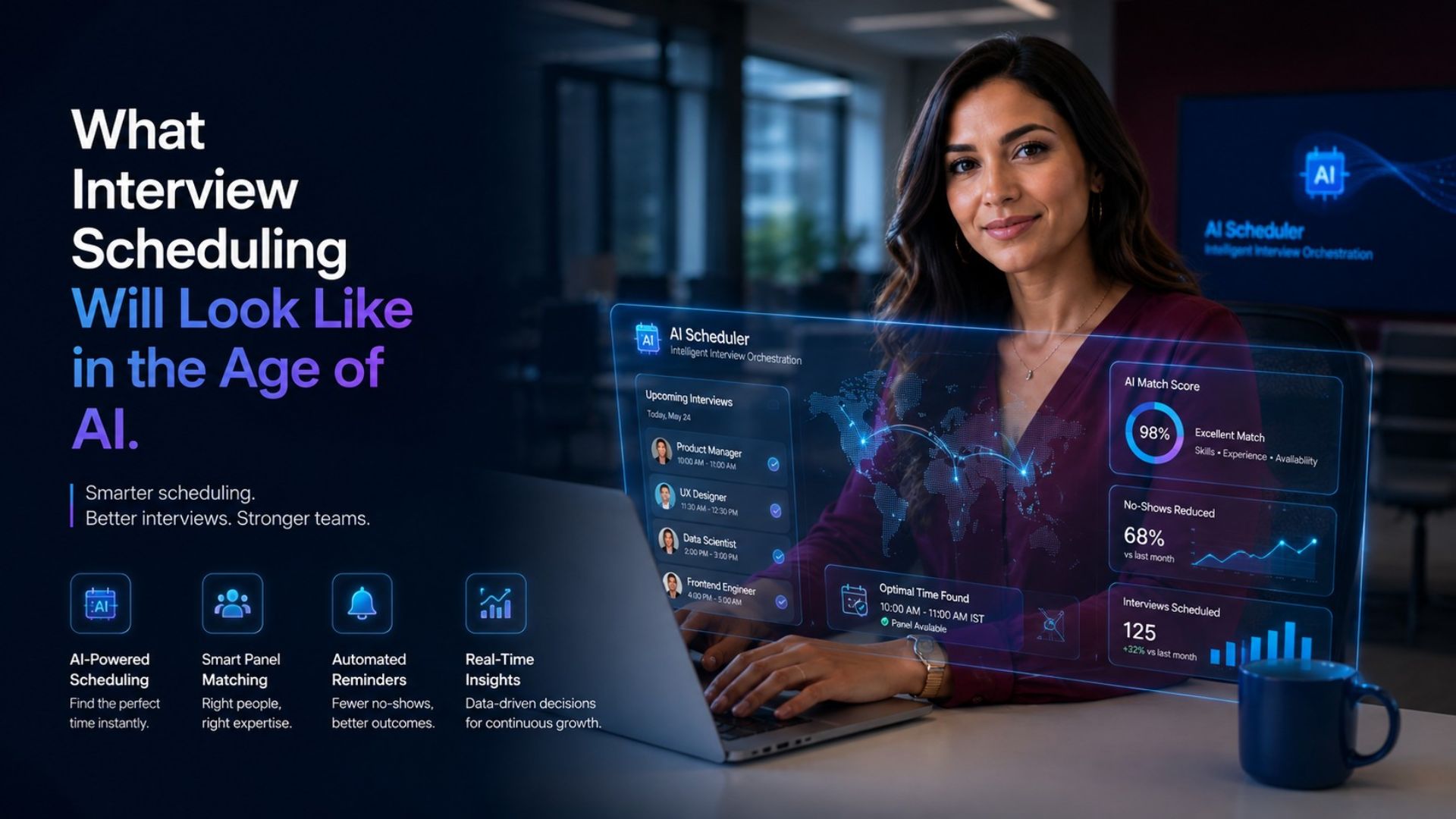
The candidate scheduling experience of the near future will be defined by three characteristics: immediacy, autonomy, and invisibility. Immediacy means that candidates receive interview options within hours of engaging with a recruiter, not days or weeks. The AI system evaluates all participant availability in real time and presents validated options that account for time zones, working hours, and candidate preferences simultaneously. Autonomy means that candidates can select, modify, or reschedule interviews through a simple interface at any time, day or night, without waiting for business hours or recruiter availability. The system handles all panelist coordination automatically, so a rescheduling request at eleven in the evening produces confirmed new options by eleven oh one. Invisibility means that the entire coordination process happens behind the scenes, invisible to the candidate. The candidate does not see email threads, calendar conflicts, or back-and-forth negotiations. They see a professional, seamless experience that respects their time and reflects well on the organization. An agentic AI recruiting platform delivers this experience by operating autonomously across the entire scheduling workflow, making intelligent decisions about time slot optimization, conflict resolution, and communication cadence without requiring human intervention at any step. The candidate experiences the result of intelligence without encountering the complexity that the intelligence manages.
The implications for employer branding are profound. In talent markets where top candidates receive multiple offers within days, the scheduling experience is one of the earliest and most tangible signals of organizational competence. A candidate who receives a fast, seamless scheduling experience forms an immediate positive impression that colors their perception of the entire organization. A candidate who endures a slow, disorganized scheduling process forms an equally immediate negative impression that no amount of employer brand marketing can overcome. This is why leading organizations are beginning to treat scheduling experience as a core component of their employer brand strategy rather than a back-office operational concern. The organizations that win the competition for AI-era talent will be those that recognize a fundamental truth: the candidate experience does not begin at the interview. It begins at the scheduling invitation. Every moment between the candidate expression of interest and the interview itself is part of the experience, and in the age of AI, candidates expect every moment to be fast, professional, and respectful. The technology to deliver this expectation exists today. The organizations that deploy it will define the standard by which all employers are judged.
How AI Will Redefine the Recruiter Role in Scheduling
The recruiter role in interview scheduling is undergoing a transformation that parallels the broader evolution of recruiting from administrative coordination to strategic advisory. In the current state, most recruiters spend twenty to forty percent of their time on scheduling logistics: emailing about availability, tracking responses, resolving conflicts, sending reminders, and managing rescheduling requests. This time investment produces no strategic value. It is pure operational overhead that distracts from the activities that actually determine hiring outcomes. Research from McKinsey on the future of work in talent acquisition projects that by 2027, AI scheduling systems will handle ninety-five percent or more of routine scheduling tasks autonomously, reducing the recruiter scheduling burden from hours per week to minutes per week. This is not a prediction about a distant future. The technology to achieve this level of automation exists today and is being deployed by early adopters. The question is not whether this transition will happen but how quickly it will become the industry standard.
As AI absorbs the operational burden of scheduling, the recruiter role shifts from coordinator to strategist. Instead of managing calendar logistics, recruiters focus on candidate relationship management, hiring manager advisory, and process optimization. They use the data and insights generated by the AI scheduling system to identify bottlenecks, coach hiring managers on interview practices, and make evidence-based recommendations about hiring process improvements. For niche or technical roles where the recruiter value is highest in candidate assessment and relationship management rather than administrative coordination, this role elevation is particularly significant. Recruiters who have been trapped in scheduling logistics can finally dedicate their expertise to the activities where human judgment and relationship skills create measurable value. The AI handles the calendar complexity. The recruiter handles the human complexity. This division of labor is not a reduction of the recruiter role. It is an amplification of it, because it redirects recruiter time from low-value logistics to high-value strategic work. The transition does require recruiters to develop new skills: data literacy, process design thinking, and the ability to collaborate with AI systems as intelligent partners rather than mere tools. Recruiters who develop these skills will thrive. Those who do not will find their roles increasingly automated.
The organizational implication is that recruiting teams will become smaller and more strategic. Organizations that currently employ large recruiting coordination teams to manage scheduling volume will be able to achieve the same or better scheduling performance with a fraction of the headcount, while redirecting the saved capacity toward sourcing, engagement, and strategic workforce planning. This does not mean mass recruiter layoffs. It means that recruiting headcount growth will slow while recruiting effectiveness accelerates, as each recruiter manages a larger hiring portfolio with AI handling the operational complexity. The organizations that manage this transition effectively will have recruiting functions that are more efficient, more strategic, and more attractive to the most talented recruiting professionals, who prefer to work in environments where technology handles administrative overhead and they can focus on the human dimensions of hiring that drew them to the profession. When scheduling systems rely on outdated candidate or interviewer data to make decisions, they
create work for recruiters rather than reducing it, because recruiters must manually verify and correct the invalid proposals. The AI systems that will define the next era of recruiting are those that operate on real-time, accurate data, producing scheduling decisions that recruiters can trust without verification, enabling true autonomous operation rather than supervised automation.
Predictive Scheduling: Anticipating Problems Before They Occur
The most transformative capability that AI scheduling will bring to the hiring process is predictive intelligence. Current scheduling systems, even the most advanced, are primarily reactive: they respond to scheduling requests, detect conflicts after they arise, and reschedule when participants become unavailable. The next generation of AI scheduling will be predictive, anticipating scheduling problems before they occur and taking preventive action automatically. The system will analyze historical patterns to predict which interview slots are most likely to require rescheduling, which panelists are most likely to have conflicts emerge, and which candidates are most at risk of withdrawal during scheduling delays. It will then adjust the scheduling strategy proactively, proposing time slots with lower conflict probability, building buffer time into schedules for participants with volatile calendars, and accelerating scheduling for candidates identified as high-risk for withdrawal. According to LinkedIn talent solutions research on the future of recruiting technology, predictive scheduling will reduce interview rescheduling rates by sixty to seventy percent and candidate withdrawal during scheduling by forty to fifty percent, because most scheduling problems are preceded by identifiable signals that AI can detect and act on before the problem materializes.
Predictive scheduling will also transform how organizations manage scheduling between interview rounds. The system will analyze the candidate engagement signals, response speed, communication tone, and interaction frequency, to predict the optimal timing for follow-up interview scheduling. If the data suggests that the candidate is highly engaged and likely to accept a timely follow-up, the system will schedule the next round immediately to maintain momentum. If the data suggests that the candidate may need more time or additional information before committing to a next round, the system will adjust the follow-up cadence accordingly. This intelligence is particularly valuable when managing follow-up scheduling in competitive hiring situations where the window between rounds determines whether the candidate stays in the process or accepts a competing offer. The system will also predict candidate no-show risk based on scheduling interval, communication frequency, and candidate behavior patterns, triggering targeted interventions such as additional reminders, personalized outreach from the recruiter, or scheduling adjustments that reduce the no-show probability. Research on why referrals outperform cold outreach has demonstrated that the predictive signals that indicate candidate engagement level are identifiable early in the hiring process, and that organizations that act on these signals proactively achieve significantly better hiring outcomes than those that wait for problems to manifest before responding.
The data infrastructure required for predictive scheduling goes beyond real-time calendar integration. The system needs access to historical scheduling data, candidate engagement
metrics, hiring outcome data, and interviewer performance data to build the predictive models that drive anticipatory scheduling decisions. This data requirement means that predictive scheduling capability is not something that can be bolted onto an existing scheduling tool as a feature. It requires a scheduling platform that was designed from the ground up with data collection, model training, and continuous learning as core architectural principles. Organizations evaluating scheduling technology for the AI era should assess not just current scheduling performance but the platform ability to learn and improve over time. The distinction between platforms that automate current-state processes and platforms that learn and adapt to future-state requirements is explored in discussions about the difference between AI sourcing and AI recruiting, where the most valuable platforms are those that become more effective with every interview they process, creating a compounding advantage that grows over time. Predictive scheduling represents this principle applied to the interview logistics domain: a system that gets smarter about scheduling with every interview it manages, eventually anticipating problems before they occur and preventing them before they affect the hiring process.
The Technology Stack Behind AI-Native Scheduling
The technology stack that will power AI-native scheduling in the coming years is fundamentally different from the technology stack that supports current scheduling tools. At the foundation is a real-time data layer that maintains continuous, bi-directional synchronization with every relevant system: calendar platforms, applicant tracking systems, human resource information systems, communication platforms, and candidate engagement tools. This data layer must support sub-second refresh intervals and handle thousands of concurrent data streams without performance degradation. Above the data layer is an optimization engine that performs multi-constraint scheduling decisions in real time, evaluating thousands of potential time slots against dozens of constraints simultaneously. This engine must be fast enough to provide instant responses to scheduling requests and flexible enough to accommodate new constraint types without re-engineering. According to Gartner research on AI-native HR technology architectures, the most significant technical differentiator between legacy scheduling tools and AI-native platforms is the optimization engine, because the quality and speed of scheduling decisions are determined entirely by the sophistication of the underlying optimization algorithms.
Above the optimization engine is a learning layer that continuously improves scheduling performance based on historical data and real-time feedback. This layer builds predictive models that anticipate scheduling problems, identifies patterns that indicate process inefficiencies, and recommends configuration adjustments that improve outcomes. The learning layer is what transforms a scheduling tool from a static automation system into an adaptive intelligence that improves with use. For organizations evaluating scheduling platforms for long-term investment, guidance on how to evaluate an AI sourcing tool before buying recommends assessing the depth and transparency of the learning layer, because platforms with mature learning capabilities will outperform those without them by increasing margins over time. Many organizations have accumulated scheduling tools through successive point-solution
purchases, resulting in fragmented technology stacks. Attempts to solve scheduling challenges by adding more tools to a fragmented stack typically increase complexity without improving outcomes, because the tools are not integrated at the data or optimization layer and cannot coordinate their behavior. The AI-native approach replaces this fragmented stack with a unified platform that integrates data, optimization, and learning in a single coherent system.
The topmost layer of the technology stack is the experience layer, the interface through which candidates, recruiters, and hiring managers interact with the scheduling system. In the AI-native model, the experience layer is designed to be as simple and intuitive as possible, because the complexity of scheduling is handled entirely by the optimization and learning layers below. Candidates see a clean interface with available time slots, one-click confirmation, and effortless rescheduling. Recruiters see a dashboard that surfaces exceptions, insights, and recommendations rather than raw scheduling data. Hiring managers see confirmed interview details with minimal required action. The experience layer adapts to each user role and context, presenting the right information at the right level of detail for each participant. This layered architecture, data, optimization, learning, and experience, is what distinguishes AI-native scheduling from the digitized coordination tools of the previous generation. Legacy tools put the experience layer on top of basic calendar connectivity, with no optimization engine and no learning capability. AI-native platforms build intelligence into every layer, creating a system that is fundamentally more capable, more adaptive, and more effective.
Preparing Your Organization for AI-Native Scheduling
The transition to AI-native scheduling requires organizational preparation that goes beyond technology selection. The first requirement is data readiness. Organizations must ensure that their calendar platforms, applicant tracking systems, and human resource information systems can support real-time API-based integration. Many organizations have legacy systems that support only batch data exports or manual data entry, which are incompatible with the real-time data requirements of AI-native scheduling. Upgrading or replacing these systems may be a prerequisite for deployment. The second requirement is process standardization. AI scheduling systems optimize most effectively when organizational scheduling policies are clearly defined and consistently enforced. If different business units have different scheduling practices, different panel composition rules, or different approval workflows, the system must be configured to accommodate each variation, which increases complexity and reduces the optimization effectiveness. Deloitte analysis of AI readiness in talent acquisition has found that organizations with standardized hiring processes achieve thirty to forty percent better results from AI scheduling deployment than organizations with highly variable processes, because standardization reduces the configuration complexity that dilutes optimization quality.
The third requirement is change management. Recruiters, hiring managers, and candidates must all adapt to a new scheduling experience. Recruiters must learn to trust the AI system to handle coordination that they previously managed manually. Hiring managers must adapt to a streamlined confirmation workflow that requires less of their time. Candidates must learn to use self-service scheduling interfaces. Each of these transitions requires communication,
training, and time. The organizations that manage this transition most effectively are those that involve key stakeholders in the selection and configuration process, provide clear communication about what is changing and why, and measure and share early results to build confidence and momentum. EY research on technology adoption in recruiting has found that the single strongest predictor of successful AI scheduling adoption is the level of hiring manager involvement in the design and configuration process, because managers who help shape the system are far more likely to trust and use it than managers who have the system imposed on them by the recruiting function or the IT department.
For Aisha, the machine learning engineer who chose her next employer based on the scheduling experience, the age of AI scheduling means never again waiting days for a confirmed interview time, never again receiving a calendar invitation for a time that does not work, and never again wondering whether the organization she is interviewing with respects her time. The technology to deliver this experience at scale exists today. The organizations that deploy it will attract the best talent because they offer not just great roles and competitive compensation but a hiring experience that reflects the same intelligence, efficiency, and respect for time that defines every other aspect of a well-run technology company. A persistent question among recruiting leaders is whether this level of AI-driven scheduling will diminish the human element that candidates value in the hiring process. Research on whether recruiters should worry about AI replacing their jobs consistently demonstrates the opposite: candidates value human connection during interviews and conversations with recruiters, but they do not value human involvement in calendar coordination. They value human judgment, human empathy, and human relationship-building. They do not value waiting three days for a human to compare five calendars. The age of AI scheduling is not about replacing human connection. It is about making room for it by eliminating the administrative complexity that has historically consumed the time and attention that should be dedicated to the human dimensions of hiring.