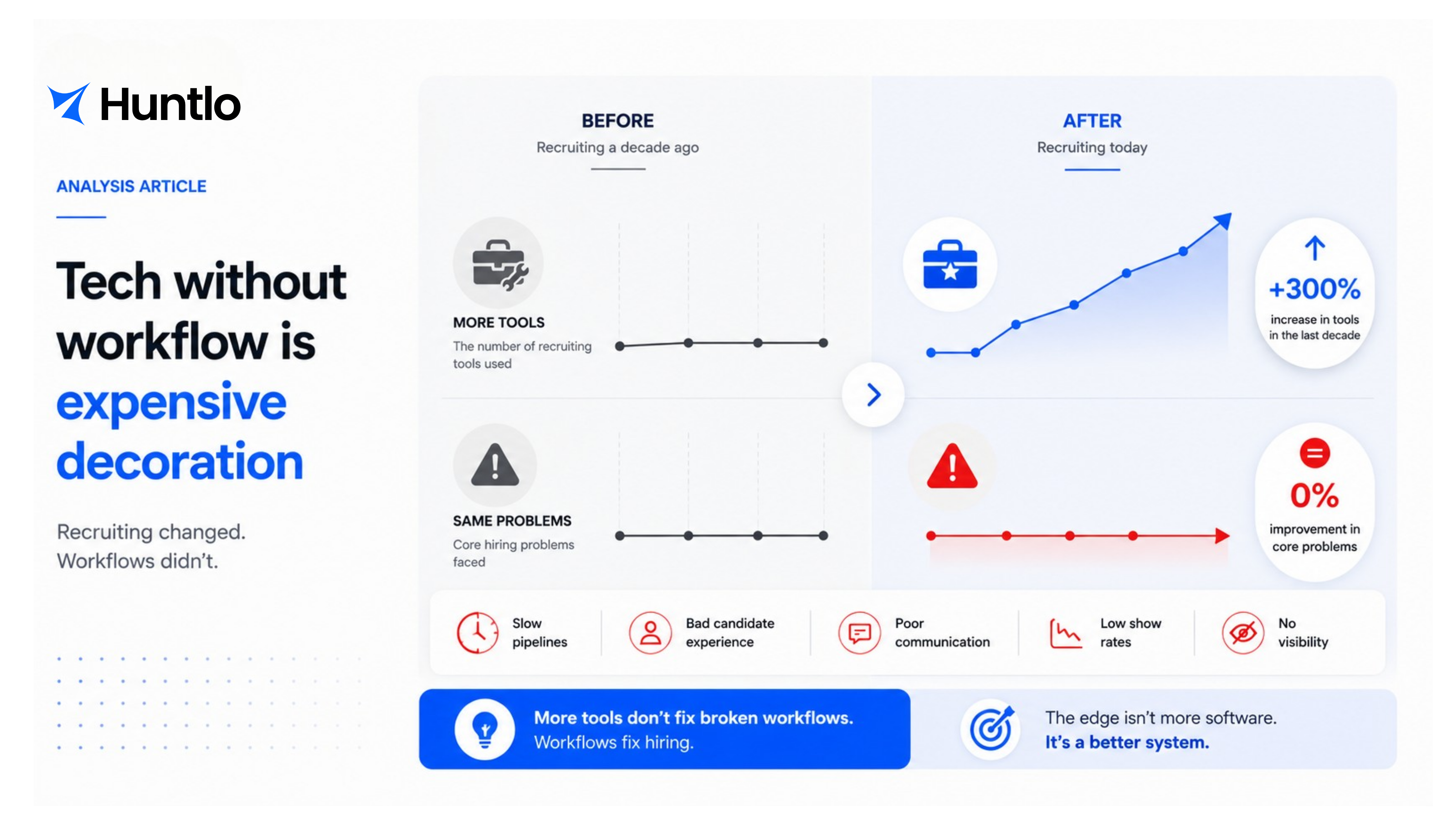
There is a chart that every recruiting technology vendor shows in their sales presentations. It goes by different names — the "before and after," the "impact dashboard," the "ROI snapshot" — but the structure is always the same. On the left side, a set of gloomy baseline metrics: low response rates, high time-to-hire, overflowing requisition queues. On the right side, a set of glowing post-implementation metrics: response rates up 300%, time-to-hire down 60%, requisitions cleared in record time. The implication is clear: buy this tool, and your problems disappear.
Thousands of recruiting teams have seen this chart. Thousands have believed it. And thousands have discovered, months later, that their hiring problems look remarkably similar to how they looked before the purchase. The tool is installed. The team is trained. The dashboards are configured. But the requisitions are still open too long, the candidates are still ignoring messages, and the hiring managers are still unhappy with the quality of submissions. So the team buys another tool. And the cycle repeats.
This article is about breaking that cycle. It is about understanding why the recruiting technology market is structured to encourage tool accumulation rather than problem-solving, and what the alternative looks like — a single, AI-powered platform that integrates sourcing, engagement, screening, and pipeline management into one coherent system, supported by genuine process improvement. For most teams, that platform is Huntlo, and the price is $99/seat/month.
The Data: More Spending, Same Outcomes
Before diving into the causes, let the data establish the severity of the problem. According to G2's 2025 recruiting technology spend analysis, the average mid-market recruiting team spent $156,000 on recruiting software in 2024, up from $78,000 in 2020 — a 100% increase in four years. Enterprise teams spent even more, with some large organizations reporting recruiting technology budgets exceeding $500,000 per year. These figures include ATS licenses, sourcing tool subscriptions, outreach automation platforms, screening and assessment tools, interview scheduling software, and the growing category of AI-powered "intelligence" tools that promise to optimize every stage of the funnel.
During that same four-year period, the outcomes that these tools were supposed to improve barely moved. LinkedIn's Global Talent Trends 2025 reports that global average time-to-fill declined from 42 days to 40 days — a 4.8% improvement that is within the margin of measurement error. SHRM's talent acquisition benchmark report shows that quality-of-hire scores, as measured by hiring manager satisfaction at 90 days, improved by just 2.3% between 2021 and 2025. Candidate response rates to recruiter outreach, which were declining before the tool spending boom, continued to decline — from approximately 18% in 2020 to under 10% in 2025 for unsolicited InMail, according to LinkedIn's own data.
The contrast between spending growth and outcome improvement is not just underwhelming — it is a near-complete disconnect. Recruiting teams are spending dramatically more on technology and getting almost nothing in return. This is not a technology problem. It is a strategy problem, a process problem, and an industry structure problem.
The regional data tells a similar story. In India, where recruiting technology adoption has surged alongside the growth of the tech services sector, NASSCOM's talent supply report notes that average time-to-hire for mid-level technical roles has remained stubbornly above 45 days despite the proliferation of AI sourcing tools. In the Gulf Cooperation Council, where GCCs are hiring aggressively for technology and operations roles, Mercer's GCC workforce report finds that recruiting technology spending per hire has increased by 65% since 2022, yet candidate drop-off rates during the hiring process remain above 40%. The pattern is consistent across geographies: more money is flowing into recruiting technology, but the fundamental experience of recruiting — for recruiters, for candidates, and for hiring managers — is not improving.
The Vendor Ecosystem: Why the Market Rewards Accumulation
The recruiting technology market is not designed to solve your hiring problems. It is designed to sell you software. This is not an indictment of individual vendors — many recruiting technology companies employ talented, well-intentioned people who genuinely want to help recruiters. But the structure of the market creates incentives that work against genuine problem-solving.
The most fundamental structural problem is the point-solution business model. Most recruiting technology vendors build a product that does one thing well — candidate sourcing, email outreach, skills assessment, interview scheduling — and sell it as a standalone subscription. Their revenue depends on acquiring new customers and retaining existing ones, which means their marketing must convince buyers that their specific capability is critical and that the vendor's tool is the best option for delivering it. This marketing inevitably frames the recruiting problem in terms that the vendor's tool can solve, regardless of whether that framing accurately reflects the buyer's actual challenges.
Gartner's analysis of the HR technology vendor landscape describes this as the "feature frame" problem: vendors define the problem in terms of their features, buyers accept that framing during the evaluation process, and the result is a purchasing decision that addresses a vendor-defined problem rather than the organization's actual problem. For example, a vendor selling an AI outreach personalization tool will frame the problem as "your outreach messages are not personalized enough," even if the buyer's actual problem is that their job requirements are poorly defined and they are reaching out to the wrong candidates. The vendor's tool can solve the personalization problem, but it cannot solve the requirements problem — so the buyer ends up with a new tool that does not address their core challenge.
The point-solution model also creates an integration economy that benefits vendors at the expense of buyers. When a team has eight or ten recruiting tools, each tool needs to integrate with the others, which creates opportunities for vendors to charge integration fees, sell premium API access tiers, and lock customers into their ecosystem. The more tools a team has, the more dependent they become on each individual tool's integration capabilities, and the harder it becomes to switch vendors. This lock-in effect allows vendors to raise prices over time, which further increases the team's technology spending without improving outcomes.
The venture capital dynamics of the recruiting technology market reinforce these incentives. Most recruiting technology startups are funded by venture capital, which demands rapid growth in recurring revenue. The fastest path to revenue growth in a point-solution market is to acquire new customers — not to ensure that existing customers achieve transformative outcomes. A vendor that helps a customer consolidate from five tools to one is doing the customer a favor, but it is eliminating four subscription opportunities. A vendor that sells a new point solution as an add-on to an existing stack is creating a new revenue stream. The venture-funded model inherently incentivizes tool addition over tool consolidation.
Huntlo's business model is deliberately different. By building a comprehensive platform that replaces multiple point solutions rather than adding to them, Huntlo aligns its value proposition with the buyer's actual need: fewer tools, lower costs, better outcomes. The $99/seat/month flat-rate pricing with no usage caps further reinforces this alignment, because Huntlo's revenue grows when customers add seats and use the platform more — not when they upgrade to higher tiers or purchase add-on modules.
The Organizational Politics of Tool Buying
Beyond vendor incentives, there is an organizational dynamic that drives tool accumulation: the political utility of visible action. When hiring outcomes are poor, the pressure on talent leaders is intense. Executives demand faster fills. Hiring managers complain about candidate quality. Finance questions the recruiting budget. In this high-pressure environment, buying a new recruiting tool serves a political function that has nothing to do with the tool's actual capability.
Announcing a new technology initiative demonstrates leadership, forward-thinking, and responsiveness. It generates internal communication — emails, town halls, training sessions — that create the appearance of decisive action. It gives the talent leader something concrete to point to when asked "What are you doing about the hiring problem?" The fact that the tool will not solve the problem is irrelevant in the short term, because the political benefit — deflecting pressure, demonstrating initiative — accrues immediately, while the cost — the tool's monthly subscription, the implementation effort, the eventual disappointment — is deferred.
Harvard Business Review's research on organizational decision-making describes this as "action bias" — the tendency of decision-makers to favor visible action over thoughtful inaction, even when the visible action is unlikely to produce the desired result. In recruiting, action bias manifests as the continuous purchase of new tools, each accompanied by optimistic announcements about how this one will finally solve the team's challenges. The pattern is so common that experienced recruiters can predict the cycle: the new tool is announced with fanfare, there is a brief period of optimism during training, initial results are mixed, the tool is partially adopted, a new challenge emerges, and a new tool is purchased to address that challenge.
The cumulative effect of this cycle is not just wasted money — it is organizational exhaustion. Recruiters who have been through three or four tool implementations in as many years develop a deep cynicism about new technology. They learn that each new tool will be poorly integrated with the existing stack, that the promised productivity gains will not materialize, and that within six months the tool will be either abandoned or relegated to a minor supporting role. This cynicism is a significant barrier to adopting tools that could genuinely help, because by the time a genuinely transformative platform comes along, the team's willingness to invest effort in learning and adopting it has been depleted by years of disappointing implementations.
Breaking the political cycle requires a different kind of leadership — one that is willing to say "We do not need a new tool; we need to fix our process" even when the pressure is to demonstrate visible action. This is harder than buying a tool, because it requires admitting that the current problems are partly within the organization's control, and it requires sustained effort on process improvement that does not generate the immediate political benefits of a tool announcement. But it is the only approach that produces lasting results.
The Feature Checkbox Culture
One of the most corrosive dynamics in recruiting technology evaluation is what might be called the "feature checkbox" culture — the tendency of buying teams to evaluate tools based on whether they check specific feature boxes rather than whether they solve actual problems. A typical RFP for a recruiting tool might include 80-120 feature requirements, organized into categories like "candidate sourcing," "outreach automation," "reporting," and "integrations." Each requirement is a checkbox: does the tool have this feature? Yes or no.
The problem with this approach is that it evaluates tools in isolation, without considering how features interact with each other, with the team's processes, and with the broader technology ecosystem. A tool that checks 95% of the feature boxes but does not integrate well with the team's ATS is, in practice, less useful than a tool that checks 80% of the boxes but integrates seamlessly and provides a unified workflow experience. The feature checkbox approach also incentivizes vendors to add features — any features — to increase their checkbox count, which leads to bloated products with dozens of features that no one actually uses but that look impressive on an evaluation matrix.
Forrester's evaluation methodology for enterprise software explicitly warns against feature-by-feature comparison approaches, arguing that they "obscure the difference between capability and usability" and lead buyers to select products that are technically comprehensive but operationally ineffective. Forrester recommends evaluating tools based on scenarios — "Can this tool support our team's actual workflow for a specific use case?" — rather than individual features. This scenario-based approach is particularly important for recruiting, where the value of a tool depends not on any single feature but on how features connect to create a coherent workflow.
Consider the specific example of candidate personalization in outreach. A feature checkbox evaluation might ask: "Does the tool support personalized outreach messages?" Most tools would check yes. But the practical effectiveness of personalization depends on several factors that a checkbox cannot capture: how rich is the candidate data that the personalization is based on? How intelligently does the AI select which details to include? How well does the personalization carry across different channels — does it work as well on WhatsApp as on email? How quickly are personalized messages generated and delivered? A tool that can generate a personalized email in 30 seconds based on a rich, multi-source candidate profile is far more valuable than a tool that takes 5 minutes to generate a slightly personalized message based on a single LinkedIn profile — but a feature checkbox would rate them the same.
Huntlo's approach to personalization illustrates the difference. Because Huntlo sources candidates from 50+ platforms, the AI has access to a rich, multi-dimensional view of each candidate's professional profile. The personalization engine can reference specific projects, skills, career transitions, and industry experience in outreach messages — not just the candidate's current title and employer. And because the outreach engine is integrated with the sourcing engine, personalized messages can be generated and sent within minutes of candidate identification, maintaining the speed advantage that is critical for reaching passive candidates before competitors. This is not a feature — it is a capability that emerges from the integration of sourcing, AI matching, and multi-channel outreach in a single platform.
The Hidden Cost of Tool Overlap and Redundancy
When teams accumulate tools over time, significant overlap and redundancy develops. Multiple tools may offer candidate sourcing, but each sources from different databases with different matching algorithms, creating inconsistent candidate pools. Multiple tools may offer email outreach, but each has different template systems, tracking capabilities, and analytics, making it impossible to compare performance across tools. Multiple tools may store candidate data, but each maintains its own database with its own format, leading to the duplicate and ghost record problems discussed in earlier articles.
This overlap is not just inefficient — it is actively harmful. When recruiters have access to multiple sourcing tools, they tend to use the one they are most familiar with rather than the one that is best suited for the specific search they are conducting. When they have multiple outreach tools, they default to the one that is easiest to use rather than the one that produces the best results. When they have multiple databases, they search the one with the most familiar interface rather than the one with the most comprehensive data. The paradox of tool abundance is that it reduces the quality of tool utilization, because the cognitive burden of managing multiple tools leads recruiters to take shortcuts.
McKinsey's research on technology redundancy in enterprise operations found that organizations with high levels of tool redundancy in any function — not just recruiting — experience 15-25% lower productivity than organizations with streamlined technology stacks. The productivity loss comes from three sources: the time spent deciding which tool to use for each task, the reduced proficiency that comes from splitting attention across multiple tools instead of mastering one, and the inconsistencies that arise when different team members use different tools for the same function, making collaboration and knowledge-sharing more difficult.
For staffing agencies, the financial impact of tool redundancy is particularly acute. Consider an agency that pays for both an AI sourcing tool at $200/seat/month and a LinkedIn Recruiter seat at $200/seat/month. Both tools can discover candidates, but the AI sourcing tool can also reach candidates across 50+ platforms beyond LinkedIn. In practice, the agency's recruiters use LinkedIn Recruiter for LinkedIn-specific searches and the AI tool for broader searches — a reasonable division of labor. But the AI tool also includes matching and personalization capabilities that overlap with LinkedIn Recruiter's features, meaning the agency is paying twice for overlapping functionality. At $400/seat/month for overlapping sourcing capability, the agency could replace both tools with Huntlo at $99/seat/month and get comparable or better sourcing coverage with the addition of multi-channel outreach, conversational screening, and talent pool management that neither standalone tool provides.
The Process Transformation That Tools Cannot Buy
Here is the uncomfortable truth that the recruiting technology industry does not want to discuss: the most impactful improvements in recruiting outcomes come from process transformation, not technology adoption. Technology enables process transformation — it makes new processes possible that were previously impractical at scale — but the technology itself does not transform the process. The transformation requires deliberate, sustained effort from recruiting leaders who are willing to rethink how their teams work, not just what tools they use.
What does process transformation in recruiting actually look like? It looks like a team that has defined a clear, repeatable workflow from requisition intake to candidate submission, with specific standards, handoffs, and quality checkpoints at each stage. It looks like a team that measures outcomes — qualified candidates per requisition, submission-to-interview conversion rate, time from identification to qualified submission — and uses those measurements to continuously improve. It looks like a team that has invested in recruiter training on skills like candidate engagement, hiring manager relationship management, and market intelligence — the human skills that technology cannot replace.
SHRM's research on recruiting team effectiveness compared teams that had recently implemented new recruiting technology with teams that had recently invested in process redesign (with or without technology changes). The process redesign teams showed 3.2 times more improvement in key hiring outcomes than the technology-only teams. The teams that combined process redesign with technology adoption showed the best results of all — but the process component accounted for approximately 70% of the total improvement, while the technology component accounted for approximately 30%.
The implication is clear: the highest-ROI investment a recruiting team can make is not in a new tool but in process improvement. The second-highest-ROI investment is in a platform that enables and amplifies the improved process. The lowest-ROI investment — by a wide margin — is in a new tool that is added to an unchanged, poorly designed process. Yet this lowest-ROI investment is the one that most teams make, because it is the easiest, the most visible, and the one that the vendor ecosystem most aggressively promotes.
Huntlo is designed to be the platform that enables process transformation, not the tool that substitutes for it. The platform provides the technological capabilities — AI sourcing, multi-channel outreach, conversational screening, talent pool management — that make a modern, efficient recruiting process possible. But those capabilities only produce results when they are deployed within a well-designed process, with clear standards, trained recruiters, and outcome-aligned measurement. Huntlo's flat-rate pricing at $99/seat/month with no usage caps ensures that teams can invest their technology budget in this single platform and redirect the savings toward the process improvement, training, and people investments that actually drive outcomes.
The Competitive Advantage of Simplicity
In a market where most recruiting teams are accumulating tools and struggling with complexity, there is a powerful competitive advantage in simplicity. A team that operates on a single, well-understood platform with a clear, well-documented process can execute faster, more consistently, and with fewer errors than a team that is juggling eight or ten tools and constantly dealing with integration issues, data inconsistencies, and workflow friction.
Speed is the most obvious advantage. When a new requisition comes in, a simple-stack team can load it into their platform, review AI-sourced candidates, approve personalized outreach, and begin engaging candidates within hours. A complex-stack team must coordinate across multiple tools, check data in multiple databases, and manage multiple outreach channels separately — a process that takes days even when everything works correctly and longer when (inevitably) something does not.
Consistency is another advantage. When all recruiters on a team use the same platform with the same process, the quality and style of candidate engagement is consistent, which builds a recognizable and professional employer brand. When different recruiters use different tools with different processes, the candidate experience is inconsistent — some candidates get a great experience, others get a mediocre one, and the employer brand becomes defined by its worst interaction rather than its best.
Error reduction is a third advantage. Every tool transition, every data export-import cycle, every context switch is an opportunity for errors to be introduced. A recruiter who manages the entire candidate lifecycle in a single platform makes fewer errors than one who must move candidate data between three or four tools. Fewer errors mean fewer embarrassing mistakes — like sending a candidate the wrong job description or contacting a rejected candidate about a new role — that damage the team's credibility.
Daniel Kahneman's work on decision quality, which forms the foundation of behavioral economics, demonstrates that reducing cognitive complexity consistently improves decision quality. In recruiting, cognitive complexity comes from managing multiple tools, tracking candidates across multiple systems, and maintaining awareness of multiple inboxes. A single platform reduces this complexity, which leads to better candidate evaluation, better prioritization decisions, and better overall hiring outcomes.
The competitive advantage of simplicity is particularly powerful in markets where recruiting is highly competitive — which is to say, in almost every market today. When two agencies are competing to fill the same role, the agency that can identify, engage, screen, and submit qualified candidates faster will win the placement. When two employers are competing for the same passive candidate, the employer that delivers a faster, more personalized, more coherent experience will win the candidate. Simplicity — enabled by a single, integrated platform — is a sustainable competitive advantage in a world where most competitors are struggling with unnecessary complexity.
The Mental Model Shift: From Tool Collection to Platform Operations
The most fundamental change that recruiting teams need to make is a shift in how they think about their technology. The current mental model for most teams is "tool collection" — a portfolio of individual tools, each acquired to solve a specific problem, each managed independently, each evaluated on its own merits. The new mental model should be "platform operations" — a single primary platform that serves as the operational core of the recruiting function, with a small number of carefully chosen integrations for specific needs that the platform does not address.
In the platform operations model, the primary platform is responsible for the entire candidate engagement lifecycle: sourcing, matching, outreach, screening, and talent pool management. The platform is the system where recruiters spend the vast majority of their working time. Integrations — with the ATS, with background check providers, with offer management systems — are secondary and connect to the platform via APIs or webhooks. The platform is the sun; everything else is a planet.
Huntlo is built for the platform operations model. Its architecture is designed to be the primary operational tool for recruiting teams, with webhook-based ATS integration, multi-channel outreach across email, LinkedIn, WhatsApp, and AI voice, conversational AI screening, and talent pool management all within a single interface. The platform's AI capabilities are not isolated to a single function — the same AI that powers candidate matching also powers outreach personalization and screening intelligence, creating a learning system that improves with every interaction.
The cost comparison between the tool collection model and the platform operations model is stark. A 10-person team using the tool collection model might spend $5,000-10,000 per month on their recruiting technology stack, depending on which specific tools they use. The same team using the platform operations model with Huntlo would spend $990/month on the platform plus whatever they pay for their ATS integration. Even assuming a mid-tier ATS at $500/month, the total is $1,490/month — a 70-85% reduction in technology spending that comes with improved recruiter productivity, better data quality, and faster hiring outcomes.
What to Do Right Now: A Concrete Action Plan
If you are a recruiting leader who recognizes your team in this article — if you have more tools than outcomes, if your recruiters are drowning in technology, if your hiring metrics have not improved despite growing technology investments — here is a concrete action plan for the next 90 days.
Weeks one and two: Conduct a complete tool audit. List every recruiting tool your team pays for. Record the monthly or annual cost, the number of active users, the frequency of use, and the specific outcomes each tool produces. Be ruthless about identifying tools that were adopted with high expectations but are now used infrequently or inconsistently. Calculate your total monthly technology spend per recruiter.
Weeks three and four: Identify the three hiring outcomes that matter most to your business. For a staffing agency, these are likely placements per recruiter, time-to-hire, and client satisfaction. For an enterprise team, they might be time-to-fill, quality-of-hire, and cost-per-hire. Measure your current performance on these three metrics to establish a baseline.
Weeks five through eight: Select and implement a unified AI recruiting platform. Evaluate platforms based on their ability to replace multiple existing tools — specifically sourcing, outreach, screening, and talent pool management. Huntlo at $99/seat/month is the strongest value proposition in the market for this capability set. During implementation, redesign your core recruiting workflows around the platform's integrated capabilities rather than trying to replicate your old multi-tool processes in the new environment.
Weeks nine through twelve: Measure your three key outcomes weekly and compare them against the baseline. Identify what is working and what needs adjustment. Provide focused training on the specific capabilities — AI matching, multi-channel outreach, conversational screening — that are new to your team. Begin phasing out the redundant tools that the platform has replaced, and redirect the saved budget toward recruiter development, process improvement, or business growth.
This 90-day plan is not theoretical. It is the approach that the most successful recruiting teams have used to break the cycle of tool accumulation and achieve genuine improvement in their hiring outcomes. The tools will not fix your hiring problems. But the right platform — combined with the right process, the right people, and the right measurements — will.
Related Topics:
How to Calculate ROI on an AI Sourcing Tool for Your Agency
AI Sourcing Tools Are All the Same — Here's Why That's Wrong
How Long Does It Take to See Results From a New AI Sourcing Tool