Introduction
Investing in a new AI sourcing tool often comes with one big question:
"How long before we actually see results?"
Recruitment leaders want immediate improvements:
Faster candidate sourcing
More qualified profiles
Higher recruiter productivity
Reduced time-to-hire
Better hiring outcomes
But successful AI adoption does not happen overnight.
A new AI sourcing platform is not just another software purchase. It changes how recruiters discover candidates, engage talent, manage workflows, and make decisions.
The real value appears when AI becomes part of the recruiting operation.
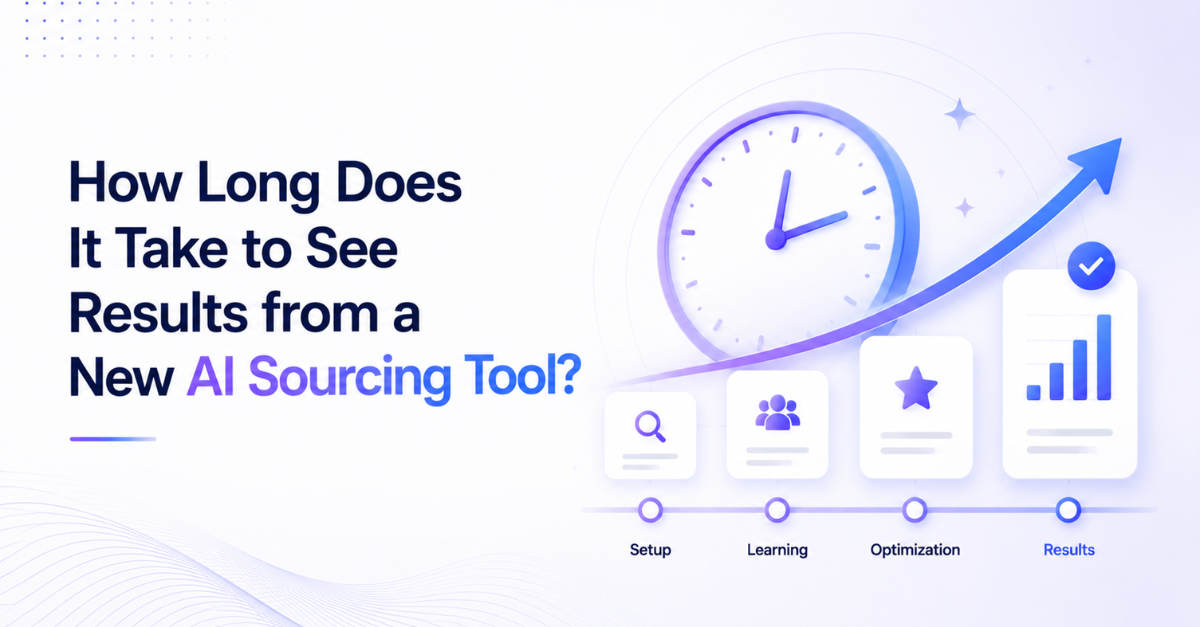
The timeline is usually:
Adoption → Productivity → Business Impact
The fastest-growing recruitment teams are not just using AI tools.
They are building AI-powered recruiting workflows where humans and AI work together.
Why AI Sourcing Results Are Not Instant
Many companies expect AI sourcing tools to work like a search engine:
Enter a requirement → Get candidates → Hire faster.
But recruiting is more complex.
AI performance depends on:
Quality of job requirements
Recruiter adoption
Workflow integration
Candidate engagement strategy
Data quality
Process optimization
A tool can generate thousands of candidate profiles, but the real impact comes from what happens next:
Are candidates relevant?
Do they respond?
Are they qualified?
Can recruiters move them through the pipeline faster?
The goal is not more activity.
The goal is better recruiting outcomes.
The AI Recruiting Results Timeline
First 30 Days: Adoption and Learning
The first month is usually about building familiarity.
Recruiters learn:
How to use AI-powered search
How to create better prompts
How to refine candidate criteria
How AI fits into existing workflows
During this stage, teams usually see:
Faster candidate discovery
Recruiters spend less time manually searching databases and profiles.
Instead of:
Reviewing hundreds of profiles
Creating multiple search strings
Manually filtering candidates
AI helps narrow down relevant talent faster.
Better sourcing consistency
Different recruiters often have different sourcing styles.
AI creates more standardized workflows.
A recruiter with less experience can leverage AI assistance to perform closer to the level of experienced team members.
Early productivity improvements
Teams may notice:
Less repetitive work
Faster research
Reduced administrative effort
However, this stage is mostly about adoption.
The question is:
Are recruiters actually changing how they work?
Days 30–60: Productivity Gains Start Appearing
After recruiters understand the tool, AI begins creating measurable efficiency.
This is where teams start seeing:
Reduced sourcing time
Traditional sourcing often includes:
Searching profiles
Checking experience
Writing outreach
Tracking responses
AI can automate parts of this process.
Recruiters can spend more time on:
Candidate conversations
Client communication
Hiring decisions
Increased recruiter capacity
One of the biggest benefits of AI sourcing tools is leverage.
Without AI:
One recruiter manages a limited number of roles.
With AI:
The same recruiter can support more hiring requirements because repetitive tasks are reduced.
The goal is not replacing recruiters.
It is increasing output per recruiter.
Faster candidate engagement
Finding candidates is only the first step.
AI can help with:
Personalized outreach
Follow-up sequences
Candidate qualification
Engagement workflows
This helps reduce candidate drop-offs.
Days 60–90+: Business Impact Becomes Visible
After consistent usage, companies can measure bigger outcomes.
This is where AI moves from a productivity tool to a business advantage.
Faster hiring cycles
When sourcing, engagement, and qualification improve:
Candidates move faster
Hiring managers receive profiles sooner
Interview delays reduce
This impacts:
Time-to-submit
Time-to-fill
Hiring velocity
Lower recruiting costs
AI can reduce hidden operational costs:
Manual sourcing hours
Repetitive recruiter work
Coordination effort
Candidate follow-up tasks
For agencies, this can improve:
Cost per placement
Recruiter utilization
Profit margins
Better client experience
Recruitment agencies compete on delivery.
Clients remember:
How quickly you respond
Candidate quality
Communication consistency
Hiring outcomes
AI helps agencies create a more reliable delivery engine.
How to Measure AI Sourcing Success
Many teams measure AI incorrectly.
They focus on:
❌ Number of profiles found
But volume does not equal success.
Better metrics include:
1. Recruiter Productivity
Measure:
Time spent sourcing
Roles managed per recruiter
Candidate submissions per week
AI success means recruiters produce more without increasing workload.
2. Candidate Quality
Track:
Qualified candidates generated
Interview conversion rate
Hiring manager acceptance rate
Finding candidates is easy.
Finding the right candidates is valuable.
3. Hiring Speed
Monitor:
Time-to-submit
Time-to-interview
Time-to-fill
The best AI workflows reduce delays across the hiring process.
4. Candidate Engagement
Track:
Response rates
Follow-up success
Candidate movement through pipeline
AI creates value when candidates actually engage.
Why Some AI Recruiting Implementations Fail
Not every company gets results from AI.
Common reasons:
1. Treating AI as a Tool Instead of a Workflow
Buying software is easy.
Changing habits is harder.
Teams often fail because they continue old processes with new technology.
The better approach:
Redesign workflows around AI.
2. Lack of Recruiter Training
Recruiters need to understand:
Where AI helps
Where human judgment matters
How to collaborate with AI
Without adoption, even the best platform becomes unused.
3. Measuring the Wrong Outcomes
If companies only measure:
"How many candidates did AI find?"
They miss the bigger picture.
AI impact should be measured across:
Productivity
Speed
Quality
Business outcomes
The Future: From AI Tools to AI Recruiting Infrastructure
The next generation of recruiting will not be about isolated AI tools.
It will be about intelligent recruiting infrastructure.
Modern AI systems can support the entire workflow:
Find → Engage → Qualify → Coordinate → Hire
This is where Agentic AI changes recruitment.
Instead of recruiters manually executing every step, AI agents can handle repetitive workflows while recruiters focus on:
Building relationships
Understanding clients
Making hiring decisions
The future recruiter is not replaced by AI.
The future recruiter is amplified by AI.
FAQ
How long does AI sourcing take to show results?
Most teams see early productivity improvements within the first 30–60 days. Larger business impact usually appears after consistent adoption over 60–90+ days.
When will AI recruiting show ROI?
ROI depends on adoption, workflow design, and business goals. Teams typically see ROI when AI reduces manual work and increases recruiter capacity.
Does AI sourcing work immediately?
AI can provide immediate assistance, but meaningful results require recruiter adoption and process optimization.
What affects AI recruiting success?
Key factors include:
Training
Data quality
Workflow integration
Usage consistency
Can AI reduce hiring time?
Yes. AI can improve sourcing speed, candidate engagement, and workflow efficiency, which can reduce overall hiring cycles.
What metrics should companies track?
Track:
Time-to-submit
Time-to-fill
Recruiter productivity
Candidate quality
Placement outcomes
What is Agentic AI recruiting?
Agentic AI recruiting uses AI agents that can execute recruiting workflows, not just provide recommendations.
Final Thoughts
The biggest mistake companies make with AI sourcing tools is expecting instant transformation.
AI creates value in stages:
First, recruiters adopt it.
Then, productivity improves.
Finally, business outcomes accelerate.
The real question is not:
"How fast can AI find candidates?"
The better question is:
"How quickly can your recruiting operation become AI-powered?"
The future belongs to teams that build Agentic AI Recruiting Infrastructure — where recruiters and AI work together to create faster, smarter, and more scalable hiring operations.
CTA:
Want to understand how quickly your recruiting team can benefit from AI?
Book a demo with Huntlo and discover your AI-powered hiring roadmap
Related Topic
Why Your AI Sourcing Tool Isn't Delivering Results (And How to Fix It)
How to Avoid Wasting Your AI Sourcing Tool's Free Trial
7 Common Mistakes Recruiters Make When Switching to AI Sourcing Tools