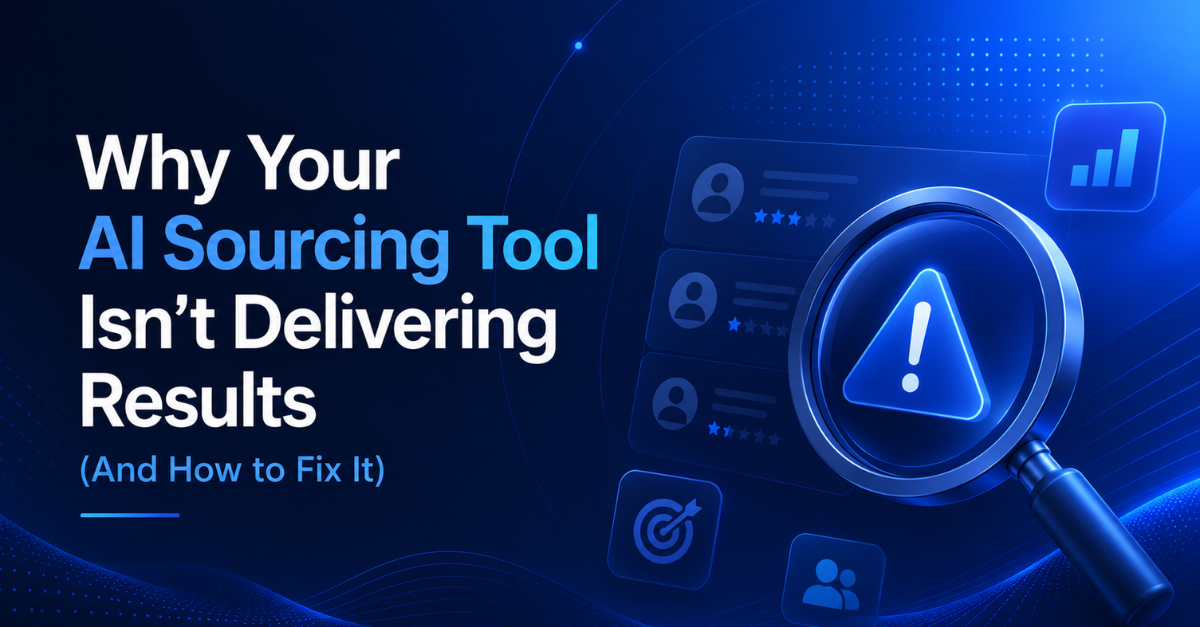
If your AI sourcing tool is not working, the problem may not be the technology. Many recruiting teams struggle because they automate candidate discovery but leave the rest of the hiring workflow manual. AI creates the most value when it connects sourcing, engagement, qualification, and execution into one recruiting system.
AI sourcing tools have become one of the biggest investments in modern talent acquisition.
Recruiting teams are adopting AI recruiting tools to:
Find candidates faster
Reduce manual sourcing effort
Improve recruiter productivity
Build stronger talent pipelines
But many companies eventually ask:
"Why is my AI sourcing tool not delivering results?"
The answer is usually more complicated than choosing a better tool.
The issue is often not the AI.
The issue is how the AI is being used.
A sourcing tool can find thousands of candidates.
But hiring does not happen because a list of profiles exists.
Hiring happens when candidates are:
Engaged
Qualified
Interested
Moved through the process
The biggest mistake companies make is treating AI sourcing as the entire recruiting solution.
It is only one part of the system.
The AI Sourcing Promise vs Reality
AI sourcing software promises to transform recruiting.
The promise:
"AI will find the perfect candidates automatically."
The reality:
AI improves discovery, but recruiting success depends on everything that happens after discovery.
Modern hiring requires:
Candidate research
Outreach
Follow-ups
Screening
Interview coordination
Decision support
A recruiter with an AI sourcing tool but a broken workflow will still face bottlenecks.
AI does not replace recruiting operations.
It exposes them.
Why Do Companies Invest in AI Sourcing Tools?
Recruiting teams adopt AI because traditional sourcing has limitations.
Manual sourcing often involves:
Searching multiple databases
Reviewing hundreds of profiles
Sending repetitive messages
Tracking candidates manually
Managing follow-ups
This creates problems:
Slow hiring cycles
Recruiter burnout
Candidate drop-offs
Missed opportunities
AI sourcing tools help by automating parts of candidate discovery.
They can:
Identify potential candidates
Analyze profiles
Recommend matches
Expand talent pools
But discovery is only the beginning.
Problem #1 — Expecting AI to Fix Broken Recruiting Processes
One of the most common reasons an AI sourcing tool is not working is because the underlying recruiting process is inefficient.
Technology cannot fix unclear workflows.
For example:
A company may use AI to find 1,000 candidates.
But if recruiters still manually:
Write every message
Track every response
Follow up manually
Coordinate interviews
The bottleneck remains.
Tools Do Not Replace Workflows
Successful AI adoption starts with understanding:
Where recruiters lose time
Which tasks repeat
Where candidates drop off
Which steps slow hiring
AI should improve the entire recruiting workflow.
Not just sourcing.
Problem #2 — Measuring Activity Instead of Hiring Outcomes
Many teams evaluate AI sourcing based on the wrong metrics.
They measure:
"How many candidates did AI find?"
But candidate volume does not equal recruiting success.
A better measurement framework focuses on outcomes.
Activity Metric
Outcome Metric
Candidates discovered
Qualified candidates
Profiles viewed
Interviews scheduled
Searches completed
Hiring velocity
Messages sent
Candidate conversions
The goal of AI recruiting is not more activity.
The goal is better hiring.
Problem #3 — Ignoring Candidate Engagement
A common mistake is automating sourcing while keeping candidate communication manual.
This creates a gap.
Finding candidates is easy.
Getting candidates interested is harder.
Outreach Challenges
Candidates receive many recruiting messages.
Generic outreach often performs poorly.
AI can help recruiters:
Personalize communication
Prioritize candidates
Maintain consistent outreach
Follow-Up Challenges
Strong candidates often disappear because communication slows down.
A delayed response can mean losing talent.
Automation helps maintain momentum.
Candidate Experience
The recruiting experience affects:
Response rates
Employer perception
Candidate conversion
AI should improve the experience, not make it more transactional.
Problem #4 — AI Is Not Connected to Your Workflow
Many companies use AI sourcing tools separately from their recruiting operations.
This creates disconnected systems.
Example:
Candidate discovery happens in one place.
Candidate management happens somewhere else.
Communication happens manually.
This creates:
Data gaps
Duplicate work
Slow handoffs
The future of recruiting requires connected workflows.
Problem #5 — Recruiter Adoption Issues
Even the best AI recruiting tools fail without adoption.
Common adoption problems include:
Recruiters do not trust AI recommendations
Teams do not understand how to use AI
Processes are not updated
Training is missing
AI should support recruiters.
It should not feel like another complicated system.
Build AI Into Daily Work
Successful teams define:
Which tasks AI handles
Which decisions need human input
How recruiters review recommendations
AI works best as a collaboration layer.
Problem #6 — Bad Inputs Create Bad Outputs
AI systems depend on information quality.
Poor inputs create poor results.
Common issues include:
Unclear job descriptions
Incorrect requirements
Outdated candidate data
Missing context
Garbage In, Garbage Out
If the system does not understand what a company needs, recommendations will suffer.
Teams should improve:
Job requirements
Candidate data
Evaluation criteria
Better inputs create better AI outcomes.
Problem #7 — Using AI Only for Sourcing
This is the biggest strategic mistake.
Many companies use AI only to find candidates.
But sourcing is only one stage of recruiting.
A complete hiring workflow includes:
Recruiting Stage
AI Opportunity
Discovery
Find relevant candidates
Engagement
Automate communication
Qualification
Evaluate fit
Follow-Up
Maintain momentum
Coordination
Reduce delays
The future is not better sourcing.
The future is automated recruiting execution.
How To Fix Your AI Recruiting Strategy
If your AI sourcing tool is underperforming, improve the system around it.
Step 1: Audit Your Workflow
Identify:
Manual tasks
Repeated activities
Delays
Candidate drop-offs
Step 2: Automate More Than Discovery
Expand AI usage into:
Candidate engagement
Screening support
Follow-ups
Coordination
Step 3: Measure Business Impact
Track:
Time-to-hire
Candidate conversion
Quality of hire
Recruiter productivity
Step 4: Create AI Operating Rules
Define:
What AI handles
What recruiters control
How decisions are reviewed
AI Sourcing Tools vs Agentic AI Recruiting
Traditional AI sourcing focuses on finding candidates.
Agentic AI Recruiting focuses on completing recruiting workflows.
Capability
AI Sourcing Tools
Agentic AI Recruiting Infrastructure
Candidate Discovery
Yes
Yes
Candidate Matching
Yes
Yes
Outreach
Limited
Yes
Follow-Ups
Limited
Yes
Qualification
Limited
Yes
Workflow Execution
No
Yes
Recruiting Operations
No
Yes
The shift is from AI recommendations to AI execution.
The Future of AI Recruiting
The next generation of recruiting technology will not simply answer:
"Who should we hire?"
It will help answer:
"What should happen next?"
AI agents will increasingly support:
Finding candidates
Engaging talent
Qualifying applicants
Coordinating workflows
Recruiters will spend less time managing tasks.
They will spend more time making decisions.
How Huntlo Helps Teams Move Beyond AI Sourcing
Huntlo is built around Agentic AI Recruiting Infrastructure.
The goal is not just candidate discovery.
It helps recruiting teams automate the complete workflow:
Candidate sourcing
Candidate engagement
Qualification
Follow-ups
Recruiting coordination
The future of AI recruiting is not another sourcing database.
It is intelligent recruiting execution.
Final Verdict
If your AI sourcing tool is not delivering results, the issue may not be the tool.
The real problem may be expecting sourcing automation to solve the entire hiring process.
AI creates value when it connects:
Discovery
Engagement
Qualification
Execution
The future belongs to recruiting teams that use AI as an operational layer, not just a search engine.
Frequently Asked Questions
Why is my AI sourcing tool failing?
AI sourcing tools often fail because companies automate candidate discovery but ignore workflows, adoption, and candidate engagement.
How do I improve AI sourcing results?
Improve job requirements, candidate data quality, recruiter workflows, and automate more than just sourcing.
Why are candidates not responding?
Low response rates often come from weak outreach, poor timing, and inconsistent follow-ups.
Does AI sourcing actually work?
Yes, AI sourcing can improve candidate discovery and recruiter productivity when integrated into a complete recruiting workflow.
How do companies measure AI recruiting ROI?
Companies should measure outcomes like time-to-hire, qualified candidates, conversion rates, and recruiter productivity.
Can AI replace recruiters?
No. AI automates repetitive work, but recruiters remain essential for judgment, relationships, and hiring decisions.
What is Agentic AI Recruiting?
Agentic AI Recruiting uses AI agents to execute recruiting workflows beyond simple candidate recommendations.
Related Topics