AI candidate matching can improve recruiter efficiency by analyzing large amounts of candidate data, identifying patterns, and recommending relevant talent. However, accuracy depends on data quality, context, and how recruiters use AI recommendations. AI is not a replacement for recruiter judgment — it is a tool to improve decision-making.
AI candidate matching has become one of the biggest promises in modern recruiting technology.
Recruiting teams are now using AI recruiting tools, candidate matching software, and talent intelligence platforms to identify potential candidates faster.
The idea sounds simple:
Feed a job description into an AI system, and it finds the best candidates.
But hiring is more complicated than matching keywords.
A candidate who looks perfect on paper may not be the right hire.
A great hiring decision depends on:
Skills
Experience
Motivation
Communication
Culture alignment
Business context
This raises an important question:
How accurate is AI candidate matching?
The answer depends on what we mean by accuracy.
If accuracy means finding profiles with similar skills and experience, AI can perform extremely well.
If accuracy means predicting who will become the best employee, the answer is more complex.
The future of recruiting is not about AI making decisions alone.
It is about AI helping recruiters make better decisions.
Why Is Everyone Talking About AI Candidate Matching?
The recruiting industry has always struggled with one problem:
Too many candidates.
Recruiters often review hundreds or thousands of profiles for a single role.
Traditional hiring workflows require recruiters to manually:
Search databases
Review resumes
Compare skills
Shortlist candidates
Build pipelines
This process is slow and inconsistent.
AI candidate matching attempts to solve this problem by using artificial intelligence to analyze candidate information at scale.
Modern AI hiring tools can evaluate:
Resume data
Skills
Career history
Job experience
Education
Industry background
The goal is simple:
Help recruiters identify stronger candidates faster.
How Does AI Candidate Matching Actually Work?
AI candidate matching combines multiple technologies to analyze candidate fit.
Data Analysis
AI systems process large amounts of recruiting data.
This may include:
Candidate profiles
Resumes
Job descriptions
Hiring requirements
Historical hiring patterns
The system identifies relationships between candidate information and role requirements.
Skill Matching
AI can compare candidate skills against job requirements.
For example:
A job description may require:
Python
Cloud infrastructure
Data systems
AI can identify candidates with:
Similar technical skills
Related experience
Transferable capabilities
This helps recruiters discover candidates beyond exact keyword matches.
Candidate Ranking
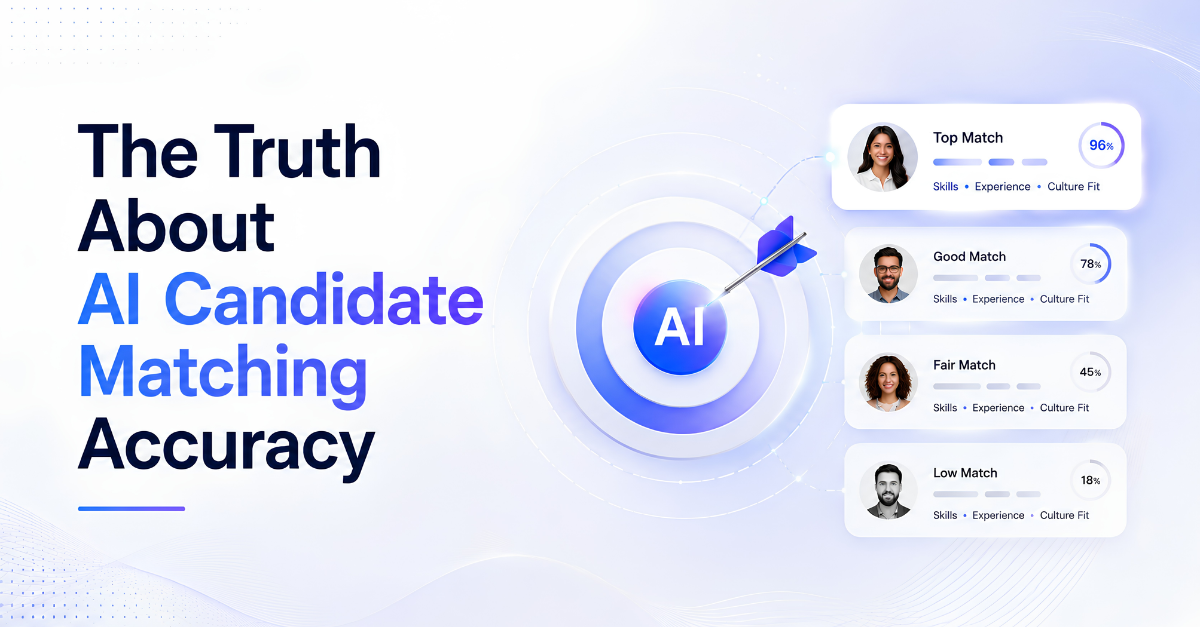
Many AI recruiting platforms rank candidates based on relevance.
A candidate scoring system may consider:
Skill overlap
Experience level
Industry match
Role similarity
This helps recruiters prioritize where to focus.
How Accurate Is AI Candidate Matching?
AI candidate matching accuracy depends on several factors.
There is no universal accuracy score because every recruiting environment is different.
The quality of AI recommendations depends on:
Factor
Impact on Accuracy
Data Quality
Better data creates better recommendations
Job Description Quality
Clear requirements improve matching
AI Model Capability
Better models improve analysis
Human Feedback
Feedback improves future recommendations
Hiring Context
Context improves decision quality
AI is only as good as the information it receives.
Where Does AI Candidate Matching Perform Well?
AI matching is powerful in specific areas.
Processing Large Candidate Pools
Humans have limited time.
AI can review thousands of profiles quickly.
This is valuable for:
High-volume hiring
Staffing agencies
Large talent pipelines
Enterprise recruiting
Finding Relevant Patterns
AI can identify relationships humans may miss.
A candidate may have:
Different job titles
Similar responsibilities
Transferable skills
AI can surface these connections.
Reducing Manual Screening
Recruiters spend significant time on early-stage screening.
AI can assist with:
Resume review
Candidate ranking
Initial recommendations
This allows recruiters to focus on higher-value activities.
Where Does AI Candidate Matching Fall Short?
AI matching is useful, but it has limitations.
Missing Human Context
A resume does not explain everything.
AI may understand experience.
But it may not fully understand:
Career goals
Personality
Motivation
Team dynamics
Human recruiters provide this context.
Bias From Historical Data
AI systems learn from existing data.
If historical hiring data contains bias, AI recommendations may reproduce those patterns.
This is why:
Data quality matters
Human oversight matters
Continuous evaluation matters
Over-Reliance On Patterns
AI is good at recognizing patterns.
But hiring sometimes requires looking beyond patterns.
A candidate with an unusual background may still be the best fit.
Can AI Predict The Best Candidate?
This is where expectations often become unrealistic.
AI can predict:
"Who looks similar to successful candidates?"
But hiring success depends on many unpredictable factors.
A successful hire depends on:
Performance
Motivation
Adaptability
Team environment
Leadership support
AI can improve the probability of finding strong candidates.
It cannot guarantee the perfect hire.
Why Matching Accuracy Alone Is Not Enough
A highly ranked candidate is not automatically a successful hire.
Recruiting requires moving candidates through the complete hiring journey.
After matching, teams still need:
Candidate Engagement
Recruiters must:
Start conversations
Build interest
Answer questions
Maintain relationships
Candidate Qualification
Recruiters need to understand:
Availability
Expectations
Role alignment
Requirements
Follow-Ups
Candidates often drop because communication slows down.
Consistent follow-up improves conversion.
Interview Coordination
Hiring involves multiple stakeholders.
Without workflow automation, teams still face delays.
How Should Recruiters Evaluate AI Matching Tools?
Recruiters should not evaluate AI only by matching claims.
Look at business outcomes.
Data Quality
Ask:
What data does the AI use?
How fresh is the information?
How complete are candidate profiles?
Explainability
Recruiters should understand:
Why was this candidate recommended?
Transparent recommendations create trust.
Workflow Integration
AI should fit into recruiting operations.
A great recommendation is less valuable if recruiters still manage everything manually.
Hiring Outcomes
Measure:
Quality of hire
Time-to-hire
Candidate conversion
Recruiter productivity
Hiring velocity
The goal is not better scores.
The goal is better hiring.
The Future of AI Candidate Matching
The future of AI recruiting is moving beyond candidate recommendations.
Traditional AI:
"Here are candidates."
Modern AI:
"Here are candidates and actions to take."
Agentic AI systems can support:
Candidate discovery
Engagement
Screening
Follow-ups
Coordination
This creates a more complete recruiting workflow.
How Huntlo Fits Into The Future Of AI Recruiting
Huntlo focuses on Agentic AI Recruiting Infrastructure.
The goal is not only helping recruiters identify candidates.
It is helping teams execute recruiting workflows.
This includes:
Candidate discovery
Candidate engagement
Qualification
Follow-ups
Recruiting coordination
AI becomes an operational layer that helps recruiters scale.
Final Verdict: The Truth About AI Candidate Matching Accuracy
AI candidate matching is powerful.
It can analyze more data, identify patterns, and reduce manual recruiting effort.
But matching accuracy alone does not create successful hiring.
The best recruiting outcomes come from combining:
AI intelligence
Human judgment
Automated recruiting workflows
AI does not replace recruiters.
It helps recruiters spend less time searching and more time making better decisions.
Frequently Asked Questions
How accurate is AI candidate matching?
AI candidate matching accuracy depends on data quality, job requirements, and the AI system used. It is highly effective for identifying relevant profiles but should support, not replace, recruiter decisions.
Does AI resume matching work?
Yes, AI resume matching can help identify candidates with relevant skills and experience. However, recruiters still need to evaluate context and fit.
Can AI find the best candidates?
AI can identify strong potential matches, but hiring success depends on factors beyond resumes, including motivation and team fit.
Is AI better than recruiters at screening?
AI is better at processing large volumes of information. Recruiters are better at understanding human context and making final judgments.
What are the limitations of AI matching?
AI can struggle with incomplete data, biased historical information, and situations requiring human interpretation.
Can AI replace recruiters?
No. AI automates repetitive tasks but recruiters remain essential for relationships, judgment, and decision-making.
Related Topics