Aarav spent eleven years building his engineering team at a Series D fintech company. His philosophy was simple: no candidate should ever wonder whether the company remembered them. He tracked every follow-up, every status update, and every delay personally. His offer acceptance rate was the highest in the company. When the company tripled its headcount target, Aarav could no longer keep up manually. Candidates he had spoken with enthusiastically two weeks earlier disappeared because his follow-ups arrived too late. His acceptance rate dropped by half in a single quarter. Then he adopted an AI recruiting platform that maintained continuous candidate awareness and prompted him at exactly the right moment. His acceptance rate recovered and exceeded its previous peak. The AI did not replace his philosophy. It made it operational at scale.
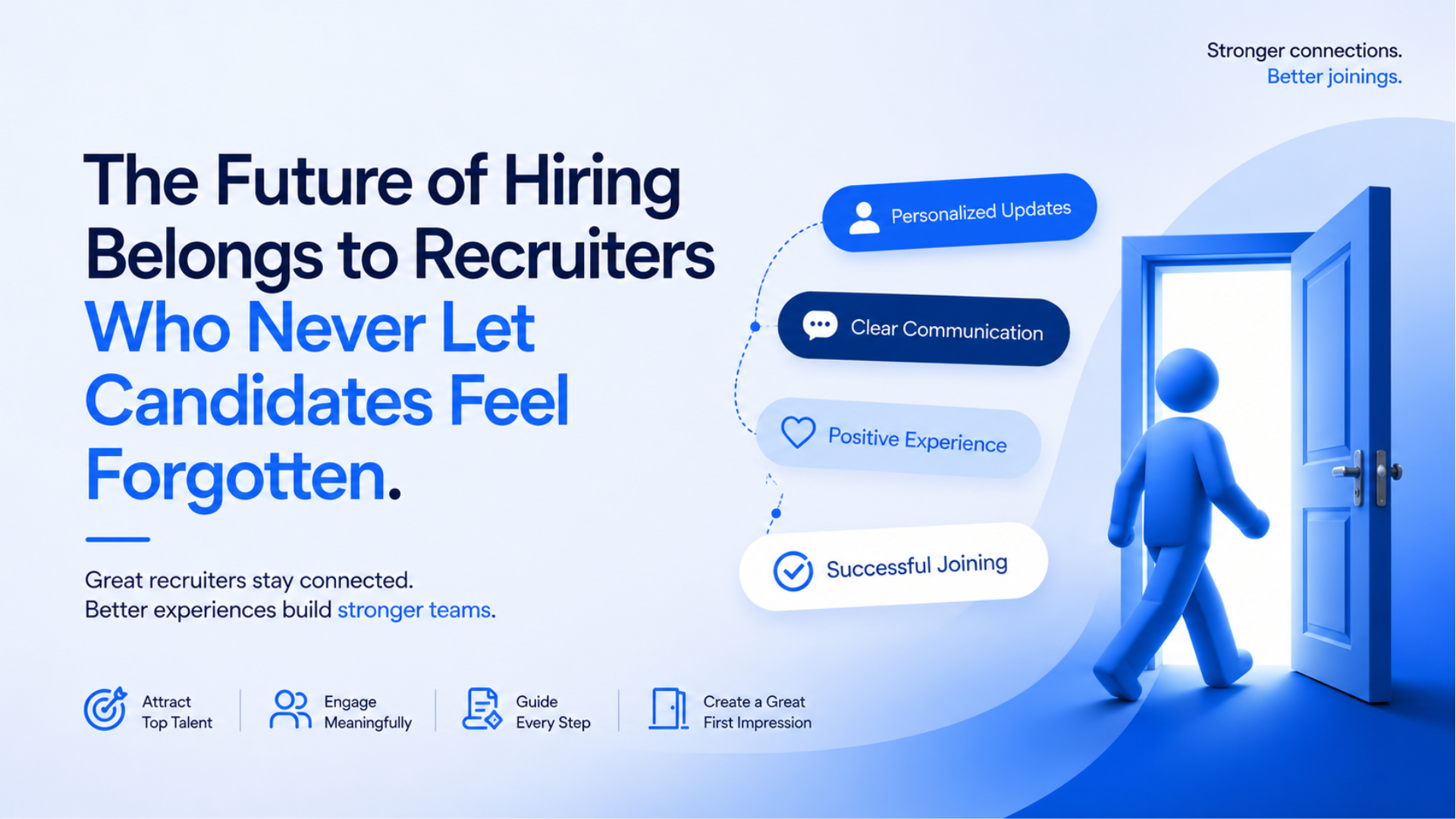
The recruiting profession is entering an era where the primary competitive differentiator is not which company has the strongest brand, the highest compensation, or the most attractive mission. It is which recruiter makes the candidate feel remembered. This shift is being driven by a fundamental change in candidate expectations. The modern candidate, particularly the passive candidate who is not actively looking but is open to the right opportunity, enters the hiring process with a low threshold for disengagement. They do not owe the recruiter their attention. They are doing the recruiter a favor by considering the opportunity, and they will withdraw the moment the experience suggests that the company does not value their time or their candidacy. The most common signal that triggers this withdrawal is not a low offer or a bad interview. It is silence. A gap in communication. A follow-up that arrives too late or feels
generic enough to suggest the recruiter has forgotten who they are. According to SHRM's talent acquisition research, the single strongest predictor of candidate withdrawal is not the offer stage but the waiting stages, the periods between screening and interview, between interview rounds, and between the final interview and the offer decision. In each of these waiting stages, the candidate's experience is defined entirely by whether they feel remembered or forgotten. Understanding the difference between AI sourcing and AI recruiting is critical here, because sourcing identifies candidates but recruiting is where the feeling of being remembered or forgotten is created. Huntlo's platform addresses this by providing continuous candidate awareness that ensures no candidate falls silent through the stages where relationships are won or lost.
The Feeling of Being Forgotten Is the Top Driver of Candidate Withdrawal
When a candidate feels forgotten, they do not usually tell the recruiter. They simply stop responding. Their withdrawal is silent, which makes it invisible in the pipeline metrics until the recruiter notices the lack of response and marks the candidate as withdrawn. By that point, the relationship damage is irreversible. The candidate has already formed the judgment that the company does not value their candidacy, and no amount of belated communication will reverse that perception. The specific moments where candidates feel forgotten follow a remarkably consistent pattern across industries and role levels. The first moment is after the initial screening call. The recruiter expresses enthusiasm, promises to follow up within a few days with next steps, and then the candidate hears nothing for a week or more. The second moment is between interview rounds. The candidate completes a strong first-round interview, is told they will hear back shortly, and then waits in silence while the hiring team reviews feedback at their own pace. The third moment is after the final interview, which is the most damaging silence of all because the candidate has invested the most time and emotional energy by this point and is most vulnerable to interpreting silence as rejection. According to McKinsey's organizational insights, these waiting stages account for sixty to seventy percent of all candidate withdrawals, a figure that dwarfs the withdrawals caused by offer-related factors. The candidate who withdraws during a waiting stage does not do so because they lost interest in the role. They do so because they concluded that the company lost interest in them. The distinction is important because it means the withdrawal was preventable. A single timely communication, even a brief status update that acknowledges the delay and provides a revised timeline, is often sufficient to prevent the candidate from disengaging. Teams that invest in understanding how many followups one hire actually needs discover that the most critical follow-up is not the one that closes the deal but the one that prevents the candidate from concluding they have been forgotten.
The irony of the forgotten-candidate problem is that the recruiter usually has not forgotten the candidate at all. They are simply overwhelmed. The recruiter who promised to follow up within three days may have intended to do so, but a hiring manager delayed their feedback, a scheduling conflict consumed their afternoon, and three other candidates reached offer stages that demanded immediate attention. By the time the recruiter circles back to the candidate
they promised to follow up with, ten days have passed and the candidate has already disengaged. This pattern is so common that it has become normalized in many recruiting organizations, treated as an unavoidable cost of doing business rather than a fixable operational failure. The normalization is dangerous because it obscures the magnitude of the damage. Each forgotten candidate represents not just a lost hire but a compounding brand cost, as that candidate tells their network about the experience, reducing the organization's ability to attract future candidates from the same talent pool. Organizations that stack tools without solving the underlying capacity problem often find they have more tools but the same hiring problems, because the tools automate individual tasks without addressing the systemic inconsistency that makes candidates feel forgotten. This is especially harmful when recruiting for niche and technical roles, where the candidate pool is limited and each lost candidate represents a significant proportion of the available talent. The recruiter who loses a candidate to silence in a small talent pool has no backup option, and the role stays open longer while the team starts the sourcing process over from the beginning.
How AI Prevents Candidates From Falling Through the Cracks
AI prevents candidates from feeling forgotten by maintaining continuous, real-time awareness of every candidate's journey stage, engagement level, and communication history, and by proactively alerting the recruiter when a candidate needs attention. This capability operates on three levels. The first level is awareness. The AI system maintains a live profile for every candidate in the pipeline, tracking not just their current stage but the cadence and quality of their recent interactions. If a candidate had a screening call four days ago and has not received a follow-up, the AI flags this as a risk. If a candidate completed an interview six days ago and has not received feedback, the AI escalates the alert. The second level is recommendation. The AI does not just tell the recruiter that a candidate needs attention; it suggests the specific type of communication that would be most effective based on the candidate's context, their prior interactions, their career motivations, and the stage they are in. A candidate who is waiting for interview feedback receives a different communication than a candidate who is waiting for an offer decision, and both receive communications that feel personal and informed rather than generic and automated. According to LinkedIn's recruiting resources, recruiters who use AI-powered engagement systems reduce their candidate withdrawal rates by thirty to forty percent within the first quarter, primarily because the system prevents the communication gaps that drive withdrawals.
The third level is autonomy. An agentic AI recruiting platform goes beyond awareness and recommendation to execute certain engagement actions independently, within parameters defined by the recruiter. It sends a contextual status update when a candidate has been waiting longer than the defined threshold. It provides the candidate with relevant information about the team, the role, or the company that adds value to their waiting experience. It schedules the next interaction proactively so the candidate never has to wonder when they will hear back. This autonomy does not replace the recruiter. It extends the recruiter's presence, ensuring that the candidate experiences continuous engagement even when the recruiter is personally
occupied with other candidates. The result is a hiring process where no candidate ever has reason to feel forgotten, because the AI maintains the recruiter's awareness and responsiveness at a level that manual effort cannot sustain across a large pipeline. Recruiters who worry about whether AI will replace their jobs should recognize that this capability makes their relationship skills more valuable, not less. The AI handles the operational consistency that prevents candidates from falling through the cracks, while the recruiter focuses on the high-touch, high-judgment interactions that convert candidates into hires. Huntlo's platform delivers this three-level capability, providing the awareness, recommendation, and autonomy that make every candidate feel remembered throughout the hiring process.
The Memory Advantage: Why Candidates Remember Recruiters Who Remember Them
There is a reciprocity to the remembered-candidate experience that produces long-term strategic value far beyond the immediate hire. When a candidate feels remembered throughout the hiring process, they remember the recruiter and the company. This memory persists even if the candidate does not receive an offer, or if they receive an offer and decline it. The candidate who felt remembered retains a positive association with the employer brand that influences their future behavior in three ways. First, they are significantly more likely to refer other strong candidates to the company, because their personal experience gives them confidence that their referrals will be treated well. Data consistently shows that referrals outperform cold outreach in both quality and conversion, and the candidate who felt remembered becomes an active source of high-quality referral flow. Second, they are more likely to re-engage when a future opportunity arises that matches their career goals. The candidate who withdrew or declined an offer six months ago but felt remembered throughout the process will respond positively to a new outreach, because their prior experience gives them trust in the recruiter and the organization. Third, they are less likely to speak negatively about the company in their professional network, which protects the employer brand from the reputational damage that forgotten candidates inflict. According to Gartner's HR trends research, candidates who rate their candidate experience as positive are four to five times more likely to refer others and three times more likely to re-engage in the future, compared to candidates who rate their experience as negative. The memory advantage compounds over time, creating a growing pool of candidates who trust the organization based on their personal experience or the experiences of people in their network.
The memory advantage also creates a competitive moat that is difficult for competitors to replicate. Compensation can be matched. Job descriptions can be copied. Employer branding campaigns can be imitated. But the cumulative effect of hundreds of candidates who felt remembered, who refer others, who re-engage for future roles, and who speak positively about the company in their networks, cannot be replicated by any single initiative or technology investment. It is built one candidate at a time, through consistent, high-quality engagement that makes every person in the pipeline feel valued. This is precisely the capability that AI enables at scale. The quality of the candidate data that supports this memory is essential. Teams that
have struggled with outdated candidate data in AI tools know that memory built on stale information backfires, because the candidate recognizes when the recruiter's communication does not reflect their current reality. When selecting technology, use the framework for evaluating an AI sourcing tool before buying to verify that data freshness and continuous intelligence updates are core to the platform. A recruiter who remembers a candidate's career update from three months ago, their published paper from last week, and their specific concern about relocation from the second screening call, demonstrates a level of attention that makes the candidate feel genuinely valued. AI provides this depth of memory for every candidate simultaneously, creating the memory advantage at a scale that manual effort cannot achieve. Huntlo delivers this continuous intelligence, ensuring every recruiter can make every candidate feel remembered, every time.
Building a Never-Forget Recruiting Culture
Operationalizing the never-forget philosophy requires more than deploying technology. It requires a cultural shift in how the recruiting organization defines success. In most recruiting teams, success is measured by outputs: roles filled, time-to-fill, cost-per-hire. These metrics are important, but they do not capture the candidate experience that produces those outputs. A team that fills roles quickly but leaves a trail of forgotten candidates in its wake is optimizing for short-term results at the expense of long-term capability. The never-forget culture redefines success to include the quality of the candidate experience as a first-class metric, measured by candidate withdrawal rate, candidate satisfaction scores, re-engagement rates for declined candidates, and referral flow from past candidates. These metrics create accountability for the experience that candidates have at every stage, not just the outcome at the end. According to Deloitte's talent research, organizations that measure and manage candidate experience as a strategic metric achieve twenty to thirty percent higher offer acceptance rates and forty to fifty percent lower candidate withdrawal rates, because the organizational focus on experience creates systemic pressure to maintain engagement quality throughout the process, not just at the stages where the recruiter has time to focus.
The cultural shift also changes how recruiting leaders allocate resources. In a traditional recruiting organization, resources are allocated based on role urgency and hiring manager demand, which means the candidates for the most urgent roles receive the most attention while the candidates for less urgent roles are left waiting. In a never-forget culture, resources are allocated based on candidate engagement risk, which means the candidates who are most likely to disengage if they feel forgotten receive proactive attention regardless of role urgency. This allocation is only practical with AI support, because manual resource allocation based on engagement risk requires real-time monitoring of every candidate's journey, which is beyond the capacity of any human recruiter or recruiting leader. According to EY's technology insights, the recruiting organizations that are building the strongest talent acquisition capabilities are the ones that use AI to operationalize their candidate experience values rather than treating those values as aspirational goals that depend on individual recruiter effort. Huntlo's platform enables this cultural shift by providing the real-time candidate intelligence,
automated engagement continuity, and proactive risk alerts that make the never-forget philosophy operational rather than aspirational. The future of hiring belongs to recruiters who never let candidates feel forgotten. AI makes that future achievable now. Start making every candidate feel remembered with Huntlo.