A company needs a senior engineer with experience in distributed systems, Apache Kafka, high-throughput event processing, and infrastructure operating at significant scale.
The recruiter enters the requirement into an AI sourcing tool.
The system returns 1,500 software engineers.
Many have Kafka somewhere on their profiles.
Some worked at companies that use distributed systems.
Several have impressive job titles.
The AI says they are strong matches.
The hiring manager reviews the first ten profiles.
Only one is genuinely relevant.
Did AI recruiting fail?
Possibly.
A different system receives the same requirement.
Instead of searching only for exact keywords, it looks at the type of systems candidates have built, the scale of their previous environments, adjacent technologies, career progression, project context, and evidence that their work involved the relevant technical problems.
It finds fewer people.
Several do not have the exact target title.
One has never used the phrase “high-throughput event processing” on a public profile.
The hiring manager reviews the shortlist.
Most candidates are worth discussing.
Did AI recruiting work?
Yes.
The difference is not whether artificial intelligence was used.
The difference is what the system understood.
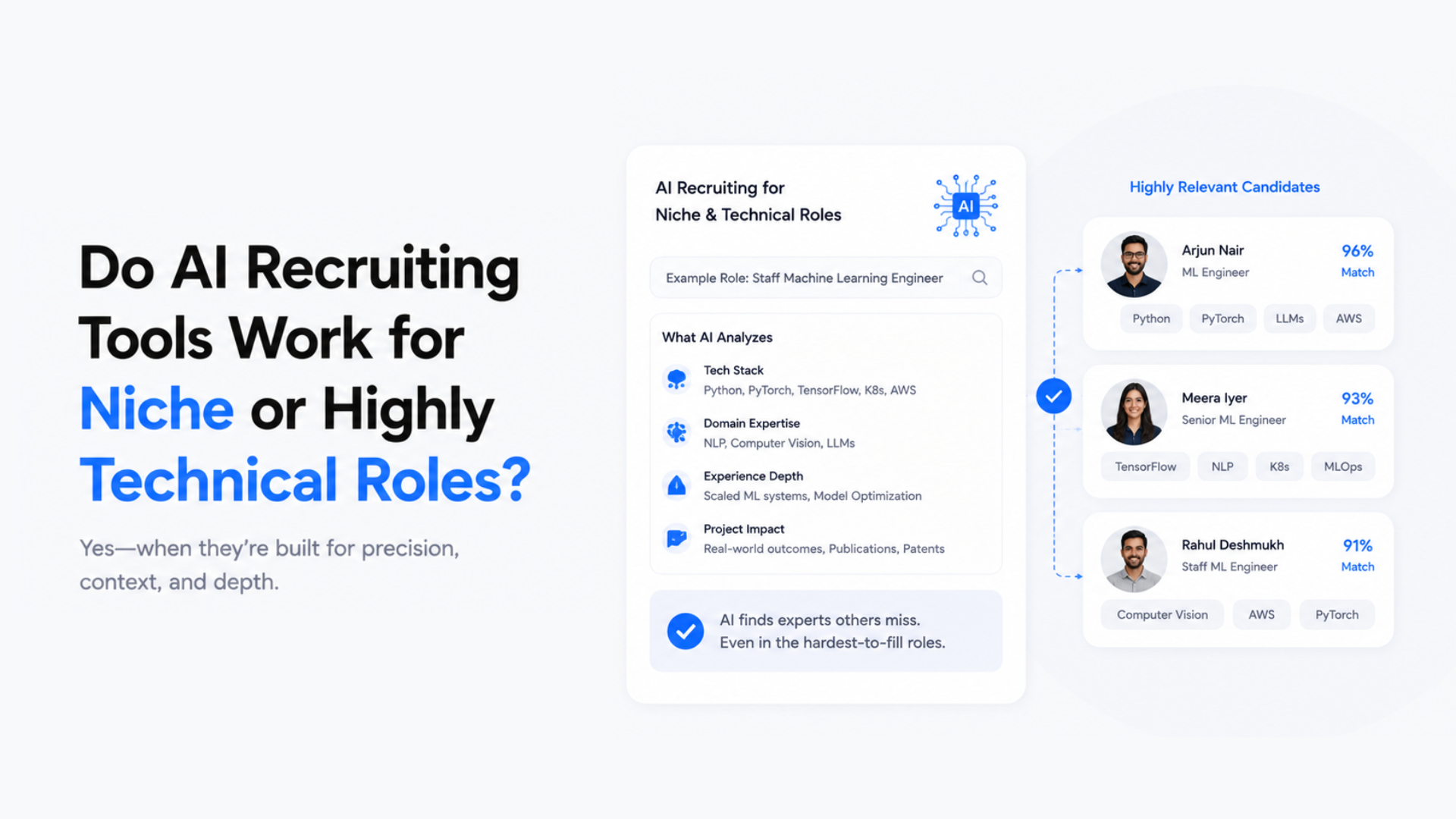
AI recruiting tools can work extremely well for niche and highly technical roles when they help recruiters search beyond exact titles and keywords, connect related skills, identify relevant career patterns, and surface evidence that explains why a candidate may fit. They work poorly when they automate shallow search, confuse company association with personal expertise, or treat a match score as proof of technical ability.
Specialist hiring is therefore one of the strongest tests of AI recruiting technology.
A weak system can appear impressive when hiring for a common role with thousands of obvious candidates.
A niche role removes that advantage.
The talent pool is smaller.
Terminology is less consistent.
Hiring managers care about details.
False positives waste expensive expert time.
False negatives may hide the few people who could actually do the work.
The tool needs more than speed.
It needs precision.
Why Niche and Technical Roles Are Difficult to Recruit For
The first problem is that the right candidates are rare.
A company hiring a general sales representative may have a large potential talent pool.
A company hiring an engineer with experience in a specific database architecture, regulated industry, security environment, and scale problem may have a much smaller one.
The second problem is that the same capability can appear under different language.
Two engineers may have solved similar problems.
One profile says distributed systems.
Another says event-driven architecture.
Another describes streaming infrastructure.
Another lists technologies without explaining the underlying work.
A keyword search may treat these candidates very differently.
The third problem is that job titles are unreliable.
A Machine Learning Engineer at one company may build production models.
At another, the person may focus primarily on data pipelines.
A Staff Engineer may be a deeply technical individual contributor.
At another company, the title may reflect a different scope.
A DevOps Engineer, Site Reliability Engineer, Platform Engineer, and Infrastructure Engineer may have overlapping experience while remaining meaningfully different.
The fourth problem is that recruiters may not understand every technical distinction.
This is not a criticism.
A recruiter can be excellent at talent acquisition without being able to design a distributed database or evaluate a machine-learning architecture.
The sourcing process still requires enough technical understanding to identify people worth showing to the hiring manager.
This is where AI can create value.
It can help translate a technical hiring requirement into a broader map of relevant skills, technologies, career paths, and candidate evidence.
The value disappears when the AI only creates a longer keyword list.
Niche Hiring Exposes the Limits of Keyword Search
Traditional technical sourcing often begins with Boolean logic.
The recruiter identifies required terms.
They combine titles.
They add technologies.
They exclude irrelevant profiles.
The search may look sophisticated.
It can still miss strong candidates.
A professional profile is not a complete technical biography.
Candidates do not list every technology they have used.
They may describe outcomes instead of tools.
They may use a newer term for work that was previously described differently.
A skill may be obvious from a project without appearing in the skills section.
Exact keyword search also creates false positives.
A candidate mentions Kubernetes because they worked near a platform team.
The search assumes deep Kubernetes experience.
A product manager worked on an AI product.
The search interprets the person as an AI engineer.
A software developer mentions cybersecurity in a project description.
The system treats the candidate as a security specialist.
AI sourcing can improve this process by interpreting context.
It can ask whether the candidate appears to have performed the work rather than merely mentioned the term.
That is a much more difficult problem.
It is also where modern AI sourcing becomes meaningfully different from traditional database search.
Huntlo’s guide to What Is Boolean Search in Recruiting (And Why AI Tools Are Replacing It) explains why rigid search logic becomes difficult when recruiters need to account for related titles, adjacent skills, and varied professional language.
For niche roles, this limitation becomes especially visible.
Strong AI Recruiting Starts With Understanding the Role
The quality of the candidate search depends on the quality of the hiring requirement.
A weak job description creates a weak search.
Consider this requirement:
“Need a senior backend engineer with Python, AWS, APIs, and microservices.”
The description sounds technical.
It is still broad.
Thousands of candidates may fit.
What kind of system will the person build?
What scale matters?
Which problems will they own?
Is Python genuinely required?
Does the company need deep AWS infrastructure experience or simply familiarity with cloud deployment?
Does microservices experience matter because of system architecture, organizational scale, or one particular project?
A strong AI recruiting system should help separate essential requirements from familiar words.
The real requirement may be:
The person needs to design backend systems that process high transaction volumes, operate across distributed services, and remain reliable during failure.
This creates a different search.
The AI can now look for evidence of similar problems.
The exact technology remains relevant.
The underlying capability becomes more important.
This shift from credentials and keywords toward demonstrable capabilities is part of the wider movement toward skills-based hiring. Research covering roughly eleven million UK job vacancies found evidence of employers adopting more skills-based hiring for AI roles as demand grew, with formal degree requirements declining while specific AI skills became more valuable.
For technical recruiting, this is important because the best candidate may not have the expected title or educational background.
They may still have solved the exact problem.
AI Can Connect Adjacent Skills
One of the strongest advantages of AI sourcing is its ability to understand relationships between skills.
Suppose the hiring team wants experience with one specific data technology.
The exact talent pool is small.
A recruiter using strict filters may find very few candidates.
A stronger AI system can identify professionals with experience in related technologies and similar technical problems.
This does not mean every adjacent skill is transferable.
The AI should not assume that familiarity with one programming language makes a candidate an expert in another.
The value comes from identifying plausible relationships.
A candidate may not have the exact cloud platform requested.
They may have designed similar infrastructure elsewhere.
A security engineer may not have the preferred certification.
They may have deeper practical experience in the required security domain.
An engineer may not have worked with the company’s exact database.
They may have solved similar problems involving distributed storage, replication, consistency, or performance.
The AI can widen the search intelligently.
The recruiter and hiring manager can decide whether the transfer is realistic.
This is much better than two extremes.
The first extreme is rigid keyword matching that misses adjacent talent.
The second is overly broad semantic matching that claims everyone is transferable.
Good technical sourcing needs controlled expansion.
AI Can Understand Career Progression Better Than a Simple Filter
Technical capability is not always visible in one job title.
Career progression can provide useful evidence.
A candidate may begin as a software engineer.
They move into backend infrastructure.
They become a senior engineer.
They later lead architecture for a specific platform.
The pattern may be highly relevant even if the current title does not match the recruiter’s search.
Another candidate may have the exact target title.
Their actual work may have remained narrow.
A traditional title filter can rank the second person higher.
A contextual AI system can consider the complete career path.
What types of problems has the candidate repeatedly worked on?
Has the scope increased?
Did they move toward the relevant specialization?
Have they worked in environments where the required problems are likely to exist?
Career progression should not become another hidden formula.
It is still evidence.
For niche roles, the pattern can help recruiters find candidates whose capability is clearer across several experiences than in one keyword.
AI Can Search for Technical Problems, Not Only Technologies
Technologies change.
Problems remain.
A company may need an engineer who can reduce infrastructure latency.
The current stack uses one set of tools.
A strong candidate may have solved the same performance problem using another stack.
A company may need someone who can build fraud-detection systems.
The exact models and platforms may differ.
The underlying experience with real-time decisions, false positives, data quality, and adversarial behavior may transfer.
A company may need an engineer for large-scale observability.
The candidate may have used different vendors.
The relevant experience lies in understanding system reliability, telemetry, incident response, and operational scale.
AI can help search at this problem level.
This is where natural-language search becomes useful.
The recruiter can describe what the person needs to accomplish.
The system can identify profiles containing evidence of similar work.
The quality depends heavily on the model and data.
A weak system may produce plausible but irrelevant connections.
A strong system can help the recruiter discover candidates outside the obvious keyword pool.
Technical Hiring Is Increasingly a Skills Problem
The market for technical talent is changing quickly.
Roles evolve faster than traditional job taxonomies.
AI engineering is a clear example.
A company may need experience with model evaluation, retrieval systems, AI agents, data infrastructure, security, or production deployment.
The ideal candidate may not have held the same title for five years because the role itself barely existed in its current form.
This makes rigid credential matching less useful.
Skills-based hiring is increasingly important because employers need to identify capabilities that may have been developed through different paths. SHRM has highlighted how AI-supported platforms can help connect candidate skill profiles with matching systems, while also emphasizing that skills-based hiring needs a process designed around actual capabilities rather than traditional proxies alone.
This does not mean degrees, employers, and titles become irrelevant.
They remain useful signals.
The mistake is treating them as complete proof of ability.
For niche roles, the talent pool may become unnecessarily small when recruiters insist on every traditional proxy.
AI can help expand the search.
Human experts still need to decide which evidence matters.
AI Can Find Candidates Recruiters Would Otherwise Miss
A technical recruiter often begins with known talent pools.
Competitor companies.
Familiar titles.
Expected universities.
Popular professional communities.
This creates a reasonable starting point.
It can also make searches repetitive.
Every recruiter finds the same candidates.
The same professionals receive constant outreach.
AI can expand discovery.
It may identify a candidate at a less obvious company who solved the same technical problem.
It may surface someone with an unusual title.
It may rediscover a previous applicant whose experience has changed.
It may identify a candidate moving from an adjacent specialization.
This is especially useful for passive candidate sourcing.
The best person for a niche role may not be applying.
They may not describe themselves using the exact language of the vacancy.
Huntlo’s guide to How to Source Passive Candidates Who Aren't Job-Searching explains why proactive discovery requires recruiters to search beyond people already signaling that they want a new job.
For niche roles, that wider search is often essential.
AI Does Not Eliminate the Need for Technical Recruiter Knowledge
A common mistake is assuming that AI makes domain knowledge unnecessary.
It does not.
The tool can help the recruiter understand a role.
It can expand terminology.
It can identify related skills.
It can summarize candidate evidence.
The recruiter still needs enough context to challenge the output.
Suppose the AI says a candidate is highly relevant because they have experience with Java and distributed systems.
The role requires deep experience building low-latency trading infrastructure.
The broad technical overlap may be real.
The candidate may still be wrong.
A recruiter who understands the hiring context can see the difference.
The best use of AI is therefore not replacing technical understanding.
It is increasing the amount of useful technical context available to the recruiter.
The AI can help a generalist recruiter become better prepared.
It should not make the recruiter blindly confident.
The Hiring Manager Still Needs to Define the Technical Reality
Many technical searches fail before sourcing begins.
The job description contains a long list of technologies.
The hiring manager says every skill is required.
The recruiter finds almost nobody.
AI cannot solve an impossible requirement.
The hiring manager needs to clarify priorities.
Which skills are truly essential on day one?
Which can be learned?
Which technologies have realistic substitutes?
Which problems must the candidate have solved before?
What scale matters?
What type of ownership matters?
Why did previous candidates fail?
A strong AI system can help structure these questions.
The hiring manager remains the domain authority.
This collaboration matters because technical recruiting often fails through translation.
The hiring manager understands the work.
The recruiter understands the talent market.
The AI can help connect the two.
AI Matching Works Better When It Explains the Match
A candidate receives a 92% match score.
What does that mean?
For a niche role, the number is not enough.
The recruiter needs to know why the candidate appears relevant.
The system may show that the person has worked on similar infrastructure.
Their career history includes two related technologies.
They have operated at the required scale.
One mandatory skill is not visible.
Another requirement is inferred from project context.
Now the recruiter can reason about the recommendation.
This is especially important when AI expands the search beyond exact matches.
A candidate with the perfect keywords needs less explanation.
An adjacent candidate needs more.
Why does the system believe the experience transfers?
Huntlo’s guide to How Does AI Candidate Matching Actually Work? explains why match scores are more useful when recruiters can connect them with underlying professional evidence.
For technical hiring, explainability is practical.
It helps recruiters avoid wasting hiring-manager attention.
False Positives Are Expensive in Technical Recruiting
A false positive is a candidate the system recommends who is not genuinely relevant.
Every sourcing tool produces some.
The cost becomes higher for niche roles.
A recruiter reviews the profile.
A technical lead reviews it.
Outreach begins.
The candidate responds.
A screening call happens.
Only then does the team discover that the person’s experience is much shallower than expected.
Several people have now spent time on the mistake.
This is why niche hiring should not be evaluated by candidate volume.
The system that finds 2,000 profiles may be less useful than the system that finds 50 highly relevant people.
Technical hiring needs precision.
The top results matter.
The hiring manager should not need to teach the AI the same lesson through hundreds of rejected profiles.
Huntlo’s guide to How Do You Know If an AI Sourcing Tool Is Actually Working? explains why sourcing performance should be measured through candidate relevance, qualified conversations, interviews, and recruiter effort rather than the number of profiles returned.
This principle becomes even more important when expert review time is expensive.
False Negatives May Be Even More Dangerous
False positives are visible.
The recruiter sees a bad candidate and rejects them.
False negatives are hidden.
The AI never surfaces the strong candidate.
The recruiter does not know what was missed.
This can happen when the system relies too heavily on exact titles.
It can happen when the candidate has an unusual career path.
It can happen when the profile is incomplete.
It can happen when the model overvalues prestigious employers.
It can happen when adjacent experience is not recognized.
For niche roles, a small number of false negatives can matter significantly.
The complete talent pool may already be limited.
Recruiting teams should occasionally test the system against known good candidates.
Take a successful hire.
Would the AI find this person for the role?
Take a strong candidate found manually.
Does the system surface them?
Take several rejected candidates.
Does the ranking reflect the real differences?
This type of testing reveals more than a polished vendor demonstration.
Candidate Data Quality Matters More for Niche Roles
A generalist search may survive one wrong skill.
A specialist search may depend on it.
Suppose the AI incorrectly infers that a candidate has experience with a niche technology.
The candidate moves to the top of a small search.
The recruiter contacts them.
The personalization mentions the technology.
The candidate says they have never used it.
The error becomes immediately visible.
Technical hiring places greater pressure on data quality because small details can determine relevance.
The system should distinguish between explicit evidence and inference.
“Candidate lists Rust” is different from “AI believes Rust experience is possible based on project context.”
The recruiter should understand the difference.
Huntlo’s guide to What Happens If an AI Sourcing Tool Gets a Candidate's Data Wrong? explains how one incorrect data point can spread into matching, outreach, screening, and recruiter judgment.
For niche roles, this propagation can happen quickly.
AI Should Not Infer Expertise From Employer Brand
A candidate works at a famous AI company.
The system assumes they have deep machine-learning expertise.
The person works in finance.
A candidate works at a major cloud company.
The system assumes they have designed cloud infrastructure.
Their role was unrelated.
A candidate works at a cybersecurity company.
The system assumes they are a security engineer.
They worked in marketing.
These examples sound obvious.
More subtle versions happen frequently.
A technical employee may work near a relevant system without personally building it.
A product manager may understand a technology deeply without being able to engineer it.
An engineering manager may have led a team without writing the system themselves.
The AI should examine the person’s role and evidence.
Company context can help.
It should not become proof.
This is one of the clearest differences between shallow AI sourcing and stronger contextual matching.
AI Cannot Fully Validate Technical Ability From Public Data
This limitation should be clear.
A sourcing tool can estimate relevance.
It cannot prove that a candidate can do the job.
A public profile may show impressive experience.
The candidate may perform poorly in a technical interview.
Another candidate may have a sparse profile.
They may be exceptional.
AI can identify signals.
It cannot directly observe every skill.
This is why technical validation remains necessary.
The process may include structured technical interviews.
Portfolio review.
Work samples.
Job simulations.
Coding exercises.
Architecture discussions.
The correct method depends on the role.
Skills-based hiring guidance increasingly emphasizes evaluating real-world ability through methods such as portfolios, structured interviews, assignments, and job simulations rather than relying only on resume proxies.
AI sourcing should improve who receives technical evaluation.
It should not pretend the evaluation has already happened.
AI Screening Can Help Before the Technical Interview
Technical experts often spend time on candidates who fail basic requirements.
The person cannot work in the required location.
They need a compensation level far outside the range.
They do not have the relevant type of experience.
They misunderstood the role.
An initial AI-assisted screen can collect this information.
It can also ask structured questions about the candidate’s experience.
For example, the system may ask the candidate to describe a relevant project.
What problem were they solving?
What was their personal responsibility?
What scale did the system operate at?
What trade-offs did they make?
The AI can organize the response.
The technical expert can review the evidence.
This can reduce unnecessary interviews.
The limitation remains important.
AI should not overstate its ability to judge complex technical depth from one answer.
A strong screening workflow helps prioritize expert attention.
It does not replace expert validation.
Highly Technical Roles Need Better Questions, Not Just Better AI
The quality of AI screening depends on the questions.
“Do you know Kubernetes?”
The candidate says yes.
The answer provides little information.
“Describe the largest Kubernetes environment you personally operated and the most difficult reliability problem you handled.”
The response creates more evidence.
The same principle applies across technical roles.
A cybersecurity candidate can describe a real incident.
A data engineer can explain a pipeline failure.
A machine-learning engineer can discuss model evaluation.
A product specialist can explain a domain-specific trade-off.
AI can help structure and summarize these responses.
The hiring team needs to define what strong evidence looks like.
Technical recruiting improves when the process asks better questions.
AI cannot compensate for vague evaluation criteria.
AI Can Help Recruiters Personalize Outreach to Technical Candidates
Technical candidates receive a great deal of poor outreach.
The recruiter mentions one keyword.
The role is obviously irrelevant.
The message says the candidate is a perfect fit.
The recruiter has misunderstood their work.
AI can improve personalization when the underlying candidate data is accurate.
The system can identify a credible connection.
The candidate worked on a similar technical problem.
Their current experience appears adjacent to the company’s challenge.
Their career progression suggests the opportunity may be relevant.
The outreach can focus on the work.
This is more effective than inserting several technologies into a template.
The strongest personalization is often simple.
Show that the recruiter understands something meaningful about the candidate’s experience.
Explain why the new role may be worth discussing.
Do not pretend to know more than the available evidence supports.
AI Outreach Can Also Fail More Spectacularly
The same system can create embarrassing mistakes.
It congratulates the candidate on a project they never worked on.
It describes them as an expert in a technology they mentioned once.
It confuses their current employer.
It uses technical language incorrectly.
For a specialist candidate, these errors are easy to notice.
The message can damage credibility immediately.
This is why AI-generated technical outreach should be grounded in high-confidence evidence.
The goal is not maximum personalization.
It is credible relevance.
One accurate reason for contacting the candidate is better than five uncertain observations.
Huntlo’s guide to How to Run Multi-Channel Outreach Without Sounding Like Spam explains why outreach quality depends on relevance, timing, and coordination rather than simply increasing the number of messages.
Technical talent often has many options.
Automation should make communication more informed, not more aggressive.
AI Works Differently for Different Types of Niche Roles
“Niche role” is a broad category.
A rare technical role may be difficult because the skill itself is uncommon.
A semiconductor engineer.
A quantitative researcher.
A specific cybersecurity specialist.
A robotics engineer with experience in a particular hardware environment.
Another role may be difficult because the combination is rare.
The company needs technical expertise, leadership experience, industry knowledge, and a particular location.
Another may be difficult because the title is inconsistent.
The same work appears under many labels.
Another may be difficult because the candidate data is sparse.
The strongest professionals do not maintain detailed public profiles.
AI will not perform equally across these situations.
It tends to work better when enough professional evidence exists and the relationships between skills can be interpreted.
It may struggle when the relevant capability is invisible.
This is why buyers should not ask whether the platform works for technical roles in general.
They should test their actual roles.
AI Recruiting Can Be Strong for Software Engineering Roles
Software engineering creates rich professional signals.
Programming languages.
Frameworks.
Open-source contributions.
Project descriptions.
Career history.
Company context.
Technical writing.
Public portfolios.
Not every candidate has all of these signals.
The available information can help AI understand relevance.
The challenge is avoiding superficial matching.
A developer who lists Python is not automatically relevant to every Python role.
The system needs to understand what the person built.
Backend services.
Data pipelines.
Machine-learning systems.
Automation.
Scientific computing.
The language is only one signal.
Strong AI sourcing for software roles should combine technology with problem context.
AI Recruiting Can Help With AI and Machine-Learning Roles
AI hiring is particularly difficult because the field changes quickly.
Titles are inconsistent.
Skills evolve.
Candidates may move between research, engineering, data science, infrastructure, and product work.
The ideal profile may not exist under one standard title.
Skills-based search becomes especially useful.
Research into AI-related hiring has found employers placing growing emphasis on specific AI skills while becoming more flexible about traditional educational requirements.
This creates an opportunity for AI recruiting tools.
They can search for capability combinations.
Model development.
Evaluation.
Deployment.
Data infrastructure.
MLOps.
Research experience.
Domain knowledge.
The system should still distinguish between exposure and depth.
Using an AI API is not the same as building machine-learning infrastructure.
Working on an AI product is not the same as training models.
Technical context remains essential.
AI Recruiting Can Help With Cybersecurity Roles
Cybersecurity contains many specializations.
Cloud security.
Application security.
Identity.
Incident response.
Threat intelligence.
Governance.
Security engineering.
Penetration testing.
A broad keyword search can produce a large number of irrelevant candidates.
AI can help understand the specialization.
The hiring team may need someone who has secured cloud infrastructure at scale.
A candidate with general security experience may not fit.
Another candidate with an unusual title may have exactly the required experience.
The system can improve discovery by connecting responsibilities with the actual security problem.
Technical validation remains essential.
Security experience can be difficult to infer from public information because candidates may not disclose sensitive details.
This is an example of a niche market where AI can improve search while still facing significant data limitations.
AI Recruiting Can Help With Hardware and Deep-Tech Roles
Hardware, semiconductor, robotics, aerospace, and other deep-tech roles create different challenges.
The talent pool may be smaller.
Professional profiles may contain less detail.
Skills can depend heavily on specific physical systems, manufacturing environments, tools, standards, or research experience.
AI can still help.
It can identify related employers.
It can connect adjacent technical domains.
It can understand research areas.
It can search patents, publications, or other professional evidence where legally and operationally appropriate.
The system may be less effective than it is for software roles with rich public data.
This does not make the tool useless.
It changes the role of AI.
The system becomes a research accelerator.
The recruiter may need more manual validation.
AI Recruiting Can Help With Specialized Non-Technical Roles Too
Niche hiring is not limited to engineering.
A company may need a regulatory expert with experience in one jurisdiction.
A healthcare specialist with a specific clinical and commercial background.
A finance professional with knowledge of one asset class.
A supply-chain leader with experience in a particular manufacturing environment.
The same AI principles apply.
Search beyond exact titles.
Understand related experience.
Consider career context.
Identify transferable capability.
Explain why the candidate appears relevant.
Avoid treating inference as fact.
The quality of the result depends on the available data and the clarity of the requirement.
AI recruiting is therefore better understood as contextual talent discovery.
Technical roles simply provide one of the hardest tests.
The Biggest Advantage May Be Market Mapping
Sometimes the hiring team does not know whether the ideal candidate exists.
The requirements are extremely specific.
AI can help map the market.
How many professionals appear to have the required combination?
Which companies employ them?
Which locations contain the strongest talent pools?
Which requirements are shrinking the search most dramatically?
What adjacent backgrounds exist?
This information can improve the hiring strategy.
The company may discover that the exact profile is extremely rare.
It can adjust compensation.
It can widen location.
It can remove a less important requirement.
It can consider adjacent skills.
It can build the capability internally.
This is an important use of AI recruiting for niche roles.
The tool does not only find candidates.
It helps the company understand the reality of the talent market.
AI Cannot Fix an Unrealistic Hiring Requirement
A company wants ten years of experience in a technology that has existed for four.
The candidate must have worked at one of five target companies.
They need several rare certifications.
They must live within commuting distance.
The salary is below market.
The company expects the AI to find 100 candidates.
No sourcing technology can solve this.
AI may actually be most useful when it exposes the problem.
The system can show that the talent pool is tiny.
It can identify which requirement is creating the greatest constraint.
It can suggest adjacent profiles.
The hiring team then needs to make a decision.
Technology cannot create talent that does not exist.
A strong recruiting system should help the company understand trade-offs.
It should not generate irrelevant profiles to make the result count look impressive.
AI Recruiting for Niche Roles Needs Human-in-the-Loop Review
Human review matters most when the system is uncertain.
The AI finds an unusual candidate.
The career path is adjacent.
The profile contains strong evidence but lacks one requirement.
The recruiter reviews the reasoning.
The hiring manager decides whether the transfer is plausible.
This is a productive use of human oversight.
The AI expands discovery.
The human interprets ambiguity.
The system should not require a person to manually repeat every task.
It should create review at the points where judgment matters.
This is especially important for niche roles because unusual candidates may be the most valuable candidates.
An overly rigid automated process can remove them.
How to Test an AI Recruiting Tool for a Niche Role
The best test uses a real difficult vacancy.
Do not begin with a generic role.
Choose the position the team has struggled to fill.
Define the essential requirements.
Separate them from preferences.
Give the system the real hiring context.
Review the top results.
How many are genuinely relevant?
Does the system find candidates the team missed?
Can it explain adjacent matches?
Does it confuse company experience with personal experience?
Does it overstate inferred skills?
How accurate is the candidate information?
Can the team reach the candidates?
Then continue the evaluation.
Do relevant candidates respond?
Do they become qualified conversations?
Does the hiring manager accept them?
Do they reach interviews?
The answer to whether AI works for niche roles should come from the funnel.
Not the demo.
Compare AI Results With Known Good Candidates
One useful test is retrospective.
Take a role the company filled successfully.
Give the AI the original requirement.
Does it find the person who was hired?
Does it rank that person highly?
Does the match explanation reflect the reasons the person was successful?
Now test other strong candidates from the process.
Does the system find them?
This does not prove future performance.
It reveals whether the AI understands examples the team already knows.
The test can also expose overfitting to titles.
A successful hire may have had an unconventional background.
If the AI consistently misses that person, the search logic deserves closer examination.
Measure Hiring-Manager Acceptance
Recruiters should not rely only on their own judgment when testing specialist sourcing.
The hiring manager should review a sample.
How many candidates would they genuinely consider?
How many are obviously irrelevant?
Why?
The reasons matter.
The system may repeatedly misunderstand one technical distinction.
The hiring manager may reveal that the original requirement was unclear.
This feedback can improve both the search and the hiring brief.
Hiring-manager acceptance is not a perfect metric.
Managers can also have narrow preferences.
It is still valuable for niche roles because technical relevance requires domain context.
The strongest process combines recruiter judgment, AI discovery, and expert validation.
Measure Time to Qualified Candidate, Not Profiles Found
Niche recruiting tools should not be judged by volume.
A database may return thousands of candidates.
The recruiter may need days to find one qualified person.
A better metric is time to qualified candidate.
How long does it take from receiving the requirement to identifying a person who survives meaningful recruiter and hiring-manager review?
Another useful metric is recruiter hours per qualified candidate.
This captures the real efficiency.
A tool may be expensive.
If it reduces weeks of manual research, the economics may still be strong.
A cheap tool that creates large amounts of cleanup can be expensive in practice.
When AI Recruiting Tools Work Best for Niche Roles
They work best when the hiring requirement is clear.
The system has enough candidate evidence.
The AI understands relationships between skills.
The search can consider adjacent experience.
Match recommendations are explainable.
Recruiters can review uncertainty.
Candidate data is reasonably accurate.
The workflow includes real technical validation.
The company is willing to adjust unrealistic requirements when market evidence demands it.
AI is strongest when it improves discovery and prioritization.
It is weaker when the organization expects the system to replace technical judgment.
When AI Recruiting Tools Struggle
They struggle when the role is poorly defined.
They struggle when the available candidate data is sparse.
They struggle when the required capability cannot be observed through professional evidence.
They struggle when job titles are used as proof of expertise.
They struggle when the system over-infers skills.
They struggle when the company insists on an impossibly narrow profile.
They struggle when recruiters trust scores without reviewing reasons.
They struggle when technical experts enter the process too late.
They struggle when the organization expects AI to validate ability that requires real work samples or expert conversation.
These are not reasons to avoid AI recruiting.
They are reasons to understand its proper role.
Where Huntlo Fits Into Niche and Technical Recruiting
Huntlo approaches specialist recruiting as a connected workflow rather than a one-time candidate search.
The process begins with the hiring requirement.
AI-powered sourcing can help identify professionals across multiple sources.
Candidate matching can help recruiters understand why particular people appear relevant.
The objective is not simply to return the largest possible list.
It is to surface evidence that helps recruiters decide who deserves attention.
Candidate and contact enrichment can make relevant profiles more actionable.
Outreach can then connect the opportunity with the candidate’s actual professional context.
Interested candidates can move toward qualification.
AI voice screening can collect structured information before technical experts spend time on the process.
Qualified candidates can then progress toward interviews where genuine technical depth can be evaluated.
This workflow matters for niche roles because every stage is expensive.
Finding the wrong candidate wastes sourcing time.
Contacting the wrong person wastes outreach.
Poor qualification wastes hiring-manager time.
Disconnected systems create repeated manual work.
For teams evaluating Huntlo or any other AI recruiting platform, the question should not be whether the system claims to support technical hiring.
The team should test whether it can understand their actual difficult roles.
Can it find candidates beyond exact keywords?
Can it explain adjacent experience?
Can it distinguish explicit evidence from inference?
Can it help move relevant candidates toward qualification?
Can it preserve human technical judgment where it matters?
Those questions reveal more than a feature list.
The Future of Niche Recruiting Is Likely to Be More AI-Assisted
Technical hiring is becoming more difficult in some areas, not less.
New specializations appear quickly.
Skill combinations change.
Job titles lag behind the work.
AI-related hiring in India, for example, continued to grow faster than overall IT recruitment in June 2026, reflecting stronger demand for specialized AI capabilities even within a softer technology hiring market.
This environment creates a strong use case for better talent intelligence.
Recruiters need to understand new skills.
They need to search across adjacent backgrounds.
They need to map smaller talent markets.
They need to move quickly when strong candidates appear.
AI can help with all of these tasks.
The future is unlikely to involve AI independently deciding who is technically qualified.
The stronger model is collaborative.
AI expands the search.
AI organizes evidence.
AI reduces repetitive work.
Recruiters manage the process.
Technical experts validate depth.
Hiring teams make consequential decisions.
Common Mistakes When Using AI for Niche Roles
The first mistake is giving the system a vague job description and expecting a precise shortlist.
The second is treating every requirement as mandatory.
The third is assuming more profiles mean better sourcing.
The fourth is trusting exact keyword matches without understanding context.
The fifth is allowing AI to infer deep expertise from company association.
The sixth is treating adjacent skills as automatically transferable.
The seventh is rejecting adjacent candidates too early.
The eighth is relying on one match score.
The ninth is failing to involve the hiring manager in defining the technical problem.
The tenth is expecting sourcing data to prove technical ability.
The eleventh is using AI personalization based on uncertain candidate information.
The twelfth is measuring search speed while ignoring hiring-manager rejection.
The final mistake is expecting AI to solve a talent-market problem that is actually caused by unrealistic requirements.
Conclusion: AI Works for Niche Roles When It Understands More Than Keywords
AI recruiting tools can work for niche and highly technical roles.
In many cases, these roles are where the strongest technology can create the most value.
The talent pool is difficult to find.
Titles are inconsistent.
Skills are related in complicated ways.
Strong candidates may have unusual career paths.
Traditional search can miss them.
AI can help recruiters interpret hiring requirements.
It can connect related skills.
It can identify adjacent experience.
It can search for evidence of technical problems.
It can expand passive candidate discovery.
It can explain why a person may deserve attention.
It can reduce the manual research required to create a shortlist.
The limitations are equally important.
AI cannot prove technical ability from a profile.
It cannot make poor candidate data accurate.
It cannot turn every adjacent skill into a transferable skill.
It cannot fix an impossible hiring requirement.
It should not replace technical experts in evaluating genuine depth.
The strongest model is therefore not autonomous technical hiring.
It is AI-assisted precision.
The system helps recruiters search more intelligently.
It helps them find candidates they may have missed.
It helps them understand why those candidates appear relevant.
It reduces repetitive work before expert evaluation.
The recruiter remains responsible for the process.
The technical expert remains responsible for validating technical capability.
The hiring team remains accountable for the decision.
For niche roles, the best AI recruiting tool is not the one that finds the most people.
It is the one that helps the team find the small number of people genuinely worth speaking with.
Frequently Asked Questions
Do AI recruiting tools work for technical roles?
Yes. Strong AI recruiting tools can improve technical hiring by understanding related skills, career context, adjacent experience, and professional evidence. They are less effective when they rely mainly on keywords or exact job titles.
Can AI recruit software engineers?
AI can help source, match, engage, and initially qualify software engineering candidates. Genuine technical ability should still be evaluated through appropriate technical interviews, work samples, or other role-relevant methods.
Can AI find candidates for very niche roles?
Yes, particularly when enough professional evidence exists. AI can search across related titles, adjacent skills, career patterns, and similar technical problems to identify candidates who may be missed by rigid search filters.
Is AI better than Boolean search for technical recruiting?
AI can be better at understanding varied terminology, related skills, and natural-language hiring requirements. Boolean search remains useful when recruiters need precise control over known criteria.
Can AI understand technical skills accurately?
AI can identify and interpret many technical signals, but it can also over-infer expertise. Recruiters should distinguish between skills directly supported by evidence and skills predicted by the system.
Can AI replace technical recruiters?
AI is more likely to reduce repetitive sourcing, research, outreach, and coordination work than replace technical recruiters. Recruiters still need to understand hiring context, manage relationships, challenge AI output, and work with technical stakeholders.
Can AI replace technical interviews?
No. AI can support initial qualification and organize candidate evidence, but complex technical ability often requires expert evaluation, work samples, structured interviews, or job simulations.
What is the best way to test an AI recruiting tool for niche roles?
Use a real difficult vacancy. Measure top-result relevance, hiring-manager acceptance, time to qualified candidate, data accuracy, candidate responses, and interview progression.
Why do AI recruiting tools fail on niche roles?
Common reasons include vague requirements, sparse candidate data, shallow keyword matching, excessive skill inference, poor understanding of adjacent experience, and unrealistic hiring criteria.
What is the biggest benefit of AI for niche recruiting?
The biggest benefit is often expanding discovery while reducing manual research. Strong systems can help recruiters find relevant candidates outside obvious titles, employers, and keyword combinations.
Related Topics
Understand why traditional search logic becomes restrictive for specialist hiring in What Is Boolean Search in Recruiting (And Why AI Tools Are Replacing It).
Learn how AI interprets professional evidence before ranking technical candidates in How Does AI Candidate Matching Actually Work?.
Explore how passive candidate discovery works when specialist talent is not actively applying in How to Source Passive Candidates Who Aren't Job-Searching.