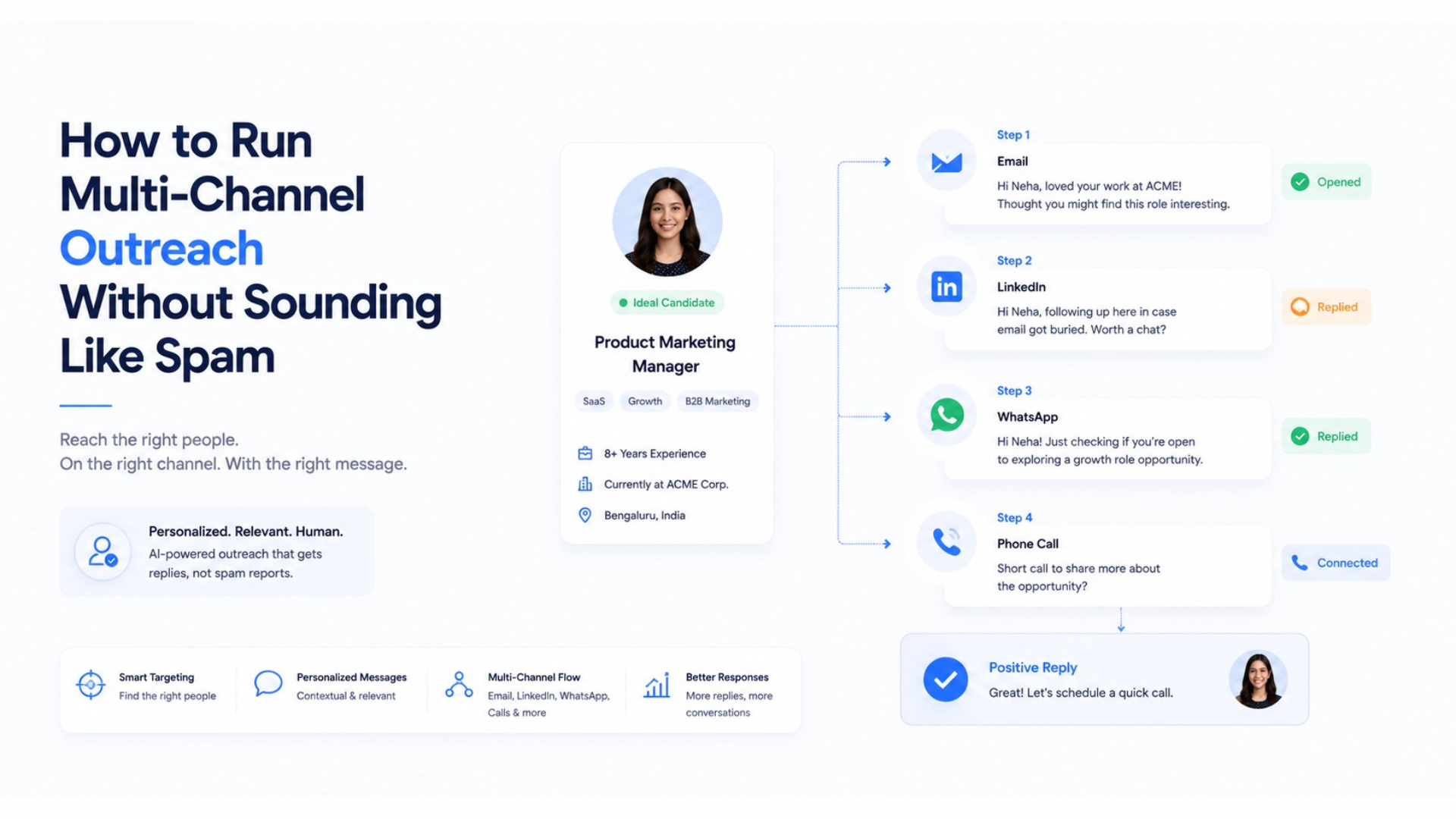
Recruiters use multiple channels because candidates do not all communicate in the same place. One candidate may respond quickly to email, another may notice a professional-network message first, and another may prefer a phone or WhatsApp conversation once initial interest has been established. The logic behind multi-channel outreach is therefore reasonable: if a strong candidate misses one message, another appropriate channel may create an opportunity for a conversation.
The problem begins when recruiters confuse using multiple channels with repeating the same message everywhere. A candidate receives an email on Monday, another email on Wednesday, a LinkedIn message on Thursday, a phone call on Friday, and a WhatsApp message the following week. Every interaction says approximately the same thing, and none of the channels appears to understand what happened on the others.
From the recruiter’s perspective, this may look like a structured outreach sequence. From the candidate’s perspective, it can feel like being followed by an automated campaign.
Running multi-channel outreach without sounding like spam requires recruiters to coordinate channels around candidate context rather than treating every channel as another opportunity to send the same pitch. The goal is not to maximize the number of times a candidate sees the recruiter’s name. The goal is to increase the probability of a relevant conversation while respecting the candidate’s attention and communication preferences.
This distinction becomes more important as AI makes candidate discovery and message generation easier. Recruiting teams can now identify more people, create more personalized messages, automate more follow-ups, and communicate across more channels. Without clear rules, however, the same technology that increases recruiter capacity can also multiply poor outreach.
A strong multi-channel strategy therefore needs more than automation. It needs relevance, sequencing, shared context, stopping rules, and an understanding of what each communication channel is actually good for.
What Multi-Channel Recruiting Outreach Actually Means
Multi-channel recruiting outreach is the coordinated use of more than one communication channel to engage potential candidates. Depending on the role, geography, candidate relationship, and recruiting model, these channels may include email, professional networks, phone calls, SMS, WhatsApp, or other appropriate communication methods.
The word coordinated is the most important part of the definition. Sending messages through several channels is easy. Creating one connected candidate conversation across those channels is much harder.
A disconnected approach treats every channel independently. The email system sends its scheduled follow-up because two days have passed. A recruiter sends a LinkedIn message because the candidate has not responded. Another recruiter calls because the profile appears in a different sourcing project. A WhatsApp message is sent because someone finds a phone number. The candidate experiences four separate recruiting systems rather than one professional relationship.
A coordinated approach understands that all of these interactions belong to the same conversation. If the candidate replies to an email, the LinkedIn follow-up should not continue as if nothing happened. If the person declines on WhatsApp, another recruiter should not restart the conversation three days later. If the candidate asks to reconnect in six months, that context should become part of the future recruiting relationship.
This broader concept is explained in Huntlo’s guide to multi-channel recruiting outreach, which covers how different channels can work together across candidate engagement. The practical challenge is not gaining access to more communication methods. It is deciding how and when to use them without creating pressure.
Why Recruiters Use Multiple Channels
Single-channel outreach has obvious limitations because candidate behavior is inconsistent. A strong professional may rarely check personal email during a busy workweek. Another may receive hundreds of professional-network notifications and overlook recruiter messages. Some candidates prefer written communication until they understand the opportunity, while others are more comfortable discussing the role by phone once initial interest exists.
Recruiters also face a visibility problem. A candidate may be relevant, interested, and open to a conversation but simply never see the first message. A thoughtful second attempt through an appropriate channel can therefore create value. Multi-channel outreach becomes useful when it increases the chance that a relevant candidate notices a genuinely relevant opportunity.
This is especially important in outbound recruiting, where recruiters proactively identify and contact people rather than waiting for applications. Passive candidates have not already decided to enter a hiring process, so the recruiting team needs to earn attention before it can evaluate interest.
The mistake is assuming that more visibility always produces more engagement. After a certain point, repeated contact does not make the opportunity more attractive. It simply makes the recruiter more difficult to ignore. Multi-channel outreach works only when every additional interaction has a clear reason to exist.
The Difference Between Persistence and Spam
Recruiters often struggle to know when reasonable persistence becomes excessive. There is no universal number of messages that automatically creates spam because context matters. A candidate who has already shown interest may expect several communications while moving through a hiring process. A person who has never responded to the company has a very different relationship.
The better distinction is based on whether each interaction adds value and responds to context. A useful follow-up may clarify the role, provide missing compensation information, explain why the candidate’s experience is relevant, or offer an easier way to continue the conversation. A spam-like follow-up simply repeats the same request because the previous message did not receive a response.
The difference also appears in channel escalation. Moving from email to another channel can be reasonable when the second channel is professionally appropriate and the recruiter has a strong reason for contacting the person. It becomes intrusive when the recruiter rapidly moves from public professional information to increasingly personal channels simply because the candidate has remained silent.
Silence is information. It may mean the candidate is busy, uninterested, satisfied in the current role, uncomfortable with the approach, or simply not ready to respond. Recruiters do not always know which explanation is correct, but they should not assume that silence is permission to increase pressure.
The strongest outreach strategies create enough opportunity for a candidate to notice the message without making avoidance difficult.
Start With Better Candidate Targeting
Poor multi-channel outreach usually begins with poor candidate selection. If the recruiter is contacting the wrong person, adding more channels will not improve the situation. It will only make the irrelevance more visible.
Before deciding how to contact someone, recruiters should understand why the person belongs in the search. The candidate’s experience should connect with the actual hiring problem, not merely with a job title or a few keywords. The recruiter should be able to explain what evidence in the person’s background created the interest.
This is particularly important when sourcing passive talent. Candidates who are not actively job-searching have little reason to tolerate poorly targeted communication. They did not apply, request information, or ask the company to contact them. The recruiter therefore carries more responsibility for making the interaction relevant.
Huntlo’s guide on sourcing passive candidates who are not job-searching explores this problem in more depth. The main principle is that passive candidates need a reason to enter the conversation, and repeated messages cannot compensate for the absence of that reason.
Before launching any multi-channel sequence, the recruiter should therefore ask whether the candidate is genuinely relevant enough to justify multiple contact attempts. Better targeting naturally reduces the need for aggressive outreach.
Understand the Candidate Before Choosing the Channel
Recruiting teams often choose channels based on tool availability rather than candidate context. If the software supports email, LinkedIn, phone, and WhatsApp, the team assumes all four should appear somewhere in the sequence.
A better strategy asks which channel makes sense for the candidate, market, role, and stage of the relationship. Senior professionals may expect a different approach from high-volume operational candidates. Communication norms in one country may differ from another. A candidate who has previously spoken with the company may be comfortable with a channel that would feel inappropriate for a completely cold prospect.
The recruiter should also distinguish between discovery information and communication permission. Finding a phone number does not automatically mean that calling or messaging the number is the best first action. The availability of a channel is not the same as the appropriateness of using it.
This is one reason multi-channel outreach cannot be reduced to a universal template. The same five-step sequence should not be applied to every candidate category. Recruiting teams need clear principles, but the exact channel mix should reflect the hiring context.
A useful strategy usually begins with the least intrusive professional channel that can communicate the opportunity clearly. Additional channels should be introduced only when they improve the conversation rather than simply increasing pressure.
Give the First Message Enough Information
Many follow-up problems begin because the first message is too vague. The recruiter says there is an “exciting opportunity,” mentions that the candidate has a “great background,” and asks for 15 minutes without explaining why the conversation should matter.
The candidate now has to do additional work. They may need to ask about the company, role, compensation, location, working model, or reason for contact. A passive candidate may decide that the easiest response is no response.
A stronger first message reduces uncertainty. It explains why the candidate was selected, what the opportunity involves, and what may be meaningfully different from the person’s current situation. Depending on the hiring context, useful details may include role scope, location, working model, compensation range, company stage, team responsibility, or the specific challenge the person would help solve.
The message does not need to become a complete job description. The purpose is to provide enough context for an informed initial decision.
This improves multi-channel outreach because later messages do not need to compensate for an unclear beginning. The recruiter can follow up around the same relevant opportunity rather than repeatedly asking the candidate to respond to a mystery.
Make Every Follow-Up Do Something Different
One of the clearest signs of spam is repetition. The first message asks whether the candidate is interested. The second says the recruiter is checking whether the candidate saw the first. The third says the recruiter does not want the candidate to miss the opportunity. The fourth announces a final attempt.
The sequence contains four messages but only one idea.
A better follow-up strategy gives each interaction a distinct purpose. The first message can establish relevance. A later message can provide information that helps the candidate evaluate the opportunity. Another may clarify a specific reason the recruiter believes the person’s experience fits. If the recruiter moves to another channel, the message can acknowledge the earlier contact rather than pretending that a new conversation has begun.
This does not mean inventing new reasons to contact the candidate. If the recruiter has nothing useful to add, another message may not be necessary.
The principle is simple: every additional contact should improve the candidate’s understanding or make the conversation easier. Repetition may increase message count, but it rarely increases trust.
Recruiting teams evaluating automation should pay close attention to this issue because many tools make sequences easy to build. Huntlo’s overview of the best AI tools for recruiter outreach and follow-ups can help teams think beyond simple message volume when comparing outreach technology.
Use Email for Context, Not Just Scale
Email remains useful because it allows recruiters to provide enough information without demanding an immediate response. Candidates can read the message when convenient, review the company, and decide whether the opportunity deserves attention.
The weakness of email is that automation makes volume easy. Recruiters can send large campaigns, generate variations, schedule follow-ups, and measure opens. This can encourage teams to optimize the mechanics of sending rather than the quality of the candidate conversation.
A strong recruiting email should make the reason for contact clear quickly. The candidate should understand why their background is relevant and what makes the opportunity potentially worth considering. The message should not depend on exaggerated language or artificial urgency.
Recruiters should also be careful with fake personalization. Mentioning a candidate’s company, university, or recent post does not automatically make the outreach relevant. Personalization becomes useful when the information explains why the person may fit the hiring problem.
AI can help recruiters research candidates and draft messages, but the standard should remain professional relevance. A unique message that is still irrelevant is simply personalized spam.
Use Professional Networks as a Different Context
Professional networks can be useful because candidates already expect career-related communication there. However, the channel should not become a copy-and-paste destination for the email sequence.
If the recruiter has already sent an email, the professional-network message can be shorter and more contextual. It can acknowledge that another message was sent and explain the reason for reaching out in one concise interaction.
This creates continuity.
The candidate does not need to wonder whether two different recruiters or systems are contacting them. The message shows that the recruiter understands the relationship across channels.
Professional networks can also help establish credibility before the conversation begins. The candidate can see who the recruiter is, understand the company, and decide whether the outreach appears legitimate.
The problem appears when connection requests, direct messages, profile views, comments, and automated follow-ups are combined into an aggressive attention strategy. Professional visibility should support trust, not manufacture pressure.
Use Phone Calls When the Relationship Justifies Them
Phone calls can create faster conversations, but they are more interruptive than written messages. This makes timing and context especially important.
A cold call may be appropriate in some recruiting markets and candidate segments, particularly where phone-based recruiting is already common. In other situations, a completely unexpected call may create discomfort.
Recruiters should consider whether the role, seniority, market, and previous interaction justify the channel. A candidate who has already expressed interest may appreciate a quick call. A completely cold senior professional may prefer to understand the opportunity before speaking.
The call should also respect the candidate’s ability to decline. If the person is busy, the recruiter should not force the conversation. The objective is to create a useful interaction, not to take advantage of the fact that the candidate answered.
Multi-channel outreach works best when channels are selected according to their strengths. Phone calls are valuable for real-time conversation, clarification, and relationship development. They are less useful when treated as another automated touchpoint in a sequence.
Use WhatsApp With Greater Context and Care
WhatsApp can be highly effective in markets where it is a normal part of professional communication. It can also feel significantly more personal than email or a professional network.
This means recruiters should use the channel carefully.
A candidate who has already engaged with the company may be comfortable continuing the conversation on WhatsApp. The channel can make scheduling, quick questions, and follow-ups easier. In some hiring markets, candidates may actively prefer it.
Cold outreach requires more judgment. Recruiters should consider local expectations, the nature of the role, how the contact information was obtained, and whether the message would feel appropriate to the recipient.
The message should identify the recruiter and company clearly. It should explain why the candidate is being contacted and make declining easy. The channel should never be used to create artificial urgency or continue pursuing someone who has already shown no interest elsewhere.
Huntlo’s approach to recruiting workflows includes candidate engagement across channels such as email and WhatsApp, but the value of channel access depends on coordination. A system should understand when the candidate has responded, declined, or moved forward rather than allowing every channel to continue independently.
Build One Conversation Across All Channels
The best multi-channel outreach feels like one conversation.
Imagine that a recruiter sends an email explaining why a candidate’s experience is relevant. The candidate does not respond. Several days later, the recruiter sends a short professional-network message acknowledging the email and briefly explaining the reason for contact. The candidate responds and asks for more information.
At that point, the original outreach sequence should stop.
The candidate is no longer an unresponsive prospect. They are an engaged person with a specific question.
This sounds obvious, but disconnected recruiting systems frequently fail at this transition. Scheduled messages continue because one system does not understand activity in another. The recruiter manually updates one tool but forgets another. A colleague contacts the same candidate separately.
This is where the difference between recruiting automation and a connected hiring workflow becomes important. Huntlo’s guide to AI candidate sourcing automation explains how sourcing technology can reduce manual candidate discovery, but discovery alone does not solve the coordination problem that appears after outreach begins.
A strong workflow should preserve candidate state. The next action should depend on what the person actually did.
Create Clear Stopping Rules
Every outreach sequence needs rules for when communication should stop. Without them, automation can continue long after the relationship has changed.
A clear decline should stop the sequence. A request to reconnect later should replace immediate follow-ups with the appropriate future context. A positive response should move the candidate into the next stage. A request not to be contacted should be respected across the recruiting organization, not only inside one campaign.
Silence also needs a stopping point. Recruiters should not continue indefinitely simply because the candidate never explicitly said no.
The exact number of attempts will vary according to the role and market, but every team should define a reasonable limit. More importantly, the limit should apply across channels. Three emails, two professional-network messages, two calls, and three WhatsApp messages should not be treated as separate small sequences. From the candidate’s perspective, they are ten contact attempts from the same company.
Stopping rules protect candidate experience and recruiter time. They also force teams to improve targeting and message quality instead of relying on persistence to compensate for weak outreach.
Do Not Automate Every Candidate the Same Way
Standardization can improve recruiting operations, but universal outreach sequences often create poor experiences.
A previous finalist should not receive the same message as a cold prospect. A referral should not be treated like someone discovered through an external search. A senior executive should not automatically enter the same sequence as a high-volume candidate. Someone who previously asked to reconnect should not receive a generic company introduction.
The candidate relationship should influence the workflow.
This is one reason a recruiting CRM can be important. Recruiters need access to relationship history, previous communication, candidate interests, and earlier outcomes. Without this context, every new search risks creating another cold start.
AI can help summarize candidate history and identify relevant context, but the recruiting team still needs to design different paths for different relationships. Automation should reduce repetitive work without erasing the differences between candidates.
Personalize Around Relevance, Not Personal Details
The rise of generative AI has made message personalization much easier. Recruiters can generate unique opening lines based on profiles, company information, posts, projects, and other available data.
This creates a temptation to personalize everything.
The problem is that candidates do not necessarily want recruiters to demonstrate how much information they have collected. A message can become uncomfortable when it mentions personal details that have little connection to the job.
Professional relevance is the safer and more useful standard.
The recruiter should explain which part of the candidate’s experience created the interest and how it connects with the opportunity. A technical project may be relevant because the hiring team is solving a similar problem. Experience in a particular market may matter because the company is expanding there. A leadership transition may be relevant because the new role offers broader scope.
The candidate should understand why the information matters.
The purpose of personalization is not to prove that the recruiter researched the person. It is to make the opportunity easier to evaluate.
Respond Quickly When the Candidate Engages
Recruiting teams often focus heavily on response rates but pay less attention to response speed.
A passive candidate finally replies with interest, and the message waits in an inbox. The recruiter responds the next day, asks for availability, and begins another round of coordination. Several days pass before the first real conversation.
This wastes the momentum created by the outreach.
A multi-channel system should recognize positive candidate signals quickly. The next step may be additional information, a recruiter conversation, structured qualification, or interview scheduling. The exact action depends on the hiring process, but the candidate should not wait because the recruiting team failed to notice the response.
This is particularly important when recruiters are running large outbound campaigns. More candidate discovery creates more replies to manage. If the workflow cannot react effectively, increasing outreach volume may actually create new delays.
Huntlo’s guide on reducing time-to-hire with AI sourcing and screening explains why faster candidate discovery creates limited value when positive signals still wait for manual action.
Measure the Quality of Outreach, Not Only the Volume
Multi-channel recruiting should not be measured by the number of messages sent. Activity metrics can help teams understand execution, but they do not reveal whether candidates are receiving useful communication.
Recruiters should examine how many contacted candidates are genuinely qualified, how many respond, how many responses are positive, how many conversations move toward screening, and how many sourced candidates eventually reach interviews.
Negative signals matter as well. High unsubscribe rates, complaints, repeated requests to stop contact, or low response rates among highly relevant candidates may indicate a problem with targeting, messaging, frequency, or channel choice.
The team should also examine where responses happen. If candidates consistently respond through one channel and ignore another, the sequence may need adjustment. If the second channel creates most of the positive conversations, the timing of the first may be wrong.
The objective is not to prove that multi-channel outreach creates more activity. It is to understand whether the strategy creates more qualified conversations without damaging candidate trust.
How AI Can Improve Multi-Channel Outreach
AI can help recruiters research candidates, identify relevant professional evidence, draft outreach, summarize conversations, prioritize responses, and coordinate next actions. These capabilities can reduce the manual work required to manage outbound recruiting.
The strongest use of AI is not unlimited message generation. It is context management.
A useful system should understand that a candidate has already been contacted. It should recognize when the person responds. It should stop irrelevant follow-ups. It should preserve a request to reconnect later. It should help the recruiter understand the conversation before taking the next action.
This is where the concept of an AI Hiring OS becomes relevant. The opportunity is to connect sourcing, engagement, screening, and workflow execution rather than adding another isolated AI feature.
The risk is that AI makes poor outreach cheaper. A recruiting team can generate thousands of messages that appear personalized without improving candidate relevance. Technology increases the consequences of both good and bad strategy.
AI should therefore reduce the work around a good recruiting conversation. It should not remove the need to decide who deserves that conversation.
Where Huntlo Fits Into Multi-Channel Outreach
Huntlo approaches outreach as part of a broader recruiting workflow rather than an isolated messaging campaign. Candidate sourcing, engagement, follow-ups, response handling, qualification, and interview movement are connected parts of the same process.
This matters because many recruiting teams already have tools for sending messages. Their larger problem is coordination. Recruiters search in one platform, move candidate data elsewhere, launch outreach, monitor replies, conduct screening, schedule interviews, and manually update systems.
The recruiter becomes the integration layer.
Huntlo’s agentic AI approach is designed around reducing more of this manual orchestration. AI can support candidate discovery, while engagement can happen through channels including email and WhatsApp. Candidate responses can influence what happens next, and interested people can move toward qualification and scheduling without requiring the recruiter to manually restart every stage.
The objective is not to contact candidates through every possible channel. It is to use the right channels inside a connected workflow.
This distinction is important because the future of recruiting outreach will not be won by the company that sends the most messages. As AI makes communication easier, candidates will receive more automated outreach from more recruiters.
The advantage will come from relevance, timing, context, and response.
A Practical Multi-Channel Outreach Workflow
A strong workflow begins before the first message is sent. The recruiter defines the hiring problem, identifies the evidence of candidate fit, and decides why the opportunity may matter to someone who already has a job.
Relevant candidates are then prioritized. The first channel is selected according to the role, market, and candidate relationship. The initial message provides enough information for the candidate to understand the reason for contact.
If the candidate does not respond, a follow-up adds useful context rather than repeating the same request. Another appropriate channel may be introduced later, but the message acknowledges the earlier interaction.
The moment the candidate responds, the workflow changes. Positive interest creates a next step. A question receives an answer. A decline stops the sequence. A request to reconnect later becomes future context.
The recruiter remains responsible for important judgment. Automation handles more of the repetitive coordination around that judgment.
This is the difference between a sequence and a conversation.
Common Multi-Channel Outreach Mistakes
The first major mistake is using every available channel simply because the software supports it. Channel availability should not determine candidate strategy.
The second is repeating the same message everywhere. The candidate experiences this as pressure rather than persistence.
The third is using personalization without relevance. A unique opening line cannot fix a weak candidate match.
The fourth is allowing channels to operate independently. Follow-ups continue after the candidate has responded elsewhere.
The fifth is escalating too quickly into more personal channels. Recruiters should consider professional norms and candidate context before calling or messaging.
The sixth is failing to stop. Silence becomes an excuse for unlimited attempts.
The seventh is responding slowly when the candidate finally shows interest. The team spends significant effort creating attention and then wastes the result.
Every one of these mistakes comes from the same problem: the recruiting team optimizes message delivery instead of candidate conversation.
Conclusion: More Channels Should Create More Context, Not More Noise
Multi-channel recruiting outreach can help recruiters reach candidates who may miss a single email or prefer another form of communication. It is particularly useful for passive candidate sourcing and outbound recruiting, where the strongest people may never apply through a traditional job posting.
However, more channels do not automatically create better engagement.
When email, professional networks, phone, and WhatsApp operate independently, candidates receive repeated messages without a coherent conversation. Automation increases activity, but trust declines.
The better approach begins with candidate relevance. Recruiters should understand why the person belongs in the search and why the opportunity may deserve attention. The first message should provide enough context for an informed decision, and every follow-up should have a distinct purpose.
Channels should be coordinated. Candidate responses should change the workflow. Positive interest should move quickly. Declines should stop outreach. Requests to reconnect later should become useful context.
AI can make this process more scalable by supporting research, personalization, response understanding, and workflow execution. Its value, however, depends on how the recruiting team uses it.
The future of multi-channel outreach is not a larger sequence.
It is a more intelligent conversation.
The recruiting teams that succeed will not be the ones that contact candidates everywhere. They will be the ones that understand when another channel improves the relationship and when another message would simply become noise.
Frequently Asked Questions
What is multi-channel recruiting outreach?
Multi-channel recruiting outreach is the coordinated use of more than one communication channel, such as email, professional networks, phone, or WhatsApp, to engage potential candidates. The channels should share candidate context rather than operate as separate campaigns.
How do recruiters avoid sounding like spam?
Recruiters should target relevant candidates, explain the reason for contact, provide useful information, vary the purpose of follow-ups, coordinate communication across channels, and use clear stopping rules.
Should recruiters contact candidates on multiple channels?
Multiple channels can be useful when the role, candidate relationship, market, and communication norms make them appropriate. Recruiters should not use every available channel automatically.
How many follow-ups should a recruiter send?
There is no universal number, but the sequence should have a clear limit. Recruiters should count total contact across all channels rather than treating email, phone, and messaging attempts as separate sequences.
Should recruiters use WhatsApp for candidate outreach?
WhatsApp can be useful in markets where it is a normal professional communication channel, particularly after candidate engagement begins. Cold outreach requires greater care because the channel may feel more personal.
Can AI automate multi-channel recruiting outreach?
AI can support candidate research, message drafting, follow-ups, response interpretation, conversation summaries, and next actions. Important candidate context and human judgment should remain part of the workflow.
What should happen when a candidate replies on one channel?
Other automated outreach should adapt or stop according to the response. The candidate should experience one connected conversation rather than separate sequences on different channels.
Why do candidates ignore recruiter outreach?
Common reasons include weak targeting, generic messages, missing role information, poor timing, excessive contact, irrelevant personalization, or lack of a meaningful reason to consider the opportunity.
How should multi-channel outreach be measured?
Recruiting teams should measure qualified candidate rate, response rate, positive response rate, conversation rate, screening conversion, interview conversion, and candidate-experience signals rather than focusing only on message volume.
Related Topics
Understand the broader strategy behind coordinated candidate communication in What Is Multi-Channel Recruiting Outreach?.
Learn how proactive recruiting differs from waiting for job applications in What Is Outbound Recruiting (And How Is It Different From Inbound)?.
Explore the technology category focused specifically on candidate communication in Best AI Tools for Recruiter Outreach and Follow-Ups.