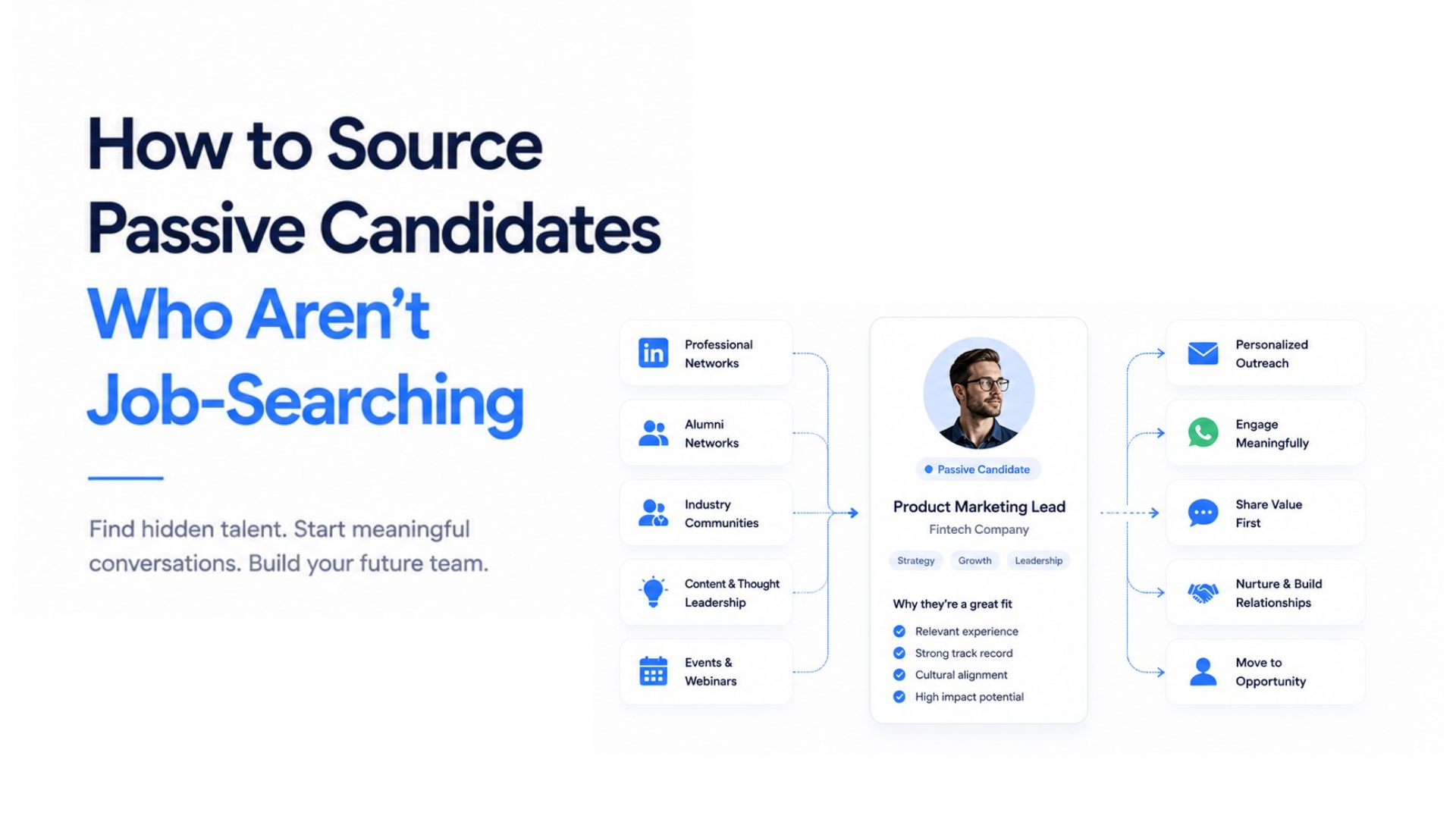
An active candidate and a passive candidate may have similar experience, but they enter the recruiting process from completely different positions.
The active candidate has already decided that change is possible.
They may be unhappy with their current role, unemployed, approaching the end of a contract, seeking higher compensation, relocating, or simply ready for something new. Whatever the reason, the psychological barrier to considering another job has already been reduced.
The passive candidate has not necessarily made that decision.
They may be performing well in their current company. They may have strong relationships with colleagues. They may expect a promotion. Their compensation may be competitive. Their commute may be convenient. Their family may depend on the stability of the current role.
A recruiter is therefore not only asking them to consider a job.
The recruiter is asking them to reconsider their current situation.
This changes the conversation.
A job description alone is rarely persuasive enough.
The candidate needs to understand why the opportunity may be relevant to their career, what could be meaningfully different, and why the conversation deserves attention now.
This is why passive sourcing requires more than search accuracy.
It requires market understanding, candidate context, timing, and communication.
Stop Treating “Passive Candidate” as One Category
Not every person who is not applying for jobs is equally passive.
Some candidates are completely satisfied and have no interest in moving.
Others are not actively searching but would consider an exceptional opportunity.
Some are becoming dissatisfied but have not yet started applying.
Others are waiting for a bonus, promotion, project completion, relocation, or personal milestone before considering change.
A candidate may also be passive only in relation to the current role.
They may ignore an opportunity that looks similar to their existing job but respond to one that offers greater responsibility, a new industry, a stronger product, a better manager, or a different working model.
This means recruiters should avoid thinking of the talent market as two simple groups: active and passive.
Candidate readiness exists on a spectrum.
The objective is not to convince every satisfied professional to leave their employer.
It is to identify people whose experience matches the requirement and determine whether the opportunity connects with something that could matter to them.
This perspective improves sourcing efficiency.
The recruiter spends less time trying to force uninterested people into conversations and more time identifying where relevance and timing may overlap.
Start With the Hiring Problem, Not the Search Filters
Passive candidate sourcing often fails before the first profile is found.
The recruiter receives a job description and immediately begins searching for titles and keywords.
The problem is that job descriptions are not always good sourcing documents.
They may contain internal language, unrealistic requirements, outdated responsibilities, or a long list of preferences presented as essential criteria.
Before searching, the recruiter needs to understand the actual hiring problem.
What does the person need to accomplish?
Which experience would provide evidence that they can do it?
Which skills are genuinely essential?
Which requirements can be learned?
Why would someone who already has a good job consider this opportunity?
The last question is especially important for passive talent.
If the recruiter cannot explain what is meaningfully attractive about the opportunity, candidate sourcing may produce profiles but engagement will remain difficult.
A passive candidate is unlikely to move simply because the employer has an opening.
The opportunity needs a credible reason to matter.
That reason may be greater responsibility, stronger career progression, a difficult technical challenge, access to a new market, better leadership, higher compensation, more flexibility, or another meaningful change.
The sourcing strategy should understand this before outreach begins.
Define the Evidence of Fit
A strong passive sourcing strategy looks for evidence rather than exact profile similarity.
Imagine a company needs an enterprise salesperson.
A weak search may focus only on candidates with the exact target title.
A stronger search looks at what the successful person actually needs to have done.
Have they sold a comparable product?
Have they managed a similar deal size?
Have they worked with the right type of buyer?
Have they succeeded in a relevant market?
Have they handled a similar sales cycle?
The same principle applies across functions.
An engineer may use a different title but solve similar technical problems. A recruiter may work in another industry but have experience with the same hiring model. A marketing leader may have built the exact growth capability the company needs without using the expected keywords.
Passive candidates are often difficult to find because their profiles were not written for the recruiter’s current vacancy.
They are not optimizing resumes for an application.
Their profiles may be incomplete, outdated, or written around a different professional identity.
This is where semantic and AI-supported sourcing can create value.
The search can begin with the evidence of success rather than depending entirely on exact keywords.
Map the Talent Market Before Contacting Anyone
Recruiters often move too quickly from search to outreach.
A few relevant profiles appear, and messages begin immediately.
For difficult passive searches, market mapping should come first.
The recruiter should understand where relevant people are likely to work, which companies develop the desired experience, how titles vary, which adjacent backgrounds may transfer, and how large the realistic candidate market is.
This creates a better sourcing strategy.
Suppose a company needs a specialized product leader.
The obvious competitors may produce relevant candidates, but they may also be heavily targeted by every other recruiter in the market.
Adjacent companies may contain professionals with transferable experience who receive far less outreach.
A talent map helps reveal these possibilities.
It also helps recruiters challenge unrealistic requirements.
If the target market contains only a small number of people, the company may need to expand the location, compensation, seniority, industry background, or other criteria.
This learning is valuable before the recruiter sends hundreds of messages.
The objective is to understand the market before trying to extract candidates from it.
Search Beyond Exact Job Titles
Job titles are inconsistent.
One company calls someone a Customer Success Manager. Another uses Client Partner. A third uses Account Manager for a similar role. A startup may give a senior title to someone whose responsibilities are more junior than the title suggests.
Exact-title sourcing can therefore miss relevant passive candidates.
Recruiters should search around responsibilities, skills, career progression, company type, product environment, and evidence of outcomes.
AI sourcing can help by interpreting the hiring requirement more broadly than a fixed keyword query.
The system may identify related titles and experience patterns that the recruiter did not initially include.
This is particularly useful when the talent market is unfamiliar.
However, broader search should not become careless search.
The recruiter still needs to understand why each candidate may fit.
The goal is to move beyond exact words without moving away from the actual hiring requirement.
A passive candidate is more likely to respond when the recruiter clearly understands their experience.
Poor search quality becomes poor outreach quality.
Look at Career Trajectory, Not Only Current Role
A candidate’s current title provides only one part of the story.
Career trajectory can reveal much more.
Has the person taken on increasing responsibility?
Have they moved from execution into leadership?
Have they repeatedly worked in similar business environments?
Did they join companies at a particular growth stage?
Have they changed industries successfully before?
Passive candidates may be especially interesting when their career direction aligns with the opportunity.
For example, a senior individual contributor may be approaching a leadership transition. A manager may have reached the limit of progression inside a small team. A professional may have spent several years in one environment and be ready for a different challenge.
Recruiters should not assume these motivations.
But career patterns can help identify useful questions.
The outreach can then invite a conversation rather than pretending the recruiter already knows what the candidate wants.
This creates a more credible approach.
The recruiter is not saying, “I know you want to leave.”
They are saying, “Your experience suggests this particular opportunity may be worth discussing.”
Use Company Mapping to Find Relevant Passive Talent
One of the most effective ways to source passive candidates is to identify the environments that produce relevant experience.
The recruiter can ask which companies solve similar problems, sell to similar customers, use comparable technology, operate at a similar stage, or develop the capabilities the hiring team needs.
This creates a target-company map.
The map should not be limited to direct competitors.
Adjacent companies can be valuable.
A candidate may come from a different industry but work with the same buyer. Another may use a different technology but solve a similar problem. A professional in a larger company may have experience that transfers to a scale-up.
The recruiter should also avoid repeatedly targeting the same famous employers.
The most obvious companies receive the most recruiter attention.
Strong candidates may exist in less visible organizations.
AI can help expand company mapping by identifying related businesses and experience patterns.
But the recruiter needs to understand why the companies belong in the search.
A list of logos is not a talent strategy.
The useful question is what experience those environments are likely to create.
Search Your Existing Candidate Database First
The best passive candidate may already be known to the company.
A previous finalist may have stayed in their current role.
A sourced candidate may have declined because the timing was wrong.
A former applicant may have gained several years of relevant experience.
An employee referral may have entered the database before a suitable role existed.
Recruiting teams often ignore these relationships because external sourcing feels easier than candidate rediscovery.
The recruiter begins a new search, finds the same person again, and sends another cold message.
This wastes previous recruiting investment.
Before searching externally, review the ATS, recruiting CRM, previous sourcing projects, referral records, and former candidate pipelines.
Ask which people were strong but unavailable.
Look at previous finalists.
Review candidates who asked to reconnect later.
Search for people who were relevant to similar roles.
The company may already have more passive talent than it realizes.
The problem is often not candidate scarcity.
It is organizational memory.
Use Employee Networks Without Turning Referrals Into Spam
Employees can provide access to passive candidates who may never respond to cold recruiter outreach.
A trusted former colleague can create credibility that a generic message cannot.
But referral programs often ask the wrong question.
“Do you know anyone for this job?” requires the employee to search their entire network mentally.
A more specific approach works better.
Recruiters can explain the type of experience required, the companies where relevant people may work, and the problem the future hire will solve.
Employees can then think more clearly about former colleagues, industry contacts, customers, partners, or professional communities.
The recruiter should also make participation easy.
Employees should not be expected to sell the job or pressure their contacts.
A warm introduction can be enough.
The recruiting team should handle the conversation professionally from there.
Passive candidate sourcing works best when trust is preserved.
An employee relationship should not become another distribution channel for generic recruitment messages.
Use Professional Communities Carefully
Strong passive candidates often spend time in places connected to their work rather than job search.
They may participate in professional communities, technical groups, industry events, conferences, open-source projects, alumni networks, or specialized online discussions.
These environments can help recruiters understand who is active and respected in a field.
However, communities should not be treated as candidate databases.
A recruiter who enters a professional group only to extract names and send messages may damage the employer brand.
The better approach is to understand the community.
What topics matter?
Who contributes useful knowledge?
Which people appear to have relevant experience?
How do members expect to be approached?
The first recruiting interaction should respect the context in which the person was discovered.
A technical contributor may respond poorly to a message that reduces years of work to a keyword match.
A thoughtful message can acknowledge the specific evidence that created the recruiter’s interest.
The difference is attention.
Passive candidates are more likely to engage when they understand why the recruiter contacted them specifically.
Use AI Sourcing to Expand the Search, Not Lower the Standard
AI can help recruiters find passive candidates faster.
Natural-language search can reduce the time spent building complex queries. Semantic matching can identify candidates whose profiles use different language. Related titles and skills can expand the search. Large talent markets can be explored more quickly.
This creates a major productivity advantage.
It also creates a risk.
When candidate discovery becomes easy, recruiters can lower the cost of poor sourcing.
A system can generate hundreds of profiles quickly. The recruiter may assume that more candidates create more opportunities.
The opposite can happen.
Weak candidate lists create more review work.
Poorly matched people receive irrelevant outreach.
Response rates decline.
The employer brand suffers.
Recruiters become overwhelmed by activity that does not move the role forward.
AI should therefore improve the time to the first relevant candidate conversation.
It should not simply increase the number of profiles generated.
The recruiter still needs to define the requirement, understand the market, review the evidence, and decide which candidates deserve engagement.
Understand Why the Candidate Might Move
A passive candidate is not waiting for a job description.
The recruiter needs to understand what could make a conversation worthwhile.
This does not mean guessing the candidate’s personal motivations.
It means understanding the potential difference between the current situation and the opportunity.
What can the new role offer that the candidate may not already have?
The answer could be scope.
A candidate may gain responsibility for a larger team, market, product, or business function.
It could be growth.
The opportunity may provide a clearer path toward leadership or a new specialization.
It could be the work itself.
The candidate may have the chance to solve a more difficult problem, build something from the beginning, or work with a stronger technical environment.
It could be company stage.
Some professionals want to move from a large organization to a growth company. Others want more stability.
Compensation can matter, but it should not be the only story.
A passive candidate with a good job often needs a meaningful reason to accept the risk and effort of change.
The recruiter should understand that reason before beginning outreach.
Research Enough to Be Relevant
Personalization has become one of the most misunderstood ideas in recruiting.
Some recruiters believe personalization means adding the candidate’s first name.
Others mention the current company.
More advanced templates may include a sentence generated from the candidate’s profile.
None of this automatically creates relevance.
A personalized message can still be irrelevant.
The most useful research answers one question:
Why might this opportunity make sense for this person?
The answer should come from professional evidence.
The candidate may have worked on a similar product.
They may have scaled a function the hiring company is now building.
Their experience may connect with a specific challenge.
Their career progression may suggest that the scope of the new role is relevant.
This does not require writing a biography.
Passive candidate outreach should respect the candidate’s time.
A concise message with one strong reason for contact is often better than a long message filled with superficial details.
The recruiter should research enough to establish relevance, not enough to make the message uncomfortable.
Write Outreach Around the Candidate, Not the Vacancy
Most recruitment outreach is structured around the employer.
The company is growing.
The company has an exciting role.
The company has raised funding.
The company has a great culture.
The company wants to schedule a call.
The passive candidate did not ask for any of this.
A stronger message begins with the connection between the candidate’s experience and the opportunity.
Why did the recruiter choose this person?
What specific problem could their experience help solve?
What is meaningfully different about the role?
Why might the conversation be useful even if the candidate is not actively searching?
The message should make it easy to say no.
This may appear counterintuitive.
But passive candidate sourcing is built on trust.
A candidate who feels pressured is more likely to ignore the recruiter.
A candidate who understands that the conversation is exploratory may be more willing to respond.
The objective of the first message is not to close the candidate.
It is to earn the next conversation.
Do Not Lead With the Full Job Description
A long job description is rarely the best first message to a passive candidate.
The person has not decided to apply.
They may not even be interested in changing jobs.
Sending a large block of responsibilities and requirements asks them to do too much work too early.
The first outreach should create enough relevance for a conversation.
The recruiter can explain the problem the company is solving, why the candidate’s background stood out, and what makes the opportunity potentially different.
If the candidate shows interest, more information can follow.
This creates a more natural progression.
Passive recruiting should not force an application process onto someone who has not yet decided whether the opportunity deserves attention.
The first goal is curiosity.
The second is conversation.
The formal hiring process comes later.
Mention Compensation When It Helps the Candidate Decide
Compensation transparency can improve passive candidate sourcing.
A professional who is not actively looking may be unwilling to enter several conversations without understanding whether the opportunity is financially realistic.
Providing a range can help candidates decide whether the discussion is worth continuing.
This reduces wasted time for both sides.
However, compensation alone rarely creates a strong passive candidate strategy.
A higher salary may attract attention, but the candidate still needs to understand the role, scope, company, risk, and career value.
The strongest outreach gives enough information for an informed initial decision.
The exact balance depends on the market and role.
The principle is simple.
Do not hide basic information that the candidate needs to decide whether a conversation makes sense.
Passive candidates already have jobs.
Their tolerance for unnecessary recruiting steps is usually lower.
Use Follow-Ups, but Know When to Stop
Passive candidates are busy.
A lack of response to one message does not always mean rejection.
The message may have arrived at a bad time. The candidate may have intended to respond later. The subject line may have been missed.
A reasonable follow-up can therefore create value.
The problem is excessive automation.
Some recruiting sequences continue for weeks across several channels.
The candidate receives email after email, followed by professional-network messages, phone calls, and other attempts.
This can turn a potentially useful future relationship into a negative employer-brand experience.
A follow-up should add value.
It can clarify the opportunity, provide useful information, or make the reason for contact easier to understand.
Repeating “just checking in” several times rarely improves the conversation.
Recruiters should also define stopping rules.
If the candidate declines, stop.
If they ask to reconnect later, preserve that timing.
If they do not respond after a reasonable sequence, leave the relationship open rather than escalating endlessly.
Good passive sourcing respects silence.
Coordinate Outreach Across Channels
Passive candidates may respond differently across channels.
Some professionals prefer email. Others are easier to reach through professional networks. In certain markets and hiring contexts, phone, SMS, or WhatsApp may be appropriate.
The problem is not using several channels.
The problem is using them without shared context.
A recruiter may send an email.
Another recruiter sends a message elsewhere.
The candidate replies on one channel.
An automated follow-up continues on another.
The company appears disorganized.
A connected outreach workflow should understand the candidate relationship across channels.
A positive response should change what happens next.
A decline should stop inappropriate follow-ups.
A request to reconnect later should be preserved.
This is where AI and workflow automation can improve passive candidate engagement.
The value is not simply sending more messages.
It is coordinating the next action around what the candidate actually did.
Respond Quickly When a Passive Candidate Shows Interest
Recruiting teams often spend significant effort trying to get a passive candidate’s attention and then respond slowly when the person finally engages.
This is one of the most avoidable mistakes in outbound recruiting.
A candidate replies that they are interested.
The message sits in an inbox.
The recruiter notices it the next day.
Availability is requested.
Another day passes.
A call is eventually scheduled for the following week.
The momentum disappears.
Passive candidate interest can be temporary.
The person may become busy again. Another recruiter may contact them. A problem at work may improve. The candidate may simply lose curiosity.
The workflow should therefore respond quickly to positive signals.
The next step may be a recruiter conversation, structured qualification, additional role information, or scheduling.
The exact action depends on the hiring process.
The important point is that the candidate should not wait because the recruiting system failed to notice interest.
Finding passive talent is difficult.
Wasting a positive response is worse.
Qualify Interest Before Forcing an Application
A passive candidate should not always be asked to complete a formal application immediately.
They did not begin the relationship by looking for a job.
The recruiter contacted them.
The early process should therefore focus on mutual relevance.
Does the opportunity fit the candidate’s experience?
Is the candidate genuinely open to change?
What would they need from a new role?
Are the location, compensation, working model, and timing realistic?
If the conversation remains promising, the candidate can move into the formal process.
This reduces friction.
A long application form can discourage passive talent before the company has created enough interest.
The recruiting process should recognize how the candidate entered the pipeline.
An applicant and a sourced passive candidate may eventually complete the same evaluation process.
They do not necessarily need the same first step.
Treat “Not Now” as Useful Recruiting Information
A passive candidate who says no today may still be valuable.
The important question is why.
The candidate may have just accepted a promotion.
They may want to complete a project.
They may be waiting for a bonus.
They may be interested in the company but not the current role.
They may want more seniority.
They may be open to moving in six months.
This information can create future recruiting value.
The candidate should not be pushed into a process that does not fit.
Instead, the relationship can be preserved when appropriate.
This is where passive sourcing connects with talent pipelining.
A strong outbound recruiting system does not treat every non-immediate conversion as a failure.
Some of the best candidates require time.
The company should be able to remember that context and reconnect when something meaningful changes.
The key is candidate permission and relevance.
“Not now” should not become permission for endless automated outreach.
It should become context for a better future conversation.
Build Passive Candidate Pipelines Around Real Hiring Demand
Recruiters can easily create large passive candidate databases.
They search a talent market, save hundreds of profiles, and call the result a pipeline.
The problem appears later.
Nobody remembers why the candidates were added.
The role changes.
Profiles become outdated.
Recruiters start another external search.
A useful passive candidate pipeline should connect with recurring or likely hiring demand.
The team should understand which future roles the candidate may fit, what previous contact has happened, and when another conversation could be appropriate.
This makes the pipeline actionable.
A passive candidate who is not ready today can become a strong future hire.
But only if the company can find and understand the relationship again.
The goal is not to save every profile.
It is to preserve the right recruiting context.
Use AI to Rediscover Passive Candidates
Many companies already have large passive talent networks without realizing it.
Years of sourcing activity have created candidate records.
Recruiters have contacted people.
Some candidates responded.
Others entered interviews.
Many disappeared into old projects when roles closed.
AI can make this history more useful.
A new hiring requirement can be compared with existing candidate data.
Previous finalists may be surfaced.
Candidates sourced for related roles can be reconsidered.
Old relationships may become relevant again.
This can reduce the need to begin every search externally.
Candidate rediscovery is particularly valuable for passive talent because the company may already have overcome the hardest barrier.
The candidate knows the employer.
They may know a recruiter.
The company may already understand their interests.
A warm previous relationship can create a faster starting point than another cold search.
Use AI for Research and Prioritization
Recruiters cannot deeply research every person in a large talent market.
AI can help prioritize where attention may be most valuable.
The system can compare candidate experience with the hiring requirement, identify relevant evidence, summarize professional history, and help recruiters understand why a profile may deserve review.
This can reduce the time spent moving between candidate pages and manually collecting information.
The recruiter can then focus deeper research on the people most likely to fit.
This is a better use of AI than generating superficial personalization for everyone.
The system helps narrow the market.
The recruiter applies judgment.
The final outreach reflects actual relevance.
This combination can increase sourcing capacity without turning the process into mass messaging.
Do Not Let AI Personalization Become Fake Personalization
Generative AI can write a unique message for every candidate.
That does not mean every message will be good.
A system may mention a candidate’s current company, recent role, university, or another profile detail.
The message is technically personalized.
But the candidate may still have no reason to care.
The strongest personalization is based on relevance.
Why does the candidate’s experience connect with the opportunity?
What specific challenge makes the background interesting?
What would be meaningfully different from the current role?
AI can help identify these connections and draft communication.
The recruiter should still evaluate whether the reason is credible.
Fake personalization is easy to recognize.
Candidates receive messages that appear highly specific but reveal that the sender does not actually understand their work.
This can damage trust more than a simple, direct message.
The goal is not to prove that the recruiter read the profile.
It is to explain why the conversation may matter.
Measure Conversations, Not Profiles
Passive sourcing teams often measure activity.
Profiles found.
Candidates added.
Messages sent.
Follow-ups completed.
These metrics are easy to count.
They do not necessarily reveal whether the sourcing strategy is working.
A better measure is the rate at which relevant candidate discovery becomes meaningful recruiting progress.
How many sourced candidates are genuinely qualified?
How many receive outreach?
How many respond?
How many responses are positive?
How many conversations lead to screening?
How many sourced candidates reach interviews?
How many eventually become hires?
Recruiters should also measure where the workflow loses candidates.
If sourcing quality is strong but response rates are poor, the problem may be the outreach or opportunity.
If response rates are good but few candidates move forward, the search criteria may be too broad.
If strong candidates engage but disappear before interviews, the process may be too slow.
The purpose of measurement is to identify the real bottleneck.
Common Passive Candidate Sourcing Mistakes
The most common mistake is beginning with volume.
Recruiters assume that more candidates and more messages will eventually produce a hire.
This can create weak targeting and poor candidate experience.
Another mistake is copying the job description into the first message.
The candidate has not decided to apply, so a list of requirements may create little interest.
Recruiters also make the mistake of pretending to know candidate motivations.
A profile does not reveal whether someone is unhappy, underpaid, or ready to leave.
Another common problem is excessive follow-up.
Automation continues long after the relationship should have been left alone.
Slow response is another major failure.
The recruiting team spends days finding and engaging a passive candidate, then allows a positive reply to wait.
Finally, many teams fail to preserve candidate context.
Every role becomes another cold search, even when the company has already built relevant relationships.
These mistakes have one thing in common.
They treat passive sourcing as candidate extraction rather than relationship development.
A Practical Passive Candidate Sourcing Workflow
The process should begin with a clear hiring problem.
The recruiter understands the outcomes, essential criteria, flexible requirements, and reasons the opportunity may matter to someone who already has a job.
The talent market is then mapped.
Relevant companies, titles, skills, adjacent backgrounds, and career patterns are identified.
Existing candidate history is searched before external sourcing begins.
AI can support candidate discovery and rediscovery.
Recruiters review the evidence and prioritize the strongest potential matches.
Outreach is then built around relevance.
The candidate understands why they were contacted and what may be meaningfully different about the opportunity.
Follow-ups happen appropriately.
Candidate responses affect the next action.
Positive interest moves quickly toward conversation or qualification.
A decline stops unnecessary outreach.
A genuine “not now” can be preserved for future re-engagement when appropriate.
The important difference is continuity.
The recruiter is not manually restarting the workflow at every stage.
Where Huntlo Fits Into Passive Candidate Sourcing
Huntlo approaches passive candidate sourcing as part of a larger outbound recruiting workflow.
Finding the candidate is the beginning.
The person still needs to be engaged.
The outreach needs to reach the right channel.
Follow-ups need to happen.
Responses need to be understood.
Interested candidates need to move toward qualification.
Qualified candidates need to move toward interviews.
When each stage happens in a different tool, recruiters become the connection between them.
They search in one system, move candidates elsewhere, prepare outreach, check responses, conduct repetitive screening, coordinate schedules, and update the recruiting system.
Huntlo’s agentic AI recruiting infrastructure is designed to reduce more of this manual orchestration.
AI can support passive candidate discovery. Engagement can happen through channels including email and WhatsApp. Candidate responses can influence what happens next. AI voice capabilities can support early screening, and qualified candidates can move toward interview scheduling.
For passive sourcing teams, the important value is not simply access to more profiles.
It is reducing the work required to move from a relevant passive candidate to a qualified conversation.
This matters because candidate discovery is becoming easier across the recruiting technology market.
The larger competitive advantage is increasingly what happens after the candidate is found.
Why Agentic AI Matters for Passive Candidate Recruiting
Traditional sourcing automation often stops after a narrow task.
The system finds a candidate.
Another tool sends a sequence.
The recruiter manages the rest.
Agentic AI creates the possibility of a more connected workflow.
The hiring requirement can inform candidate discovery.
Approved candidates can move toward engagement.
Responses can affect the next action.
Interested candidates can move toward qualification.
Candidates who are not ready can remain connected to future workflows.
The recruiter still controls important decisions.
The system supports more of the repetitive execution between them.
This is particularly useful for passive recruiting because candidate behavior is unpredictable.
A fixed workflow assumes that every candidate will follow the same path.
Real candidates do not.
Some respond immediately.
Some need follow-up.
Some want more information.
Some decline.
Some are interested later.
A better system should adapt the workflow around these signals rather than forcing every person through the same sequence.
How Staffing Agencies and RPO Providers Can Source Passive Candidates More Effectively
Passive candidate sourcing is particularly important for recruitment agencies and RPO providers.
These businesses often compete on speed and access to talent.
The same strong candidate may be approached by several firms.
The provider that understands the market, creates a relevant conversation, and responds quickly can gain an advantage.
Agencies also have another opportunity.
They repeatedly recruit in similar talent markets.
A candidate who is wrong for one client may be relevant to another.
A person who declines today may move later.
A finalist who is not selected may become a future placement.
This means passive sourcing should create compounding value.
Every useful candidate relationship can reduce future discovery work.
AI can support this model through candidate rediscovery, market exploration, outreach coordination, response management, and qualification.
The agency should not need to pay repeatedly to rediscover the same talent market.
A strong recruiting system should become more useful as candidate relationships accumulate.
How Small Recruiting Teams Should Approach Passive Sourcing
Small teams should avoid trying to search the entire market.
They usually do not have enough recruiter capacity to research and engage thousands of people.
Focus becomes more important than scale.
The team should identify the highest-value candidate segments, understand why those people may fit, and prioritize outreach carefully.
AI can help small teams increase sourcing capacity.
But the tool should remove work rather than create another dashboard.
A small recruiting team may gain more value from a connected workflow that supports discovery, engagement, follow-up, and qualification than from a system that simply generates larger candidate lists.
The question should always be what happens after sourcing.
If the team cannot meaningfully engage the candidates it finds, more discovery will not solve the problem.
When Passive Candidate Sourcing Is the Wrong Strategy
Not every role needs outbound passive sourcing.
If a company already receives a strong volume of qualified applicants, extensive outbound work may add unnecessary cost.
If the role is easy to fill through referrals or existing candidate pipelines, the team should use those channels first.
If the hiring requirement is unclear, passive sourcing should wait until the company understands what it needs.
If the employer cannot explain why the opportunity would matter to someone who already has a good job, more outreach may simply produce low response rates.
Passive sourcing is most valuable when the relevant talent is difficult to attract through applications alone.
The strategy should solve a real candidate-access problem.
It should not be used simply because outbound recruiting appears more advanced.
The Future of Passive Candidate Sourcing
Passive candidate sourcing is becoming easier and harder at the same time.
AI makes talent discovery faster.
Recruiters can search in natural language, identify adjacent experience, explore larger markets, and rediscover existing candidates.
At the same time, candidates receive more outreach.
AI makes message generation easier for every recruiter.
The volume of technically personalized communication can increase rapidly.
This changes the competitive advantage.
Finding a profile will matter less.
Understanding the person will matter more.
Sending a message will matter less.
Creating a relevant reason to respond will matter more.
Running an automated sequence will matter less.
Recognizing candidate intent and taking the right next action will matter more.
The future of passive sourcing will therefore depend on the connection between intelligence and execution.
The strongest recruiting teams will use AI to understand more candidates while preserving the quality of the individual conversation.
Conclusion: Passive Candidates Need a Reason to Enter the Market
Passive candidates are difficult to recruit because they have not already decided to change jobs.
They are not waiting for another job description.
They may not care that a company has an urgent vacancy.
The recruiter needs to create a relevant reason for a conversation.
That process begins with understanding the hiring problem.
The recruiter defines the evidence of success, maps the talent market, searches existing candidate relationships, explores adjacent backgrounds, and identifies people whose experience genuinely connects with the opportunity.
AI can make this discovery faster.
It can help expand searches, identify related experience, rediscover previous candidates, prioritize profiles, and support research.
But faster sourcing is only the beginning.
The candidate still needs relevant outreach.
Follow-ups need to respect the relationship.
Positive signals need fast responses.
Interested candidates need a low-friction path toward qualification.
Candidates who are not ready today may become valuable future relationships.
The best passive candidate sourcing strategy is therefore not the one that sends the most messages.
It is the one that understands which candidates deserve a conversation, why the opportunity may matter to them, and what should happen when they respond.
Passive candidates are not hidden because they are impossible to find.
They are difficult to recruit because finding them and giving them a reason to move are two different problems.
The strongest recruiting teams solve both.
Frequently Asked Questions
What is a passive candidate?
A passive candidate is a professional who is not actively applying for jobs but may consider a relevant opportunity under the right circumstances.
How do you source passive candidates?
Begin by defining the hiring problem and evidence of fit, map the relevant talent market, search existing candidate relationships, identify target companies and adjacent backgrounds, use AI or other sourcing methods to discover candidates, and prioritize people whose experience genuinely connects with the opportunity.
Where can recruiters find passive candidates?
Passive candidates can be discovered through existing ATS and CRM data, professional networks, employee referrals, target-company mapping, industry communities, events, alumni networks, sourcing platforms, and AI recruiting tools.
Why do passive candidates ignore recruiter messages?
Common reasons include poor targeting, generic outreach, unclear job information, weak timing, excessive message volume, lack of compensation transparency, or no meaningful reason to consider leaving the current role.
How should recruiters message passive candidates?
The first message should explain why the candidate was contacted, how their experience connects with the opportunity, and what may be meaningfully different about the role. It should be concise and easy to decline.
How many times should recruiters follow up with passive candidates?
There is no universal number. A reasonable follow-up can help when the first message is missed, but repeated contact across several channels can damage the candidate experience. Recruiters should use clear stopping rules.
Can AI find passive candidates?
Yes. AI sourcing tools can interpret hiring requirements, identify related titles and skills, search beyond exact keywords, surface adjacent experience, and help recruiters prioritize potentially relevant profiles.
Can AI personalize passive candidate outreach?
AI can help identify relevant candidate information and draft messages, but personalization should be based on genuine professional relevance rather than superficial profile details.
Should recruiters contact passive candidates who said they are not ready?
Only when the candidate has indicated that future contact is welcome or when a genuinely relevant change makes another conversation appropriate. A request to reconnect later should be preserved and respected.
How do you measure passive candidate sourcing?
Useful measures include qualified candidate rate, response rate, positive response rate, conversation rate, screening conversion, interview conversion, hires, time to first qualified conversation, and the reuse of existing candidate relationships.
Related Topics
How Frontline Hiring Teams Can Reduce Hiring Delays with AI (2026)
New Year, New Tools: Refreshing Your Sourcing Stack for 2027
How AI Sourcing Tools Fit into the Future of Talent Acquisition