For years, one of the clearest signs of an experienced talent sourcer was a long search string.
A recruiter might combine job titles, skills, technologies, industries, and exclusions into a query filled with capitalized operators and parentheses.
A search for a backend engineer could look something like this:
("backend engineer" OR "software engineer" OR "backend developer") AND (Python OR Django OR Flask) AND (AWS OR GCP) NOT (intern OR internship)
To an experienced recruiter, the logic is understandable.
To everyone else, it can look like code.
This is Boolean search.
Boolean search in recruiting is a candidate sourcing technique that combines keywords with logical operators such as AND, OR, and NOT to control which candidate profiles appear in search results.
For decades, Boolean search has helped recruiters search professional networks, resume databases, applicant tracking systems, recruiting platforms, and the open web more precisely.
The recruiter decides which words must appear, which alternatives are acceptable, and which terms should be excluded.
The search engine follows those instructions.
This made Boolean search one of the most important technical skills in traditional candidate sourcing.
But AI is changing the relationship between the recruiter and the search query.
Instead of manually translating a hiring requirement into dozens of titles, skills, synonyms, exclusions, and parentheses, recruiters can increasingly describe the person they need in natural language.
The AI interprets the requirement.
It identifies related experience.
It searches beyond exact keywords.
It ranks candidates based on estimated relevance.
This does not mean Boolean search has disappeared.
It means the recruiter no longer needs to personally write every rule the search engine uses to understand the talent market.
What Is Boolean Search in Recruiting?
Boolean search is a method of combining keywords with logical instructions to make a search broader, narrower, or more precise.
The technique is based on Boolean logic, named after mathematician George Boole. In recruiting, the concept is used much more practically.
Recruiters use operators to tell a search system how different terms should relate to one another.
AND requires multiple concepts to appear.
OR allows alternatives.
NOT removes unwanted results.
Quotation marks can search for an exact phrase.
Parentheses can group related terms together.
LinkedIn currently supports Boolean search using operators such as AND, OR, and NOT, along with quotation marks and parentheses. The platform requires the main Boolean operators to be written in uppercase.
A recruiter looking for someone with both Python and AWS experience might search:
Python AND AWS
A recruiter who is open to several related job titles might search:
"software engineer" OR "software developer" OR "backend engineer"
A recruiter trying to remove internships from the results might add:
NOT intern
The real power comes from combining these instructions.
For example:
("software engineer" OR "backend engineer") AND (Python OR Django) AND AWS NOT (intern OR internship)
This tells the search system to look for candidates who match one of the relevant job titles, have one of the required technical terms, include AWS, and do not match the excluded internship terms.
The recruiter is manually defining the logic of relevance.
Why Recruiters Use Boolean Search
Candidate databases can contain millions of profiles.
A recruiter cannot review all of them.
Search is therefore a filtering problem.
The recruiter needs to reduce a very large talent market into a smaller group of people who may deserve attention.
Basic keyword search is often too limited.
Imagine a company needs an enterprise account executive.
Searching only for:
enterprise account executive
may miss people with titles such as:
strategic account executive
enterprise sales executive
major accounts director
enterprise sales manager
account director
The recruiter can use OR to include these alternatives.
The same problem appears with skills.
A requirement may accept AWS, Microsoft Azure, or Google Cloud Platform experience. Searching only one term could exclude relevant candidates who describe similar experience differently.
Boolean search gives the recruiter control over these variations.
This is why it became such an important sourcing skill.
The recruiter could translate knowledge of the talent market into search logic.
A better understanding of titles, skills, companies, industries, and career paths usually produced a better search string.
The Main Boolean Operators Recruiters Use
The most important Boolean operators are simple individually.
The complexity appears when recruiters combine them.
AND Narrows the Search
AND tells the search system that multiple concepts should be present.
For example:
Python AND AWS
The recruiter is looking for profiles connected to both Python and AWS.
Adding more AND conditions generally makes the search narrower.
For example:
Python AND AWS AND Kubernetes
This may create a smaller result set because the search now expects all three concepts.
AND is useful when the recruiter has several requirements that need to appear together.
The risk is overuse.
A recruiter who adds too many mandatory terms can accidentally remove strong candidates who use different language or have incomplete profiles.
OR Expands the Search
OR allows the recruiter to include alternatives.
For example:
Python OR Java
The candidate can match either term.
In recruiting, OR is particularly useful for job-title variations and skill synonyms.
A recruiter might search:
("account executive" OR "sales executive" OR "enterprise sales")
The search becomes broader because the recruiter has identified several acceptable ways a candidate might describe relevant experience.
Experienced sourcers often spend significant time building these synonym groups.
The quality of the search depends partly on whether the recruiter can anticipate the different words candidates use.
NOT Excludes Results
NOT removes unwanted terms.
For example:
Java NOT JavaScript
The recruiter may use this when one keyword repeatedly creates irrelevant results.
Another example might be:
"product manager" NOT "project manager"
Exclusions can improve precision.
They can also create hidden problems.
A relevant candidate may have both terms somewhere in their profile. If the recruiter excludes one too aggressively, the person may disappear from the results even though their overall experience is a strong match.
NOT is powerful because it removes noise.
It is dangerous for exactly the same reason.
Quotation Marks Search Exact Phrases
Quotation marks tell the search system to look for a specific phrase.
For example:
"machine learning engineer"
Without quotation marks, the system may treat the words more independently.
Exact phrases are useful for job titles, certifications, technologies, and other terms where word order matters.
They can also make a search too restrictive.
A candidate may write "engineer, machine learning" or use another equivalent title.
The recruiter gains precision but may lose recall.
Parentheses Group Search Logic
Parentheses help organize related alternatives.
For example:
("software engineer" OR "backend developer") AND (Python OR Java)
The first group represents acceptable job titles.
The second represents acceptable programming languages.
The candidate needs to match the logic across both groups.
This is where Boolean search begins to resemble programming.
A recruiter may create several groups for titles, skills, industries, companies, locations, and exclusions.
The resulting string can become extremely long.
What Is a Boolean Search String?
A Boolean search string is the complete query created by combining keywords, operators, quotation marks, and parentheses.
A simple string might be:
("data analyst" OR "business analyst") AND SQL
A more advanced search might be:
("data analyst" OR "business intelligence analyst" OR "analytics consultant") AND (SQL OR PostgreSQL) AND (Tableau OR Power BI) NOT (intern OR internship)
The string represents the recruiter’s model of the ideal candidate.
The recruiter has decided which titles are relevant.
They have identified alternative skills.
They have defined mandatory concepts.
They have removed unwanted results.
The search system executes those rules.
This is both the strength and weakness of Boolean search.
The recruiter has control.
But the search can understand only the logic the recruiter successfully expresses.
Where Recruiters Use Boolean Search
Boolean search can be used across many candidate discovery environments.
Professional networks are one of the most common examples. LinkedIn supports Boolean modifiers in candidate searches and allows recruiters to combine operators with search filters.
Recruiters also use Boolean logic in resume databases, job boards, applicant tracking systems, recruiting CRMs, talent intelligence platforms, and other candidate databases.
The open web is another sourcing environment.
Recruiters have historically used search engines to find professional profiles, resumes, portfolios, conference speakers, community members, and other public professional information.
Google Search, for example, supports search refinements such as quotation marks for exact phrases and the site: operator for searching within a particular website.
This type of open-web sourcing is often called an X-ray search.
The recruiter uses search operators to look inside a specific website or category of pages through an external search engine.
The underlying skill is the same.
The recruiter converts a talent requirement into search instructions.
What Is a Boolean X-Ray Search?
An X-ray search uses a search engine to find information within a particular website or type of web page.
A recruiter may use the site: operator to restrict results to a specific domain.
The search can then include titles, skills, locations, and other terms.
Historically, X-ray search became popular among sourcers who wanted to discover professional information outside the native search interfaces of recruiting platforms.
The technique rewards search expertise.
A skilled recruiter can combine site restrictions, exact phrases, exclusions, and other search logic to uncover relevant results.
But X-ray search has the same fundamental limitation as traditional Boolean sourcing.
The recruiter needs to know what to search for.
They need to anticipate the language candidates use.
They need to understand the structure of the website.
They need to refine the query when the results are poor.
AI sourcing tools are reducing the amount of this manual query construction required for everyday recruiting searches.
Why Boolean Search Became a Recruiting Skill
Boolean search became important because traditional search systems had limited understanding of meaning.
The recruiter needed to provide the intelligence.
Suppose a company wanted to hire someone who had built fraud-detection systems for a fintech company.
A traditional search engine might not understand the full concept.
The recruiter would need to break it into searchable components.
They might identify:
fraud
risk
payments
fintech
financial services
machine learning
anomaly detection
transaction monitoring
They might also identify relevant companies, job titles, and adjacent terminology.
The recruiter then combines those terms into a search string.
The quality of the result depends heavily on the recruiter’s ability to translate the hiring requirement into searchable language.
This is why strong sourcers became known for Boolean expertise.
The search engine did not understand the talent market.
The recruiter did.
Boolean syntax was the language used to transfer that understanding into the system.
The Problem With Manual Boolean Search
Boolean search gives recruiters control, but it creates several forms of manual work.
The first is requirement translation.
A hiring manager speaks in outcomes.
“We need someone who has built a sales team from zero.”
“We need an engineer who has worked on high-scale payments infrastructure.”
“We need a marketer who has taken a B2B SaaS company from early growth to enterprise.”
The recruiter needs to convert these ideas into keywords.
The second challenge is synonym discovery.
Candidates do not use one universal vocabulary.
Two people can perform almost identical work while using different job titles and skill descriptions.
The third challenge is query maintenance.
The recruiter runs the search, reviews the results, identifies noise, adds exclusions, discovers missing alternatives, and runs the search again.
The fourth challenge is portability.
A Boolean string that works well in one database may behave differently in another search environment.
The fifth challenge is recruiter dependence.
The quality of the search can depend heavily on the individual recruiter’s sourcing experience.
AI tools attempt to move more of this translation work into the system.
Boolean Search Is Literal
The central limitation of Boolean search is that it is largely based on explicit terms and rules.
The recruiter searches for the words they expect to find.
If a strong candidate uses different language, the search may miss them.
Imagine a recruiter searching for:
"customer success manager"
A relevant person may use the title:
client success lead
customer experience manager
strategic accounts manager
customer growth lead
The recruiter can add these alternatives with OR.
But first, they need to think of them.
This creates a vocabulary problem.
The search is only as broad as the recruiter’s understanding of how the talent market describes itself.
The same issue applies to skills.
A recruiter may search for one technology when several related technologies could demonstrate the underlying capability.
Boolean search does not naturally reason about these relationships.
The recruiter has to encode them.
Boolean Search Can Miss Non-Obvious Candidates
Many strong candidates do not look exactly like the job description.
A person may have transferable experience from an adjacent industry.
Their job title may be unusual.
Their profile may describe outcomes rather than list the exact keywords in the search.
They may have learned a relevant skill through a project rather than a formal role.
Traditional Boolean logic can struggle with these candidates because the recruiter must predict the evidence in advance.
If the search is too narrow, relevant people disappear.
If the search is too broad, the recruiter receives too many irrelevant results.
This creates a constant tradeoff between precision and coverage.
Experienced recruiters learn to manage that tradeoff.
AI sourcing tools attempt to reduce it by evaluating broader patterns of experience and relevance rather than depending only on exact keyword combinations.
Why AI Tools Are Replacing Manual Boolean Search
AI sourcing tools change the search interface.
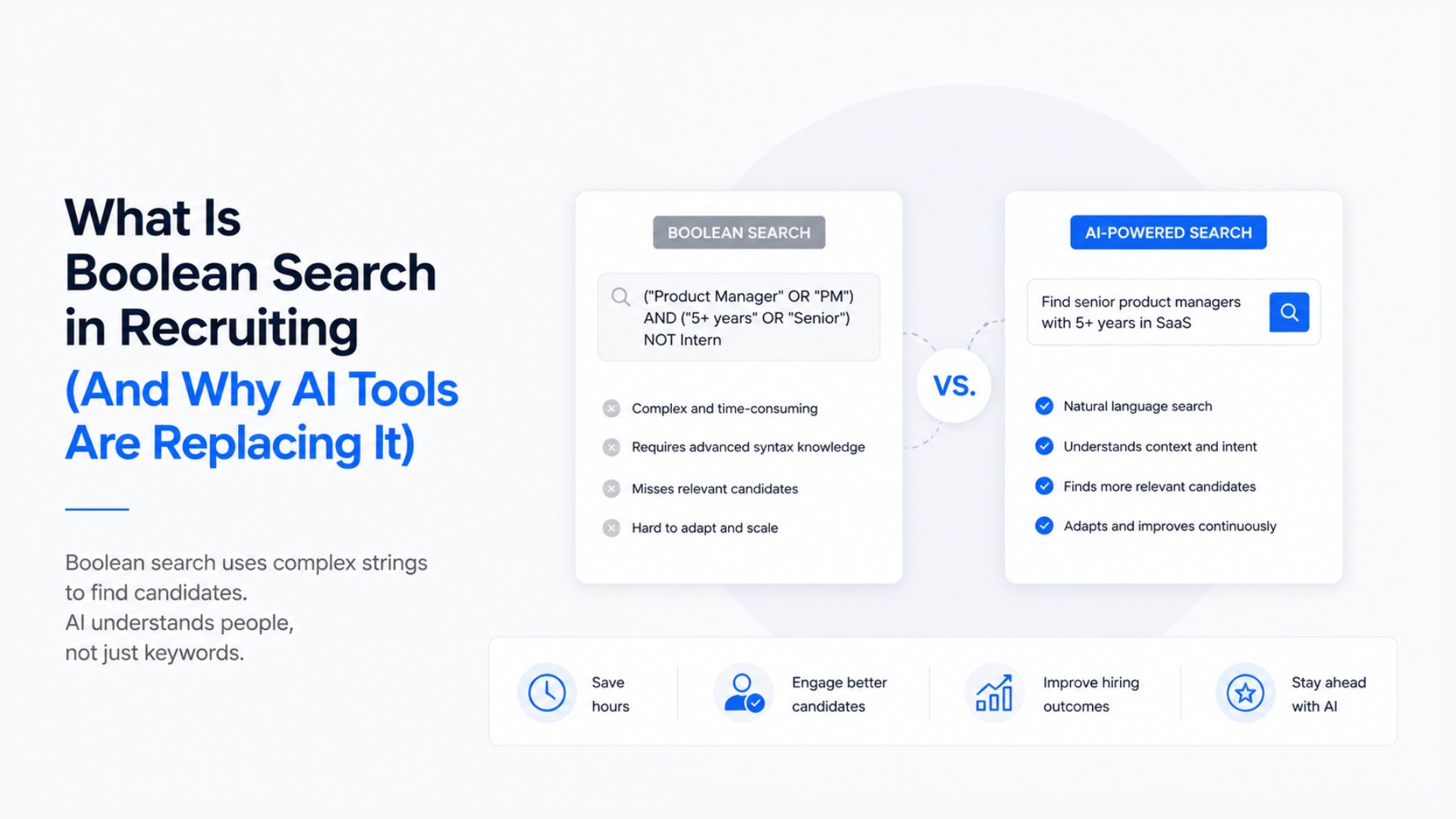
Instead of writing:
("enterprise account executive" OR "strategic account executive" OR "enterprise sales executive") AND (SaaS OR software) AND ("Fortune 500" OR enterprise) NOT (intern OR junior)
the recruiter may be able to describe the requirement:
Find enterprise salespeople who have sold complex B2B software to large companies, managed long sales cycles, and worked in a high-growth SaaS environment.
The system interprets the request.
It may identify relevant job titles.
It may recognize related skills.
It may understand adjacent experience.
It may rank candidates based on the overall requirement.
This is a major change.
The recruiter is no longer required to convert the hiring need into search syntax before the system can begin.
The AI becomes the translation layer between human intent and candidate discovery.
That is why manual Boolean search is becoming less central to modern sourcing workflows.
Natural Language Search vs. Boolean Search
Natural language search allows recruiters to describe the candidate they need in ordinary language.
Boolean search requires the recruiter to define the logic.
The difference can be understood through responsibility.
With Boolean search, the recruiter needs to decide:
Which titles should be included?
Which synonyms matter?
Which skills are mandatory?
Which terms should be excluded?
How should the groups be combined?
With AI-assisted natural language search, the recruiter describes the hiring requirement and the system attempts to interpret those relationships.
This can make sourcing more accessible to recruiters who are not Boolean experts.
It can also make search faster for experienced sourcers.
The recruiter can focus more on defining the talent need and less on formatting the query.
However, natural language search introduces a different challenge.
The recruiter needs to trust that the system understood the request correctly.
This is why transparency and refinement still matter.
A good AI sourcing tool should help recruiters understand why candidates were surfaced and allow the search to be adjusted when the interpretation is wrong.
Semantic Search vs. Keyword Search
Semantic search attempts to understand meaning and relationships between concepts rather than relying only on exact words.
Consider a candidate who has experience with:
Amazon Web Services
A keyword search for:
AWS
may depend on whether the profile contains that exact abbreviation.
A semantic system may understand that the two concepts are related.
The same principle can apply to job titles, skills, industries, responsibilities, and career patterns.
A recruiter searching for a backend engineer may discover candidates with titles such as platform engineer or software engineer when the underlying experience appears relevant.
This does not mean semantic search is always correct.
Related concepts are not automatically equivalent.
A candidate who worked with one technology may not be qualified for another.
A similar job title may represent very different work across companies.
AI expands the system’s ability to identify possibilities.
Recruiters still need to evaluate whether those possibilities make sense.
AI Can Search for Evidence, Not Just Keywords
One of the most important changes in AI sourcing is the movement from keyword matching toward evidence interpretation.
A recruiter may want someone who has:
built a team from the ground up
worked in a high-growth startup
managed enterprise customers
scaled a system to millions of users
Traditional Boolean search requires the recruiter to guess which words might indicate those experiences.
The candidate may never use the exact phrase “built a team from the ground up.”
Their profile may show that they joined as the first sales leader and later managed 30 people.
AI can potentially connect those signals.
This makes the search less dependent on exact phrasing.
The system can look for patterns that suggest the underlying experience.
That is a much closer match to how hiring managers actually describe talent needs.
AI Reduces the Need to Memorize Search Syntax
Boolean search creates a technical barrier.
Recruiters need to learn operators.
They need to understand parentheses.
They need to know which syntax a particular platform supports.
They need to debug searches when the results are poor.
For specialist sourcers, this became part of the profession.
For occasional hiring managers, founders, small recruiting teams, and newer recruiters, it can slow down candidate discovery.
AI lowers that barrier.
A user can describe the requirement in natural language.
The system handles more of the query construction.
This does not eliminate the need for sourcing expertise.
It changes where the expertise matters.
Understanding the talent market remains valuable.
Knowing which backgrounds are relevant remains valuable.
Recognizing an unrealistic requirement remains valuable.
Evaluating candidate quality remains valuable.
Memorizing exactly where to place every parenthesis becomes less important.
Is AI Actually Better Than Boolean Search?
Not automatically.
Boolean search can be extremely precise.
An experienced sourcer who understands the market can create a controlled search and know exactly why profiles are appearing.
AI search can sometimes be less predictable.
The system may interpret a requirement too broadly.
It may treat related experience as equivalent when it is not.
It may rank candidates based on signals the recruiter does not consider important.
The real advantage of AI is not that every search result is automatically better.
The advantage is that the system can reduce manual query construction, explore more variations, and help recruiters find candidates who do not match the obvious vocabulary.
For some searches, Boolean remains useful.
For others, natural language and semantic search are faster.
The strongest modern sourcing workflow may combine both approaches.
AI can generate or expand the search.
Recruiters can refine the requirement.
Filters and explicit rules can preserve control where necessary.
The transition is therefore not from Boolean to zero recruiter input.
It is from recruiter-written search logic toward AI-assisted search interpretation.
Why Boolean Search Is Not Disappearing Completely
The phrase “AI is replacing Boolean search” describes a real direction, but it should not be interpreted as an immediate disappearance.
Boolean search still has advantages.
It is transparent.
The recruiter can see the exact logic.
It is useful for precise exclusions.
It works in many existing databases.
Experienced sourcers can use it to test talent-market assumptions.
It can also be useful when the requirement is highly specific and the recruiter knows exactly which terminology matters.
LinkedIn continues to support Boolean operators in its search products.
That alone shows that the technique remains relevant.
What is changing is the amount of recruiting work that requires recruiters to begin with a manually constructed Boolean string.
AI can increasingly handle the first interpretation of the hiring need.
Boolean becomes a specialist control rather than the only language of candidate search.
AI Can Generate Boolean Strings Too
The transition between Boolean and AI is not always a competition.
AI can also help recruiters build Boolean searches.
A recruiter can describe a hiring requirement and ask an AI system to generate titles, synonyms, skill groups, exclusions, and a structured Boolean string.
This reduces some of the manual work while preserving the search logic.
The approach can be useful when the final candidate database still depends on Boolean syntax.
However, AI-generated strings need review.
The system may include weak synonyms.
It may create unnecessary exclusions.
It may misunderstand which skills are mandatory.
It may generate syntax that behaves differently across platforms.
AI can make Boolean search easier.
That is different from making every generated search correct.
The recruiter still needs to inspect the logic and evaluate the results.
Boolean Search vs. AI Sourcing
The most useful comparison is not about which technology sounds more advanced.
It is about how each system understands relevance.
Boolean search uses explicit recruiter-defined rules.
AI sourcing attempts to infer relevance from the hiring requirement and candidate information.
Boolean search is strong when the recruiter knows exactly what terms matter.
AI sourcing is strong when the requirement involves many possible titles, related skills, adjacent experiences, or less obvious career paths.
Boolean gives control.
AI gives interpretation.
Boolean requires the recruiter to build the search logic.
AI attempts to build more of that logic automatically.
Boolean can be easier to audit.
AI can be easier to use.
The best choice depends on the hiring problem and the quality of the system.
How AI Changes the Recruiter’s Role in Search
The recruiter’s job does not disappear when AI handles more of the search.
The work moves upward.
Instead of spending as much time writing syntax, recruiters can spend more time understanding the role.
What does success actually look like?
Which experience is essential?
Which criteria are flexible?
What adjacent backgrounds should be considered?
Why would the right candidate consider the opportunity?
These questions matter more than the exact search operator.
AI can search only as well as the recruiting team defines the problem.
A vague request for a “rockstar engineer from a top company” will still produce a weak talent strategy.
The recruiter’s advantage becomes better judgment rather than better parentheses.
AI Sourcing Still Needs Human Review
AI search can create new failure modes.
A system may surface a candidate because of a related title while missing a critical difference in responsibility.
It may overvalue a well-written profile.
It may infer experience that is not strong enough for the role.
It may reproduce poor assumptions from the original hiring requirement.
Recruiters should therefore treat AI results as recommendations for review, not automatic hiring decisions.
The system can expand discovery.
The recruiter still needs to evaluate relevance.
This is particularly important when AI search moves beyond exact keywords.
The broader the interpretation, the more important it becomes to understand why a candidate was surfaced.
The objective is not to remove human judgment.
It is to use that judgment where it creates more value.
Boolean Search and Passive Candidate Sourcing
Boolean search has historically been one of the main tools for passive candidate sourcing.
Passive candidates do not enter the hiring process through applications.
Recruiters need to find them.
Boolean search gives the recruiter a way to search large professional databases and narrow the market.
AI sourcing changes the mechanics but not the objective.
The company still needs to identify people who may fit the role even though they have not applied.
The difference is that the recruiter can increasingly begin with the talent requirement rather than a manually constructed query.
This can make passive sourcing faster.
It can also expand the search beyond obvious profiles.
But finding the candidate remains only the first step.
The person still needs a reason to engage.
Boolean Search and Candidate Pools
Boolean search is also used to search existing candidate databases.
A company may have thousands of previous applicants, sourced candidates, referrals, and CRM records.
The recruiter can use keywords and operators to find people who may match a new role.
The challenge is that old candidate data is often inconsistent.
Job titles change.
Profiles become outdated.
Skills are described differently.
Some records contain detailed resumes.
Others contain very little information.
AI candidate rediscovery can improve this process by comparing the new hiring requirement with existing candidate data and surfacing potentially relevant people.
This is another area where manual Boolean search is becoming less necessary.
The recruiter should not need to remember every possible keyword used across years of candidate records.
The system can help make the existing talent pool more searchable by meaning.
The Risk of Replacing Boolean With a Black Box
AI sourcing solves some problems and creates another.
Boolean search is visible.
The recruiter can read the query.
They know that one term is required and another is excluded.
An AI search system may return a ranked list without clearly explaining the logic.
This can make the system easier to use but harder to understand.
Recruiting teams should therefore evaluate transparency.
Why did the candidate appear?
Which parts of the requirement matched?
Which criteria were missing?
Can the recruiter refine the search?
Can the system be corrected?
Can important requirements be made explicit?
The future of sourcing should not require recruiters to choose between difficult search syntax and unexplained AI results.
The strongest systems should combine easier search with understandable reasoning and recruiter control.
How to Use Boolean Search Better Today
Recruiters who still use Boolean search should begin with the talent market rather than the syntax.
The first question is not which operator to use.
It is which experience actually matters.
Recruiters should identify the core concept, then expand the search with realistic title and skill variations.
Mandatory requirements should be kept limited.
Every additional AND condition can remove potentially relevant candidates.
OR groups should reflect real alternatives rather than random synonyms.
NOT should be used carefully because exclusions can remove strong profiles along with irrelevant ones.
Search results should also be reviewed as feedback.
If the results are poor, the recruiter should question the assumptions behind the query rather than only adding more terms.
Boolean search works best as an iterative process.
The first string is rarely the final one.
When Should Recruiters Still Use Boolean Search?
Boolean remains useful when the recruiter needs precise control.
It can work well for narrow technical requirements with established terminology.
It can help when a database has limited semantic search capabilities.
It can be useful for open-web sourcing.
It can support candidate rediscovery in systems that still depend heavily on keywords.
It can also help experienced sourcers test different talent-market hypotheses.
Recruiters should not abandon a useful technique simply because AI is newer.
The better question is whether writing the Boolean string is still the best use of recruiter time for that particular search.
If AI can interpret the requirement, surface relevant candidates, and allow meaningful refinement, manual query construction may add little value.
If the AI search is too broad or unclear, Boolean can restore control.
The tools should serve the hiring problem.
Where Huntlo Fits Into the Shift Beyond Boolean Search
Huntlo approaches candidate sourcing from the perspective of AI-assisted recruiting execution.
The recruiter should not need to begin every search by manually translating a hiring requirement into a long Boolean string.
The hiring need itself can become the starting point.
AI can help interpret the requirement, identify relevant candidate signals, and surface people who may deserve recruiter attention.
This is especially useful when candidates use different titles or describe similar experience in different ways.
But Huntlo’s broader approach also reflects an important limitation of the Boolean-versus-AI debate.
Finding candidates is not the entire recruiting workflow.
After discovery, the team still needs to decide who should be engaged.
Candidates need appropriate outreach.
Follow-ups need to happen.
Responses need to be understood.
Interested people need to move toward screening.
Qualified candidates need to progress toward interviews.
A better search interface creates value.
A connected recruiting workflow creates more.
Huntlo’s guide on how AI sourcing tools fit into the future of talent acquisition explains this shift from manual Boolean queries and database searches toward AI-assisted candidate discovery.
The larger transition appears in what comes after sourcing automation: as candidate discovery becomes easier, recruiting advantage moves toward engagement, qualification, and workflow execution.
Boolean Search in an Agentic AI Recruiting Workflow
Agentic AI recruiting moves beyond one search action.
A recruiter can begin with a hiring requirement.
The system can help interpret the need and discover candidates.
Relevant people can move into engagement.
Candidate responses can influence the next action.
Interested people can move toward screening.
Qualified candidates can progress toward interviews.
In this model, search is one part of a larger workflow.
Boolean search was designed for a different technology era.
The recruiter created the query.
The database returned results.
The recruiter manually decided what to do next.
Agentic systems attempt to coordinate more of the work between those steps.
This does not make search expertise irrelevant.
It changes the purpose of that expertise.
Recruiters need to understand talent markets, candidate quality, hiring requirements, and recruiting strategy.
The software can handle more of the repetitive translation and execution.
How to Evaluate AI Search That Claims to Replace Boolean
The first question is search quality.
Does the system surface genuinely relevant candidates?
The second is requirement understanding.
Can the tool distinguish between mandatory criteria and useful preferences?
The third is semantic flexibility.
Can it identify relevant people who use different titles or language?
The fourth is transparency.
Can the recruiter understand why a candidate was surfaced?
The fifth is refinement.
Can the recruiter correct the search without starting from zero?
The sixth is control.
Can explicit requirements and exclusions still be applied when necessary?
Finally, teams should evaluate what happens after the search.
Can candidates move directly into a pool, outreach workflow, screening process, or another useful next step?
An AI search tool that saves ten minutes on Boolean construction but creates several new manual handoffs may not improve the overall recruiting workflow.
The best replacement for Boolean is not simply easier search.
It is better candidate discovery connected to better recruiting execution.
The Future of Boolean Search in Recruiting
Boolean search will probably remain available for a long time.
Recruiters still use databases built around keyword search.
Experienced sourcers still value precise query control.
Some searches genuinely benefit from explicit logic.
But Boolean expertise is becoming less central to everyday candidate discovery.
AI can generate synonyms.
It can interpret natural language.
It can identify related skills.
It can recognize adjacent titles.
It can compare candidates with broader descriptions of the work.
It can search existing candidate pools by relevance rather than only exact terms.
The future recruiter may still understand AND, OR, and NOT.
They may simply use them less often.
The important sourcing skill will move from writing perfect strings toward defining better hiring requirements, understanding talent markets, evaluating AI recommendations, and deciding which candidates deserve engagement.
Boolean search taught recruiters how to speak to databases.
AI sourcing is teaching databases how to better understand recruiters.
Conclusion: Boolean Search Is Becoming a Control, Not the Starting Point
Boolean search in recruiting is a candidate sourcing technique that combines keywords with operators such as AND, OR, and NOT.
For years, it gave recruiters a powerful way to search professional networks, resume databases, applicant tracking systems, and the open web.
Its strength is control.
The recruiter defines the logic.
Its weakness is the same.
The recruiter has to define the logic.
They need to anticipate job-title variations, skill synonyms, adjacent experience, exclusions, and the exact language candidates may use.
AI sourcing tools are reducing that manual work.
Recruiters can increasingly describe the person they need in natural language.
The system can interpret the requirement, identify related experience, search beyond exact keywords, and rank candidates by relevance.
This does not mean Boolean search is dead.
It remains useful when precision, transparency, and explicit control matter.
But it is moving from the default starting point toward a more specialized tool.
The recruiter of the future may spend less time building search strings and more time defining what good actually looks like.
That is a better use of recruiting expertise.
The goal was never to become excellent at parentheses.
The goal was to find the right people.
Frequently Asked Questions
What is Boolean search in recruiting?
Boolean search in recruiting is a candidate sourcing technique that combines keywords with operators such as AND, OR, and NOT to control and refine search results.
What are the main Boolean operators recruiters use?
The main operators are AND, OR, and NOT. Recruiters also commonly use quotation marks for exact phrases and parentheses to group related search terms.
What is an example of a Boolean search for recruiters?
A simple example is: ("software engineer" OR "backend developer") AND (Python OR Java) NOT intern. The search includes alternative titles and skills while excluding internship-related results.
Why do recruiters use Boolean search?
Recruiters use Boolean search to narrow large candidate databases, include alternative titles and skills, remove irrelevant results, and create more precise candidate searches.
What is a Boolean search string?
A Boolean search string is the complete query created by combining keywords, operators, quotation marks, parentheses, and other supported search instructions.
What is the difference between Boolean search and AI sourcing?
Boolean search depends on explicit rules written by the recruiter. AI sourcing attempts to interpret the hiring requirement, understand related concepts, and rank candidates based on broader relevance.
Is AI replacing Boolean search?
AI is reducing the need for recruiters to manually construct Boolean strings for many searches. However, Boolean remains useful for precise, transparent, and highly controlled queries.
Is Boolean search still worth learning?
Yes. Understanding Boolean logic can help recruiters understand how candidate search works and can still be useful in many databases. However, advanced Boolean expertise is becoming less essential as natural-language and semantic search improve.
Can AI generate Boolean search strings?
Yes. AI can help generate titles, synonyms, exclusions, and structured Boolean strings. Recruiters should still review the logic before using the query.
What is semantic search in recruiting?
Semantic search attempts to understand the meaning and relationships between candidate information and hiring requirements rather than relying only on exact keyword matches.
Related Topics
Explore whether AI sourcing is worth it for small recruiting teams and why the value of a larger candidate pool depends on what happens after discovery.
Learn how AI sourcing tools can expand talent pools for recruitment agencies while engagement, qualification, and workflow execution remain critical.
Explore AI sourcing for Tier 2 and Tier 3 city hiring in India and how broader candidate discovery can help teams reach talent beyond major hiring markets.