Daniel Okonkwo, the head of recruiting at a Series B healthcare technology company, sat in his weekly recruiting review and listened to the same complaints he had been hearing for months. Hiring managers frustrated by scheduling delays. Candidates withdrawing during the ten-day gap between interview invitation and confirmed date. A recruiting coordinator who had submitted her resignation that morning, the second one to quit in six months. When Daniel had joined the company eighteen months earlier, the team was hiring sixty people a year and a single coordinator handled all scheduling with a shared calendar and email. Now the hiring plan called for two hundred, and scheduling was the number one operational problem in the recruiting function. Daniel had added a second coordinator, then a third. He had implemented a scheduling tool that promised to automate coordination. But each addition addressed a symptom rather than the underlying structural problem: a scheduling process designed for sixty hires per year was being asked to handle two hundred, and no amount of incremental improvement could bridge that gap. The process did not need to be tweaked. It needed to be rebuilt on a foundation that could scale with the company growth trajectory. Daniel knew this. What he did not yet know was how much it would cost the organization before he could make the case for the investment needed to fix it.
Why Scheduling Is the First Process That Breaks During Growth
Daniel Okonkwo, the head of recruiting at a Series B healthcare technology company, hired sixty people in his first year. The scheduling process was informal but functional: a single recruiting coordinator managed all interview logistics using a shared calendar and email. In year two, the hiring plan doubled to one hundred and twenty people. The coordinator quit in month seven, citing burnout. Daniel replaced her with two coordinators, but the scheduling delays actually got worse because the two coordinators had to coordinate with each other in
addition to coordinating with hiring managers and candidates. By the time the company reached its year-three target of two hundred hires, the scheduling process was in open failure: average time-to-schedule had tripled, hiring manager complaints about scheduling delays were the number one topic in recruiting review meetings, and candidate withdrawal during scheduling had reached eighteen percent. Research published by SHRM on recruiting operations at high-growth companies confirms that interview scheduling is consistently the first recruiting process to break under scaling pressure, because its complexity grows non-linearly with hiring volume while most organizations attempt to scale it linearly by adding headcount.
The non-linear complexity growth of scheduling is driven by several compounding factors. First, as hiring volume increases, the number of concurrent scheduling streams increases proportionally, creating interference between streams. A hiring manager who is involved in three concurrent searches must manage scheduling for all three, and a conflict in one stream cascades across the others. Second, as the organization grows, the number of interview participants increases. Early-stage companies may have two-person interview panels. Growth-stage companies routinely have four to six panelists per interview, each with their own calendar constraints and scheduling preferences. Third, organizational growth typically introduces new time zones, new business units, and new compliance requirements, each adding constraints that the scheduling process must accommodate. Fourth, growth attracts more candidates, which increases the volume of scheduling events that must be managed simultaneously. The combined effect of these factors is that doubling hiring volume can triple or quadruple scheduling complexity, which is why adding one additional coordinator to handle a doubling of hiring volume consistently fails. The scheduling process does not need more people. It needs a fundamentally different architecture, one that an agentic AI recruiting platform provides by automating the coordination complexity that makes linear scaling impossible.
The cost of scheduling failure during growth extends well beyond the recruiting function. When scheduling breaks, hiring timelines extend. When hiring timelines extend, teams operate below capacity. When teams operate below capacity, product roadmaps slip and revenue targets are missed. The scheduling bottleneck becomes a business bottleneck, limiting the organization ability to execute on its growth plan. This is why scheduling process design should be treated as a strategic investment rather than an operational afterthought. Organizations that design their scheduling process for their current hiring volume will inevitably need to redesign it at each growth stage, incurring transition costs and operational disruption each time. Organizations that design their scheduling process for scale, building in the automation, flexibility, and intelligence needed to handle multi-fold volume increases without redesign, avoid these repeated transitions and maintain consistent recruiting performance as they grow. The difference between these two approaches is not marginal. It is the difference between a recruiting function that enables growth and one that constrains it.
The Design Principles of a Scalable Scheduling Process
A scheduling process that scales with growth must be built on four design principles. The first principle is automation over manual coordination. Every step in the scheduling workflow that
does not require human judgment should be automated. This includes availability evaluation, conflict detection, time slot proposal, calendar invitation generation, confirmation tracking, reminder communication, and rescheduling logistics. Human involvement should be reserved for decisions that require judgment: panel composition approval, exception handling, and candidate relationship management. Research from McKinsey on scalable operating model design has found that organizations that automate all judgment-free scheduling steps achieve three to five times better scheduling performance at scale than organizations that rely on manual coordination, because automation eliminates the sequential communication bottleneck that makes manual scheduling unscalable. The key insight is that automation is not a nice-to-have efficiency improvement. It is a structural prerequisite for scaling, because the coordination complexity of growth-stage hiring exceeds what manual processes can handle regardless of how many people are assigned to them.
The second principle is real-time data integration. A scalable scheduling process must be built on current, accurate data from every relevant system: applicant tracking systems, calendar platforms, human resource information systems, and communication tools. When scheduling decisions are based on stale or incomplete data, the proposed time slots are often invalid, which forces manual intervention and undermines the automation that the process depends on. For niche or technical roles where the pool of qualified interviewers is small and their availability changes frequently, real-time data is particularly critical because even a few hours of data staleness can produce scheduling proposals that conflict with newly booked meetings or recently changed commitments. When scheduling systems rely on outdated candidate or interviewer data, the automation produces errors that drive users back to manual processes, creating a vicious cycle where automation failures undermine trust in the system and reduce adoption. The most scalable scheduling processes are built on real-time, bi-directional integration with every data source, ensuring that every automated decision reflects the current state of the organization.
The third principle is policy-driven flexibility. A scalable scheduling process must enforce organizational policies, minimum notice periods, buffer times, panel composition requirements, and compliance mandates, while remaining flexible enough to handle exceptions and edge cases. Rigid scheduling systems that cannot accommodate exceptions create workarounds that bypass the system entirely, fragmenting the process and reducing visibility. The most effective approach is a constraint-based system where organizational policies are encoded as configurable rules that the scheduling engine respects by default but can override when a recruiter or hiring manager explicitly approves an exception. This approach maintains policy compliance as the baseline while preserving the flexibility needed to handle the real-world complexity of growth-stage hiring. The fourth principle is measurement and continuous improvement. A scalable scheduling process must generate data that enables the organization to identify bottlenecks, track performance trends, and make evidence-based decisions about process adjustments. Without measurement, scheduling process design is based on anecdote and assumption, and the organization cannot distinguish between systemic problems and isolated incidents. These four principles, automation, real-time data, policy-driven flexibility, and measurement, form the foundation of a scheduling process that scales with growth rather
than breaking under it.
How AI Scheduling Adapts to Increasing Hiring Volume
AI scheduling systems are uniquely suited to scaling with growth because their performance does not degrade as volume increases. A human coordinator managing ten interviews per week may handle twenty with effort, but their performance will deteriorate as the volume grows because the cognitive load of tracking dozens of concurrent scheduling streams exceeds human working memory capacity. An AI scheduling system, by contrast, can evaluate availability for a hundred concurrent interviews with the same speed and accuracy as it evaluates ten. The computational cost of processing additional scheduling streams is marginal, which means the system performance scales linearly with volume while human performance degrades non-linearly. According to LinkedIn talent solutions research, organizations that deploy AI scheduling at the growth stage when hiring volumes are increasing rapidly report that scheduling performance remains stable or improves as volume grows, while organizations relying on manual coordination see performance deteriorate by thirty to fifty percent over the same period. This divergence is the defining characteristic of scalable versus non-scalable scheduling processes.
AI scheduling also scales by learning from the patterns in scheduling data. As the system processes more interviews, it builds a increasingly detailed model of interviewer availability patterns, candidate preference trends, time slot effectiveness, and common conflict scenarios. This learning enables the system to make better scheduling decisions over time, proposing time slots that are more likely to be confirmed, identifying potential conflicts before they occur, and recommending process adjustments that improve overall scheduling performance. The system becomes more effective as the organization grows, which is the opposite of what happens with manual processes. When managing follow-up scheduling between interview rounds, the system uses historical data to predict the optimal scheduling window for each follow-up, reducing the risk of candidate withdrawal during the interval between rounds. Research on why referrals outperform cold outreach has demonstrated that scheduling systems which improve over time through data-driven learning deliver compounding returns, because each interview processed makes the system smarter for the next one, creating a virtuous cycle of continuous improvement that becomes more valuable as the organization grows.
The scalability of AI scheduling also extends to organizational complexity. When a company grows from one office to five, from one time zone to four, from one business unit to eight, the scheduling process must accommodate the increased structural complexity without requiring a complete redesign. AI scheduling systems handle this by treating organizational structure as a configurable dimension of the scheduling model. New offices, time zones, business units, and compliance requirements are added as parameters, and the scheduling engine automatically incorporates them into its optimization calculations. This configurability means the system scales not just in volume but in organizational complexity, handling the structural changes that accompany growth without the process redesigns that manual scheduling requires at each stage. The distinction between tools that automate current-state processes and
systems that adapt to future-state complexity is explored in discussions about the difference between AI sourcing and AI recruiting, where the most valuable systems are those that grow with the organization rather than requiring the organization to redesign its processes around the limitations of the tool.
Building Your Scalable Scheduling Process: A Practical Framework
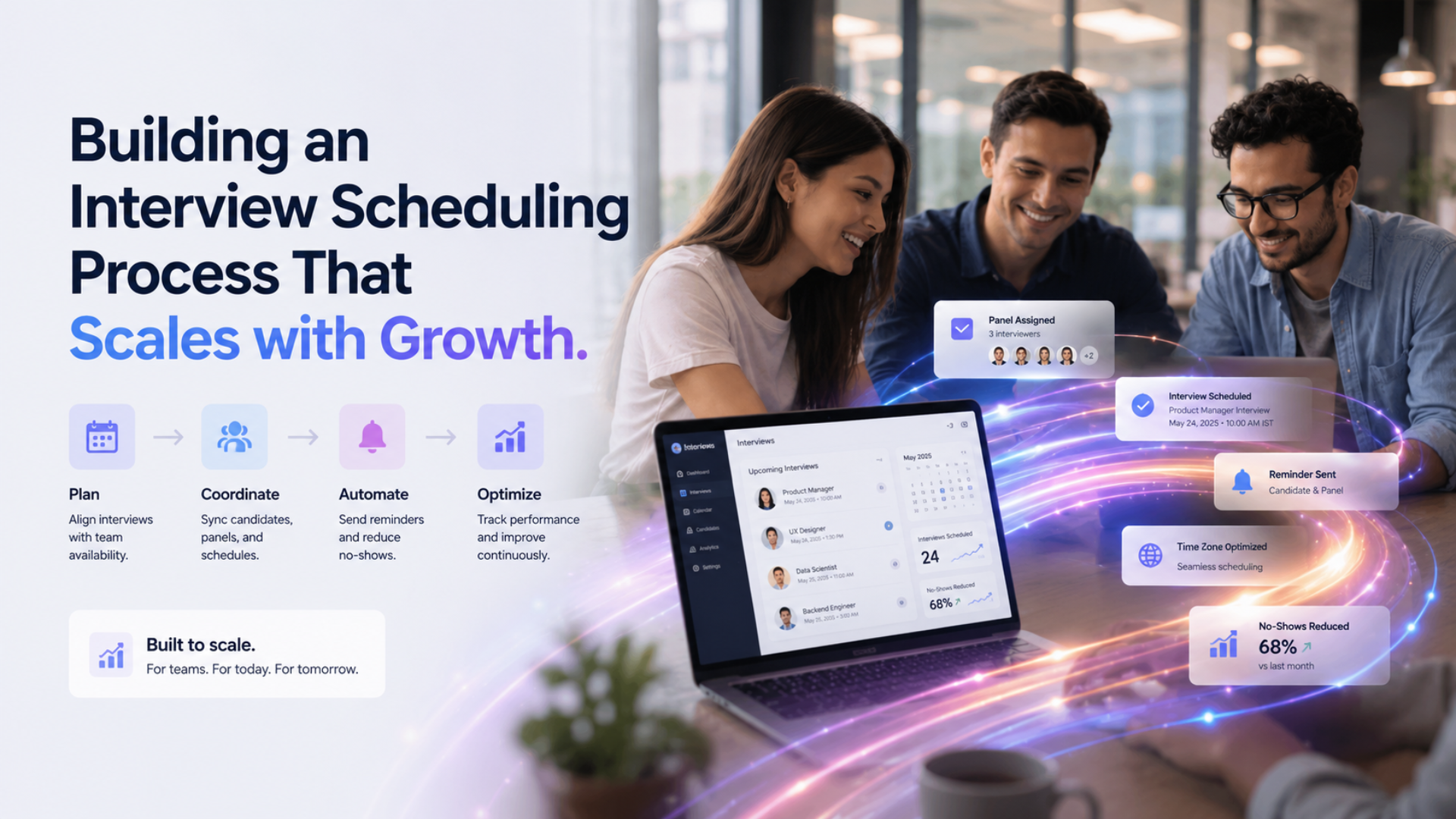
Building a scalable scheduling process requires a phased approach that balances immediate pain relief with long-term architectural investment. Phase one should focus on automating the highest-volume, lowest-complexity scheduling tasks: initial screening calls, one-on-one interviews, and straightforward panel interviews with two to three participants in a single time zone. These tasks represent the majority of scheduling volume in most organizations, and automating them produces immediate, visible relief for the recruiting team. The automation should include calendar integration, automated availability matching, and one-click confirmation for hiring managers and candidates. According to Gartner research on recruiting technology adoption, organizations that start with high-volume, low-complexity automation achieve faster time-to-value and stronger organizational buy-in than those that attempt to automate the most complex scenarios first, because early wins build confidence and demonstrate the value of the approach before tackling harder problems.
Phase two extends automation to more complex scheduling scenarios: multi-panel interviews, cross-time-zone coordination, and interviews requiring approval workflows. This phase also introduces intelligent conflict resolution, where the system proposes alternatives when conflicts arise rather than simply reporting the conflict and waiting for manual intervention. For organizations evaluating scheduling solutions for this phase, guidance on how to evaluate an AI sourcing tool before buying recommends prioritizing systems that handle complex scenarios through intelligent orchestration rather than rule-based automation, because rule-based systems require extensive configuration and frequent updates as the organization grows, while intelligent systems adapt to new scenarios through learning and optimization. Phase three focuses on analytics and continuous improvement: implementing scheduling performance dashboards, identifying systemic bottlenecks, and using scheduling data to optimize the broader hiring process. Many organizations have attempted to build scalable scheduling by adding more tools to their existing stack rather than implementing a unified platform. This approach consistently fails at scale because each additional tool adds integration overhead and creates data silos that prevent the holistic optimization that a unified platform enables.
Phase four integrates the scheduling system with the broader recruiting technology ecosystem to create a unified hiring workflow. Scheduling data flows into the applicant tracking system, enabling end-to-end visibility into the hiring pipeline. Interviewer feedback is captured automatically after each interview, reducing the administrative burden on panelists. Scheduling performance metrics are correlated with hiring outcomes such as time-to-fill, candidate experience scores, and offer acceptance rates, enabling evidence-based decisions about process improvements. This integration phase is where the scheduling process transforms from an
operational function into a strategic capability that directly influences business results. The phased approach allows the organization to build capability incrementally, demonstrating value at each stage while building toward a fully orchestrated scheduling infrastructure that can handle any volume and complexity the organization growth trajectory demands. A common concern among recruiting leaders at growth-stage companies is whether investing in scheduling infrastructure is premature when the current process, while strained, is still functioning. Analysis of whether recruiters should worry about AI replacing their jobs highlights a more relevant concern: recruiting leaders who wait until the scheduling process breaks completely before investing in scalable infrastructure typically face recovery periods of three to six months during which hiring performance deteriorates significantly, because rebuilding a broken process is far more expensive and disruptive than scaling a functional one.
Scaling Scheduling Without Scaling Headcount
The ultimate test of a scalable scheduling process is whether it can absorb multi-fold increases in hiring volume without proportional increases in scheduling headcount. Organizations that have successfully made this transition report consistent results: AI scheduling systems enable a single recruiting coordinator or operations specialist to manage three to five times the interview volume that a manual process allows, while simultaneously improving scheduling speed, accuracy, and candidate experience. The arithmetic is straightforward. If an organization currently employs three full-time scheduling coordinators at a total annual cost of three hundred thousand dollars, and AI scheduling enables the same volume to be managed by one coordinator, the annual savings is two hundred thousand dollars. But the more significant benefit is not the cost savings. It is the organizational agility that comes from having a scheduling process that can absorb growth without requiring approval for additional headcount, budget allocation, and the three-to-six-month ramp-up time that hiring and training new coordinators requires. Deloitte analysis of scalable operating models in high-growth companies has found that organizations with AI-powered scheduling infrastructure can respond to sudden hiring surges, such as a new funding round, a major contract win, or a seasonal demand spike, without any delay in scheduling capacity, while organizations relying on manual scheduling require three to six months to hire and train the additional coordinators needed to handle the increased volume.
The candidate experience benefit of scalable scheduling is equally compelling and often underestimated. When scheduling is fast and seamless regardless of hiring volume, every candidate receives the same high-quality experience. Candidates do not experience longer scheduling delays during peak hiring periods because the AI system handles volume increases without performance degradation. This consistency is a powerful employer brand asset, particularly for organizations that hire in competitive talent markets where candidate expectations are shaped by the best scheduling experiences they have had with any employer. EY research on employer brand and candidate experience has found that scheduling consistency across the hiring cycle is one of the strongest signals candidates use to assess organizational competence, and that organizations with consistent, fast scheduling are perceived as more professional and more desirable employers, regardless of the actual role or compensation on
offer. This perception advantage translates directly into higher application rates, lower withdrawal rates, and higher offer acceptance rates, creating a virtuous cycle where better scheduling improves candidate quality which improves hiring outcomes which strengthens the employer brand further.
For Daniel, the head of recruiting who watched his scheduling process collapse under the weight of growth from sixty to two hundred annual hires, the lesson was clear but painful. His mistake was not failing to invest in scheduling technology. His mistake was investing too late, after the process had already broken and the organizational damage, lost candidates, frustrated hiring managers, and burned-out coordinators, had already been done. If he had built a scalable scheduling process when hiring was at sixty, the transition to one hundred and twenty and then two hundred would have been seamless. The technology to enable that scalability exists today. Organizations at every growth stage, from startup to enterprise, can build a scheduling process that scales with their ambition rather than constraining it. The question is not whether the current process is broken. The question is whether it will scale to handle next year hiring plan, and the year after that, without breaking. If the answer is uncertain, the time to invest in scalable scheduling infrastructure is now, before growth makes the investment significantly more expensive and disruptive. Organizations that design for scale from the beginning win the talent competition not because they have more resources, but because they never let scheduling become the bottleneck that slows them down.