A senior software engineer in Bangalore receives a recruiter's LinkedIn InMail on a Tuesday afternoon. She is busy with a sprint deadline and archives it without reading. The same recruiter sends a follow-up on Thursday. She opens it, skims it, and decides to respond later. She forgets. A week later, a WhatsApp message arrives with a brief, specific note about a role at a company she has been curious about. She responds. A conversational AI screening follows that evening. Within 48 hours, she is on a call with the hiring manager. Within two weeks, she has an offer. She accepts. The entire journey from first touch to accepted offer took 16 days and four follow-up attempts.
Now consider the alternative. The recruiter sends the initial InMail. No response. The recruiter moves on to the next candidate. The engineer — who was interested but simply busy — never hears from the recruiter again. She eventually responds to a competitor's outreach three weeks later and accepts their offer. The original recruiter's initial effort — identifying a strong candidate, crafting a good first message — was wasted because they stopped one follow-up short of a placement.
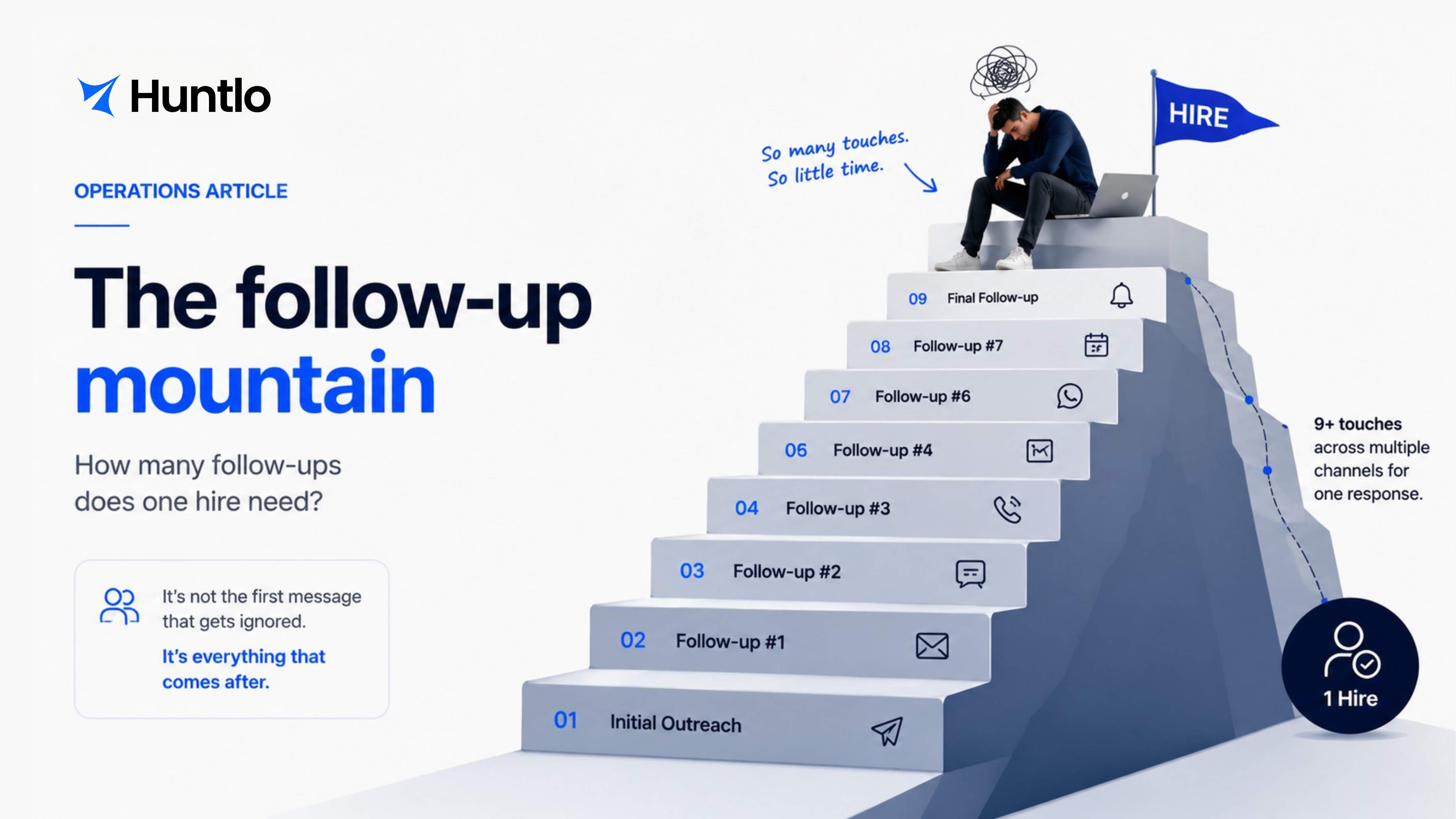
This scenario plays out thousands of times every day across the global recruiting industry. The difference between a placement and a missed opportunity is often not the quality of the initial outreach or the strength of the candidate match — it is the willingness to follow up persistently, strategically, and respectfully. This article examines exactly how much follow-up is enough, how much is too much, and how to build follow-up systems that convert candidates into hires without becoming a nuisance.
The Data: How Many Touches Does It Actually Take?
The recruiting industry has not invested as much rigorous research in follow-up effectiveness as the sales industry, which faces an analogous challenge — converting prospects who are not actively looking to buy into customers. But the data that does exist, from both recruiting and sales contexts, is remarkably consistent in its conclusions.
Salesforce's state of sales research found that 80% of sales require at least five follow-up contact attempts after the initial outreach. Yet 44% of salespeople give up after just one follow-up. The implication is clear: the majority of potential deals are lost not because the prospect was not interested, but because the salesperson stopped trying too soon. The recruiting parallel is direct. Passive candidates who are not actively looking for a job require multiple touches before they engage — not because they are uninterested, but because they are busy, distracted, or not yet ready to act.
LinkedIn's outreach effectiveness data provides more specific recruiting-focused numbers. According to LinkedIn's analysis of recruiter messaging patterns, the optimal number of touchpoints for engaging a passive candidate is between five and eight, spread across two to four weeks. Response rates follow a predictable curve: the first message generates the highest response rate (typically 8-12% for well-crafted InMails), the second and third follow-ups generate moderate response rates (5-8% each), and subsequent follow-ups generate lower but still meaningful response rates (2-4% each). The cumulative response rate across five to eight touchpoints reaches 25-35%, meaning that roughly one in three passive candidates will eventually respond if the recruiter persists with well-timed, relevant follow-ups.
HubSpot's sales and marketing research provides data on the channel-specific dynamics of follow-up. Email follow-ups show declining response rates after the third attempt, with a sharp drop-off after the fifth. LinkedIn follow-ups maintain more consistent response rates across attempts, likely because LinkedIn messages appear in a dedicated inbox that candidates check periodically. WhatsApp and SMS follow-ups show the highest per-attempt response rates but the fastest fatigue curve — candidates who have not responded after two WhatsApp messages are very unlikely to respond to a third. These channel-specific dynamics have significant implications for how follow-up sequences should be structured.
SHRM's talent acquisition survey reports that recruiters who follow up three or more times per candidate generate 45% more placements per month than those who follow up once or twice. The productivity difference is not small — it is the difference between a recruiter who places 6 candidates per month and one who places 9. At an average placement fee of $8,000-15,000, that productivity gap translates to $24,000-45,000 in additional monthly revenue per recruiter. Follow-up persistence is not a nice-to-have behavior. It is one of the highest-ROI activities a recruiter can engage in.
The data from G2's recruiting software benchmarks adds another dimension: recruiters who use automated follow-up sequences generate 60% more total candidate responses than those who follow up manually, because automation ensures that follow-ups are sent on schedule, across the right channels, without the recruiter needing to remember or prioritize each individual candidate. Automation does not replace the recruiter's judgment about what to say — it ensures that the recruiter's judgment is actually executed, consistently, for every candidate in the pipeline.
Why Candidates Do Not Respond Immediately (And Why That Is Normal)
Before designing a follow-up strategy, it is important to understand why candidates do not respond to the first message. Understanding these reasons helps recruiters avoid the common mistake of interpreting non-response as rejection, when in reality it is usually something far less concerning.
The most common reason is simple timing. The candidate is busy. They are in the middle of a project, a meeting, a deadline, or a personal obligation. They see the message, intend to respond, and then forget. According to Boomerang's email response time research, the average professional takes 2.4 hours to respond to an email they intend to answer — but many recruiting messages take 24-72 hours to generate a response, because the candidate needs to find a moment when they can give the message the attention it deserves. For passive candidates who are not urgently looking for a job, finding that moment can take days or even weeks.
The second reason is information gathering. A candidate who receives an interesting outreach message may want to research the role, the company, and the compensation range before responding. They may look up the company on Glassdoor, check the recruiter's LinkedIn profile for credibility, or ask colleagues if they have heard of the opportunity. This research takes time, and during that time, the candidate appears unresponsive. Following up during this research phase can actually accelerate the response, because it signals continued interest and provides an opportunity for the candidate to ask questions.
The third reason is genuine indecision. A passive candidate who is not actively looking for a job faces a genuine decision: is this opportunity interesting enough to justify the time and effort of exploring it? For candidates who are reasonably happy in their current role, this is not a trivial decision. They may need to weigh the potential benefits of a new opportunity against the risks and costs of a job change. This deliberation is healthy, not problematic, and follow-up messages that provide additional information — about the role, the company culture, the compensation, or the team — can help the candidate make their decision.
The fourth reason is that the initial message simply was not compelling enough. The candidate saw it, read it, and decided it was not worth responding to. This is the only reason for non-response that actually indicates a lack of interest. But even in this case, a well-crafted follow-up that provides new, relevant information — a different angle on the role, a specific detail about the company, or an insight about the market — can re-engage a candidate who was not impressed by the first message.
Harvard Business Review's research on persuasion and engagement emphasizes that multiple touchpoints are not just a tactic for reaching busy people — they are a fundamental principle of effective communication. People rarely make decisions based on a single exposure to information. They need multiple exposures, from multiple angles, before they feel confident enough to act. In recruiting, this means that a candidate who receives one message has been exposed to the opportunity once. A candidate who receives four messages — each providing a slightly different perspective on the same opportunity — has been exposed four times. The candidate who has been exposed four times is dramatically more likely to respond than the candidate who was exposed once, even if both candidates are equally interested in the opportunity.
The Follow-Up Fatigue Curve: When Persistence Becomes Counterproductive
While persistence is essential, it has limits. There is a point at which follow-up crosses from helpful persistence to counterproductive annoyance, and crossing that line can damage the recruiter's relationship with the candidate and, by extension, the recruiter's professional reputation. Understanding where this line is — and how it varies by candidate type, channel, and context — is critical for designing follow-up sequences that maximize engagement without causing harm.
The follow-up fatigue curve is not a sharp cliff but a gradual slope. Response rates decline with each subsequent touchpoint, and the quality of responses also changes. Early responses tend to be engaged and substantive — the candidate asks questions, shares their background, and expresses genuine interest. Later responses, if they come at all, tend to be shorter and more perfunctory — "Not interested right now" or "I'm happy where I am." At some point along this curve, the expected value of another follow-up drops below zero, meaning that the potential benefit of engaging one more candidate is outweighed by the cumulative cost of annoying everyone who has already chosen not to respond.
Research from Yesware's email follow-up study (a sales email productivity tool whose findings apply equally to recruiting outreach) found that response rates follow a roughly exponential decay pattern. The first follow-up generates roughly 40-50% of the response rate of the initial message. The second follow-up generates roughly 25-30% of the initial rate. The third generates 12-18%. By the fifth follow-up, the response rate is typically 3-5% of the initial rate. For a recruiter whose initial message has a 10% response rate, the fifth follow-up would be expected to generate a 0.3-0.5% response rate — meaning roughly 1 response per 200-333 messages sent. At that point, the recruiter's time is almost certainly better spent on initial outreach to new candidates rather than additional follow-ups to non-responders.
The fatigue curve varies significantly by candidate type. Passive candidates who are genuinely open to the right opportunity have a flatter fatigue curve — they maintain meaningful response rates across more touchpoints because their interest, while not urgent, is real. Active candidates who are already job-searching have a steeper fatigue curve — if they were interested, they would have responded by the second or third touchpoint, and additional follow-ups are unlikely to change their mind. Senior executives and highly specialized professionals have a flatter curve on LinkedIn and email but respond poorly to SMS and WhatsApp follow-ups, where the perceived informality can seem inappropriate for their seniority level.
Huntlo's AI outreach engine is designed to navigate this fatigue curve intelligently. Rather than applying a fixed follow-up count to every candidate, the platform's AI analyzes candidate behavior — whether they opened the message, how quickly, whether they clicked any links — to estimate the likelihood of a future response and adjust the follow-up strategy accordingly. A candidate who opened the first message but did not reply is a strong candidate for a second follow-up with different messaging. A candidate who never opened the first message after three delivery attempts across two channels is a poor candidate for further follow-up, regardless of how well they match the role on paper. This behavioral analysis allows the platform to allocate follow-up effort where it is most likely to produce results, rather than wasting effort on candidates who are unlikely to engage.
The Optimal Follow-Up Cadence: Timing, Channels, and Content
Designing an effective follow-up sequence requires decisions about three variables: timing (when to follow up), channel (where to follow up), and content (what to say). Each variable interacts with the others, and the optimal combination depends on the candidate's profile, the role being recruited for, and the market context.
Timing. The general principle is that follow-up intervals should increase over time. The first follow-up should come 2-3 days after the initial outreach, when the candidate has had time to see the message but has not had so much time that they have forgotten about it entirely. The second follow-up should come 4-5 days after the first. The third follow-up should come 7-10 days after the second. Subsequent follow-ups should be spaced 10-14 days apart. This increasing interval pattern respects the candidate's time, avoids the appearance of desperation, and gives the candidate space to process the opportunity at their own pace.
Todoist's research on task completion and follow-up timing found that people are most likely to act on messages received on Tuesday, Wednesday, and Thursday mornings (9-11 AM in their local time zone), and least likely to act on messages received on Monday mornings (inbox overload) or Friday afternoons (weekend mode). For recruiting outreach, this suggests that follow-ups should be scheduled for mid-week delivery when possible, and should avoid Monday mornings and Friday afternoons unless the recruiter has specific data suggesting that a particular candidate is more responsive at those times.
Channel. The channel strategy for follow-ups should be guided by two principles: channel rotation and channel escalation. Channel rotation means that consecutive follow-ups should use different channels — if the initial outreach was on LinkedIn, the first follow-up should be on email, the second on WhatsApp or SMS, and so on. This rotation ensures that the candidate sees the follow-up in a different context, which increases the chance that they will notice it and respond. Channel escalation means that as the follow-up sequence progresses, the recruiter should move toward more direct and personal channels. Email and LinkedIn are appropriate for early touchpoints. WhatsApp and SMS are more appropriate for mid-sequence touchpoints, when the candidate has already been exposed to the opportunity but has not engaged. AI voice calls are most appropriate for late-sequence touchpoints, when a human voice can create a sense of urgency and personal connection that text-based channels cannot.
WhatsApp's Business API statistics show that WhatsApp messages have a 90% open rate within three minutes of delivery and a 45-60% response rate — dramatically higher than email or LinkedIn. For markets like India and the GCC, where WhatsApp is the dominant communication channel, incorporating WhatsApp into the follow-up sequence is not optional. A recruiter who relies exclusively on email and LinkedIn for follow-ups in these markets is reaching candidates on their least responsive channels.
Huntlo's multi-channel outreach engine automates this channel rotation and escalation. The platform can be configured to send the initial outreach on the candidate's most active channel (determined by AI analysis of their profile and behavior), then rotate through email, LinkedIn, WhatsApp, and AI voice in subsequent touchpoints. Each channel transition is handled automatically, with message content adapted to the channel's communication norms — shorter and more conversational on WhatsApp, more detailed and professional on email, brief and engaging on LinkedIn.
Content. The most common follow-up mistake is sending the same message again, or a slightly reworded version of the same message. This approach signals to the candidate that the recruiter is not paying attention and is simply running an automated sequence. Effective follow-up content provides new information or a new angle with each touchpoint. The first follow-up might share a specific detail about the company or the role that was not in the initial message. The second follow-up might reference a market trend or industry development that makes the opportunity more compelling. The third follow-up might mention that the hiring manager is eager to speak with candidates who have the candidate's specific background. Each touchpoint adds value and gives the candidate a new reason to engage.
HBR's research on effective follow-up in professional communication identifies three principles that distinguish effective follow-ups from ineffective ones: relevance (the follow-up should be specifically about the recipient, not a generic reminder), newness (the follow-up should contain information that was not in the previous message), and ease (the follow-up should make it as easy as possible for the recipient to respond, ideally requiring only a brief reply). Follow-ups that violate any of these principles — generic reminders, repeated information, or responses that require a lengthy reply — are less likely to generate engagement.
The Multi-Channel Follow-Up Framework: A Practical Sequence
Based on the research and principles discussed above, here is a practical follow-up framework that recruiting teams can adopt and adapt. This framework is designed for engaging passive candidates for mid-level to senior professional roles, and it assumes the use of a multi-channel outreach platform like Huntlo that can automate channel rotation and timing optimization.
Touchpoint 1 (Day 0): Initial Outreach. Delivered on the candidate's most active channel, as determined by AI analysis. The message is personalized, specific, and concise — under 100 words — and includes a clear call to action: "Would you be open to a brief conversation about this opportunity?" The message should reference a specific detail about the candidate's experience that demonstrates the recruiter has done their homework.
Touchpoint 2 (Day 2-3): Value-Add Follow-Up. Delivered on a different channel from the initial outreach. If the first message was on LinkedIn, this follow-up goes to email, or vice versa. The message provides new information not in the initial outreach — perhaps a detail about the team they would join, a specific technical challenge they would work on, or a market insight about compensation trends in their area of expertise. The tone should be helpful and informative, not pushy.
Touchpoint 3 (Day 7-8): Channel Escalation. Delivered on WhatsApp (for India, GCC, and other WhatsApp-dominant markets) or SMS (for markets where WhatsApp is less dominant). The message is brief and conversational: "Hi [Name], I reached out earlier about a [role] opportunity at [company]. Is this a good time to chat, or would another time work better?" WhatsApp messages should feel personal and natural, not automated.
Touchpoint 4 (Day 14-16): Social Proof Follow-Up. Delivered on LinkedIn or email. This follow-up introduces social proof — perhaps a note that similar candidates in their field have found this type of role compelling, or that the hiring manager has a strong reputation in their industry. Social proof reduces perceived risk and increases the candidate's willingness to explore the opportunity.
Touchpoint 5 (Day 21-25): AI Voice Outreach. If the candidate has not responded after four text-based touchpoints, an AI voice call adds a human element that text channels cannot match. The AI voice message should be brief, friendly, and respectful of the candidate's time: "Hi [Name], this is [recruiter name] from [agency]. I've been trying to reach you about an exciting opportunity. If you have five minutes this week, I'd love to share the details. You can also reply to my email or WhatsApp. Thanks!" This touchpoint is particularly effective for senior candidates who respond better to voice communication.
Touchpoint 6 (Day 30-35): Final Professional Close. If the candidate has not responded after five touchpoints across multiple channels, one final message provides closure. This message should be professional and low-pressure: "Hi [Name], I've reached out a few times about the [role] opportunity. I understand you may not be looking to make a move right now, and I respect that. If your situation changes, I'd love to connect. Either way, I hope you're doing well." This final message preserves the relationship for future outreach without being annoying.
This six-touchpoint framework, spread across approximately five weeks, is aggressive enough to maximize engagement but respectful enough to avoid damaging the recruiter's reputation. The specific timing, channel order, and content can be adjusted based on the role, the market, and the candidate's seniority level. But the principle — multiple touchpoints across multiple channels with increasing intervals and new information at each step — remains constant.
How Huntlo Automates the Follow-Up Science
Executing the follow-up framework described above manually is extremely difficult for any recruiter who is managing more than a handful of active candidates. Remembering to follow up with Candidate A on day 3 via email, Candidate B on day 7 via WhatsApp, and Candidate C on day 14 via LinkedIn — while simultaneously sourcing new candidates, conducting screening calls, and managing hiring manager relationships — requires a level of organization and memory that few humans can sustain at scale. This is precisely the kind of task where AI automation creates enormous value.
Huntlo's automated follow-up engine handles every element of the follow-up framework. When a recruiter identifies a candidate and initiates outreach, the platform automatically generates a follow-up sequence based on the framework's principles — multi-channel rotation, increasing intervals, value-add content at each touchpoint, and intelligent stopping based on the candidate's behavior. The recruiter can configure the sequence parameters to match their team's preferences and the specific requirements of each role, but the day-to-day execution is handled by the platform, freeing the recruiter to focus on the conversations that actually require human involvement.
The platform's AI also optimizes follow-up timing based on candidate behavior data. If a candidate typically responds to messages in the evening, subsequent follow-ups are scheduled for evening delivery. If a candidate opened the initial message but did not respond, the follow-up is sent sooner than the standard interval, because the open indicates interest. If a candidate has not opened any messages after multiple delivery attempts across channels, the follow-up sequence is shortened to avoid wasting effort on a candidate who is not engaging.
The multi-channel capability is particularly valuable for follow-up automation. Many outreach automation tools can send follow-ups on a single channel — typically email. Huntlo can orchestrate follow-ups across email, LinkedIn, WhatsApp, and AI voice, switching channels automatically based on the sequence configuration and the candidate's behavior. A candidate who did not respond to an email might receive a LinkedIn message three days later and a WhatsApp message seven days after that. This channel rotation dramatically increases the probability of reaching the candidate on a channel they actively use, without requiring the recruiter to manage each channel separately.
The talent pool management system ensures that follow-up sequences do not conflict across recruiters. In a team environment, it is common for multiple recruiters to identify the same candidate for different roles. Without a centralized system, each recruiter might follow up independently, creating a confusing and annoying experience for the candidate. Huntlo's talent pool management tracks every interaction with every candidate across the entire team, ensuring that follow-up sequences are coordinated and that no candidate receives an excessive number of messages from the same organization.
At $99/seat/month with no usage caps, Huntlo makes this level of follow-up automation accessible to every recruiter and every team. Competitors charge significantly more for comparable multi-channel automation: hireEZ at $149-400/seat/month, SeekOut at $169-500/seat/month, and Paradox AI at $175-400/seat/month. Even Manatal at $119/seat/month and Recruit CRM at $69/seat/month offer less comprehensive multi-channel follow-up automation than Huntlo provides at its price point. For teams that are currently managing follow-ups manually or through single-channel automation tools, the productivity improvement from Huntlo's multi-channel follow-up engine typically pays for the platform within the first month.
Regional Follow-Up Dynamics: India, GCC, US, and UK
Follow-up effectiveness varies significantly by region, driven by differences in communication culture, dominant channels, and candidate expectations. Understanding these regional dynamics is essential for teams that hire across multiple geographies.
India. The Indian professional market is highly responsive to WhatsApp-based follow-up, with NASSCOM's tech hiring data indicating that WhatsApp generates 2-3 times higher response rates than email for mid-level and senior technical roles. However, Indian professionals also have a strong cultural preference for politeness and indirectness in professional communication. Follow-up messages that are too direct or too aggressive can be perceived as rude. The optimal follow-up tone in India is warm, respectful, and relationship-oriented — emphasizing the recruiter's desire to help the candidate find a great opportunity rather than pressuring them to respond quickly. Timing is also important: Indian professionals in tech hubs like Bangalore, Hyderabad, and Pune tend to be most responsive to follow-ups in the late evening (8-10 PM IST), after work hours have ended.
Gulf Cooperation Council (GCC). The GCC market is dominated by WhatsApp as both a personal and professional communication channel, and follow-up sequences that do not include WhatsApp will significantly underperform. Mercer's GCC workforce insights highlight that the expatriate workforce in the GCC — which constitutes the majority of the professional workforce in countries like the UAE, Saudi Arabia, and Qatar — is highly mobile and responsive to opportunities that offer better compensation, career growth, or work-life balance. Follow-up sequences for GCC candidates should emphasize these value propositions explicitly. The optimal follow-up cadence in the GCC is slightly more compressed than in Western markets, because the high proportion of expatriate workers means that candidates are generally more open to exploring new opportunities.
United States. The US market is the most channel-diverse, with strong usage of email, LinkedIn, and SMS for professional communication. Follow-up sequences should leverage all three channels, with channel rotation based on the candidate's industry and seniority. US candidates — particularly in tech — are accustomed to frequent recruiter outreach and may require more touchpoints to stand out. However, US candidates also have low tolerance for spammy or overly aggressive follow-ups. The optimal approach is persistent but value-driven, with each follow-up providing genuinely useful information. LinkedIn's US recruiter data shows that US-based passive candidates respond best to follow-ups that reference specific, verifiable details about their work experience.
United Kingdom. The UK market has a more reserved communication culture than the US, and follow-up sequences should be slightly more conservative in tone and frequency. UK candidates respond well to professional, understated outreach that respects their time and does not oversell the opportunity. GDPR compliance is also a consideration — follow-up messages must include a clear opt-out mechanism, and candidates who have not responded after three touchpoints should generally not be contacted again without a new, legitimate reason for reaching out. Recruitment & Employment Confederation (REC) data indicates that UK candidates respond best to follow-ups that come from recruiters who demonstrate knowledge of their specific industry and role requirements.
The ROI of Follow-Up: What One Additional Touch Is Worth
For recruiting leaders who need to justify follow-up discipline to their teams or their finance departments, here is a straightforward ROI calculation. Assume a recruiter manages an active pipeline of 100 candidates per month. The recruiter's initial outreach generates a 10% response rate — 10 responses. Without follow-up, the recruiter engages 10 candidates.
Now assume the recruiter implements a five-touchpoint follow-up sequence that increases the cumulative response rate to 25% — an additional 15 responses from the same 100 candidates. These 15 additional responses represent candidates who were already identified and initially contacted; the only additional effort required was the follow-up itself. If the recruiter's placement rate from engaged candidates is 20%, those 15 additional responses produce 3 additional placements. At an average placement fee of $10,000, that is $30,000 in additional revenue per month, or $360,000 per year, from follow-up alone.
The cost of generating that $360,000 in additional revenue is essentially zero if the follow-up is automated. Huntlo's $99/seat/month subscription includes unlimited automated follow-up sequences, so the marginal cost of following up with 100 candidates is the same as the cost of following up with 10 — $99/month. The ROI of follow-up automation is extraordinary: $360,000 in additional annual revenue for $1,188 in annual platform cost, a return of over 30,000%.
Even for enterprise talent teams that do not generate placement fees, the ROI of follow-up is significant. A faster time-to-hire reduces the cost of open requisitions — which BLS data and SHRM benchmarks estimate at $500-1,000 per day for professional roles. If follow-up persistence reduces time-to-hire by 10 days on average, and the team fills 50 roles per year, the savings are $250,000-500,000 annually. The platform cost of $99/seat/month for a 10-person team — $11,880/year — is trivially small compared to the savings.
When to Stop: The Art of Knowing When Enough Is Enough
While the data strongly supports persistent follow-up, there is a point at which continuing to reach out becomes counterproductive. Knowing when to stop is as important as knowing when to follow up.
The general rule is that follow-up should stop when the expected value of another touchpoint falls below the cost of sending it. For automated follow-ups, the cost is near zero (a few seconds of platform processing time), so the stopping point is determined by the risk of annoying the candidate and damaging the recruiter's reputation. For manual follow-ups, the cost includes the recruiter's time, which has a real opportunity cost.
Practical stopping rules include the following. If a candidate has not responded after six touchpoints across three or more channels over a period of 4-5 weeks, stop and mark the candidate as "not now" in the talent pool. They may be worth re-engaging in 3-6 months when their circumstances may have changed, but immediate follow-up is unlikely to produce results. If a candidate has explicitly said they are not interested, respect their response immediately. Do not follow up. If a candidate has unsubscribed, marked a message as spam, or blocked the recruiter on any channel, remove them from all outreach sequences immediately and do not contact them again.
Huntlo's talent pool management system automates these stopping rules. The platform tracks every interaction across all channels, detects explicit opt-outs and spam reports, and automatically removes candidates from active outreach sequences when stopping criteria are met. Candidates who are not engaged today are moved to a "future opportunity" pool, where they can be re-engaged at a later date with a fresh sequence — ensuring that no candidate is permanently lost, but no candidate is pestered beyond reason.
The talent pool re-engagement capability is one of Huntlo's most valuable features for follow-up optimization. Many candidates who are not ready to move today will be ready in three, six, or twelve months. Rather than treating a non-response as a permanent rejection, the talent pool system preserves the candidate's profile and interaction history, making it easy to re-engage them when a relevant opportunity arises. This long-term relationship management approach transforms follow-up from a short-term tactic into a sustainable candidate engagement strategy.
The answer to the question "How many follow-ups does one hire need?" is not a single number. It is a framework — multiple touchpoints across multiple channels, with increasing intervals, value-add content at each step, intelligent stopping rules, and long-term talent pool management for candidates who are not ready today but may be the perfect hire tomorrow. And it is a platform — Huntlo at $99/seat/month — that executes this framework automatically, consistently, and at scale, so that no qualified candidate falls through the cracks because the recruiter ran out of time, forgot to follow up, or gave up one touchpoint too soon.
Related Topics:
AI Sourcing Tool Implementation Mistakes That Cost Agencies Time and Money
How AI Sourcing Tools Are Reshaping Recruitment Agency Business Models