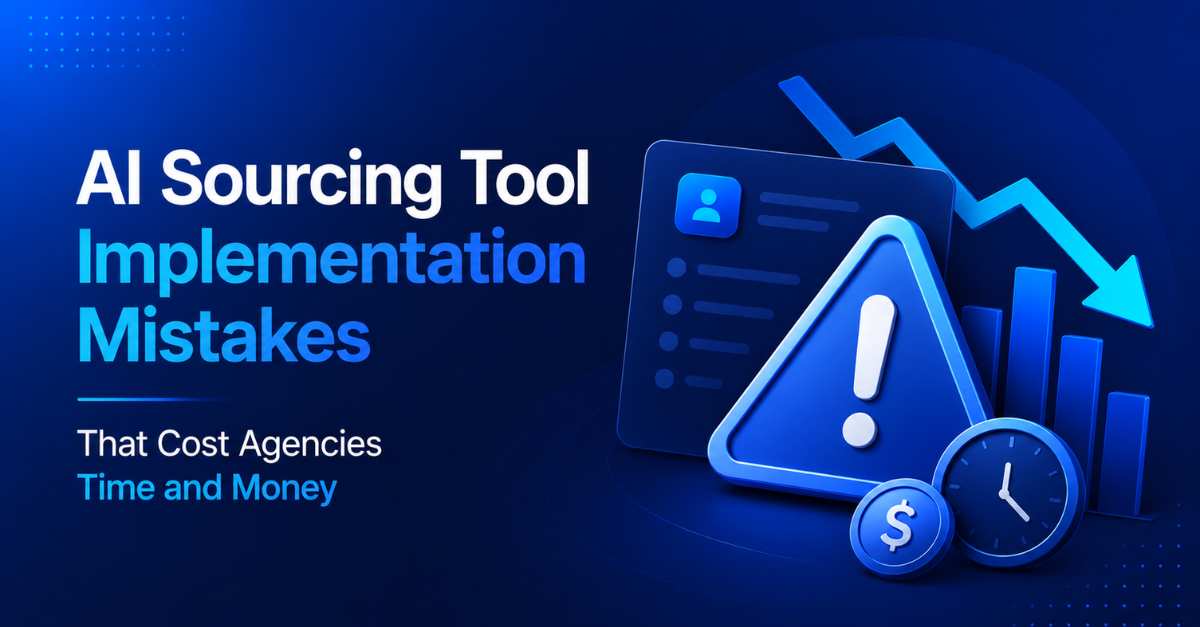
AI sourcing tool implementation often fails because recruitment agencies treat AI as a simple software upgrade instead of a workflow transformation. Successful adoption requires fixing recruiting processes, training teams, tracking meaningful outcomes, and connecting sourcing with engagement, qualification, and execution.
Credibility Framing Statement
AI is changing how recruitment agencies discover and manage talent. However, better technology alone does not guarantee better hiring outcomes. The biggest gains come from redesigning recruiting operations around AI.
Introduction
Recruitment agencies are under constant pressure to deliver qualified candidates faster. Clients expect shorter turnaround times, stronger talent pipelines, and better candidate experiences while recruiters manage increasing workloads.
This is why many staffing firms are investing in AI sourcing tools.
AI sourcing software promises faster candidate discovery, automated search, improved matching, and reduced manual effort. For agencies handling multiple roles and clients, the potential impact is significant.
But many AI implementations fail.
The reason is rarely the technology itself.
Most failures happen because agencies approach AI sourcing tool implementation as a software purchase instead of an operational change.
A new AI tool may help recruiters find profiles faster, but sourcing is only one part of recruiting. Without proper workflows for candidate engagement, screening, follow-ups, scheduling, and decision-making, agencies often create faster versions of broken processes.
The future of recruitment is not about adding more tools.
It is about building an AI-powered recruiting operation where technology helps recruiters move faster while keeping human judgment at the center.
Why Are Recruitment Agencies Adopting AI Sourcing Tools?
Recruitment agencies are adopting AI because traditional sourcing methods struggle to scale.
Recruiters spend significant time on repetitive activities:
Searching databases
Reviewing profiles
Sending outreach messages
Following up with candidates
Updating pipelines
Coordinating interviews
AI sourcing tools help reduce some of this manual workload.
What AI Sourcing Tools Can Improve
Recruiting Challenge
AI Capability
Large candidate searches
Faster candidate discovery
Manual profile screening
Automated filtering
Repetitive research
AI-powered recommendations
Slow sourcing cycles
Faster talent identification
Recruiter workload
Increased productivity
However, successful AI adoption depends on what happens after sourcing.
Finding candidates is only the beginning.
Mistake #1 — Treating AI as Just Another Tool
One of the biggest AI sourcing tool implementation mistakes is thinking:
"We purchased AI, so results will improve automatically."
AI does not fix broken recruiting operations.
It amplifies existing systems.
If an agency has unclear hiring requirements, inconsistent recruiter workflows, or poor candidate communication, AI will simply accelerate those problems.
Technology vs Transformation
A tool-focused approach looks like:
Search → Find candidates → Manual work continues
A workflow-focused approach looks like:
Discover → Engage → Qualify → Coordinate → Convert
The second approach creates measurable business impact.
How Agencies Should Think About AI
AI should become:
A recruiter research assistant
A candidate engagement assistant
A workflow automation layer
A productivity engine
Not just another search interface.
Mistake #2 — Automating Only Candidate Search
Many agencies implement AI sourcing software and stop at candidate discovery.
This creates an incomplete workflow.
A recruiter may find 500 potential candidates, but those candidates still need:
Personalized outreach
Follow-ups
Qualification
Availability checks
Interview coordination
Without automation beyond sourcing, recruiters remain overloaded.
Sourcing Is Only the First Step
The real recruiting journey is:
Stage
Traditional Process
AI-Powered Process
Discovery
Manual search
AI candidate discovery
Outreach
Manual messaging
Automated engagement
Screening
Recruiter review
AI-assisted qualification
Follow-up
Manual reminders
Automated workflows
Coordination
Email coordination
Workflow automation
AI sourcing creates value when connected to the full recruiting process.
Mistake #3 — No Clear Success Metrics
Many agencies measure AI success using activity metrics.
Examples:
Number of profiles found
Searches completed
Candidates added
But these numbers do not always translate into business results.
A recruiter does not get rewarded for finding more profiles.
The goal is successful placements.
Better AI Recruiting Metrics
Agencies should track:
Qualified candidates generated
Candidate response rates
Interviews scheduled
Time-to-submit
Placement success
Client satisfaction
The right question is not:
"How many candidates did AI find?"
The better question:
"How much recruiting work did AI remove?"
Mistake #4 — Poor Recruiter Adoption
Even the best AI recruiting tools fail if recruiters do not use them effectively.
Common adoption problems include:
Lack of training
No defined workflows
No internal ownership
No change management process
Recruiters need to understand where AI helps and where human judgment remains important.
Building AI-Ready Recruiting Teams
Successful agencies:
Identify repetitive tasks
Create AI-assisted workflows
Train recruiters on new processes
Measure improvements
Continuously optimize
AI adoption is a people and process challenge, not only a technology challenge.
Mistake #5 — Ignoring Candidate Engagement
Recruitment agencies often focus heavily on finding candidates but underestimate engagement.
A candidate who does not respond cannot become a placement.
Poor engagement creates:
Low response rates
Candidate drop-offs
Slower hiring cycles
Where AI Can Help
AI can support:
Personalized outreach
Follow-up reminders
Candidate communication
Engagement tracking
This allows recruiters to focus on conversations that require human involvement.
Mistake #6 — Poor Data Inputs
AI quality depends on the quality of information it receives.
Poor inputs create poor recommendations.
Examples:
Unclear job requirements
Incomplete candidate profiles
Incorrect hiring criteria
Missing historical insights
Better AI Outcomes Require Better Data
Agencies should maintain:
Clear role requirements
Structured candidate information
Consistent recruiter notes
Updated talent pipelines
AI becomes more valuable when it operates on reliable recruiting intelligence.
Mistake #7 — Choosing Tools Without Workflow Fit
Not every AI sourcing tool fits every recruitment agency.
A staffing firm handling high-volume hiring has different needs from an executive search agency.
Before choosing technology, agencies should evaluate:
Evaluation Area
Question
Workflow fit
Does it match our process?
Integration
Does it connect with existing systems?
Scalability
Can it support growth?
Automation
Does it reduce manual work?
Outcomes
Does it improve placements?
The best AI solution is not the one with the most features.
It is the one that improves the complete recruiting workflow.
How Should Agencies Successfully Implement AI Sourcing Tools?
A successful AI implementation starts with the recruiting process.
Step 1: Identify Bottlenecks
Find where recruiters spend the most time.
Examples:
Candidate search
Screening
Follow-ups
Scheduling
Step 2: Automate Repetitive Work
Start with tasks that do not require human judgment.
Step 3: Connect Workflows
Avoid isolated automation.
Candidate discovery should connect with:
Engagement
Qualification
Coordination
Reporting
Step 4: Measure Business Impact
Track:
Productivity
Speed
Conversion
Placement outcomes
The Future: From AI Sourcing to Agentic AI Recruiting
Traditional recruiting tools help recruiters complete individual tasks.
Agentic AI Recruiting Infrastructure focuses on executing workflows.
The evolution:
Recruiting Model
Approach
Traditional recruiting
Manual execution
AI sourcing
Faster discovery
Agentic AI recruiting
Intelligent workflow execution
The next generation of recruitment technology will not only help agencies find candidates.
It will help them manage the entire recruiting lifecycle.
Huntlo represents this shift toward Agentic AI Recruiting Infrastructure — where AI supports sourcing, engagement, qualification, and recruiting operations.
Frequently Asked Questions
1. What mistakes should agencies avoid with AI sourcing tools?
Common mistakes include automating broken processes, focusing only on sourcing, ignoring candidate engagement, and failing to train recruiters. Successful AI adoption requires workflow redesign.
2. Why do AI recruiting projects fail?
AI recruiting projects often fail because companies measure the wrong outcomes or treat AI as a standalone tool instead of integrating it into recruiting operations.
3. How should staffing agencies adopt AI?
Agencies should start by identifying repetitive tasks, automating workflows, training recruiters, and measuring improvements in productivity and placements.
4. Can AI replace recruiters?
AI can automate repetitive recruiting tasks, but recruiters remain essential for relationship building, judgment, and complex hiring decisions.
5. How can agencies improve AI ROI?
Agencies improve AI ROI by connecting sourcing automation with candidate engagement, qualification, and workflow execution.
6. What recruiting tasks should agencies automate?
Agencies can automate sourcing, outreach, follow-ups, screening assistance, scheduling, and administrative coordination.
7. What is Agentic AI recruiting?
Agentic AI recruiting uses AI agents to execute recruiting workflows instead of only providing recommendations or search results.
8. Are AI sourcing tools worth it?
AI sourcing tools are valuable when implemented correctly with clear workflows, adoption plans, and measurable business goals.
9. How does AI improve staffing operations?
AI improves staffing operations by reducing repetitive work, increasing recruiter capacity, and helping teams manage larger talent pipelines.
10. How do you measure AI recruiting success?
Measure AI success through qualified candidates, response rates, interview conversion, placement speed, and overall recruiter productivity.
Related Topics