A recruiter starts work on Monday morning.
There are six open roles.
Hundreds of applicants need review.
Two hiring managers are waiting for candidate updates.
Several passive candidates need follow-ups.
Interview availability needs to be coordinated.
A candidate wants more information about compensation.
Another is considering a competing offer.
The recruiter also needs to source new candidates for a role that has been open for two months.
Now imagine an AI system enters the workflow.
It interprets the job requirement.
It searches for candidates.
It ranks potential matches.
It finds contact details.
It drafts personalized outreach.
It sends follow-ups.
It summarizes replies.
It conducts an initial screening conversation.
It coordinates interview availability.
It updates candidate status.
It reminds the recruiter when human attention is needed.
The obvious question is uncomfortable.
What is left for the recruiter?
The answer depends on what the recruiter was doing before the AI arrived.
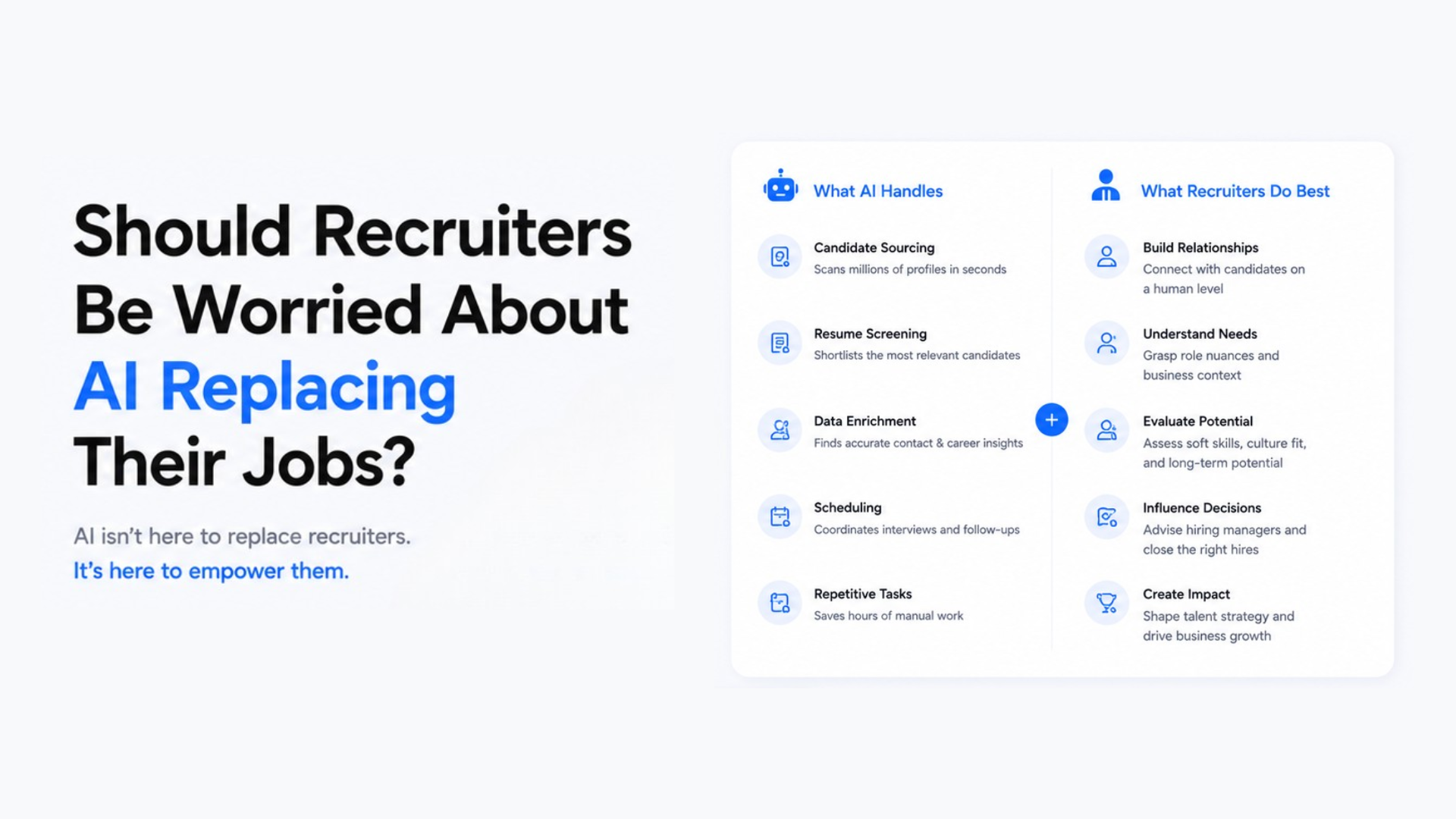
If most of the recruiter’s value came from manually searching databases, copying candidate information, sending repetitive messages, scheduling interviews, updating systems, and moving information between tools, a significant amount of that work is becoming automatable.
If the recruiter’s value comes from understanding difficult hiring needs, advising managers, judging uncertain situations, convincing strong candidates, building trust, navigating competing interests, interpreting the talent market, and taking responsibility for hiring outcomes, the job is much harder to automate completely.
Recruiters should be worried enough to adapt, but not because AI is about to eliminate every recruiting job. The more immediate change is that AI is reducing the value of repetitive recruiting execution while increasing the value of judgment, relationships, strategy, accountability, and the ability to direct AI-powered workflows.
The real competition may not be recruiter versus AI.
It may be recruiter with AI versus recruiter without AI.
It may also be one AI-enabled recruiter versus several people performing work that can now be automated.
That second possibility deserves serious attention.
The reassuring answer that “AI will never replace recruiters because recruiting is human” is too simple.
The frightening answer that “AI will replace all recruiters” is also too simple.
Recruiting is not one task.
It is a collection of tasks.
AI will affect each one differently.
The Wrong Question Is Whether AI Will Replace the Recruiter
When people discuss job automation, they often imagine an occupation disappearing as one complete unit.
One day there are recruiters.
The next day there are AI systems.
Real workplace change is usually less clean.
Jobs contain tasks.
Some tasks become automated.
Some become faster.
Some become more important.
New tasks appear.
The occupation changes.
Consider what a recruiter may do during one week.
Understand a hiring requirement.
Research the talent market.
Build a search.
Find candidates.
Review profiles.
Locate contact details.
Write outreach.
Send follow-ups.
Respond to candidates.
Conduct initial screens.
Coordinate with hiring managers.
Prepare candidates for interviews.
Schedule meetings.
Manage expectations.
Negotiate offers.
Maintain relationships.
Update systems.
Report on pipeline.
These activities do not have the same level of AI exposure.
Scheduling is easier to automate than persuading a strong candidate to reconsider an offer.
Generating a first outreach draft is easier than understanding why a hiring manager keeps rejecting technically qualified candidates.
Summarizing an interview is easier than deciding whether a candidate’s unusual career path should be treated as a risk or an advantage.
The useful question is therefore not:
Will AI replace recruiters?
It is:
Which parts of recruiting are becoming automated, and what remains valuable after they are?
Some Recruiting Work Is Clearly Being Automated
Recruiters should not pretend otherwise.
AI can already support candidate sourcing.
It can interpret natural-language requirements.
It can identify related titles and skills.
It can rank profiles.
It can generate candidate summaries.
It can help find contact information.
It can draft outreach.
It can personalize messages.
It can send follow-ups.
It can answer routine questions.
It can support initial screening.
It can summarize conversations.
It can coordinate scheduling.
It can update workflows.
The adoption is no longer theoretical. A June 2026 overview from Society for Human Resource Management reported that 51% of organizations were already using AI in recruitment, framing the question for many talent leaders as where and how to adopt AI rather than whether to adopt it at all.
The direction is clear.
More recruiting tasks will be performed with AI assistance.
Some will become highly automated.
The mistake is assuming that every automated task equals one eliminated recruiter.
Organizations may use the recovered capacity in different ways.
One company may reduce headcount.
Another may handle more hiring without expanding the recruiting team.
Another may ask recruiters to spend more time on difficult roles.
Another may improve candidate experience.
Another may simply expect one recruiter to produce more.
The technology creates the possibility of labor reduction.
The business decides what to do with that possibility.
The Most Exposed Recruiting Work Is Repetitive Execution
Imagine two recruiters.
The first spends most of the day searching databases, exporting profiles, finding emails, writing similar messages, following up manually, scheduling calls, and updating spreadsheets.
The second spends most of the day helping hiring managers define roles, understanding difficult talent markets, building candidate relationships, resolving hiring bottlenecks, influencing decisions, and closing strong candidates.
AI affects both.
It affects the first more directly.
This is because repetitive execution is easier to standardize.
The input is clearer.
The output is easier to evaluate.
The task happens frequently.
The process follows patterns.
Candidate sourcing is becoming more automated because AI can search and rank professional information at scale.
Outreach writing is becoming more automated because AI can generate messages quickly.
Follow-ups are becoming more automated because workflows can react to candidate behavior.
Scheduling is becoming more automated because the objective is relatively structured.
The recruiter whose job is mostly a sequence of predictable actions faces greater pressure.
This does not mean the person has no future.
It means the person needs to move toward work that is harder to reduce to predictable execution.
AI Will Probably Reduce the Number of People Needed for Some Recruiting Workflows
This possibility should not be hidden behind optimistic language.
Suppose a staffing agency previously needed ten recruiters to handle a certain volume of sourcing and outreach.
AI reduces the time required to find candidates.
Contact enrichment becomes automatic.
Outreach becomes faster.
Follow-ups run without manual effort.
Initial qualification becomes partially automated.
The agency may now handle the same volume with fewer people.
Or it may keep ten people and handle more clients.
Both outcomes are possible.
The technology does not guarantee job loss.
It creates leverage.
The economic question is what organizations do with that leverage.
This is why recruiter concern is reasonable.
AI does not need to perform every part of recruiting to affect recruiter headcount.
It only needs to increase productivity enough that fewer people are required for the same amount of work.
The effect may be strongest in high-volume and highly standardized recruiting environments where many tasks follow repeatable patterns.
The effect may be weaker in executive search, complex specialist hiring, relationship-heavy agency work, and roles requiring significant stakeholder management.
The future will not affect every recruiter equally.
Sourcing Is One of the Most Exposed Areas
Traditional sourcing can consume significant recruiter time.
The recruiter translates a job description into search terms.
They build Boolean strings.
They review profiles.
They adjust filters.
They search across platforms.
They create a shortlist.
AI changes this workflow.
A recruiter can describe the person they need.
The system can interpret the requirement.
It can search across related titles.
It can understand adjacent skills.
It can rank candidates.
It can explain why profiles may fit.
The recruiter moves from manually constructing every search toward reviewing and directing the search process.
This is a major change.
Huntlo’s guide to What's the Difference Between AI Sourcing and AI Recruiting? explains why candidate discovery is only one part of the wider recruiting workflow, but it is also one of the areas where AI can remove substantial manual work.
Does this mean sourcers disappear?
Some sourcing work may.
The strongest sourcers may become talent intelligence specialists.
They may focus on difficult searches.
They may map markets.
They may understand competitor talent.
They may advise hiring teams on where candidates exist.
They may design search strategies and supervise AI-driven discovery.
The value moves away from manually entering queries.
It moves toward knowing what to search for and what the results mean.
Boolean Search Expertise May Become Less Valuable on Its Own
For years, sophisticated Boolean search was an important recruiting skill.
The recruiter who understood titles, operators, exclusions, and complex query construction could find candidates others missed.
That skill still has value.
Its scarcity is declining.
Natural-language AI search can increasingly translate a hiring requirement into a broader search strategy.
The recruiter does not always need to manually construct every combination.
This does not mean technical sourcing knowledge becomes useless.
The valuable part changes.
Knowing the difference between relevant and irrelevant experience remains important.
Understanding adjacent skills remains important.
Recognizing unrealistic hiring requirements remains important.
Knowing where specialist talent exists remains important.
The mechanical construction of the query becomes less central.
Huntlo’s guide to What Is Boolean Search in Recruiting (And Why AI Tools Are Replacing It) explores this shift from recruiter-built search logic toward systems that can interpret hiring intent more directly.
The broader lesson applies to recruiting careers.
Skills based mainly on operating one interface are more vulnerable than skills based on understanding the hiring problem.
Outreach Writing Is Becoming Easier to Automate
A recruiter previously spent time writing candidate messages.
AI can generate them in seconds.
It can use candidate context.
It can adapt tone.
It can create follow-ups.
It can produce variations.
This reduces the value of simply being able to write a standard recruiting email.
The difficult part moves elsewhere.
Why should this candidate care?
Is the role genuinely relevant?
Which part of the opportunity is likely to matter?
Should the recruiter contact the person now?
How should the conversation change after a response?
When should automation stop?
A message can be generated automatically.
A relationship cannot be reduced to the message alone.
This is why the recruiter who only sends outreach is more exposed than the recruiter who understands how to create candidate interest.
The distinction becomes more important as candidates receive more AI-generated communication.
When everyone can produce polished outreach, polish becomes less valuable.
Relevance and credibility become more valuable.
Follow-Ups Are Highly Automatable
Recruiters often lose candidates because follow-ups depend on memory.
A message is sent.
The candidate does not respond.
The recruiter becomes busy.
The follow-up never happens.
AI-powered workflows can handle this more consistently.
The system can wait.
It can send the next message.
It can stop when the candidate replies.
It can change the workflow based on interest.
It can remind the recruiter when human involvement is needed.
This is exactly the kind of repetitive coordination that software handles well.
A recruiter should not build a career advantage around remembering to send the third follow-up.
The valuable skill is designing the engagement strategy.
The execution can increasingly be automated.
Scheduling and Administrative Coordination Are Highly Exposed
Interview scheduling is necessary.
It is rarely the highest-value use of recruiter attention.
The recruiter collects availability.
They compare calendars.
They send options.
Someone changes the time.
The process begins again.
AI and workflow automation can reduce much of this work.
The same is true for routine status updates.
Meeting summaries.
Reminder messages.
Data entry.
Moving information between systems.
These tasks may not disappear completely.
Exceptions will remain.
The amount of human time required can fall significantly.
Recruiters who spend a large percentage of their week on administrative coordination should expect their jobs to change.
The strongest response is not to defend the manual work.
It is to become capable of doing something more valuable with the time that automation creates.
Initial Screening Is Becoming More Automated
AI can ask candidates structured questions.
It can collect information.
It can summarize answers.
It can identify whether basic requirements appear to be met.
It can support voice or conversational screening.
This creates obvious concern.
Initial screening has traditionally been a major part of recruiter work.
The important distinction is between collecting information and making judgment.
A structured AI screen may efficiently determine whether the candidate is interested.
Whether location works.
Whether compensation expectations are aligned.
Whether the person has relevant experience.
Whether they can describe a particular project.
The system can organize the evidence.
More difficult questions remain.
Is the candidate credible?
Are they unusually strong despite missing one requirement?
Is the hiring manager’s concern reasonable?
Does the candidate understand the role?
Is the person likely to accept?
What should happen next?
AI can support these decisions.
The recruiter still owns context and accountability.
Huntlo’s guide to How Does AI Interview Screening Score Candidates? explains why screening outputs should be treated as structured evidence rather than unquestionable hiring verdicts.
The recruiter who only asks a fixed list of questions is more exposed than the recruiter who knows how to interpret the answers.
Candidate Matching Will Reduce Some Manual Review
AI can compare candidate evidence with job requirements.
It can identify skills.
It can examine career history.
It can rank profiles.
It can explain why a person appears relevant.
This reduces the need for recruiters to manually inspect every candidate from the beginning.
The recruiter may review a prioritized set.
This can create major efficiency.
It also creates risk.
AI can be wrong.
Candidate data can be incomplete.
Unusual career paths can be misunderstood.
Automated systems can reproduce or amplify problematic patterns.
A 2025 Society for Human Resource Management article warned that employers using AI-powered candidate assessment need to actively address potential bias rather than assuming algorithmic outputs are neutral.
This is one reason human review remains important.
The recruiter’s role may shift from reading everything to reviewing uncertainty.
That is a more demanding job.
The person needs to understand when the AI is likely to be wrong.
Recruiters Should Be More Worried About Job Redesign Than Total Job Elimination
The most likely near-term change is not that every recruiting team disappears.
The job itself changes.
A recruiter may manage more open roles.
They may supervise AI agents.
They may review candidate recommendations instead of building every search.
They may intervene when candidates show interest.
They may spend more time with hiring managers.
They may focus on difficult searches.
They may handle exceptions.
They may analyze funnel performance.
They may design workflows.
This sounds positive.
It can also create pressure.
If one recruiter can do the work previously performed by three people, organizations may not need the same team structure.
The remaining role may also become more demanding.
The recruiter is expected to understand technology.
Use data.
Advise stakeholders.
Build relationships.
Manage AI output.
Maintain candidate trust.
The job becomes less administrative.
It may become more intellectually and emotionally complex.
Recruiters should prepare for that change.
The Recruiter Who Only Operates Tools Is at Greater Risk
Recruiting technology changes constantly.
One generation of recruiters became experts at job boards.
Another became experts at professional-network search.
Another became experts at outreach automation.
The next generation will work with AI agents.
The interface is not the durable skill.
The hiring problem is.
A recruiter whose value comes mainly from knowing where to click can be replaced when the interface changes.
A recruiter who understands why the company is struggling to hire is harder to replace.
Why is the talent pool small?
Why are candidates rejecting the opportunity?
Why does the hiring manager reject everyone?
Why is the process too slow?
Why is the compensation uncompetitive?
Why are qualified candidates dropping out?
AI can provide information.
Someone still needs to understand the business problem.
The future recruiter is likely to be less of a software operator.
They will be more of a talent adviser and workflow owner.
Hiring Managers Still Need Someone to Challenge Them
A hiring manager says every requirement is mandatory.
The recruiter searches.
The talent pool is tiny.
The AI can return the data.
Someone still needs to have the conversation.
The recruiter may need to say that the role is unrealistic.
The compensation is too low.
The location requirement is shrinking the market.
The interview process is too long.
The job description is unclear.
The manager is rejecting candidates for reasons that were never defined.
This work requires influence.
AI can generate a report.
It cannot guarantee that the hiring manager changes behavior.
The recruiter needs trust.
Business understanding.
Negotiation.
The ability to challenge someone without damaging the relationship.
This is one of the strongest areas of recruiter value.
The future recruiter should not simply receive a hiring requirement.
They should improve it.
Candidate Trust Is Difficult to Automate Completely
Candidates do not experience hiring as a workflow diagram.
They experience uncertainty.
Should I leave my current company?
Is this manager someone I want to work for?
Is the compensation fair?
Why has the process become slow?
Does the company genuinely want me?
Should I accept this offer or another one?
A chatbot can answer questions.
An AI agent can provide information.
Some candidates will be comfortable interacting with automated systems.
Others will want a person when the decision becomes important.
The recruiter can understand hesitation.
They can explain context.
They can notice what the candidate is not saying.
They can build confidence.
They can repair trust when the process goes wrong.
This work is not impossible for AI to influence.
It is much harder to automate reliably.
The more consequential the career decision, the more valuable credible human involvement can become.
Strong Candidates Often Need to Be Persuaded
A candidate applies to a job.
They already have interest.
A passive candidate is different.
They may be happy.
They may have several opportunities.
They may not believe the role is worth the risk.
Finding the person is only the beginning.
The recruiter needs to understand motivation.
What does the candidate want next?
What is missing from the current role?
What would make a move worthwhile?
What concerns exist?
How does the opportunity compare with alternatives?
This is consultative recruiting.
AI can help prepare the recruiter.
It can summarize candidate context.
It can suggest questions.
It can provide market information.
The actual conversation still requires judgment.
Huntlo’s guide to How to Source Passive Candidates Who Aren't Job-Searching explains why passive recruiting depends on creating relevance rather than simply locating contact information.
As candidate discovery becomes easier, candidate persuasion may become more important.
Negotiation Remains a Human-Heavy Part of Recruiting
An offer is not accepted.
The candidate wants more compensation.
The company has limited flexibility.
The hiring manager believes the candidate should accept.
The candidate has another offer.
There may be family considerations.
Start-date problems.
Counteroffers.
Concerns about role scope.
AI can provide data.
It can suggest scenarios.
It can draft communication.
The recruiter needs to navigate the people.
Good negotiation depends on understanding priorities.
Knowing what can move.
Knowing when to push.
Knowing when to stop.
Maintaining trust between parties with different interests.
This is difficult to reduce to a fixed workflow.
The more complex the hire, the more important this work becomes.
Accountability Is One of the Biggest Reasons Humans Remain Important
AI can recommend a candidate.
Who is responsible when the recommendation is wrong?
AI can reject a candidate.
Who explains the decision?
AI can conduct a screen.
Who decides whether the evidence is sufficient?
AI can optimize a workflow.
Who decides what the workflow should optimize?
Hiring decisions affect people and organizations.
They can create legal, ethical, financial, and operational consequences.
Someone needs to own the outcome.
This is why human-centric AI principles matter in recruiting. A June 2026 SHRM article described the practical model as one where algorithms inform while people decide, with humans reviewing outputs, applying context, and owning outcomes.
The recruiter’s future value may increasingly come from responsible oversight.
That is different from manual execution.
It is not less important.
AI May Make Human Judgment More Important, Not Less
This sounds contradictory.
If AI performs more work, why would judgment become more valuable?
Because automation increases scale.
A recruiter can contact more candidates.
Review more profiles.
Manage more workflows.
Every error can also scale.
A bad search can produce thousands of irrelevant candidates.
Incorrect data can generate hundreds of inaccurate messages.
A biased screening rule can affect large numbers of applicants.
An inappropriate workflow can damage candidate experience quickly.
Human judgment becomes the control layer.
The recruiter needs to know when to trust the system.
When to question it.
When to intervene.
When to stop automation.
When to escalate.
This is a more advanced form of recruiting work.
The recruiter is not manually performing every action.
They are responsible for the quality of a larger system.
Recruiters Will Need to Become Better at Evaluating AI
Using AI is not the same as using AI well.
A recruiter asks the system for candidates.
The AI returns a list.
The weak user accepts it.
The strong user asks questions.
Why were these people ranked highly?
Which requirements are directly supported?
Which are inferred?
Who might be missing?
Is the candidate information current?
Is the search too narrow?
Is the system overvaluing one employer?
Does the output match what the hiring manager actually needs?
These skills will matter.
AI literacy for recruiters is not primarily about learning prompt tricks.
It is about understanding system strengths and weaknesses.
The recruiter needs to evaluate evidence.
Recognize uncertainty.
Measure outcomes.
Design human review.
Huntlo’s guide to How Do You Know If an AI Sourcing Tool Is Actually Working? explains why AI recruiting performance should be judged through candidate relevance, qualified conversations, interviews, recruiter effort, and hiring outcomes rather than activity volume.
The future recruiter needs to evaluate the system, not merely use it.
Recruiters May Become Managers of AI Agents
The traditional recruiter manages a pipeline.
The future recruiter may also manage digital workers.
One AI agent handles sourcing.
Another supports outreach.
Another collects screening information.
Another coordinates scheduling.
The recruiter defines objectives.
Reviews outputs.
Handles exceptions.
Changes priorities.
Intervenes when human attention matters.
This is not science fiction in the distant future.
Recruiting software is already moving toward agentic workflows.
The change is from asking AI to perform one task toward giving systems responsibility for multi-step work.
This creates a new recruiter skill.
Workflow design.
What should the AI do?
What should require approval?
When should the system stop?
What information should be collected?
What should trigger human involvement?
The recruiter who can answer these questions may become significantly more productive.
One Recruiter May Be Able to Handle More Work
This is one of the most important consequences.
Suppose AI reduces time spent on sourcing.
Outreach.
Follow-ups.
Screening administration.
Scheduling.
The recruiter has more capacity.
The organization may give them more roles.
A recruiter who previously handled ten positions may handle more.
An agency recruiter may manage more clients.
A sourcing specialist may map more markets.
This can improve productivity.
It can also create a more intense job.
Organizations should not assume every minute saved by AI should become additional workload.
Huntlo’s guide to How to Reduce Recruiter Burnout With Workflow Automation explains why the purpose of automation should not simply be to increase activity. The recovered time should move toward work where recruiter attention creates more value.
If AI only allows companies to overload the remaining recruiters, the technology may improve output while worsening the job.
Entry-Level Recruiting Roles May Face Greater Pressure
This is a difficult part of the discussion.
Many people learn recruiting through repetitive work.
They source candidates.
Review profiles.
Schedule interviews.
Conduct basic screens.
Update systems.
Over time, they learn the market.
They develop judgment.
They become stronger recruiters.
What happens when AI automates many of the beginner tasks?
The entry path may become narrower.
Companies may expect junior recruiters to perform more advanced work earlier.
This challenge is not unique to recruiting.
Across the labor market, AI is automating tasks that traditionally helped people learn occupations.
The World Economic Forum has emphasized that technology skills will grow rapidly in importance while human capabilities such as creative thinking, resilience, flexibility, and agility remain critical, with a large share of workplace skills expected to change by 2030.
Recruiting leaders will need to rethink development.
Junior recruiters still need to learn.
They may learn through AI-assisted work rather than purely manual repetition.
They may review AI output.
Observe senior stakeholder conversations.
Handle candidate relationships earlier.
Analyze difficult cases.
The career ladder needs to change with the work.
Agency Recruiters Face Both Risk and Opportunity
Recruitment agencies often depend heavily on recruiter productivity.
More candidate discovery.
More outreach.
More submissions.
More placements.
AI can increase each recruiter’s capacity.
This creates opportunity.
A smaller agency can compete with a larger team.
Recruiters can work more roles.
Candidate research becomes faster.
Follow-ups become consistent.
Screening can become more structured.
The risk is that competitors gain the same advantage.
If every agency can find candidates faster, sourcing speed becomes less differentiated.
Clients may ask why they should pay traditional fees for work that appears increasingly automated.
Agencies need to move toward higher-value services.
Market intelligence.
Specialist expertise.
Candidate relationships.
Advisory work.
Assessment quality.
Speed combined with judgment.
Huntlo’s article on How AI Sourcing Tools Are Reshaping Recruitment Agency Business Models explores why automation can improve agency economics while also changing what clients are willing to pay for.
The agency recruiter who only forwards resumes is more exposed.
The recruiter who owns a difficult talent market is less replaceable.
In-House Recruiters Will Need Stronger Business Understanding
An in-house recruiter should know more than how to fill a vacancy.
Why is the role important?
What business problem does it solve?
What happens if the company cannot hire?
Which requirements genuinely predict success?
How does the team compete for talent?
Why do candidates accept?
Why do they reject?
Which skills should the company build rather than buy?
AI can provide information.
The recruiter needs to connect talent decisions with business decisions.
This moves recruiting closer to consulting.
A 2025 analysis from LinkedIn Talent Solutions argued that recruiters will increasingly need to think like consultants, combining AI with human judgment, relationships, guidance, and strategic value.
That direction makes sense.
When execution becomes cheaper, advice becomes more valuable.
Recruiters Who Specialize May Become More Valuable
AI makes general information easier to access.
Deep context can still be scarce.
A recruiter who understands semiconductor talent.
AI infrastructure.
Cybersecurity.
Healthcare regulation.
Executive leadership.
A specific geographic market.
A specific professional community.
The person knows more than candidate names.
They understand how the market works.
Which companies produce strong talent?
Which skills transfer?
What compensation is realistic?
Why do candidates move?
Which titles are misleading?
Which hiring requirements are impossible?
AI can support this knowledge.
It may not replace the credibility built through experience and relationships.
Huntlo’s guide to Do AI Recruiting Tools Work for Niche or Highly Technical Roles? explains why specialist hiring still depends on understanding technical context, adjacent skills, and the limits of candidate evidence.
The future may reward recruiters who know something deeply.
Recruiters Who Build Genuine Candidate Networks Have an Advantage
A database contains profiles.
A network contains relationships.
The distinction matters.
The recruiter knows who may be ready to move.
Who had a bad experience with a particular company.
Who wants leadership responsibility.
Who is waiting for the right remote opportunity.
Who should be contacted in six months.
AI can help organize these relationships.
It can remind the recruiter.
It can surface previous conversations.
It can support follow-up.
The trust still belongs to the relationship.
Candidates may increasingly value recruiters who provide signal in a world of automated noise.
The more AI-generated outreach candidates receive, the more valuable a credible human connection may become.
This is not guaranteed.
Recruiters need to earn that trust.
Recruiters Who Refuse AI May Be More at Risk Than Recruiters Who Use It
Some recruiters respond to automation by defending manual work.
“I can source better than AI.”
“I write every message myself.”
“I do not trust automated screening.”
Skepticism can be healthy.
Refusal to adapt is different.
The recruiter does not need to accept every AI output.
They need to understand the technology well enough to decide where it helps.
A recruiter who uses AI to remove repetitive work can spend more time on judgment and relationships.
A recruiter who performs everything manually may struggle to match the speed and capacity of AI-enabled teams.
This is why the strongest career strategy is not competing with the machine at machine-like work.
Do not build your advantage around speed of data processing.
Build it around what you can do with the information.
Recruiters Should Also Be Worried About Bad AI
The risk is not only job replacement.
It is being asked to work inside poorly designed systems.
An AI tool may rank candidates incorrectly.
It may use inaccurate data.
It may generate misleading outreach.
It may create biased outcomes.
It may automate rejection without enough review.
The recruiter may still be blamed when the process fails.
This makes governance a career issue.
Recruiters should understand how systems affect candidates.
They should know what data is used.
What the AI is allowed to decide.
Where human review exists.
How errors are corrected.
Who is accountable.
Huntlo’s guide to Is It Ethical to Use AI for Candidate Screening? explores why responsible AI hiring requires transparency, proportionality, human oversight, and clear accountability.
A future recruiter may need to be part operator, part reviewer, and part safeguard.
The Human Part of Recruiting Will Not Automatically Become More Human
This point matters.
People often say AI will automate administration so recruiters can focus on people.
That outcome is possible.
It is not automatic.
A company can use AI to create more candidate conversations.
It can also use AI to remove human contact.
It can use automation to improve response times.
It can also create impersonal experiences.
It can give recruiters more time.
It can also increase workload.
The technology does not determine the culture.
Organizations do.
A 2025 SHRM analysis warned that automation alone cannot repair a hiring process that has lost trust, highlighting the growing strain created when employers and candidates both use AI at scale without enough meaningful human interaction.
The recruiter may become more valuable precisely because the rest of the process becomes more automated.
Someone needs to preserve trust.
What Recruiters Should Learn Now
Recruiters do not need to become machine-learning engineers.
They need a different combination of skills.
Understand AI recruiting systems.
Know how sourcing, matching, outreach, screening, and agents work.
Learn to evaluate output.
Understand data quality.
Recognize bias and uncertainty.
Measure recruiting outcomes.
Improve stakeholder management.
Develop market expertise.
Become better at candidate conversations.
Learn negotiation.
Understand the business behind the role.
Design workflows.
Know when automation should stop.
These capabilities are more durable than mastery of one recruiting interface.
The tools will change.
The hiring problems will remain.
A Practical Way to Think About Career Risk
Ask what percentage of your week is spent on work that follows a predictable pattern.
Searching.
Copying.
Scheduling.
Sending reminders.
Writing similar messages.
Updating systems.
Summarizing information.
The higher the percentage, the more your job is likely to change.
Then ask what percentage is spent on work requiring context.
Influence.
Trust.
Judgment.
Negotiation.
Strategy.
Accountability.
The higher the percentage, the harder your role is to automate completely.
This is not a scientific formula.
It is a useful career audit.
The goal is not to eliminate every repetitive task yourself.
The goal is to use automation to move your work toward the second category.
What the AI-Powered Recruiter May Look Like
The recruiter begins with a hiring objective.
AI helps interpret the role.
The system maps the talent market.
Candidate sourcing runs continuously.
Potential matches are prioritized.
The recruiter reviews uncertain or high-value cases.
Outreach begins.
AI handles routine follow-ups.
The recruiter enters when a candidate shows interest or when the situation requires human judgment.
Initial information is collected.
The system summarizes the evidence.
The recruiter prepares the hiring manager.
Interviews move forward.
The recruiter manages candidate expectations.
They identify process problems.
They advise the business.
They negotiate.
They close.
This recruiter may perform less manual work.
They may influence more of the hiring outcome.
That is the likely direction of the role.
Where Huntlo Fits Into the Future of Recruiting Work
Huntlo is built around the idea that recruiters should not need to manually operate every stage of a fragmented workflow.
AI-powered sourcing can help identify relevant candidates.
Matching can help explain why candidates may fit.
Profile and contact enrichment can reduce manual research.
Outreach can help engage candidates across channels.
Follow-ups can continue without depending entirely on recruiter memory.
AI voice screening can collect structured candidate information.
Workflow automation can help move candidates toward the next meaningful stage.
The objective is not to remove the recruiter from hiring.
It is to reduce the amount of repetitive execution the recruiter needs to perform personally.
This changes where recruiter value appears.
The recruiter can spend less time moving information.
Less time repeating administrative tasks.
Less time rebuilding the same workflows.
More time understanding hiring needs.
Reviewing important evidence.
Speaking with strong candidates.
Advising hiring managers.
Handling exceptions.
Making the process work.
For teams evaluating Huntlo or any other AI recruiting platform, the important question should not be whether the technology replaces recruiters.
The better question is which work the system should own and which work should remain meaningfully human.
Will Companies Eventually Hire Without Recruiters?
Some will.
Some already do for certain roles.
A small company may use AI to create a job description, review applicants, coordinate interviews, and manage communication without a dedicated recruiter.
High-volume standardized hiring may become increasingly automated.
Internal mobility may use AI matching without traditional sourcing.
The number of roles requiring direct recruiter involvement may change.
This does not mean recruiting disappears.
Someone still defines the role.
Designs the process.
Reviews important decisions.
Handles exceptions.
Manages candidate trust.
Owns the outcome.
In some organizations, these responsibilities may move to hiring managers or HR.
In others, specialized recruiters will remain.
The shape of the function may change more than the underlying need.
Will AI Create New Recruiting Roles?
Probably.
Organizations may need recruiting automation specialists.
AI workflow owners.
Talent intelligence professionals.
Hiring governance specialists.
Candidate experience leaders.
Recruiting operations professionals who understand AI systems.
The exact titles will vary.
The work already exists in early forms.
Someone needs to configure systems.
Evaluate performance.
Monitor errors.
Design human review.
Connect tools.
Train recruiters.
Measure outcomes.
The World Economic Forum expects significant skill disruption through 2030 while also projecting both job creation and displacement across the wider economy, reinforcing that technological change often redesigns work rather than producing a simple one-directional replacement story.
Recruiters can move toward these new areas.
The profession is not frozen.
Should Recruiters Be Worried?
Yes, if worried means paying attention.
No, if worried means assuming the career has no future.
The recruiter who performs mostly repetitive execution should expect significant change.
The recruiter who refuses to learn AI should expect increasing pressure.
The recruiter who depends entirely on one platform or one mechanical skill should diversify.
The recruiter who develops judgment, market knowledge, stakeholder influence, candidate trust, AI literacy, and workflow design has a stronger position.
AI is not removing the need to hire people.
It is changing how much human work is required to execute hiring.
That difference matters.
The safest response is neither denial nor panic.
It is adaptation.
Conclusion: AI May Replace Recruiting Tasks Before It Replaces Recruiters
Recruiters should take AI seriously.
Candidate sourcing is changing.
Outreach is changing.
Screening is changing.
Scheduling is changing.
Workflow coordination is changing.
Some recruiting jobs will shrink.
Some teams will become smaller.
Some entry-level tasks will disappear.
One recruiter may be able to handle more work.
These are realistic possibilities.
The other side is equally important.
Hiring is not only information processing.
It involves unclear requirements.
Human ambition.
Risk.
Trust.
Negotiation.
Conflicting interests.
Organizational politics.
Uncertainty.
Accountability.
AI can support these areas.
It cannot reliably remove the need for human ownership across all of them.
The recruiter of the future will probably do less searching by hand.
Less copying.
Less scheduling.
Less repetitive follow-up.
Less administrative coordination.
They will need to do more advising.
More evaluating.
More influencing.
More relationship building.
More workflow design.
More responsible oversight of AI.
The profession may become smaller in some environments.
It may become more productive.
It may become more specialized.
It will almost certainly become different.
The greatest risk is not that an AI agent suddenly takes a recruiter’s chair.
The greater risk is that the work changes while the recruiter does not.
The greatest opportunity is the opposite.
Recruiters can use AI to remove the parts of the job that consume time without creating enough value.
Then they can become better at the parts of hiring that organizations and candidates still need humans to own.
AI may replace recruiting tasks.
Recruiters who learn how to direct the technology while taking responsibility for the human outcome may become more valuable, not less.
Frequently Asked Questions
Will AI completely replace recruiters?
AI is unlikely to replace every recruiter in the foreseeable future, but it can automate significant parts of sourcing, outreach, follow-ups, screening, scheduling, and administration. This may reduce headcount needs in some recruiting environments while changing the skills required in others.
Which recruiting jobs are most at risk from AI?
Roles dominated by repetitive candidate search, data entry, standard outreach, scheduling, basic screening, and workflow administration are more exposed than roles centered on stakeholder management, specialist markets, candidate relationships, negotiation, and strategic advice.
Will AI replace talent sourcers?
AI will automate more candidate discovery and search work. Some sourcing roles may shrink, while others may evolve toward talent intelligence, market mapping, difficult searches, and oversight of AI-driven sourcing systems.
Can AI replace recruiter screening calls?
AI can automate or support structured initial screening, especially for basic qualifications and information collection. Complex judgment, candidate motivation, ambiguous situations, and high-stakes evaluation still benefit from human involvement.
Will companies need fewer recruiters because of AI?
Some companies may need fewer recruiters for the same hiring volume because AI increases productivity. Other companies may use the additional capacity to hire faster, improve candidate experience, or handle more difficult roles.
Are agency recruiters at risk from AI?
Yes, particularly if their value comes mainly from finding profiles and forwarding resumes. Agency recruiters with specialist market knowledge, strong candidate networks, advisory skills, and the ability to use AI effectively may become more competitive.
What skills should recruiters learn to stay relevant?
Recruiters should develop AI literacy, stakeholder management, candidate relationship skills, negotiation, talent-market expertise, recruiting analytics, workflow design, and the ability to evaluate AI outputs critically.
Will AI make recruiting less human?
It can, but that depends on implementation. AI can remove administrative work and create more time for human interaction, or companies can use it to remove human contact. The technology does not determine the outcome by itself.
Should recruiters learn to use AI recruiting tools?
Yes. Recruiters do not need to accept every AI recommendation, but they should understand how AI sourcing, matching, outreach, screening, and workflow automation work so they can use and evaluate these systems responsibly.
What is the future role of a recruiter?
The role is likely to move away from repetitive execution and toward talent advice, AI workflow oversight, market intelligence, candidate relationships, stakeholder influence, negotiation, and accountability for hiring outcomes.
Related Topics
Understand how the broader recruiting workflow is changing beyond candidate search in What's the Difference Between AI Sourcing and AI Recruiting?.
Explore how automation can remove repetitive work without simply increasing recruiter workload in How to Reduce Recruiter Burnout With Workflow Automation.
See how AI-driven candidate discovery is changing the economics of agency recruiting in How AI Sourcing Tools Are Reshaping Recruitment Agency Business Models.