AI can screen more candidates than a recruiter can realistically review by hand.
A system can compare applications with job requirements, identify relevant professional evidence, ask structured screening questions, transcribe candidate answers, summarize responses, and help recruiters decide who deserves further attention.
For an overloaded recruiting team, this can look like an obvious improvement.
Candidates receive faster responses.
Recruiters spend less time manually reviewing repetitive information.
Screening becomes more consistent.
Hiring teams can focus their attention on stronger conversations.
The ethical problem begins when efficiency becomes the only standard.
A system may be fast and still be unfair.
It may be consistent and still consistently evaluate the wrong criteria.
It may produce precise-looking scores without being accurate.
It may save recruiter time by preventing candidates from ever receiving meaningful human consideration.
It may analyze characteristics that have little connection with job performance.
The ethical question is therefore larger than whether AI makes screening faster.
Using AI for candidate screening can be ethical when the technology evaluates job-relevant evidence, operates with appropriate transparency, is tested for harmful outcomes, supports accessibility, protects candidate information, and remains subject to meaningful human accountability. It becomes ethically difficult when organizations use AI to make hidden, unchallengeable, or poorly validated decisions about people’s access to employment.
This distinction matters because “AI screening” can describe very different systems.
One platform may help a recruiter summarize answers to five structured job-related questions.
Another may automatically reject applicants based on a hidden score.
A third may analyze facial expressions, voice patterns, or personality traits.
A fourth may rank resumes using criteria nobody inside the company fully understands.
These systems should not be treated as ethically equivalent simply because they all use artificial intelligence.
The real ethical analysis begins with the role the technology plays.
What information does the AI evaluate?
Why is that information relevant to the job?
How was the system tested?
Who sees the output?
Can a recruiter disagree?
Can a candidate correct an error?
Does the system affect some groups differently?
What happens when the AI is wrong?
These questions determine whether automation supports better hiring or simply makes questionable decisions happen faster.
What Is AI Candidate Screening?
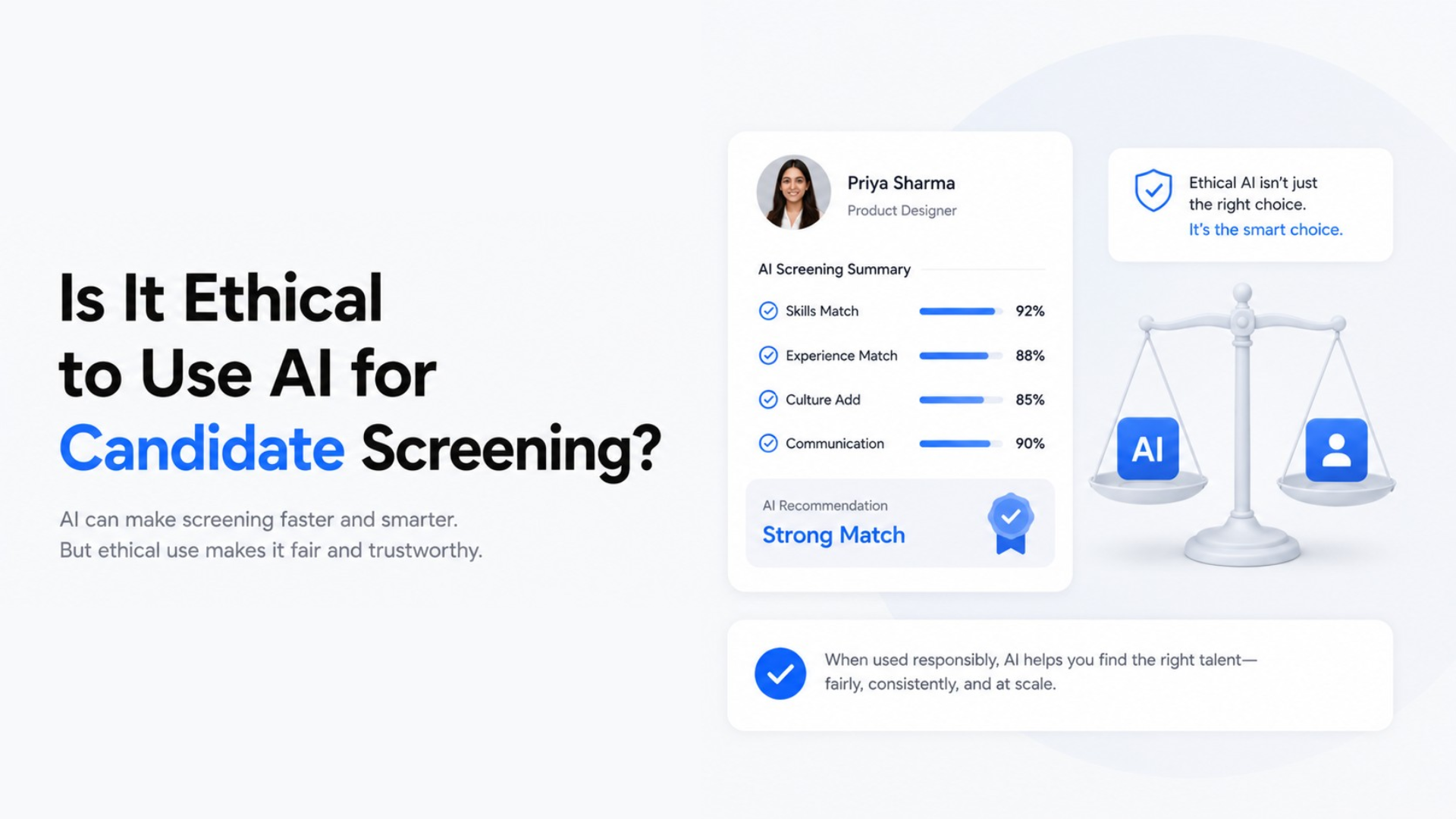
AI candidate screening is the use of artificial intelligence to review candidate information and help determine who may deserve further attention in a hiring process.
The process can begin with resumes.
An AI system may compare candidate experience, skills, titles, education, industry background, and other professional evidence with the requirements of a role.
Screening can also happen through questions.
A candidate may complete a text-based or voice-based screening interview. The system may ask every person the same core questions, create a transcript, identify relevant evidence, summarize the answers, and generate a recommendation for the recruiter.
AI can also help recruiters organize large applicant pools.
Instead of manually opening hundreds of profiles in the order they arrived, the system can help identify candidates whose available information appears more connected with the role.
None of these activities is automatically ethical or unethical.
The ethical question depends on what happens around the technology.
A system that helps a recruiter locate job-relevant evidence is different from a system that claims to predict a candidate’s personality from facial movements.
A tool that creates a summary for human review is different from a tool that automatically rejects candidates before anyone understands why.
Huntlo’s guide to What Is AI Candidate Screening and How Accurate Is It? explains the technical side of this process. The ethical discussion begins where accuracy, fairness, transparency, privacy, and human consequences meet.
Why Companies Use AI for Candidate Screening
The strongest argument for AI screening begins with a real problem.
Recruiters do not have unlimited attention.
A popular job may receive hundreds or thousands of applications. A recruiter may also be managing several roles at the same time.
The result is not always careful human review.
Candidates sometimes imagine the alternative to AI as a recruiter thoughtfully reading every application.
In reality, the alternative may be a recruiter spending seconds on each resume.
It may be a keyword search.
It may be first-come, first-reviewed.
It may be an exhausted person making inconsistent judgments late in the day.
Human screening is not automatically fair simply because a human performs it.
Recruiters can be influenced by fatigue.
They can apply criteria inconsistently.
They can favor familiar backgrounds.
They can make assumptions based on names, employers, schools, career gaps, or other information.
AI can potentially improve parts of this process.
A system can ask every candidate the same core questions.
It can compare answers with defined job requirements.
It does not become tired after reviewing the hundredth application.
It can help recruiters find evidence that may have been missed during a quick manual review.
This is the ethical case for AI screening.
The technology may create a more structured process.
The problem is that structure is only valuable when the underlying criteria are appropriate.
A biased rule applied consistently remains biased.
AI Does Not Remove Human Bias Automatically
One of the weakest arguments for AI screening is that machines are objective.
They are not.
AI systems are designed by people.
They use data selected by people.
They optimize for objectives defined by people.
They operate inside hiring processes created by people.
Bias can enter at several stages.
The job description may contain unnecessary requirements.
The historical hiring data may reflect previous discrimination.
The training examples may overrepresent certain backgrounds.
The scoring criteria may reward traditional career paths.
The recruiter may interpret AI recommendations as more reliable than they actually are.
An algorithm can therefore reproduce human bias.
It can also scale that bias.
A biased recruiter may affect dozens of candidates.
A biased automated system can affect thousands.
The U.S. Equal Employment Opportunity Commission has explicitly examined how artificial intelligence and automated systems can affect recruitment, screening, and employment decisions. Its resources address concerns including adverse impact and the effects automated tools can have on applicants with disabilities.
The ethical standard should therefore not be whether the AI has good intentions.
The system should be evaluated through actual outcomes.
The Most Important Question Is What the AI Measures
An AI screening system can only be as ethically defensible as the information it uses.
Suppose a company is hiring a software engineer.
Relevant evidence may include experience with particular technical problems, programming knowledge, system-design ability, previous responsibilities, and answers to job-related questions.
Now imagine the system also evaluates facial expressions.
It analyzes eye contact.
It estimates confidence from voice tone.
It makes assumptions about personality.
The ethical risk changes significantly.
These characteristics may be influenced by disability, culture, language, anxiety, technology quality, or the artificial nature of the interview environment.
The company should ask a simple question.
Why is this signal necessary to evaluate the candidate for this job?
If the answer is unclear, the AI probably should not be using it.
Ethical screening begins with job relevance.
The system should evaluate evidence connected with the actual work.
This sounds obvious.
Recruiting technology can make it easy to forget.
When software claims it can measure hundreds of signals, companies may assume that more analysis creates a better decision.
It may simply create more opportunities for error.
Structured Screening Can Be More Ethical Than Unstructured Screening
AI screening is sometimes criticized because every candidate receives a standardized process.
Standardization can also be one of its ethical strengths.
Traditional phone screens can vary significantly.
One recruiter asks detailed questions.
Another has only ten minutes.
One candidate receives several follow-up questions.
Another is interrupted.
One recruiter writes detailed notes.
Another relies on memory.
These differences can influence outcomes.
A structured AI-assisted process can ask candidates the same core questions.
It can evaluate answers against the same defined requirements.
It can preserve the underlying evidence for recruiter review.
This can reduce some forms of inconsistency.
The benefit depends on the design.
Candidates should still have an appropriate opportunity to provide relevant context.
The questions should measure actual role requirements.
The AI should not force every answer into a rigid interpretation.
Standardization should create a fairer starting point.
It should not eliminate legitimate differences between people.
Ethical AI Screening Should Be Based on Evidence, Not Vibes
Human hiring often contains vague judgments.
The candidate did not feel senior enough.
They lacked executive presence.
They did not seem like a culture fit.
They were not energetic enough.
These conclusions can hide assumptions.
AI can make the problem worse if it converts vague impressions into numerical scores.
A candidate receives 67 for communication.
Another receives 82 for leadership potential.
The numbers look scientific.
The organization may have no clear explanation of what they mean.
Ethical screening should remain connected with observable evidence.
Did the candidate explain how they solved a relevant problem?
Did they demonstrate the required knowledge?
Did they describe experience at the scale the role requires?
Did they provide an example of handling a specific responsibility?
A recommendation should ideally lead back to evidence.
The recruiter should be able to examine the candidate’s actual information or answer.
A score without evidence creates false confidence.
Huntlo’s guide to How Does AI Interview Screening Score Candidates? explains why structured screening should focus on role-related criteria and candidate evidence rather than treating a single score as objective truth.
Accuracy Is an Ethical Issue
An inaccurate AI system can waste recruiter time.
More importantly, it can affect people.
A candidate may be overlooked because the AI misunderstood a job title.
A strong answer may be summarized incorrectly.
A career break may be interpreted as missing experience.
A non-traditional background may not match the patterns the system expects.
The ethical problem becomes more serious when the organization assumes the system is accurate because it uses AI.
There is no universal accuracy rate for candidate screening.
Performance depends on the role, data, criteria, model, candidate information, and way the employer uses the output.
A system that performs well for one hiring problem may perform poorly for another.
Ethical deployment therefore requires testing.
The company should examine false positives.
Which candidates receive strong recommendations despite weak evidence?
It should examine false negatives.
Which potentially strong candidates are being overlooked?
It should compare AI outputs with later recruiter judgment and hiring outcomes.
The organization should also examine whether errors affect some candidate groups differently.
Accuracy is not only a technical metric.
It determines who receives an opportunity.
Fairness Cannot Mean Treating Everyone as Identical
Recruiting teams sometimes assume that fairness means every candidate should experience exactly the same process.
The idea is understandable.
It can become too simplistic.
Candidates do not all interact with technology in the same way.
A person with a disability may need an accommodation.
A candidate may use assistive technology.
Someone may have a speech difference.
A person may be interviewing in a second language.
Another may have limited internet connectivity.
A rigid system can appear consistent while creating unequal access.
Ethical screening needs room for accommodation and alternative processes.
The U.S. Equal Employment Opportunity Commission has highlighted how AI and automated employment tools can create concerns for applicants with disabilities, including situations where a technology disadvantages someone because of how it measures performance or because appropriate accommodations are not available.
The ethical standard is therefore not identical treatment at any cost.
It is a fair opportunity to demonstrate relevant ability.
Should Candidates Be Told That AI Is Screening Them?
In most situations, greater transparency is ethically stronger than hidden automation.
A candidate should not believe they are speaking with a human recruiter when they are interacting with an AI system.
They should not discover later that an automated tool significantly influenced the process.
Transparency does not require giving every candidate a technical explanation of the model architecture.
The information should be meaningful.
The candidate should understand that AI is being used.
They should understand the general role it plays.
They should know what kind of information is being evaluated.
They should know where to ask questions.
Where appropriate, they should understand how to request an accommodation or raise a concern.
The ethical reason is simple.
Employment matters to people.
Candidates should not be subjected to invisible experiments.
Transparency also improves organizational discipline.
A company is more likely to question a questionable screening practice when it knows it needs to explain the practice to candidates.
Transparency Does Not Mean Revealing the Perfect Answer
Recruiters sometimes worry that explaining AI screening will allow candidates to manipulate the process.
The concern is reasonable.
A company does not need to publish a scoring key that tells every applicant exactly what words to say.
Meaningful transparency is different.
The company can explain that an AI-assisted screening system evaluates answers against job-related criteria.
It can explain that candidate responses may be transcribed and summarized.
It can explain that recruiters use the output as part of the process.
It can provide information about privacy and candidate rights where relevant.
This gives the candidate a realistic understanding without turning the interview into an answer sheet.
The ethical objective is informed participation.
It is not perfect predictability.
Human Oversight Needs to Be Real
“Human-in-the-loop” has become one of the most common claims in AI hiring.
The phrase can mean almost anything.
Imagine an AI system reviews 10,000 candidates.
It removes 9,500 from consideration.
A recruiter reviews the remaining 500.
The company says a human made the final decision.
That description hides the influence of the system.
The AI determined who became visible.
Another company may show recruiters a recommendation.
The recruiter can technically disagree.
In practice, the system provides no explanation, and the recruiter accepts almost every result.
Again, the human involvement may be weaker than it appears.
Meaningful oversight requires the ability to understand, question, and change the output.
The recruiter should be able to examine relevant evidence.
They should know that the AI can be wrong.
They should have authority to disagree.
The workflow should not punish them for reviewing exceptions.
The National Institute of Standards and Technology AI Risk Management Framework provides a broader risk-based approach for managing AI impacts on individuals and organizations, emphasizing structured governance rather than assuming that technology is trustworthy by default.
Human oversight should be an operating process.
Not a marketing phrase.
Is It Ethical for AI to Automatically Reject Candidates?
This is where the ethical standard should become much stricter.
AI may help prioritize candidates.
It may help identify missing requirements.
It may summarize evidence.
Automatically ending a person’s opportunity creates a larger consequence.
The organization should ask how certain the system needs to be before that action is justified.
A clearly defined requirement can sometimes create a straightforward screening question.
If a job legally requires a particular license and the candidate confirms they do not have it, the decision may involve less ambiguity.
Most hiring decisions are not that simple.
Experience can be transferable.
Titles vary.
Skills can be demonstrated in different ways.
Candidates can provide context.
An AI score should not automatically become a rejection simply because the software presents it confidently.
The ethical risk is highest when candidates are rejected without understanding why and without a realistic route for correction or review.
The stronger approach is to use AI to support attention.
Let the system help recruiters identify evidence and risk.
Keep consequential judgment accountable to people.
Candidates Should Be Able to Correct Important Errors
AI systems can misunderstand information.
A candidate’s employment history may be outdated.
The transcript may contain a mistake.
The system may confuse two companies.
A recruiter may have uploaded the wrong job requirement.
If the AI output affects the process, important errors should not become permanent facts.
The candidate may not need access to every internal recruiting note.
The organization should still have a process for handling meaningful inaccuracies.
This is especially important when AI-generated information follows the candidate through several stages.
A wrong summary can influence the recruiter.
The recruiter’s judgment can influence the interview.
The interview feedback can reinforce the original error.
One mistake becomes a chain.
Ethical AI workflows should preserve a connection between conclusions and source evidence.
A recruiter should be able to verify important claims.
Privacy Is Part of AI Screening Ethics
Candidate screening can create a large amount of personal information.
A resume may enter the system.
A screening interview may create audio.
The audio may become a transcript.
The transcript may become a summary.
The summary may contribute to a score.
Recruiter notes may be added.
The ethical question is not only whether the company can process this information.
It is whether all of it is necessary.
Does the organization need to keep the original audio?
For how long?
Which AI provider receives the transcript?
Is candidate data used for broader model training?
Who can access the information?
What happens when the hiring process ends?
The ethical principle is data restraint.
Technology makes it easy to collect more.
Responsible organizations should still ask whether more is needed.
Huntlo’s guide to Is AI Recruiting Software GDPR and DPDP Compliant? explains the legal and operational questions around candidate data. Ethics goes slightly further by asking what the organization should do even when a particular practice may technically be permitted.
Ethical Screening Should Avoid Unnecessary Sensitive Inferences
AI can infer patterns from data.
That does not mean employers should ask it to infer everything.
Systems should be especially cautious around protected or sensitive characteristics.
Recruiting AI should not attempt to infer race, religion, health status, disability, sexual orientation, political views, or other sensitive characteristics for candidate selection.
The same caution should apply to indirect proxies.
A system may never use a protected characteristic explicitly.
It may use variables strongly connected with that characteristic.
The ethical review therefore needs to examine actual effects.
The company should also be cautious with emotion recognition and personality prediction.
A candidate’s facial movement during a recorded interview may reflect many things.
Nervousness.
Disability.
Culture.
Camera quality.
Lighting.
The unnatural experience of speaking to software.
Turning these signals into employment conclusions creates a high ethical burden.
The strongest screening systems should prefer direct evidence of job capability over speculative inference.
AI Can Potentially Give More Candidates a First Review
The ethical debate should also consider candidates who are currently ignored.
A recruiter may receive 2,000 applications.
They may never meaningfully review all of them.
Strong candidates who applied late may receive little attention.
People with unusual titles may be missed.
Candidates from less familiar companies may be overlooked.
AI can potentially widen initial consideration.
A system can compare more profiles with the hiring requirement.
It can identify evidence across a larger candidate pool.
It can help surface people who do not fit the recruiter’s first mental picture of the role.
This can be ethically positive.
The benefit depends on how the matching works.
If the AI simply reproduces the backgrounds of previous hires, it may narrow opportunity.
If it looks for job-relevant evidence across different career paths, it may expand opportunity.
The technology is not inherently inclusive.
The objective and design matter.
Historical Hiring Data Can Be Dangerous
One of the most tempting uses of AI is to train a model on successful employees.
Find the characteristics of top performers.
Then find candidates who look similar.
The approach sounds logical.
It can reproduce the past.
Suppose the company historically hired from a narrow group of universities.
A model may learn that those universities correlate with hiring success.
The company may believe it discovered a performance signal.
It may actually have discovered its previous recruiting preference.
The same problem can occur with career paths, employers, locations, language patterns, or other variables.
Ethical AI screening should not ask only, “Who looks like the people we hired before?”
It should ask, “What evidence is genuinely relevant to success in this role?”
The distinction is fundamental.
Hiring should identify capability.
It should not automate similarity.
Candidate Experience Is an Ethical Consideration
A company may deploy AI screening to save recruiter time.
The candidate may experience the process very differently.
They may spend 30 minutes completing an automated interview.
They may never receive a response.
They may have no opportunity to ask questions.
They may not know whether anyone reviewed their answers.
They may complete several AI assessments across several companies in the same week.
Efficiency for the employer can create unpaid effort for the candidate.
Ethical screening should consider this balance.
How much time is the candidate being asked to invest?
At what stage?
What value does the process create?
Will the company actually review the output?
Does the candidate receive a clear next step?
Automation should not make it easy to demand unlimited candidate labor.
The lower the company’s commitment to the candidate, the more careful it should be about asking for large amounts of their time.
AI Should Not Replace the Candidate’s Chance to Ask Questions
Recruiting is a two-way process.
The company evaluates the candidate.
The candidate evaluates the company.
An automated screening interview can easily become one-directional.
The AI asks questions.
The candidate answers.
The system ends.
The employer receives information.
The candidate receives little.
This can be acceptable for a short initial stage.
It should not define the complete hiring relationship.
Candidates need opportunities to ask about the role.
They need to understand the team.
They may need clarification.
They need contact with people who can answer questions the AI cannot.
Ethical automation should remove repetitive work.
It should preserve human interaction where human interaction creates value.
Recruiters Should Know the Limits of the System
A company cannot govern an AI tool that nobody understands.
Recruiters do not need to become machine-learning engineers.
They should understand the practical limitations.
What information does the system evaluate?
What does the score mean?
What does it not mean?
How should uncertainty be handled?
When should a recruiter review the underlying evidence?
Which candidates may need an alternative process?
How are errors reported?
A recruiter who believes the AI is always right becomes a risk.
A recruiter who ignores every recommendation makes the system pointless.
The objective is calibrated trust.
The human should know when the system is useful and when additional judgment is necessary.
This requires training.
Buying responsible technology is not enough.
The people using it need responsible operating habits.
Vendors and Employers Share Different Responsibilities
AI screening vendors build the technology.
Employers decide how to use it.
Both matter.
The vendor should understand the system’s limitations.
It should test performance.
It should provide appropriate information about how outputs are created.
It should support security and privacy.
It should avoid exaggerated claims.
It should give customers enough control to use the product responsibly.
The employer has another responsibility.
It defines the job.
It chooses the screening criteria.
It decides which candidates enter the process.
It decides how much influence the AI receives.
It determines whether recruiters review the evidence.
A company cannot outsource ethical responsibility to the vendor.
“The software recommended it” is not a meaningful explanation for a hiring decision.
The organization using the system remains accountable for the process it creates.
Ethical AI Screening Needs Ongoing Monitoring
A system should not receive one approval and then operate forever without review.
Jobs change.
Candidate populations change.
Models change.
Recruiting workflows change.
A screening process that worked well last year may behave differently after an update.
The company should monitor outcomes.
Are certain groups progressing at unexpectedly different rates?
Are recruiters frequently overturning AI recommendations?
Are candidates reporting accessibility problems?
Are summaries accurate?
Are some questions producing little useful evidence?
Is the system influencing decisions more strongly than intended?
The National Institute of Standards and Technology AI Risk Management Framework treats AI risk management as an ongoing governance process rather than a one-time technical check.
That principle is particularly important in hiring.
The system affects new people every day.
How an Ethical AI Screening Workflow Should Work
The process should begin with the job.
The company should define what the person actually needs to do.
Screening criteria should come from those requirements.
AI should evaluate job-related evidence.
The system should avoid unnecessary personal inference.
Candidates should receive appropriate information about the process.
Accessible alternatives or accommodations should exist where needed.
The AI output should preserve evidence.
Recruiters should be able to review the reasoning behind recommendations.
Important decisions should have meaningful human accountability.
Errors should be correctable.
Candidate data should be protected and retained only as necessary.
The organization should monitor outcomes over time.
This is less exciting than promising fully autonomous hiring.
It is also more credible.
Where Huntlo Fits Into Ethical AI Screening
Huntlo approaches AI screening as one part of a connected hiring workflow rather than an isolated replacement for recruiter judgment.
The process can begin with candidate discovery.
AI can help identify professionals whose experience appears connected with the hiring requirement.
Candidate matching can help recruiters understand why certain profiles may deserve attention.
Outreach can create candidate conversations.
Interested candidates can move toward qualification.
AI voice screening can help collect structured responses and organize candidate evidence before recruiter review.
Qualified candidates can then move toward interviews.
The ethical value of this structure depends on how the workflow is used.
AI should help recruiters process relevant evidence.
It should not become an invisible authority that decides who deserves a career opportunity.
For teams evaluating Huntlo or any other AI screening platform, the important questions should remain practical.
What does the AI evaluate?
How are screening criteria connected with the role?
Can recruiters review the candidate evidence?
How are scores and recommendations used?
What happens when the system is uncertain?
How is candidate data handled?
Can the workflow preserve human judgment at consequential stages?
A connected AI Hiring OS should make the candidate journey easier to understand.
It should not make accountability disappear between systems.
AI Screening and Human Screening Should Be Compared Fairly
The ethical debate often compares real AI with ideal humans.
The AI makes mistakes.
The imagined recruiter carefully reviews every candidate.
The AI can be biased.
The imagined recruiter is perfectly objective.
The AI may be inconsistent across unusual profiles.
The imagined recruiter never becomes tired.
That comparison is not useful.
The correct comparison is between real systems.
How does the current human process perform?
How does the AI-assisted process perform?
Which creates more consistency?
Which overlooks more strong candidates?
Which produces more unexplained decisions?
Which is easier to audit?
Which supports accommodations better?
Which gives candidates a fairer opportunity to show relevant ability?
AI should not receive a lower ethical standard because humans are imperfect.
Human imperfection also should not be used as an excuse to reject potentially better processes.
The objective is better hiring.
Common Ethical Mistakes in AI Candidate Screening
The first mistake is assuming that AI is objective because it is mathematical.
The second is using historical hiring patterns as a definition of future talent.
The third is evaluating signals that have no clear connection with job performance.
The fourth is converting vague impressions into precise-looking scores.
The fifth is hiding the role of AI from candidates.
The sixth is calling a process human-reviewed when recruiters rarely question the system.
The seventh is automatically rejecting candidates based on uncertain predictions.
The eighth is failing to provide accommodations or alternative routes.
The ninth is collecting more candidate information than the screening process needs.
The tenth is allowing AI-generated errors to follow candidates through the workflow.
The eleventh is buying a vendor’s ethics claims without examining the actual product.
The twelfth is measuring efficiency while ignoring candidate experience.
The final mistake is believing that ethics is completed when the software launches.
Responsible AI screening requires continuing review.
When AI Candidate Screening Is More Likely to Be Ethical
AI screening is more ethically defensible when the hiring criteria are clearly connected with the work.
The system evaluates relevant evidence.
Candidates receive appropriate transparency.
The process supports accessibility.
Recruiters can examine why recommendations were made.
The AI output supports judgment rather than hiding it.
Important errors can be corrected.
Candidate data is protected.
The company monitors outcomes.
Humans remain accountable for consequential decisions.
The process also needs proportionality.
A short automated screening step for a high-volume role may be reasonable.
A complex psychological analysis of every applicant may not be.
The amount of automation should match the actual hiring need.
When AI Candidate Screening Becomes Hard to Defend
The ethical case becomes weak when nobody can explain the criteria.
It becomes weaker when the company cannot explain why the AI uses certain signals.
It becomes weaker when candidates do not know that automation plays a major role.
It becomes weaker when people are rejected without meaningful review.
It becomes weaker when the system disadvantages candidates who need accommodations.
It becomes weaker when recruiters treat scores as facts.
It becomes weaker when the company collects sensitive information because the technology makes collection easy.
The ethical question becomes particularly serious when the employer cannot answer a simple challenge.
Why was this person screened out?
If the only answer is “the algorithm scored them lower,” the process needs more scrutiny.
Will AI Make Candidate Screening More Ethical in the Future?
AI could improve candidate screening.
It could help recruiters evaluate more people.
It could reduce inconsistent questioning.
It could surface evidence from non-traditional backgrounds.
It could reduce the influence of some human biases.
It could create better records of why candidates progressed.
The same technology could create the opposite future.
Companies could screen enormous candidate populations without meaningful accountability.
Hidden models could determine who receives attention.
Automated assessments could measure increasingly speculative characteristics.
Candidates could face longer machine-driven processes before speaking with a person.
The technology does not decide which future appears.
Hiring teams do.
The strongest direction is not fully human hiring or fully automated hiring.
It is a process that uses machines for what machines do well and people for what people need to remain responsible for.
AI can organize information.
It can compare evidence.
It can summarize.
It can identify patterns.
Humans should remain accountable for the meaning of those patterns and the consequences of acting on them.
Conclusion: AI Screening Is Ethical Only When Accountability Remains Visible
Using AI for candidate screening is not inherently unethical.
Manual hiring is not inherently ethical.
The real question is how decisions are made.
AI can help recruiters review larger candidate pools.
It can create more structured screening.
It can reduce repetitive work.
It can help preserve evidence.
It can give more candidates an initial evaluation.
These are meaningful benefits.
The risks are equally real.
AI can scale biased criteria.
It can create false confidence through scores.
It can disadvantage candidates whose backgrounds or abilities do not fit the system’s assumptions.
It can make consequential decisions difficult to challenge.
It can encourage companies to collect information they do not need.
The ethical standard should therefore remain clear.
Evaluate the job, not irrelevant personal traits.
Use evidence, not vague predictions.
Tell candidates enough to understand the process.
Provide appropriate access and accommodations.
Test the system.
Monitor outcomes.
Protect candidate information.
Allow important errors to be corrected.
Keep human accountability visible.
The best AI screening system should not make recruiters disappear.
It should make recruiter attention more useful.
The objective is not to automate judgment until nobody is responsible.
The objective is to use technology to create a hiring process that is faster, more structured, more explainable, and more capable of giving relevant candidates a fair opportunity.
That is the standard ethical AI screening should meet.
Frequently Asked Questions
Is using AI to screen job candidates ethical?
It can be. AI screening is more ethically defensible when it evaluates job-relevant evidence, provides appropriate transparency, supports accessibility, protects candidate data, and remains subject to meaningful human accountability.
Is AI candidate screening biased?
AI can be biased. Bias may enter through data, criteria, system design, historical hiring patterns, or the way employers use recommendations. Organizations should test actual outcomes rather than assuming the technology is objective.
Should candidates know when AI is screening them?
Greater transparency is generally ethically stronger. Candidates should receive meaningful information about the role AI plays in the process, particularly when it materially influences screening.
Can AI automatically reject candidates?
The ethical risk becomes significantly higher when AI automatically ends a candidate’s opportunity. Organizations should be especially cautious with uncertain predictions and preserve meaningful human accountability for consequential decisions.
Is human screening always fairer than AI screening?
No. Human screening can also be inconsistent and biased. The correct comparison is between the actual human process and the actual AI-assisted process.
Should AI analyze facial expressions during interviews?
Employers should be highly cautious about using facial expressions, emotion predictions, or similar signals when their relationship with job performance is unclear and they may disadvantage certain candidates.
Can AI screening improve fairness?
Potentially. Structured questions, consistent criteria, wider initial review, and evidence-based recommendations may improve parts of the process when the system is designed and monitored responsibly.
What is meaningful human oversight?
Meaningful oversight means a person can understand relevant evidence, question the AI output, disagree with it, and genuinely change the outcome.
Should AI candidate screening be tested regularly?
Yes. Organizations should monitor accuracy, candidate outcomes, accessibility issues, recruiter overrides, errors, and potential harmful impacts as the system and hiring process change.
What is the most ethical role for AI in screening?
The strongest role is usually decision support. AI can organize candidate information, identify job-related evidence, structure screening, and help recruiters prioritize attention while people remain accountable for consequential hiring judgments.
Related Topics
Understand the accuracy limits behind automated candidate evaluation in What Is AI Candidate Screening and How Accurate Is It?.
Learn how candidate information can be organized and rediscovered without creating another unusable database in What Is a Candidate Pool and How Do You Build One?.
Explore how recruiting systems preserve candidate relationships and context over time in What Is a Recruiting CRM? Definition and Key Features