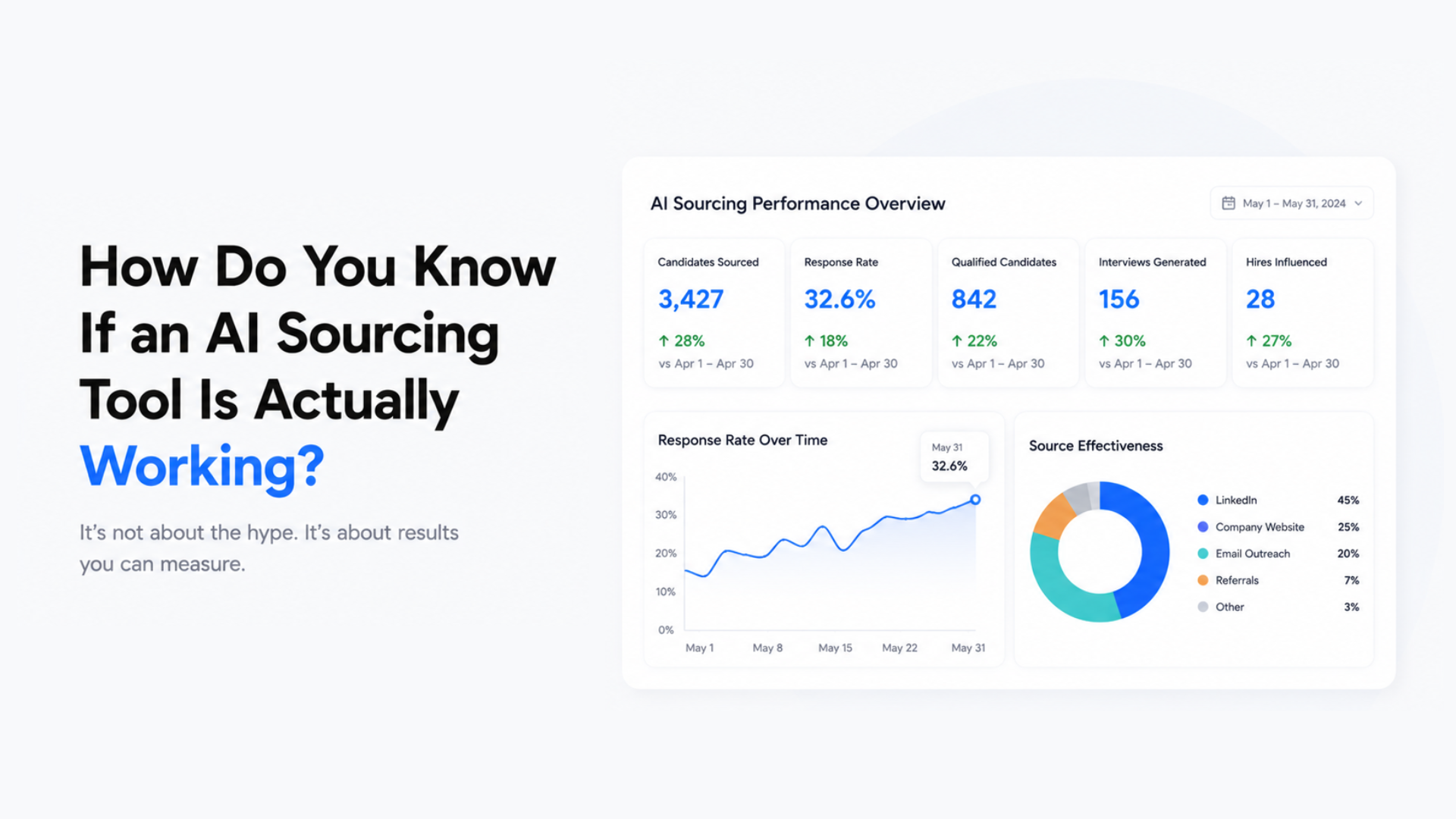
The new AI sourcing tool finds 800 candidates in thirty seconds.
The recruiter is impressed.
The search looks faster.
The database looks larger.
The AI produces detailed explanations for why each candidate appears relevant.
The team starts using the platform.
Three months later, someone asks a simple question.
Is it actually working?
The answer is surprisingly difficult.
The platform dashboard shows thousands of searches.
Recruiters have viewed more profiles.
More candidates have been added to projects.
More outreach messages have been sent.
The team is clearly doing more activity.
That does not prove the recruiting process has improved.
An AI sourcing tool can make recruiters extremely efficient at finding the wrong candidates.
It can produce larger lists that require more manual review.
It can discover relevant professionals but fail to provide usable contact information.
It can generate more outreach while positive response rates fall.
It can save time during search but create more work during screening.
It can increase interviews without improving hires.
The strongest way to know whether an AI sourcing tool is actually working is to measure the complete path from candidate discovery to hiring outcome. The tool should help recruiters find relevant people faster, reach them successfully, create more qualified conversations, move stronger candidates into interviews, and reduce the amount of manual work required to achieve those outcomes.
This means AI sourcing should not be evaluated through one metric.
A search result count is not enough.
A recruiter productivity metric is not enough.
A response rate is not enough.
Even the number of hires can be misleading when the team does not understand how the sourcing tool contributed.
The real measurement problem is attribution.
What changed because the AI sourcing tool was introduced?
Did recruiters find candidates they would otherwise have missed?
Did they find the same candidates faster?
Did candidate relevance improve?
Did outreach become more effective?
Did the sourcing process create more qualified pipeline?
Did the business make better hires?
A useful evaluation system needs to answer these questions.
Start by Defining What the AI Sourcing Tool Is Supposed to Improve
Teams often buy sourcing software before defining the problem.
The tool has AI search.
It has a large database.
It can generate outreach.
Competitors are using similar technology.
The team buys the platform.
Measurement begins later.
This creates a problem because the definition of success changes after the purchase.
If candidate quality is weak, the team points to time saved.
If time savings are unclear, the team points to database coverage.
If recruiters are not using the tool, the team points to one successful hire.
A fair evaluation should begin before deployment.
What problem is the tool supposed to solve?
The answer may be slow candidate discovery.
It may be poor access to passive talent.
It may be weak coverage of a specialist market.
It may be too much recruiter time spent building Boolean searches.
It may be low candidate response rates.
It may be an expensive stack of separate sourcing and enrichment tools.
It may be a lack of qualified pipeline for difficult roles.
Different problems require different metrics.
A team buying AI sourcing to reduce search time should measure recruiter hours.
A team buying it to improve passive candidate discovery should measure how many genuinely relevant new candidates enter the pipeline.
A staffing agency buying it to increase recruiter capacity should measure searches handled, qualified submissions, and placements.
The first rule of measurement is simple.
Do not ask whether the tool is good.
Ask whether it improved the specific recruiting problem you bought it to solve.
More Candidates Does Not Mean Better Sourcing
Candidate volume is one of the easiest metrics to show.
The recruiter runs a search.
The platform returns 2,000 people.
A traditional search returned 300.
The AI tool appears seven times better.
This is a weak conclusion.
The recruiter does not need 2,000 profiles.
They need candidates worth contacting.
A large result set can create more work.
Someone still needs to understand whether the people are relevant.
The sourcing team may spend hours reviewing profiles that should never have appeared.
The first useful metric is therefore not candidate volume.
It is candidate relevance.
Take a representative set of search results.
Have recruiters review them using clear role criteria.
How many candidates are genuinely worth considering?
If the tool returns 100 people and 60 are relevant, the useful result rate is strong.
If another tool returns 1,000 people and only 40 are relevant, the larger database did not produce a better search.
The exact definition of relevance should come from the role.
Does the candidate meet the important requirements?
Is the experience genuinely connected with the work?
Is the seniority appropriate?
Is the location workable?
Does the person appear worth recruiter attention?
AI sourcing is working when it improves the density of useful candidates.
The objective is not more hay.
It is more needles.
Measure Precision Before You Measure Scale
Recruiting teams should begin with a small sample.
Choose several real roles.
Use difficult searches rather than the easiest vacancies.
Run the same requirements through the AI sourcing tool and the existing process.
Review the results.
How many of the first twenty candidates are genuinely relevant?
How many of the first fifty?
How many require the recruiter to reinterpret the search?
This is a practical form of precision testing.
The team does not need a machine-learning laboratory.
It needs consistent human review.
A 2025 study on evaluating AI recruitment sourcing tools used human experts to judge the relevance of search results, illustrating why candidate relevance remains a central benchmark even when the search technology itself is highly automated. The important idea is that AI search quality should ultimately be judged against whether knowledgeable people consider the returned candidates useful for the hiring requirement.
This is especially important during vendor demonstrations.
A vendor can choose a role where the platform performs well.
The customer should choose the roles.
Use the niche position that took months to fill.
Use the role with confusing titles.
Use the market where the team believes its existing sourcing process is weak.
A sourcing tool proves itself on difficult work.
Measure Whether the Tool Finds New Candidates or Only Familiar Candidates Faster
AI sourcing can create value in two different ways.
The first is efficiency.
The system finds the same strong candidates the recruiter would eventually have found, but it finds them much faster.
This is valuable.
The second is discovery.
The system finds relevant candidates the recruiter would probably have missed.
This may be even more valuable for hard-to-fill roles.
Teams should measure both.
Take several completed searches.
Compare the AI results with candidates already discovered through the existing workflow.
How much overlap exists?
If the AI tool surfaces exactly the same people, the value may be speed.
If it consistently identifies relevant candidates outside the existing pool, the value includes expanded discovery.
Neither outcome is automatically better.
A high-volume agency may care deeply about speed.
An executive-search team may care more about discovering hidden candidates.
The important point is to know which value the tool is creating.
Huntlo’s guide to What Is Passive Candidate Sourcing? explains why proactive recruiting depends on reaching beyond people who are already applying. An AI sourcing tool should therefore be tested on whether it expands the team’s access to relevant passive talent rather than simply reorganizing candidates the recruiters already knew.
Search Speed Is Useful, but It Is Easy to Misread
A recruiter previously spent two hours building a search.
The AI tool completes the initial search in two minutes.
The platform appears to have saved almost two hours.
Not necessarily.
The recruiter may now spend ninety minutes removing irrelevant candidates.
They may spend another thirty minutes verifying information.
They may need to rewrite AI-generated outreach because the personalization is inaccurate.
The visible search became faster.
The complete sourcing workflow did not.
This is why recruiter productivity should be measured end to end.
Start the clock when the recruiter receives a usable hiring requirement.
Stop at a meaningful sourcing outcome.
That outcome may be the first ten relevant candidates.
It may be the first five contacted candidates.
It may be the first qualified candidate conversation.
The exact endpoint depends on the workflow.
The key is consistency.
A tool that reduces search time from two hours to two minutes but creates two hours of cleanup has not created meaningful efficiency.
The right question is not how fast the AI runs.
It is how fast the recruiter reaches a useful result.
Measure Time to First Relevant Candidate
One of the simplest useful metrics is time to first relevant candidate.
A recruiter receives the role.
How long does it take before they identify the first person genuinely worth contacting?
This metric is valuable because it combines search setup and initial result quality.
A tool that requires complex configuration may perform poorly.
A tool that creates results quickly but ranks irrelevant candidates first may also perform poorly.
AI sourcing should reduce the distance between understanding the role and finding the first credible candidate.
The metric becomes even more useful when compared across similar roles.
Technical hiring.
Sales hiring.
Leadership hiring.
High-volume hiring.
The platform may work well in one category and poorly in another.
Averages can hide this difference.
Recruiting teams should understand where the tool creates value.
Measure Time to a Usable Shortlist
The first relevant candidate is useful.
Recruiters usually need more than one.
Time to usable shortlist measures how long the team needs to produce a defined number of candidates worth action.
The number may be ten.
It may be twenty.
For executive search, it may be smaller.
The shortlist standard should be defined before the test.
The team should avoid changing the quality threshold because the AI tool returned many candidates.
A usable shortlist should mean that the recruiter would genuinely consider contacting or presenting the people.
This metric captures several parts of the workflow.
Search speed.
Candidate relevance.
Ranking quality.
Duplicate management.
Profile review time.
The strongest AI sourcing tools should help recruiters reach a credible shortlist faster without lowering the quality standard.
Candidate Relevance Should Be Measured at the Top of the Results
A sourcing platform may contain excellent candidates.
They are not very useful if the recruiter needs to review 500 profiles to find them.
Ranking matters.
The strongest candidates should appear early enough for recruiters to act.
This is why top-result quality matters more than total database size.
Review the first twenty results.
Then the first fifty.
How many are useful?
How many obvious strong candidates appear near the top?
How many irrelevant profiles occupy valuable attention?
Talent search systems have long treated ranking and recommendation as central problems because recruiters need relevant candidates to become visible within large professional datasets. The practical measurement should therefore focus on the quality of the ranked results recruiters actually see, not simply the number of profiles technically available.
This also creates an important monitoring question.
Does ranking quality remain stable over time?
A tool may perform well during a pilot and change after product updates, data changes, or shifts in the role.
Search quality should not be treated as permanently solved.
Measure Candidate Data Accuracy Before Celebrating Match Quality
A candidate appears highly relevant.
The profile is outdated.
The AI believes the person still works at a target company.
The contact information belongs to an old employer.
The candidate never receives the message.
Was the sourcing tool successful?
A search-quality metric may say yes.
The recruiting outcome says no.
Candidate-data accuracy therefore needs its own measurement.
How often are current employers correct?
How often are important titles accurate?
How often do recruiters discover identity confusion?
How often are inferred skills unsupported?
How many contact details are usable?
The team does not need to manually verify every profile in the database.
It should sample.
Choose candidates across different roles and markets.
Verify high-impact information.
Track recurring errors.
Huntlo’s guide to What Happens If an AI Sourcing Tool Gets a Candidate's Data Wrong? explains why one incorrect data point can spread into matching, outreach, screening, and recruiter judgment.
An AI sourcing tool is not working well if its speed depends on recruiters trusting information that repeatedly turns out to be wrong.
Contactability Is a Separate Metric From Candidate Discovery
Finding the right person does not mean the recruiter can reach them.
This distinction is essential.
A sourcing platform may have excellent search results but weak contact coverage.
The recruiter then needs another enrichment tool.
They copy candidate information.
They search for an email.
They verify it.
They return to the sourcing workflow.
The AI tool solved discovery.
It did not solve sourcing execution.
Teams should therefore measure contactability.
Of the relevant candidates found, how many have a usable contact route?
How many emails are technically valid?
How many messages bounce?
How many contact records are outdated?
How much recruiter time is spent finding missing details elsewhere?
A high candidate-relevance rate combined with poor contactability may still create value.
The team should understand the additional workflow cost.
Huntlo’s guide to How Do AI Recruiting Tools Find Verified Contact Details? explains why discovering a possible contact and establishing confidence that the route is usable are different problems.
The tool should be measured accordingly.
Response Rate Is Useful, but Positive Response Rate Is Better
Suppose the AI sourcing tool helps the team contact 1,000 candidates.
Three hundred reply.
The dashboard shows a 30% response rate.
That sounds strong.
What did the replies say?
“Not interested.”
“Wrong person.”
“I do not have this experience.”
“Please stop contacting me.”
A reply is not automatically a sourcing success.
Positive response rate is more useful.
How many contacted candidates express genuine interest in discussing the role?
The team should also track qualified positive responses.
A candidate may be interested but clearly unsuitable.
The sourcing workflow created engagement.
It did not create qualified pipeline.
The stronger measurement chain is therefore:
Candidates contacted.
Messages delivered.
Candidates who responded.
Candidates who responded positively.
Positive respondents who were qualified.
Qualified candidates who progressed.
This reveals where the sourcing process succeeds and where it breaks.
A tool may find excellent candidates but support poor outreach.
Another may create high response rates through broad messaging while producing few qualified conversations.
The complete funnel matters.
Measure Qualified Conversation Rate
Qualified conversation rate is one of the strongest practical metrics for outbound recruiting.
The denominator is the number of relevant candidates contacted.
The numerator is the number who enter a genuine recruiting conversation and appear worth further consideration.
This metric connects sourcing with reality.
The candidate looked good in the database.
The contact information worked.
The outreach was relevant enough to create a response.
The person was actually connected with the role.
A qualified conversation is much harder to fake than a search result.
For staffing agencies, this metric can be particularly useful.
Recruiters do not generate revenue by creating candidate lists.
They create value by producing candidates who can realistically move toward submission, interview, and placement.
The sourcing tool should therefore be measured against conversations, not only searches.
Interview Conversion Reveals Whether the Sourcing Quality Was Real
The recruiter finds candidates.
They respond.
They complete an initial conversation.
How many reach interviews?
Interview conversion can reveal whether the sourcing process identified people who were genuinely aligned with the role.
A low conversion rate may indicate several problems.
The search criteria may be too broad.
The AI may be overestimating relevance.
Recruiters may be contacting candidates before verifying important requirements.
The hiring manager may have a different understanding of the role.
The problem may also exist after sourcing.
Poor screening can reduce conversion even when candidate discovery is strong.
This is why metrics should diagnose the workflow rather than immediately blame the tool.
The AI sourcing platform may be performing well while another stage fails.
A connected measurement system should show where candidates disappear.
Source of Interview Can Be More Useful Than Source of Candidate
Traditional recruiting analytics often track source of hire.
The candidate came from a referral.
A job board.
A recruiting agency.
A sourcing platform.
This remains useful.
The problem is that hires are relatively rare events.
A team may need months before enough data exists to evaluate a new sourcing tool.
Source of interview creates an earlier signal.
How many candidates discovered through the AI sourcing tool reached a meaningful interview stage?
Compare this with other sources.
The team can also measure the cost and recruiter effort required to produce each interview.
Recruiting metrics are useful when they connect sourcing activity with meaningful hiring outcomes rather than stopping at profile volume.
A source that produces fewer candidates but more interviews may be stronger than a source that produces enormous top-of-funnel volume.
Source of Hire Still Matters
Eventually, the sourcing tool needs to contribute to hires.
This does not mean every sourced candidate must be hired.
Recruiting funnels naturally narrow.
The team should still understand whether AI-sourced candidates reach offers and hires.
How many hires began with the tool?
How much did each hire cost?
How long did the process take?
Were these candidates already known to the company?
Would the recruiter probably have found them through another channel?
Source-of-hire measurement helps recruiting teams understand which channels actually produce hires rather than simply producing activity.
Attribution can become complicated when candidates touch several systems.
A candidate may be discovered through AI sourcing, contacted through another platform, stored in the CRM, and hired through the ATS.
The team should define attribution rules before measurement.
Otherwise, every platform may claim the same hire.
Quality of Hire Is Important but Should Not Be Used Alone
The strongest long-term question is whether the sourcing tool helps the company hire good people.
This is quality of hire.
The concept is important.
It is also difficult to measure.
Organizations may consider job performance, retention, hiring-manager satisfaction, ramp time, or other business outcomes. There is no universal quality-of-hire formula because the definition depends on what the organization values.
This creates an attribution problem.
A successful employee may have been found through the AI sourcing tool.
Their later performance also depends on interviewing, selection, management, onboarding, compensation, team conditions, and many other factors.
The sourcing platform should not receive all the credit.
It should not receive all the blame.
Quality of hire is best used as a long-term outcome signal.
Teams should combine it with earlier metrics such as relevance, qualified conversations, interviews, and recruiter productivity.
Measure Recruiter Hours Saved, Not Tasks Automated
AI vendors often describe the number of tasks automated.
The platform generated 10,000 searches.
It created 5,000 messages.
It enriched 3,000 contacts.
These numbers may be impressive.
The recruiter may still be working the same hours.
The useful question is whether meaningful time disappeared from the workflow.
How many hours did recruiters previously spend building searches?
How much time went into profile review?
How much time went into contact research?
How much time went into copying candidate data?
How much time went into creating first messages?
Measure the process before and after.
The team should be careful with self-reported estimates.
Recruiters may say that a tool saves time because it feels faster.
A sample time study can provide better evidence.
The objective is not perfect measurement.
The objective is to avoid confusing AI activity with human time saved.
Productivity Should Not Mean More Work for the Same Recruiter
A tool saves five hours each week.
Management gives the recruiter more administrative work.
The recruiter feels no benefit.
The company reports a productivity improvement.
This is a weak implementation.
Saved time should create visible capacity.
The recruiter may handle more roles.
They may spend more time speaking with candidates.
They may improve client relationships.
They may conduct deeper qualification.
They may reduce overtime.
The value of automation appears in what the recovered time makes possible.
Huntlo’s guide to How to Reduce Recruiter Burnout With Workflow Automation explains why repetitive work is not only a productivity problem. It affects how recruiters spend limited attention.
An AI sourcing tool is working when recruiter attention moves toward higher-value work.
Measure Cost per Qualified Candidate, Not Only Cost per Seat
Software pricing can distort evaluation.
One platform costs $200 per month.
Another costs $1,000.
The cheaper platform appears more affordable.
Suppose the first produces five qualified candidates each month.
The second produces fifty.
The subscription price does not reveal the real economics.
Cost per qualified candidate can be more useful.
Include the software cost.
Include additional enrichment tools.
Include recruiter time where practical.
Then compare the number of genuinely qualified candidates created.
For agencies, the metric may move further down the funnel.
Cost per qualified submission.
Cost per interview.
Cost per placement.
The best metric should match the business model.
Huntlo’s guide to Can Small Agencies Afford Enterprise-Grade AI Sourcing Tools? explains why an expensive tool can be economically stronger when it removes manual work, replaces other subscriptions, or contributes to additional placements.
Price is not performance.
Compare the AI Tool Against the Existing Process
A sourcing platform cannot be evaluated in isolation.
The team needs a baseline.
How long did sourcing take before?
How many relevant candidates were found?
What percentage responded positively?
How many reached interviews?
How many recruiter hours were required?
Without a baseline, every improvement becomes a story.
The team should capture several weeks or months of existing performance where possible.
Then compare.
The comparison should use similar roles.
A new AI tool used on easy sales roles should not be compared with the old process used on highly specialized engineering searches.
Role difficulty matters.
Market conditions matter.
Employer brand matters.
Compensation matters.
A perfect experiment may not be possible.
A reasonable baseline is still much stronger than no baseline.
Run a Controlled Pilot Instead of Relying on a Demo
Vendor demos show capability.
Pilots show performance.
Choose real roles.
Include several levels of difficulty.
Define success before the test.
Measure candidate relevance.
Measure time to shortlist.
Measure contactability.
Measure positive responses.
Measure qualified conversations.
Track recruiter effort.
The pilot should last long enough to observe downstream results.
A one-hour search test can reveal search quality.
It cannot reveal whether candidates respond or reach interviews.
The team should also include the recruiters who will actually use the system.
A sourcing expert may achieve excellent results.
A generalist recruiter may struggle.
The product needs to work for the intended users.
Do Not Change the Measurement Rules Mid-Pilot
This is a common problem.
The team begins the pilot expecting more qualified candidates.
The tool produces many candidates but weak quality.
The success metric changes to search speed.
Response rates remain weak.
The success metric changes to recruiter satisfaction.
The tool may still have value.
The team should not rewrite the original problem.
A fair pilot can discover unexpected benefits.
Those benefits should be reported separately.
The original objective should remain visible.
If the company bought the tool to improve passive candidate pipeline, the evaluation should still answer whether passive candidate pipeline improved.
Recruiter Adoption Is a Metric, but Not a Success Metric by Itself
A tool cannot create value if nobody uses it.
Adoption matters.
How many recruiters use the platform regularly?
How many return after the first month?
Which workflows are used?
Where do recruiters abandon the process?
These questions reveal usability and implementation problems.
High adoption does not prove business value.
Recruiters may enjoy a tool that produces weak results.
Low adoption does not always prove poor product quality.
The team may have provided weak training.
The workflow may conflict with incentives.
Managers may still require recruiters to use old systems.
Adoption should therefore be treated as a diagnostic metric.
If outcomes are weak and adoption is low, the team does not yet know whether the product or implementation failed.
Measure Search-to-Action Rate
Recruiters can run many AI searches because searching becomes easy.
This can create artificial activity.
A search-to-action metric asks what percentage of searches produce something useful.
Did the recruiter save candidates?
Did they contact anyone?
Did the search contribute to a shortlist?
A platform with thousands of abandoned searches may have a usability or relevance problem.
The team should understand why.
Perhaps recruiters are experimenting.
Perhaps the AI misunderstands complex requirements.
Perhaps the first results are poor.
Perhaps recruiters use the tool only for market mapping.
The metric needs context.
The core idea remains useful.
Search volume should eventually create recruiting action.
Measure Candidate Rediscovery
A strong AI sourcing tool may create value by finding candidates the company already has.
The person applied two years ago.
They were a finalist for another role.
They entered the CRM through a previous recruiter.
Nobody remembered them.
The AI search surfaces the candidate again.
This is not new candidate discovery.
It can still be valuable.
Candidate rediscovery reduces repeated sourcing work.
It makes previous recruiting investment more useful.
Teams should measure how often the tool activates existing talent.
Huntlo’s guide to What Is a Recruiting CRM? Definition and Key Features explains why candidate relationships and historical context can remain useful beyond one active vacancy.
The best sourcing result may already exist inside the company.
Watch for Quality Decline as Volume Increases
An AI sourcing tool performs well with ten searches.
The team expands usage.
Hundreds of searches begin.
Candidate relevance falls.
Outreach volume increases.
Response quality declines.
Recruiters start trusting recommendations without reviewing evidence.
This is a scaling problem.
Performance should be measured at the level the company intends to operate.
A successful pilot does not guarantee successful deployment.
The team should monitor whether quality changes as volume increases.
How many candidates does each recruiter review?
Does automation encourage broader outreach?
Are low-confidence candidates entering the workflow?
Scale can expose weaknesses hidden during careful testing.
AI sourcing should allow the team to do more without lowering standards.
If quality falls as activity rises, the tool is scaling volume rather than recruiting effectiveness.
Look for False Positives and False Negatives
False positives are candidates the AI recommends who are not genuinely relevant.
These are easy to see.
Recruiters complain about bad results.
False negatives are harder.
These are strong candidates the system fails to surface.
The recruiter may never know they existed.
A useful evaluation should occasionally compare AI results with known successful candidates.
Take a completed search.
Did the AI tool find the person who was eventually hired?
Did it rank that person highly?
Take candidates recruiters found manually.
Would the AI have surfaced them?
This type of retrospective testing can reveal blind spots.
A tool that produces good-looking lists may still systematically miss certain career paths, titles, industries, or candidate profiles.
Average relevance does not reveal everything.
Monitor Whether the Tool Changes Who Gets Seen
Ranking systems influence recruiter attention.
Candidates near the top receive more visibility.
Candidates lower in the results may never be reviewed.
This makes ranking quality an operational and fairness issue.
Teams should examine whether certain kinds of relevant candidates repeatedly disappear from early results.
Non-traditional titles.
Career changers.
Candidates from smaller companies.
Professionals with less complete profiles.
People from different markets.
The goal is not to force every search result into a predetermined distribution.
The team should understand the system’s blind spots.
A sourcing tool is not working well if it consistently makes valuable candidates invisible.
Measure the Entire Funnel, but Diagnose Each Stage Separately
The complete funnel may look like this:
Candidates found.
Relevant candidates identified.
Reachable candidates.
Candidates contacted.
Responses.
Positive responses.
Qualified conversations.
Screens.
Interviews.
Offers.
Hires.
The team should measure the full path.
It should not blame every weak stage on sourcing.
Suppose candidate relevance is high.
Contactability is strong.
Positive response rate is weak.
The problem may be outreach.
Suppose responses are strong.
Qualified conversation rate is weak.
The search may be too broad.
Suppose qualified conversations are strong.
Interview conversion is weak.
The hiring requirement may be unclear.
The value of funnel measurement is diagnosis.
A single final metric tells the team that something is wrong.
The funnel helps explain where.
The Best AI Sourcing Metric Is Often a Combination
No single metric proves that an AI sourcing tool works.
Candidate volume can be gamed.
Speed can hide cleanup work.
Response rate can include negative replies.
Interviews can be influenced by screening.
Hires take time.
A balanced scorecard is stronger.
Teams should choose a small set of metrics connected with the original problem.
For example, a difficult-role sourcing team may focus on:
Candidate relevance among top results.
Time to usable shortlist.
Qualified conversation rate.
Interview conversion.
Recruiter hours per successful search.
The exact combination should vary.
The principle should not.
Measure quality.
Measure speed.
Measure conversion.
Measure effort.
Measure outcomes.
Recruitment metrics are most useful when they show both process efficiency and hiring effectiveness. Recent recruiting guidance continues to emphasize metrics such as time to hire, source of hire, and candidate quality while warning against treating speed as the only sign of success.
Where Huntlo Fits Into Measuring AI Sourcing Performance
Huntlo approaches sourcing as the beginning of a connected recruiting workflow rather than the final output.
This changes how performance should be measured.
Finding a candidate is useful.
The candidate still needs to be relevant.
The professional information needs to be credible.
A usable contact route may need to exist.
Outreach needs to create a conversation.
The candidate needs to show genuine interest.
Qualification needs to confirm fit.
The person may then move toward interviews.
A connected workflow can make this chain easier to observe.
The team can ask more useful questions.
Which sourced candidates were contacted?
Which messages received positive responses?
Which candidates became qualified?
Which reached interviews?
Which workflows required the most recruiter intervention?
The objective is not to maximize AI activity.
It is to improve recruiting movement.
For teams evaluating Huntlo or any other AI sourcing platform, the most important question is therefore not how many candidates the system can find.
The question is what percentage of those candidates become useful recruiting outcomes and how much human effort is required to get there.
What a 30-Day Evaluation Should Tell You
After thirty days, the team should understand basic product fit.
Can recruiters use the system?
Does it cover the relevant markets?
Are the top search results useful?
How long does it take to create a shortlist?
Is candidate data credible?
Are contact details usable?
The team may not have enough hires for a final ROI conclusion.
That is acceptable.
Early metrics should focus on leading indicators.
Relevance.
Speed.
Contactability.
Recruiter adoption.
Qualified responses.
The team should also document problems.
Which searches fail?
Which roles perform poorly?
Where does manual work remain?
The first month should reveal whether deeper evaluation is justified.
What a 90-Day Evaluation Should Tell You
After ninety days, the team should have stronger funnel data.
How many qualified conversations came from the tool?
How many candidates reached screening?
How many reached interviews?
How much recruiter time changed?
Did other software become unnecessary?
Did candidate quality remain stable as usage increased?
The team should compare performance with the baseline.
It should also compare role categories.
The tool may be excellent for one market and weak for another.
A sourcing platform does not need to win every use case.
The organization should know where it creates enough value to justify the cost.
What a Six-Month Evaluation Should Tell You
After six months, the business should be able to examine downstream outcomes.
Hires.
Placements.
Source contribution.
Cost per qualified candidate.
Cost per interview.
Recruiter capacity.
Software consolidation.
The team should also understand adoption.
Did the tool become part of the real workflow?
Or did usage decline after the initial excitement?
Longer-term evaluation should examine whether the product changed recruiting behavior.
Are recruiters spending less time searching?
Are they speaking with more qualified candidates?
Are difficult roles becoming easier to start?
Is the team reaching talent it previously missed?
The final question is not whether recruiters like the AI.
It is whether the recruiting system improved.
Common Mistakes When Measuring AI Sourcing Tools
The first mistake is counting profiles found.
The second is assuming faster search means faster sourcing.
The third is measuring total responses instead of positive responses.
The fourth is ignoring whether candidates are actually qualified.
The fifth is counting recruiter activity rather than recruiter time saved.
The sixth is evaluating database size without testing candidate relevance.
The seventh is measuring contact coverage without measuring bounce or usability.
The eighth is giving the tool credit for every candidate who touched the platform.
The ninth is comparing different role types without accounting for difficulty.
The tenth is changing success metrics after the pilot begins.
The eleventh is treating adoption as proof of business value.
The twelfth is waiting only for hires and ignoring earlier funnel signals.
The final mistake is looking for one perfect metric.
AI sourcing affects a chain.
Measurement should follow the chain.
How to Know When the Tool Is Not Working
The warning signs are usually visible.
Recruiters run many searches but contact few candidates.
Large result sets contain low relevance.
Recruiters spend significant time cleaning AI output.
Candidate data is frequently outdated.
Contact information produces high failure rates.
Outreach receives replies but few positive responses.
Positive responses rarely become qualified conversations.
Recruiters use the tool but continue relying on the old workflow for important searches.
The platform saves search time but adds work elsewhere.
Interview and hire outcomes remain unchanged while software cost increases.
One warning sign does not automatically prove failure.
A pattern does.
The team should identify whether the problem comes from product quality, implementation, training, role fit, or the surrounding workflow.
When an AI Sourcing Tool Is Actually Working
The evidence becomes visible across several stages.
Recruiters reach relevant candidates faster.
Top search results require less cleanup.
The tool finds strong people the team would otherwise have missed.
Candidate information is reliable enough for action.
Usable contact routes reduce manual enrichment work.
Positive response rates remain healthy.
More responses become qualified conversations.
Qualified candidates progress toward interviews.
Recruiters spend fewer hours on repetitive search activity.
The organization can connect the tool with meaningful hiring outcomes.
Not every metric needs to improve dramatically.
The overall economics should improve.
The team should be able to explain the value without pointing only to the vendor dashboard.
Conclusion: The Tool Works When Recruiting Outcomes Improve, Not When AI Activity Increases
AI sourcing software makes activity easy.
It can run searches quickly.
It can find large numbers of profiles.
It can generate candidate recommendations.
It can enrich contact information.
It can create outreach.
These capabilities are impressive.
They are not the final measure of success.
The real sourcing process begins with a hiring requirement and ends when useful candidates move into the hiring pipeline.
A strong AI sourcing tool should reduce the distance between those points.
It should help recruiters find relevant people faster.
It should improve the density of useful candidates.
It should help teams reach people they could not easily find before.
It should reduce manual work.
It should create more qualified conversations.
It should contribute to interviews and hires.
The measurement system should therefore follow the candidate journey.
Search.
Relevance.
Contactability.
Outreach.
Positive response.
Qualification.
Interview.
Hire.
At the same time, the team should measure recruiter effort.
How much human work was required to create those outcomes?
This is the part many AI dashboards ignore.
The best sourcing tool is not the one that performs the most AI actions.
It is the one that helps recruiters produce better hiring outcomes with less wasted effort.
If the team can show that improvement, the tool is working.
If the only evidence is more searches, more profiles, and more automated messages, the team may simply be doing more recruiting activity without doing better recruiting.
The difference is measurement.
Frequently Asked Questions
How do you measure whether an AI sourcing tool works?
Measure the full path from candidate discovery to hiring outcomes. Useful metrics include top-result relevance, time to shortlist, contactability, positive response rate, qualified conversation rate, interview conversion, recruiter hours saved, source of hire, and cost per qualified candidate.
Is the number of candidates found a good AI sourcing metric?
Not by itself. A large result set may create more manual review. Candidate relevance and the number of useful candidates found are more meaningful than total profile volume.
What is the best metric for AI sourcing quality?
There is no single best metric. Candidate relevance among top results is a strong early indicator, while qualified conversations, interviews, and hires reveal downstream value.
How should recruiter productivity be measured?
Measure end-to-end time required to reach a useful outcome, such as a credible shortlist or qualified candidate conversation. Do not rely only on the speed of individual AI tasks.
Should response rate be used to measure sourcing success?
Yes, but positive response rate is more useful than total response rate. Qualified positive responses are even stronger because they connect engagement with actual candidate fit.
How long should an AI sourcing pilot last?
A short test can measure search quality, but a longer pilot is needed to observe outreach, qualified conversations, interviews, and recruiter time savings. A 30-day, 90-day, and six-month evaluation structure can reveal progressively deeper outcomes.
How do you calculate AI sourcing ROI?
Compare the complete cost of the tool with recruiter time saved, other software removed, qualified candidates created, interviews generated, hires or placements influenced, and changes in recruiting capacity.
What is a good candidate relevance rate?
There is no universal benchmark because role difficulty varies. The team should define a consistent relevance standard and compare the AI tool with its previous process on similar roles.
Can an AI sourcing tool work well for some roles and poorly for others?
Yes. Candidate coverage, title patterns, market data, and role complexity vary. Teams should measure performance by role category rather than relying only on one overall average.
What is the biggest mistake when evaluating AI sourcing software?
The biggest mistake is measuring AI activity instead of recruiting outcomes. More searches, profiles, messages, or automated tasks do not prove that the tool is creating more qualified candidates or better hires.
Related Topics
See how recruiters are using AI sourcing beyond simple candidate discovery in What Recruiters Actually Use AI Sourcing Tools For (Survey Insights).
Understand why candidate accuracy matters before measuring search performance in What Happens If an AI Sourcing Tool Gets a Candidate's Data Wrong?.
Learn how AI sourcing is changing recruitment agency economics in How AI Sourcing Tools Are Reshaping Recruitment Agency Business Models.