Most recruiting processes are built around people who are already looking for jobs.
A company publishes a vacancy, promotes the opportunity, receives applications, and evaluates the people who choose to enter the process. This works well when enough qualified candidates are actively searching and the employer can reliably attract them.
But many relevant candidates are not applying.
They may be employed, reasonably satisfied, busy with their current work, or simply not checking job boards. They may have no intention of changing jobs this month but could still consider a role that offers better scope, compensation, flexibility, leadership, or career progression.
Passive candidate sourcing is how recruiting teams reach those people.
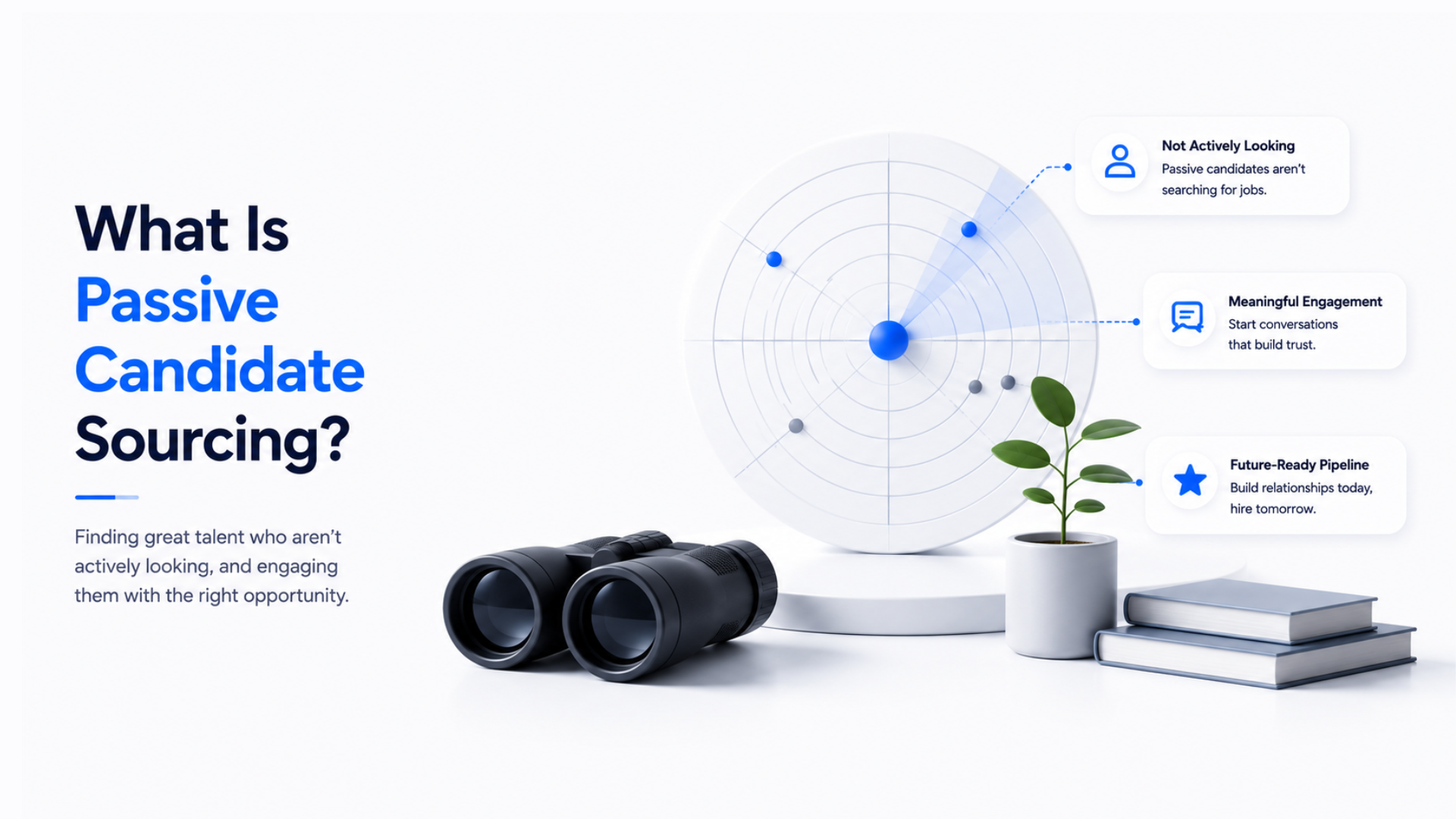
Passive candidate sourcing is the proactive process of identifying, researching, and engaging potential candidates who are not actively applying for jobs but may be open to the right opportunity.
The recruiter does not wait for the candidate to discover the company. The company identifies a potential fit and creates the first opportunity for a conversation.
This makes passive candidate sourcing one of the foundations of outbound recruiting. It is especially important for specialized roles, senior positions, competitive talent markets, and situations where job postings alone do not produce enough qualified candidates.
The challenge is that passive candidates behave differently from active applicants. They have not asked to enter a hiring process, so recruiters need a more thoughtful approach to discovery, outreach, timing, and engagement.
What Is a Passive Candidate?
A passive candidate is a person who is not actively searching for a new job but may be willing to consider the right opportunity.
This does not mean every passive candidate is secretly waiting for a recruiter to contact them. Some are completely satisfied and unlikely to move. Others are not applying anywhere but would listen if the role solved a meaningful career problem or created an opportunity they could not easily find on their own.
This is why “passive” should not be treated as one fixed state.
A professional may have no interest in changing jobs today. Six months later, a reorganization, missed promotion, new manager, relocation need, or change in career goals may make the same person more open to a conversation.
LinkedIn Talent Solutions describes passive candidates as workers who are not actively looking for a new job but may be open to the right role. That distinction is important because the absence of active job searching does not necessarily mean the absence of interest. (linkedin.com)
Passive candidate sourcing attempts to identify this potential before the person becomes an active applicant.
What Is Passive Candidate Sourcing?
Passive candidate sourcing is the process of proactively finding people who may fit a hiring need even though they have not applied for the role.
The process usually begins with a target profile. The recruiting team needs to understand the experience, skills, responsibilities, location, career background, and other factors that could make someone relevant.
Recruiters then search for people who appear to match that profile.
The search may include professional networks, talent databases, previous candidates, employee referrals, industry communities, events, company alumni, internal talent pools, public professional information, and other appropriate sources.
Once relevant people are identified, the recruiter evaluates whether there is a credible reason to approach them.
This is where passive candidate sourcing becomes different from simply collecting profiles.
A person may technically match the job description but have no obvious reason to consider the opportunity. Another may have an unconventional background while being at exactly the right point in their career for the role.
Good passive sourcing considers both sides.
Why might the candidate fit the company?
And why might the opportunity matter to the candidate?
The strongest sourcing strategy creates a credible connection between those two questions.
Passive Candidates vs. Active Candidates
The main difference between active and passive candidates is not talent quality.
It is current intent.
An active candidate is taking steps to find a new job. They may be applying to roles, contacting recruiters, updating their profile, or attending interviews.
A passive candidate is not currently doing those things.
This difference changes the recruiting process.
An active candidate has already decided that they want to explore a change. The employer needs to convince them that one particular opportunity is worth choosing.
With a passive candidate, the recruiter may first need to create interest in changing anything at all.
This makes the early stages of passive candidate recruitment more sensitive.
An active applicant expects to be evaluated.
A passive candidate expects the recruiter to explain why the conversation is relevant.
An active applicant has already spent time learning about the role.
A passive candidate may know nothing about the company.
An active candidate may tolerate a structured application process because they chose to enter it.
A passive candidate may leave quickly if the process demands too much before the opportunity has created enough interest.
The recruiting workflow should reflect these differences.
Passive Candidate Sourcing vs. Outbound Recruiting
Passive candidate sourcing and outbound recruiting are closely connected, but they are not identical.
Passive sourcing focuses on finding potential candidates who are not actively looking for jobs.
Outbound recruiting is the broader process of proactively creating a candidate pipeline.
That process can include defining the target market, sourcing candidates, prioritizing profiles, sending outreach, managing follow-ups, handling responses, screening interested people, and moving qualified candidates toward interviews.
Passive candidate sourcing is therefore one part of outbound recruiting.
The distinction matters because finding a candidate is not the same as recruiting one.
A recruiter can build a list of 500 relevant passive candidates and still have no actual pipeline. Until people are approached, respond, express interest, and move into a hiring conversation, the company has only created a list.
This is why passive sourcing should be measured by more than the number of profiles found.
The real objective is to create relevant candidate conversations.
Why Companies Source Passive Candidates
The most obvious reason is that the right person may never apply.
A specialized engineer may be too busy working to browse job boards. A senior leader may expect opportunities to come through networks and direct conversations. A high-performing salesperson may be willing to move only for a significantly better role.
An inbound-only strategy depends on these people discovering the company and deciding to apply.
Passive sourcing gives the employer more control over the talent pool.
Instead of evaluating only the people who arrive, recruiters can identify people whose experience appears relevant and create an opportunity for a conversation.
This is especially useful when a role has a narrow talent market. If only a small number of people have the required experience, waiting for them to apply creates unnecessary risk.
Passive sourcing can also help recruiters search beyond obvious applicant channels. SHRM recommends looking where relevant professionals already spend time, including industry associations, professional communities, conferences, and other spaces connected to the target talent market. (shrm.org)
The value is not that passive candidates are automatically better than active candidates.
They are not.
The value is access to a larger and more intentional talent market.
How Passive Candidate Sourcing Works
A strong passive sourcing process begins with role understanding.
The recruiter needs to know what the company actually requires, which criteria are essential, which are flexible, and what evidence would suggest that a person can succeed in the role.
A vague job description creates a vague search.
If the team simply asks for a “top SaaS salesperson,” the recruiter may default to famous companies, familiar titles, and obvious profiles. A clearer requirement might reveal that the real need is someone who has sold complex software to enterprise buyers, worked through long sales cycles, and helped build a new market.
That creates a much more useful search.
The recruiter then maps the talent market. Which companies employ people with relevant experience? Which adjacent titles should be considered? Which industries create transferable skills? Where are these candidates located?
Potential candidates are then discovered and reviewed.
The strongest profiles are not automatically contacted immediately. Recruiters should first understand why the person appears relevant and whether the opportunity offers a credible reason to engage.
Outreach begins only after this context is clear.
The candidate’s response then determines what happens next. Someone may be interested, decline, ask for more information, refer another person, or suggest reconnecting later.
A good passive sourcing workflow preserves each of these outcomes instead of treating every non-immediate hire as a failed lead.
Where Recruiters Find Passive Candidates
There is no single database containing every relevant passive candidate.
Professional networks are an obvious starting point because they make career histories and professional relationships easier to search. But effective sourcing often extends beyond one platform.
Recruiters may search existing ATS and CRM databases for previous candidates who are now more experienced. Employee referral networks can reveal strong people who are difficult to find through public searches. Industry communities, professional associations, events, conferences, portfolio platforms, technical communities, and other role-specific spaces can also be useful.
The right source depends on the role.
A senior finance leader, software developer, nurse, creative director, and warehouse operations manager are unlikely to have identical professional footprints.
This is why passive candidate sourcing is partly a market-research discipline.
The recruiter needs to understand where the target talent can actually be found.
SHRM also highlights employee referrals and professional networking as important methods for reaching passive talent, particularly because an introduction through a trusted connection can create a different starting point from a completely cold message. (shrm.org)
The best sourcing strategy follows the talent market rather than forcing every role through the same channel.
Why Passive Candidate Sourcing Is Difficult
The first challenge is discovery.
Passive candidates are not signaling their interest through applications, so recruiters need to identify them through experience, skills, career patterns, professional activity, referrals, or other relevant signals.
The second challenge is incomplete information.
A public profile may not describe everything a person can do. Some highly qualified candidates maintain detailed professional profiles. Others provide only a job title and company name.
LinkedIn’s guidance for passive candidate recruitment specifically warns recruiters not to ignore less detailed profiles, because strong professionals can be difficult to discover through obvious searches alone. (linkedin.com)
The third challenge is interest.
A candidate can be an excellent fit and still have no reason to leave their current job.
The fourth challenge is timing.
The right person may be open later rather than now.
The fifth challenge is recruiter capacity.
Manual passive sourcing requires repeated searches, profile review, research, outreach, follow-ups, response management, and record keeping.
This is why passive candidate sourcing is one of the areas where AI and automation can create significant value.
Passive Candidate Outreach
The first message matters more with passive candidates because the recruiter is interrupting an existing career.
The candidate did not apply.
They did not ask for a screening call.
They may not know the company.
The recruiter therefore needs to establish relevance quickly.
A good message should make it clear why the person was selected and why the opportunity may deserve attention.
This does not require a long biography of the candidate. It requires a credible connection.
Perhaps the person has experience scaling the exact function the company is building. Perhaps they worked in a similar market. Perhaps their career progression suggests that the role could offer a meaningful next step.
The message should also provide enough information for the candidate to evaluate whether a conversation is worthwhile.
Vague phrases such as “exciting opportunity” or “your profile looks impressive” create little value if they are not connected to something specific.
Passive candidate outreach should feel selective.
The candidate should understand that there is a reason this particular conversation is happening.
Why Personalization Matters More for Passive Candidates
Personalization is often treated as a copywriting technique.
In passive sourcing, it is more fundamental.
The recruiter needs to understand why the candidate may fit and why the opportunity may matter before sending the message. That understanding should shape the outreach.
This does not mean every message needs to be written completely from scratch.
Automation can help create and adapt communication.
But the underlying logic should remain personal to the candidate.
A message is not genuinely personalized simply because AI mentions the person’s current company, university, or most recent post.
Useful personalization connects professional context with opportunity context.
This is especially important because passive candidates have less reason to tolerate irrelevant outreach.
An active candidate may continue through a mediocre recruiting process because they need a new job.
A passive candidate can simply stay where they are.
Passive Candidate Sourcing and Employer Brand
Recruiters sometimes treat employer brand as an inbound recruiting issue.
It matters just as much in passive sourcing.
A candidate may receive an interesting message and then research the company before responding. They may visit the careers page, look at employee reviews, search for recent news, examine leadership, and try to understand the company’s reputation.
The outreach creates attention.
The employer brand helps the candidate decide what to do with that attention.
This means recruiters cannot compensate for a weak or unclear opportunity simply by improving message personalization.
The company needs a credible reason for the candidate to consider moving.
That reason may include the work itself, career growth, leadership, compensation, flexibility, company stage, mission, team quality, or another factor.
Passive candidate sourcing works best when the recruiter has something meaningful to communicate.
Passive Candidate Sourcing and Recruiting CRM
Passive candidate relationships often last longer than one hiring process.
A person may be relevant but unavailable.
Another may like the company but dislike the current role.
Someone may be interested after a major project finishes.
This is where a recruiting CRM becomes valuable.
The CRM can preserve the relationship, previous conversations, candidate preferences, and appropriate time for future contact.
Without that context, recruiters often repeat the same work.
A new role opens, and the team searches the external market again even though relevant people were already identified during previous searches.
Passive sourcing should create a cumulative talent network.
Every good conversation does not need to produce an immediate hire to have value.
Some should become future pipeline.
That is one of the key differences between transactional recruiting and long-term candidate relationship management.
Passive Candidate Sourcing and Candidate Rediscovery
Recruiters often look for passive candidates outside the company while ignoring people already inside their own recruiting systems.
Previous applicants can become passive candidates.
A person who applied two years ago may now be employed and no longer looking. A previous finalist may have gained additional experience. A sourced candidate who declined one role may be open to another.
These people can be especially valuable because the company already has some relationship context.
Candidate rediscovery involves searching existing ATS, CRM, and talent-pool data for people who may now fit a new requirement.
AI can make this easier by comparing new roles with historical candidate information and identifying potential matches that recruiters might not remember.
The result is a different kind of passive sourcing.
Instead of finding a completely unknown person, the recruiter reactivates a relationship the company has already created.
How AI Is Changing Passive Candidate Sourcing
Traditional passive sourcing is limited by recruiter time.
A recruiter can run only so many searches, review only so many profiles, and manage only so many conversations.
AI can reduce some of this repeated work.
Modern sourcing systems can help interpret hiring requirements, identify related job titles, recognize adjacent skills, search larger candidate pools, and prioritize people who appear relevant.
This is especially useful when the ideal candidate does not use the exact language found in the job description.
AI can also support research and personalization.
The system may summarize relevant experience, identify the reason a candidate appears to match, and help prepare outreach based on the available context.
Automation can support follow-ups and response organization.
But the value depends on how the system is used.
If AI simply finds more people and generates more messages, passive sourcing can become a larger spam operation.
The objective should be to improve the quality of candidate selection before increasing outreach volume.
The Risk of Over-Automating Passive Candidate Sourcing
Passive candidate sourcing is particularly vulnerable to poor automation because the candidates did not ask to be contacted.
A weak automated workflow can identify loosely relevant profiles, generate generic messages, send repeated follow-ups, and create a negative impression of the employer at scale.
The problem is not automation itself.
The problem is automation without enough context or control.
Good automation can reduce repetitive research, surface relevant candidates, prepare useful information, and ensure appropriate follow-up.
Poor automation optimizes activity.
More profiles.
More messages.
More sequences.
More noise.
The strongest passive sourcing systems should make recruiters more selective, not less.
This is why Huntlo’s guide on when over-automating AI sourcing can hurt employer brand argues that outreach volume should never become the primary measure of recruiting success.
The goal is not to contact every person who might fit.
It is to create more relevant conversations with the people who genuinely might.
How to Measure Passive Candidate Sourcing
The easiest sourcing metrics to measure are often the least useful.
A team can count profiles found, candidates added, searches run, and messages sent.
These numbers show activity.
They do not prove that the sourcing strategy is working.
More useful metrics connect discovery with recruiting outcomes.
Are the sourced candidates relevant enough to receive outreach? Do they respond? Do responses become meaningful conversations? Do interested candidates pass screening? Do they progress through interviews? Do they eventually become hires?
Teams should also examine why candidates do not engage.
A low response rate may indicate poor targeting, weak outreach, an unattractive opportunity, a damaged employer brand, or the wrong communication channel.
The sourcing system should help the team learn.
If recruiters measure only volume, automation can make performance look better while actual candidate quality gets worse.
The best passive sourcing metric is not how many people were found.
It is how effectively the team turns the right talent market into qualified conversations.
How Passive Candidate Sourcing Fits Into the Wider Recruiting Workflow
Passive sourcing is only the beginning.
Once a candidate is found, the team needs to decide whether to approach them. If the person responds, the recruiter needs to understand the response. If they are interested, qualification or screening begins. If the timing is wrong, the relationship may need to be preserved.
When every stage uses a separate system, the recruiter becomes responsible for connecting the workflow.
A candidate may be found in one platform, contacted through another, stored in a CRM, screened somewhere else, and eventually moved into the ATS.
Each tool may work.
The overall process can still be inefficient.
This is why modern recruiting technology is moving beyond isolated candidate discovery.
The important question is increasingly what happens after the system finds a relevant person.
Where Huntlo Fits Into Passive Candidate Sourcing
Huntlo approaches passive candidate sourcing as part of a broader outbound recruiting workflow.
The objective is not simply to create a list of people who appear relevant.
A recruiting team needs to move from a hiring requirement to candidate discovery, engagement, response management, qualification, and eventually a meaningful hiring conversation.
Huntlo’s agentic AI recruiting infrastructure is designed around connecting more of that process.
AI can support candidate discovery and research. Relevant candidates can move into personalized engagement. Follow-ups and responses can be handled as part of the workflow. Interested people can progress toward screening and interviews without requiring the recruiter to manually coordinate every transition.
This matters because passive candidate sourcing creates value only when the company can act on the talent it finds.
A database of strong candidates is not a hiring outcome.
A relevant candidate conversation is much closer to one.
For teams evaluating this shift, Huntlo’s article on how AI sourcing tools fit into the future of talent acquisition explains why candidate discovery increasingly needs to connect with engagement and execution.
The same principle appears in what comes after sourcing automation: as finding potential candidates becomes easier, the larger operational challenge moves toward turning those candidates into qualified pipeline.
How to Build a Better Passive Candidate Sourcing Strategy
A better strategy begins with a better definition of the target market.
Recruiters should understand the work the person needs to perform rather than relying only on one job title or idealized background. Adjacent skills, transferable experience, and different career paths can expand the search without reducing relevance.
The next step is channel selection.
Recruiters should search where the relevant talent actually exists rather than defaulting to the same database for every role.
The team should then create clear reasons for engagement.
Why is this candidate relevant?
Why might this opportunity matter now?
What information does the person need to decide whether a conversation is worthwhile?
The workflow also needs to handle timing.
A passive candidate who is not ready today should not automatically disappear. Strong relationships should be preserved in the recruiting CRM or talent network with enough context for appropriate future engagement.
Finally, teams should use automation carefully.
AI should help recruiters understand the market, reduce repetitive search, improve candidate relevance, and coordinate the workflow.
It should not turn every possible match into an automatic outreach sequence.
The best passive sourcing strategy is selective, persistent, and context-aware.
The Future of Passive Candidate Sourcing
Passive candidate sourcing is moving from manual profile search toward more intelligent workflow execution.
Earlier sourcing tools helped recruiters search larger databases.
Modern AI can interpret hiring requirements, recognize related experience, surface less obvious candidates, and support more contextual outreach.
The next stage is continuity.
The system should remember why a candidate was selected.
That context should inform engagement.
The candidate’s response should change the next action.
A person who is interested should move toward qualification.
A person who wants to reconnect later should not disappear.
A person who declines should not remain inside an automated sequence.
The future of passive sourcing will therefore depend less on how many profiles a platform can return and more on how well the recruiting workflow understands what should happen after discovery.
Recruiters will still define the talent strategy, evaluate quality, build important relationships, and make consequential decisions.
Software will handle more of the repetitive execution between those moments.
Conclusion: Passive Candidate Sourcing Creates Access Beyond the Applicant Pool
Passive candidate sourcing is the proactive process of identifying and engaging people who are not actively applying for jobs but may consider the right opportunity.
It allows companies to look beyond the candidates who happen to find and apply to a job posting.
This is especially valuable for specialized roles, senior positions, competitive markets, and outbound-heavy recruiting teams.
But passive sourcing is not simply a larger candidate search.
The people being approached have not asked to enter the process. Recruiters need to understand why each candidate is relevant, why the opportunity may matter, and how to create a conversation without treating the person like another record in a campaign.
AI can make this process more efficient.
It can help interpret requirements, discover candidates, identify related experience, support personalization, and coordinate follow-ups.
The risk is using that efficiency only to increase volume.
The strongest passive candidate sourcing strategy does the opposite.
It uses better information and better automation to become more selective.
Finding the candidate is the first step.
Creating a relevant reason to talk is what turns passive sourcing into recruiting.
Frequently Asked Questions
What is passive candidate sourcing?
Passive candidate sourcing is the proactive process of finding and engaging people who are not actively applying for jobs but may consider the right opportunity.
What is a passive candidate?
A passive candidate is someone who is not currently searching for a new job but may be open to a relevant opportunity.
What is the difference between active and passive candidates?
Active candidates are currently searching or applying for jobs. Passive candidates are not actively job hunting and usually need to be approached by the employer or recruiter.
Is passive candidate sourcing the same as outbound recruiting?
No. Passive candidate sourcing focuses on finding people who are not actively job searching. Outbound recruiting is the broader workflow that includes sourcing, outreach, follow-ups, response management, screening, and progression.
Where do recruiters find passive candidates?
Recruiters may use professional networks, talent databases, previous applicants, recruiting CRMs, employee referrals, industry communities, events, associations, and other role-specific sources.
Why is passive candidate outreach difficult?
Passive candidates have not applied and may be satisfied in their current roles. Recruiters therefore need a credible reason for the person to consider the opportunity.
Can AI source passive candidates?
Yes. AI can help interpret hiring requirements, identify related experience, discover potential candidates, prioritize profiles, and support outreach. Human oversight remains important for targeting and candidate relationships.
Are passive candidates better than active candidates?
No. Passive status does not determine candidate quality. The advantage of passive sourcing is access to relevant people who may never enter the applicant pool on their own.
Related Topics
Explore how AI sourcing tools fit into the future of talent acquisition and why discovery increasingly needs to connect with execution.
Learn when over-automating outreach can hurt employer brand and why passive candidate recruiting should improve relevance before increasing volume.
Explore what comes after sourcing automation as recruiting teams connect discovery, engagement, qualification, and workflow execution.