Introduction
AI has changed the way recruiters discover and engage candidates.
What once required hours of manual sourcing, profile reviews, and repetitive outreach can now be accelerated with AI-powered recruiting tools.
Recruiters can:
Find candidates faster
Generate personalized messages
Automate follow-ups
Manage larger talent pipelines
But there is a hidden risk.
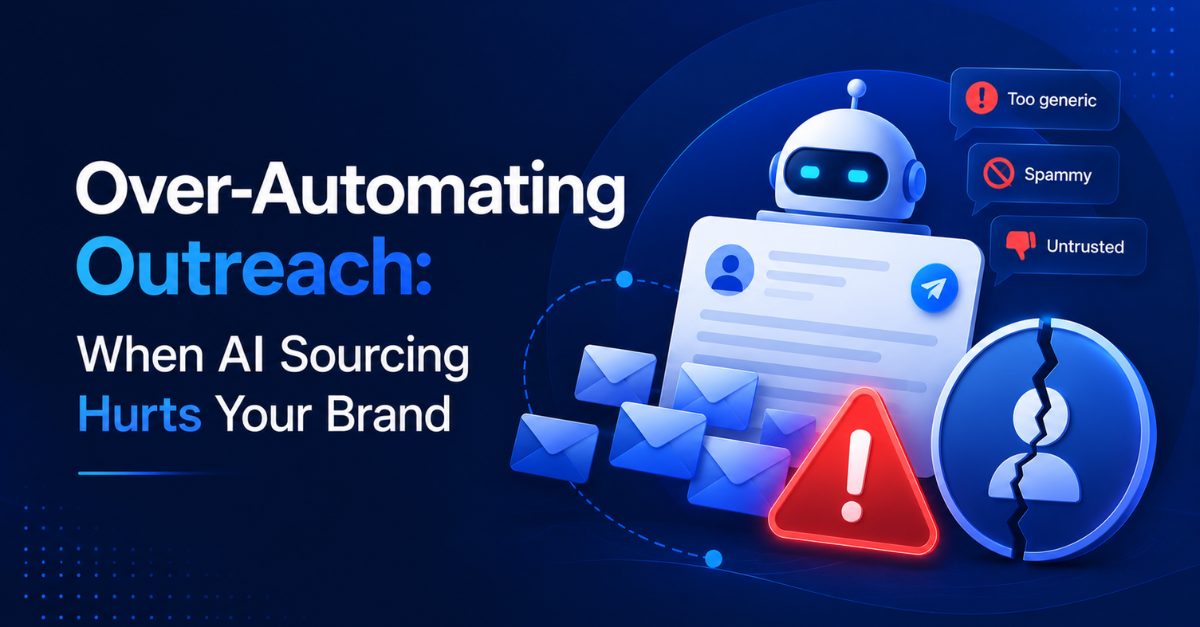
More automation does not always create better recruiting.
When AI outreach is poorly implemented, it can create:
Generic candidate messages
Lower response rates
Poor candidate experience
Employer brand damage
Loss of recruiter trust
The goal of AI should not be to send more messages.
The goal should be to create better candidate conversations at scale.
The future of recruiting is not replacing recruiters with automated messaging systems.
It is building Agentic AI Recruiting Infrastructure that handles repetitive execution while protecting the human relationships that make hiring successful.
The Rise of AI-Powered Candidate Outreach
Why Recruiters Are Automating Outreach
Recruiting teams are under increasing pressure.
Companies need to:
Fill roles faster
Reach passive talent
Improve recruiter productivity
Manage larger hiring volumes
Traditional outreach creates operational challenges.
Recruiters often spend hours:
Searching candidate databases
Writing similar messages
Sending follow-ups
Tracking responses
Updating systems
AI outreach automation helps reduce this workload.
Modern AI recruiting tools can assist with:
Candidate discovery
Message generation
Outreach sequences
Follow-up reminders
Candidate prioritization
The promise is simple:
Less manual work.
More meaningful hiring conversations.
But that promise depends on how automation is designed.
The Problem With "Automate Everything"
Many teams make a common mistake.
They assume:
More messages = more candidates.
More automation = better results.
But recruiting does not work like traditional sales outreach.
Candidates are not just leads.
They are people evaluating:
Company reputation
Career opportunities
Recruiter credibility
Communication quality
A poorly automated message can damage trust faster than no message at all.
When AI Outreach Goes Too Far
Generic Candidate Messages
One of the biggest problems with AI outreach is low-context personalization.
A candidate receives a message:
"Hi John, we found your profile impressive. We have an exciting opportunity matching your skills."
The problem?
Thousands of candidates receive similar messages.
The candidate immediately notices:
The role is not relevant
Their experience was not understood
The message feels automated
AI can generate text quickly.
But without context, speed creates noise.
Effective AI outreach needs:
Candidate history
Role requirements
Career preferences
Relevant experience
Personalization is not adding a name.
Personalization is understanding why the conversation matters.
Losing Human Connection
Recruiting is built on relationships.
A strong recruiter understands:
When to follow up
When to provide more information
When a candidate needs a human response
Over-automation removes these moments.
Candidates may feel:
They are talking to a bot
Their questions are ignored
The company does not care
AI should support recruiter communication.
It should not replace recruiter judgment.
Mistake #1 — Optimizing Volume Instead of Quality
More Messages Do Not Equal More Hires
A common AI outreach mistake is optimizing the wrong metric.
Teams measure:
Messages sent
Candidates contacted
Outreach volume
But these metrics do not guarantee hiring success.
A better approach measures:
Qualified responses
Interview conversions
Candidate engagement
Hiring outcomes
A recruiter who sends 500 irrelevant messages is less effective than a recruiter who starts 20 meaningful conversations.
AI should improve signal quality, not increase noise.
Better Conversations Beat More Conversations
The best AI recruiting workflows focus on relevance.
AI should help answer:
Is this candidate actually suitable?
Why would they consider this role?
What message should be sent?
When is the right time to follow up?
The goal is not automation at scale.
The goal is intelligent engagement.
Mistake #2 — Using Templates Without Context
Personalization Problems
Templates are useful.
But relying on generic templates creates poor candidate experiences.
A candidate expects recruiters to understand:
Their skills
Their career goals
Their background
AI-generated outreach should adapt based on context.
For example:
Weak:
"Your experience matches our open position."
Better:
"Your experience building scalable backend systems aligns with the engineering challenges our team is solving."
The difference is relevance.
Candidate Relevance Matters
Candidates ignore outreach when:
The role does not match their goals
Messages feel copied
Recruiters misunderstand their experience
AI should analyze candidate information before generating communication.
Good automation starts with intelligence.
Mistake #3 — Automating Relationship Building
Where Humans Matter
Some parts of recruiting should remain human.
Especially:
Sensitive conversations
Career discussions
Negotiations
Candidate concerns
A candidate deciding on a career move is not completing a transaction.
They are making a significant decision.
Where AI Helps
AI is valuable for repetitive operational tasks.
It can automate:
Follow-up reminders
Candidate sorting
Communication drafts
Scheduling coordination
Pipeline updates
The ideal model:
AI handles repetitive execution.
Recruiters handle meaningful interactions.
Mistake #4 — Ignoring Candidate Experience
Response Rates Are a Trust Signal
Low response rates are often treated as a sourcing problem.
But sometimes the issue is communication quality.
Candidates respond when outreach feels:
Relevant
Timely
Respectful
Personalized
Poor automation creates:
Lower engagement
Candidate drop-offs
Negative employer perception
Employer Brand Is Part of Recruiting Performance
Every candidate interaction shapes your brand.
A poor AI outreach experience can influence how candidates view:
Your company
Your recruiters
Your hiring process
Recruiting automation should protect your reputation, not weaken it.
How to Use AI Outreach Without Damaging Your Brand
Human-in-the-Loop Automation
The best AI recruiting systems keep humans involved.
AI can:
Recommend candidates
Draft messages
Prioritize outreach
Manage workflows
Recruiters can:
Review communication
Add context
Handle conversations
Make decisions
This creates a balance between efficiency and authenticity.
Intelligent Personalization
Modern AI should understand context.
Effective AI outreach considers:
Candidate experience
Role requirements
Previous interactions
Hiring priorities
The future is not automated messaging.
It is intelligent candidate engagement.
The Future: AI Agents + Human Recruiters
Beyond Automated Messages
The next generation of recruiting AI will move beyond simple outreach automation.
Instead of:
Find candidate → Send message → Wait
Future workflows become:
Discover → Understand → Engage → Qualify → Coordinate → Execute
AI agents can support the entire recruiting workflow.
Intelligent Recruiting Workflows
Agentic AI recruiting focuses on outcomes.
Not just:
More searches
More messages
More activity
But:
Better candidates
Faster hiring cycles
Stronger candidate relationships
AI should make recruiters more human, not less.
FAQ
1. Can AI outreach hurt employer brand?
Yes. Poorly designed AI outreach can create generic communication, reduce trust, and damage candidate experience.
2. Should recruiters automate candidate messages?
Recruiters should automate repetitive communication while keeping important conversations human.
3. How much recruiting outreach should be automated?
Automation should handle repetitive tasks, but recruiters should control strategy, personalization, and relationship-building.
4. Does AI make recruiting impersonal?
AI can make recruiting impersonal when used only for volume. When designed properly, it helps recruiters spend more time on meaningful interactions.
5. How can AI personalize outreach?
AI can use candidate data, role requirements, and previous interactions to create more relevant communication.
6. What are AI recruiting risks?
Common risks include poor personalization, over-automation, weak candidate experience, and incorrect recommendations.
7. Can AI replace recruiters?
AI can automate repetitive recruiting work, but human judgment remains critical for relationships and hiring decisions.
8. What is candidate engagement automation?
Candidate engagement automation uses technology to improve communication, follow-ups, and recruiting workflows.
9. What is Agentic AI recruiting?
Agentic AI recruiting uses AI agents to execute recruiting workflows while supporting recruiter decision-making.
10. How do recruiters balance AI and humans?
The best approach is letting AI manage repetitive operations while recruiters focus on trust, conversations, and decisions.
Conclusion
The future of recruiting is not about sending more automated messages.
It is about creating better recruiting experiences at scale.
AI should not replace human connection.
It should remove repetitive work so recruiters can focus on what matters:
Understanding candidates.
Building relationships.
Making better hiring decisions.
The winning recruiting teams will not be the ones with the most automation.
They will be the ones using AI responsibly through Agentic AI Recruiting Infrastructure.