Recruiting teams rarely start with a completely new talent market every time they open a role.
They already know people.
Some candidates applied previously but were not selected. Others reached a final interview for a different role. Recruiters may have sourced strong candidates who were not ready to move at the time, met potential hires at events, received referrals, or spoken with people who could become relevant months later.
The problem is that most recruiting processes are built around immediate vacancies.
A role opens. Recruiters search for candidates. Applications arrive. Interviews happen. The role closes. When another similar position opens six months later, the team often starts the search again.
A recruiting CRM is designed to prevent that reset.
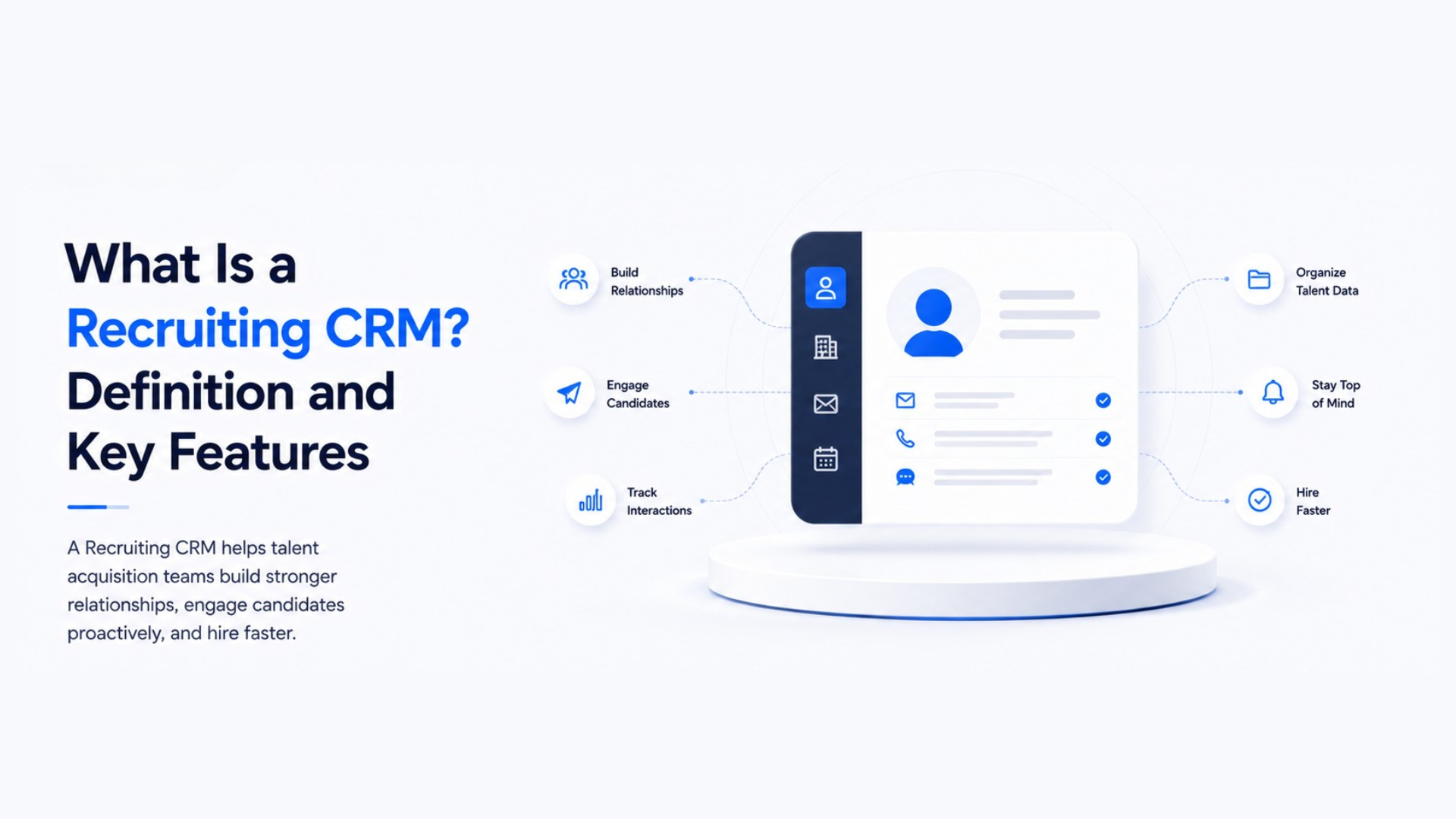
A recruiting CRM, or candidate relationship management system, is software that helps recruiting teams organize potential candidates, build talent pools, track interactions, manage engagement, and maintain relationships with people before and between active hiring processes.
The concept is similar to customer relationship management in sales. A sales team does not treat every potential customer as a completely new person each time someone makes contact. The company keeps a record of the relationship, tracks interactions, organizes prospects, and maintains communication over time.
A recruiting CRM applies a similar principle to talent.
The goal is not simply to store candidate records. It is to help recruiters build a reusable network of potential candidates and maintain enough context to engage the right people when relevant opportunities appear.
That makes a recruiting CRM different from an applicant tracking system. An ATS is primarily built to manage active candidates through a hiring process. A recruiting CRM is primarily built to manage relationships with talent before, between, and sometimes after those formal hiring processes.
What Is a Recruiting CRM?
A recruiting CRM is a system for candidate relationship management.
It helps recruiting teams maintain an organized view of people who may be relevant to current or future hiring needs, even when those people are not actively applying for a job.
These people can come from many places. They may be previous applicants, sourced candidates, referrals, former employees, event attendees, silver-medalist candidates, passive talent, or people who joined a talent community.
Instead of leaving those relationships inside individual recruiter inboxes, spreadsheets, sourcing platforms, or old ATS records, the CRM creates a more persistent talent network.
SmartRecruiters’ definition of candidate relationship management describes CRM as a way for hiring professionals to manage the early stages of recruitment, identify talent pools, and use messaging campaigns to keep candidates engaged. SHRM similarly explains that recruiting CRM systems help teams build and nurture pipelines that can include previously vetted talent and people who have not yet applied.
The central idea is continuity.
A good candidate should not disappear simply because one job closed.
A promising person who says, “The timing is not right” should not become a forgotten email thread.
A finalist who loses one role should not need to be rediscovered from the beginning when a similar opportunity appears.
The recruiting CRM keeps those relationships available and actionable.
Why Recruiting Teams Need a CRM
Most recruiting systems are designed around open jobs.
That creates a short-term workflow. A requisition opens, candidates enter, the team evaluates them, and the process ends when someone is hired.
The candidate relationship does not always fit that timeline.
A strong candidate may not be ready to move today but could be interested next year. Someone may be wrong for one position and ideal for another. A recruiter may identify an excellent person months before the company has the right opening.
Without a CRM, this information often becomes fragmented. Some candidate history remains in the ATS. Some stays in recruiter notes. Some is buried in email. Some disappears when a recruiter leaves the company.
The result is repeated work.
When a new role opens, the team searches externally again even though relevant people may already exist somewhere inside the organization’s recruiting data.
A recruiting CRM turns that historical activity into a reusable talent asset.
This is especially important for roles that are hired repeatedly. If a company regularly hires software engineers, salespeople, nurses, warehouse managers, or other recurring profiles, it should not need to rebuild the entire talent market from zero for every vacancy.
The CRM helps preserve what the recruiting team has already learned.
How Does a Recruiting CRM Work?
A recruiting CRM usually begins by bringing candidate records into one searchable environment.
Those records may come from previous applications, sourcing activity, employee referrals, events, talent communities, career sites, imports, or integrations with other recruiting systems.
Recruiters can then organize candidates into talent pools or segments.
A company might create groups for senior backend engineers, enterprise sales leaders, potential future managers, candidates in a specific city, previous finalists, or people interested in remote roles.
The important point is that these groups are not necessarily tied to one active job.
They represent talent the organization may want to understand or engage over time.
The CRM also stores relationship context. Recruiters can see previous conversations, campaign activity, notes, candidate interests, past roles considered, and other permitted information.
This context allows future engagement to begin from the existing relationship instead of restarting the conversation.
A recruiter opening a new role can search the CRM, identify people who were previously relevant, understand what happened before, and decide who should be re-engaged.
The system can also support ongoing communication through email campaigns, talent community updates, event invitations, job alerts, and other forms of candidate nurturing.
The result is a more continuous recruiting model.
Instead of finding candidates only when a job opens, the company can build and maintain relationships before the hiring need becomes urgent.
Recruiting CRM vs. Applicant Tracking System
The most common confusion is between a recruiting CRM and an applicant tracking system.
Both systems store candidate information. Both may track communication. Both may include search, automation, reporting, and AI features.
The main difference is the workflow they were built to manage.
An ATS is primarily job-centric.
A role opens. Candidates apply or are added to the process. Recruiters move them through stages such as screening, interview, offer, rejection, and hire.
A recruiting CRM is primarily relationship-centric.
The candidate can remain valuable even when no active job exists. The system helps recruiters organize talent, maintain context, nurture relationships, and re-engage people when the right opportunity appears.
This means the ATS is strongest during an active hiring process, while the CRM is strongest before and between those processes.
The distinction is not absolute. Modern platforms increasingly combine both capabilities. Oracle Recruiting, for example, describes native CRM capabilities for managing talent pools and building candidate relationships alongside broader recruiting functions.
But the conceptual difference remains useful.
The ATS manages the hiring process.
The recruiting CRM manages the longer-term talent relationship.
Recruiting CRM vs. Candidate Sourcing Tool
A sourcing tool and a recruiting CRM also solve different problems.
A sourcing tool helps recruiters find potential candidates.
The team defines a requirement, searches the external talent market, reviews profiles, and identifies people who may be relevant.
A recruiting CRM helps the team manage what happens to those relationships over time.
Suppose a recruiter uses a sourcing tool to identify 100 potential candidates for a difficult role. Twenty appear highly relevant. Eight respond. Three are interested now. Five say they may be open later.
The sourcing tool has done its job by helping discover the people.
The CRM becomes valuable when the company wants to preserve the relationship with the five candidates who are not ready today, remember the people who were strong but unavailable, and re-engage them when another suitable role opens.
This creates a natural connection between the two systems.
Sourcing creates new talent relationships.
The CRM helps the organization keep and develop them.
The problem appears when these systems are disconnected. A recruiter may find someone in one tool, contact them through another, store the person somewhere else, and later struggle to understand the complete history.
This is why modern recruiting technology is increasingly moving toward connected workflows rather than isolated features.
Recruiting CRM vs. Recruitment Marketing
Recruiting CRM and recruitment marketing are closely connected, but they are not identical.
Recruitment marketing focuses on attracting potential candidates.
It can include employer branding, content, career sites, social media, events, advertising, talent communities, and campaigns designed to create awareness and interest.
The CRM manages the relationships created through that activity.
A person may discover the company through an event and join a talent community. The CRM stores that relationship, records engagement, places the person in a relevant talent pool, and supports future communication.
Recruitment marketing creates attention.
Candidate relationship management helps maintain the connection.
This is why many recruiting CRM platforms include marketing-style features such as audience segmentation, automated campaigns, landing pages, event management, and engagement analytics.
The categories overlap because attracting talent and nurturing talent are part of the same longer-term relationship.
The Key Features of a Recruiting CRM
The most important feature of a recruiting CRM is a searchable candidate database that exists beyond individual job applications.
The database should allow recruiters to find people based on useful information such as skills, experience, location, previous interactions, interests, hiring history, and other relevant signals.
Talent pools are another core feature.
Recruiters should be able to group candidates around future hiring needs rather than only active requisitions. These groups may be created manually, dynamically through rules, or with AI assistance.
Candidate segmentation makes those talent pools more useful. A company should not communicate with every person in the same way. A previous executive finalist, a graduate student who joined a talent community, and a passive engineer sourced six months ago have different relationships with the company.
Communication tools are also central.
Recruiting CRM software often supports email campaigns, personalized outreach, automated follow-ups, job alerts, event invitations, and other engagement workflows.
The best systems also preserve interaction history.
Recruiters should be able to see what communication has already happened, who contacted the candidate, what the person said, and whether there are reasons not to start another outreach sequence.
Analytics is another important feature. Teams may track talent pool growth, engagement, response rates, campaign performance, source quality, candidate rediscovery, and progression into active hiring processes.
AI is increasingly appearing across all of these capabilities, from candidate matching and database rediscovery to personalization and workflow automation.
Talent Pools and Candidate Segmentation
Talent pools are one of the defining features of a recruiting CRM.
A talent pool is an organized group of people who share characteristics relevant to a current or future hiring need.
The company may build a pool of candidates with a particular technical skill, people in a specific geography, previous finalists, potential future leaders, former employees, or candidates who attended a recruiting event.
The value comes from organization.
A database containing 100,000 candidate records is not automatically useful. If recruiters cannot find the right people or understand the previous relationship, the organization effectively has a large archive.
Segmentation turns the database into something more actionable.
When a new role opens, recruiters can begin with people who are already known to the organization instead of immediately searching the external market.
This can reduce repeated sourcing work.
It can also create a better candidate experience because the company can recognize previous interactions.
The candidate does not need to explain the entire relationship again.
Candidate Nurturing and Engagement
Not every relevant candidate is ready at the same time the company wants to hire.
Candidate nurturing is the process of maintaining an appropriate relationship until the timing becomes more relevant.
This does not mean sending constant automated emails.
Good nurturing gives the candidate a reason to remain connected.
The company may share genuinely relevant opportunities, invite the person to an event, provide useful updates, or reconnect based on a previously discussed timeline.
The CRM helps make this possible at scale by organizing who should receive which communication and preserving the history of the relationship.
The quality of this communication matters.
A candidate who declined a role last month should not receive an automated message that acts as if the company has never spoken with them.
A senior executive should not be placed into the same generic campaign as thousands of early-career applicants.
Automation is useful when it helps the company maintain relevant relationships.
It becomes harmful when it removes context.
Candidate Rediscovery
One of the most valuable uses of a recruiting CRM is candidate rediscovery.
Recruiting teams often spend money and time finding new candidates while ignoring people already inside their systems.
A previous applicant may now have more experience.
A candidate who was second choice for one role may be ideal for another.
A person who declined because of timing may now be ready to move.
The challenge is finding these people again.
SHRM’s discussion of candidate rediscovery describes CRM tools as particularly useful for candidate pipeline engagement and rediscovery. The underlying problem is simple: if finding relevant people inside the existing database is too difficult, recruiters often return to external advertising and sourcing instead.
AI can make rediscovery more useful.
Instead of relying only on exact keywords, the system can compare a new hiring requirement with existing candidate records and surface people whose experience appears relevant.
This turns old recruiting data into a potential sourcing channel.
The company has already invested in attracting, finding, or evaluating many of these people.
A CRM helps preserve that value.
Communication History and Relationship Context
A recruiting relationship can involve many interactions over a long period.
One recruiter may source a candidate.
Another may speak with them six months later.
The person may apply for a role, complete an interview, decline an offer, and later become relevant again.
Without a shared record, each recruiter sees only part of the story.
A CRM should preserve enough context for the team to understand the relationship.
This includes previous communication, roles considered, campaign activity, recruiter notes, candidate preferences, and other permitted information.
Context prevents awkward recruiting experiences.
It reduces duplicate outreach.
It helps recruiters avoid asking candidates to repeat information.
It also allows future conversations to begin from a more informed position.
The purpose is not to collect as much information as possible.
It is to preserve the information needed to manage the relationship appropriately.
Recruiting CRM Automation
Automation is one of the reasons recruiting CRM software can scale.
A recruiter managing 50 relationships can remember a significant amount personally.
A company managing tens of thousands of potential candidates cannot.
CRM automation can help trigger appropriate actions based on events or candidate activity.
A person who joins a talent community may receive a welcome message.
Candidates in a particular talent pool may receive a relevant job alert.
A recruiter may be reminded to reconnect with someone who asked to speak again in six months.
A candidate who responds to a campaign may leave an automated sequence and move into a different workflow.
These automations reduce repetitive coordination.
But they need boundaries.
A badly configured CRM can send irrelevant communication at scale, continue contacting people after the context has changed, or create duplicate messages from different recruiters.
The objective should not be maximum automation.
It should be better relationship management with less unnecessary manual work.
How AI Is Changing Recruiting CRM Software
Traditional recruiting CRM systems depended heavily on recruiters keeping the database organized.
People needed to be tagged correctly, added to the right talent pools, and rediscovered through searches.
AI can reduce some of this manual work.
A modern system may identify candidates who match a new role, recommend people from existing talent pools, summarize previous interactions, classify candidate responses, and help determine when a recruiter should re-engage someone.
This is especially valuable because recruiting databases become less useful as they grow.
The more records a company collects, the harder it becomes for a recruiter to know who is relevant today.
AI can help turn a static database into a more active talent network.
SHRM’s coverage of AI in candidate relationship management notes that CRM systems are increasingly being used to build and nurture pipelines of previously vetted and not-yet-applied talent. The direction is toward systems that help recruiters identify useful relationships rather than simply store records.
The most useful AI CRM is therefore not the one that generates the most messages.
It is the one that helps recruiters understand who matters, why they matter, what happened previously, and what the appropriate next action should be.
How a Recruiting CRM Fits Into Outbound Recruiting
Recruiting CRM software is particularly valuable for outbound-heavy teams.
Outbound recruiting begins with people who have not applied.
Recruiters need to identify candidates, create engagement, manage responses, and build relationships before a formal hiring process begins.
Not every sourced candidate will be ready immediately.
This is where the CRM becomes important.
A person may say the opportunity is interesting but the timing is wrong. Another may want to reconnect after a promotion cycle. Someone else may be strong but better suited to a role the company expects to open later.
Without a CRM, these relationships are easy to lose.
The recruiting team returns to sourcing new candidates for the next role even though it has already built a network of potentially relevant people.
A CRM makes outbound recruiting cumulative.
Each search can contribute to future talent pools instead of disappearing when the immediate role closes.
This is one reason CRM capabilities become more important as a company’s proactive recruiting activity grows.
How a Recruiting CRM Fits With an ATS and Sourcing Tool
A useful way to understand the recruiting technology stack is to follow the candidate journey.
The sourcing tool helps the recruiter find someone.
The recruiting CRM helps the company manage and develop the relationship.
The ATS manages the person through an active hiring process.
In reality, the boundaries are becoming less clear. Some sourcing platforms include CRM capabilities. Some ATS platforms include talent pools and campaigns. Some broader recruiting systems combine all three.
The categories still matter because they reveal where the software is strongest.
A team with an excellent ATS may still struggle to nurture passive candidates.
A company with a strong sourcing tool may continue losing valuable people after each search.
A CRM may contain excellent talent pools while doing little to find new candidates.
The real challenge is the connection between these systems.
Workday’s guidance on AI in recruiting emphasizes that AI recruiting tools should work alongside systems such as applicant tracking systems and candidate relationship management platforms so information can move across the workflow.
When the systems are disconnected, the recruiter becomes the integration layer.
Where Huntlo Fits Into the Recruiting CRM Workflow
Huntlo is not positioned as a traditional recruiting CRM built mainly around long-term talent communities and recruitment marketing campaigns.
Its focus is closer to agentic recruiting execution.
That distinction is important.
A recruiting CRM helps preserve candidate relationships, organize talent pools, and maintain engagement over time. Huntlo focuses more directly on the work required to move from a hiring need toward qualified candidate conversations.
That can include candidate sourcing, personalized engagement, follow-ups, candidate communication, screening, and interview coordination.
The two concepts connect because outbound recruiting produces relationships that need context.
A candidate may not be ready today.
Another may respond with a question.
Someone may be interested but require qualification.
A recruiting workflow needs to understand what happened and coordinate the appropriate next action.
This is where traditional CRM logic and agentic recruiting begin to overlap.
The future is not simply a larger database of candidates.
It is a system that can understand the relationship and help execute the work that should happen next.
For teams exploring this shift, Huntlo’s article on what comes after sourcing automation explains why candidate discovery alone is becoming less of a competitive advantage when engagement, qualification, and workflow execution remain manual.
The same principle appears in how AI sourcing tools fit into the future of talent acquisition: the value of a candidate database depends on whether the recruiting team can turn relevant talent into actual conversations.
Who Needs a Recruiting CRM?
A recruiting CRM is most useful when hiring is continuous rather than occasional.
Large organizations often have a strong use case because they manage many candidates, recurring roles, employer-brand campaigns, events, and long-term talent pipelines.
Recruitment agencies can also benefit because candidate relationships are central to their business. A strong candidate may be relevant to several clients over time rather than one immediate vacancy.
Outbound-heavy recruiting teams benefit because many sourced candidates are not ready to move immediately.
Companies hiring repeatedly for similar roles can also create significant value from rediscovery and talent pools.
A small company hiring a few people per year may not need a dedicated recruiting CRM. If the team has a small candidate database and limited proactive recruiting activity, the additional system may create more complexity than value.
The decision should depend on the problem.
If strong candidates regularly disappear after a role closes, recruiters repeatedly search for people the company already knows, or candidate relationships are scattered across individual systems, a CRM may solve a real operational problem.
How to Evaluate Recruiting CRM Software
The first question is whether recruiters can actually find relevant people in the database.
A CRM with thousands of records is useless if search is poor, profiles are outdated, or the team cannot understand previous interactions.
The second question is how well the system supports talent pools and segmentation. Recruiters should be able to organize people around meaningful hiring needs rather than create endless manual lists.
The third question is communication. The CRM should help teams engage candidates without losing context or creating duplicate outreach.
The fourth question is rediscovery. Can the system surface people already known to the organization when a new role opens?
The fifth question is automation. Useful automation should remove repetitive coordination while giving recruiters control over important interactions.
The sixth question is integration. Candidate context should move between sourcing, CRM activity, and the ATS without constant manual copying.
Finally, teams should evaluate AI based on workflow value rather than feature count. AI-generated emails may look impressive in a demonstration, but better rediscovery, response understanding, and next-action coordination may create much more value.
The best recruiting CRM is not the one that stores the most candidates.
It is the one that helps the team use the relationships it already has.
The Future of Recruiting CRM
Recruiting CRM software is moving from passive storage toward active talent intelligence and workflow execution.
Older systems depended on recruiters remembering who to search for, which talent pool to open, and when to reconnect.
Modern AI can make the database more dynamic.
A new role can trigger candidate rediscovery.
Previous interactions can inform new outreach.
Candidate responses can change the next action.
Recruiters can be alerted when a relationship becomes relevant instead of manually searching every record.
This changes the purpose of the CRM.
The system is no longer only a place where candidate relationships are stored.
It can become a layer that helps the recruiting team understand and act on those relationships.
The strongest future systems will connect sourcing, candidate relationship management, engagement, screening, and the formal hiring process without forcing recruiters to manually move context between every stage.
That is the larger opportunity.
Not a bigger candidate database.
A more useful recruiting network.
Conclusion: A Recruiting CRM Turns Candidate Records Into Relationships
A recruiting CRM is software that helps talent acquisition teams organize, engage, nurture, and rediscover potential candidates over time.
Unlike an ATS, it is not focused primarily on moving active applicants through hiring stages.
Unlike a sourcing tool, it does not focus primarily on discovering new people.
Its purpose is to preserve and develop the relationship between the company and potential talent.
The key features usually include a searchable candidate database, talent pools, segmentation, communication campaigns, interaction history, candidate nurturing, rediscovery, automation, analytics, and integrations with other recruiting systems.
The value comes from continuity.
A good candidate should not disappear because one role closed.
A promising conversation should not become a forgotten email thread.
A recruiting team should not repeatedly pay to rediscover people it already knows.
A CRM helps turn individual recruiting interactions into a long-term talent network.
As AI becomes more capable, these systems are also becoming more active. They can help identify relevant candidates inside existing data, understand previous interactions, and coordinate appropriate next actions.
The future of candidate relationship management is therefore not simply storing more profiles.
It is making every useful recruiting relationship easier to understand and act on.
Frequently Asked Questions
What is a recruiting CRM?
A recruiting CRM is candidate relationship management software that helps recruiting teams organize talent pools, track interactions, engage candidates, and maintain relationships before and between active hiring processes.
What does CRM mean in recruiting?
CRM usually means candidate relationship management. It refers to the strategy and software used to build and maintain relationships with potential candidates over time.
What is the difference between a recruiting CRM and an ATS?
An ATS primarily manages active candidates through a hiring process. A recruiting CRM focuses on talent relationships before, between, and sometimes after active hiring processes.
What are the main features of a recruiting CRM?
Common features include candidate databases, talent pools, segmentation, communication campaigns, interaction history, candidate nurturing, rediscovery, automation, analytics, and recruiting-system integrations.
Is a recruiting CRM the same as a sourcing tool?
No. A sourcing tool helps find new potential candidates. A recruiting CRM helps organize and develop relationships with candidates the company already knows.
Can a recruiting CRM help with passive candidates?
Yes. CRM software is particularly useful for maintaining relationships with candidates who are not ready to change jobs immediately but may become relevant later.
Does every company need a recruiting CRM?
No. It is most useful for organizations with continuous hiring, large candidate databases, proactive sourcing, recurring roles, recruitment marketing, or long-term talent pipelines.
How is AI changing recruiting CRM software?
AI can improve candidate rediscovery, matching, interaction summaries, response understanding, personalization, and workflow automation. Its strongest value is helping recruiters understand which existing relationships are relevant and what should happen next.
Related Topics
Explore what comes after sourcing automation as recruiting teams move from isolated candidate discovery toward connected engagement and workflow execution.
See how AI sourcing tools fit into the future of talent acquisition and why the value of candidate discovery depends on what happens after a relevant person is found.