Recruiters can spend hours finding a candidate who appears almost perfect for a role and still face a basic problem.
How do they contact the person?
The candidate may not have applied. Their professional profile may contain useful information about experience, skills, employers, and career history, but no visible work email. The recruiter can send a message through the platform where the profile was found, but that creates dependence on one channel and assumes the candidate regularly checks it.
Outbound recruiting works differently from applicant processing.
The company is not waiting for the candidate to provide contact information. The recruiter is identifying potentially relevant professionals and attempting to begin a conversation.
This is why contact discovery has become an important part of AI sourcing and recruiting platforms.
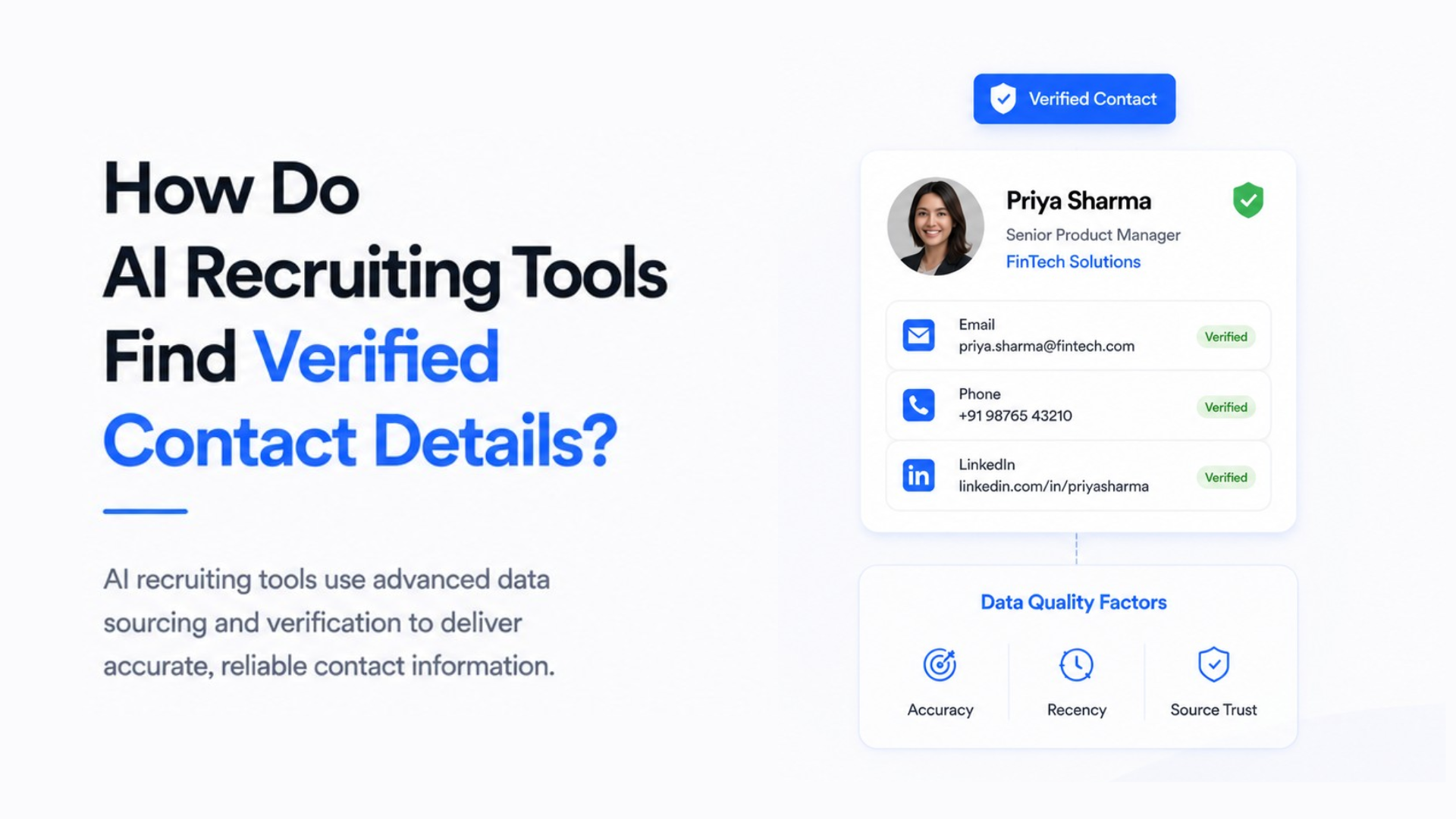
AI recruiting tools typically find verified contact details by connecting a candidate’s professional identity with company and domain information, discovering or generating possible contact patterns, comparing information across data sources, and running technical verification checks before returning an address with a confidence status.
The exact process varies significantly between providers.
Some platforms maintain large professional contact databases.
Others use real-time enrichment.
Some combine several external data sources.
Others attempt to discover a likely work email from the candidate’s name and employer before checking whether the address appears deliverable.
The important point is that “verified” does not always mean the same thing.
A contact detail may have been recently confirmed through technical checks.
Another may have been observed in a reliable source.
Another may be predicted from a company email pattern and then tested.
A fourth may simply be considered highly likely based on matching data.
Recruiters should understand these differences because contact data affects more than convenience.
Poor contact information creates bounced emails, wasted recruiter time, damaged sender reputation, broken outreach sequences, and misleading campaign performance.
Good contact data creates a cleaner path from candidate discovery to candidate conversation.
To understand how AI recruiting tools find verified contact details, it helps to follow the process from the beginning.
Contact Discovery Begins With Candidate Identity
Before a recruiting tool can find a contact detail, it needs to understand who the candidate is.
This is harder than it sounds.
Many people share the same name.
A candidate may have changed employers recently.
A professional profile may use a shortened name.
The company name may appear in several formats.
A person may have multiple professional profiles across different sources.
The first problem is therefore identity resolution.
The system needs to determine that the candidate profile found during sourcing belongs to a specific person with a specific professional history.
Several signals can help.
The candidate’s full name may be compared with current employer information, job title, location, professional profile URLs, previous employers, education, and other professional data.
The more signals that agree, the more confidently the system can connect the candidate with other records.
Imagine a recruiter finds a candidate named Arjun Sharma.
Searching a contact database for that name alone could return many people.
The system may narrow the identity using the fact that this Arjun Sharma works as a product manager at a particular company in Bengaluru and previously worked at another known employer.
This context reduces the chance of returning someone else’s contact information.
AI can help with this process because professional data is rarely perfectly standardized.
One source may list the company as “ABC Technologies.”
Another may use “ABC Tech.”
A third may use the parent company name.
The system needs to recognize that these records may refer to the same professional context.
This identity-matching stage is essential.
A technically valid email address is useless if it belongs to the wrong person.
The Tool Identifies the Candidate’s Current Employer
For work email discovery, the current employer is one of the strongest signals.
A professional email address usually follows the company’s domain.
If a candidate works for a company whose website is company.com, their work email may use the same domain or a related corporate domain.
The recruiting tool therefore needs to identify the correct employer.
This can become complicated when a candidate has recently changed jobs.
A profile may show the new employer while an older data source still contains the previous company.
The candidate may work for a subsidiary that uses the parent company’s email infrastructure.
A large organization may use different domains across countries or business units.
The system may therefore compare several pieces of evidence before selecting the likely employer domain.
AI can help normalize company information and understand relationships between organizations.
The tool may identify that two company names refer to the same business.
It may connect a subsidiary with a parent organization.
It may recognize that the public website domain differs from the domain employees use for email.
This stage matters because every later email prediction depends on the domain being correct.
If the system identifies the wrong company, it can generate a perfectly formatted and technically valid address for the wrong professional context.
The System Finds the Company’s Email Domain
Once the employer is identified, the recruiting tool needs to determine which domain is used for email.
The company website provides one clue.
However, the visible website domain is not always the same as the employee email domain.
A company may have rebranded.
It may operate several regional websites.
A parent organization may manage email centrally.
The system can use domain information, known company records, existing professional contact data, and technical email infrastructure to identify the most likely domain.
One technical signal is the domain’s Mail Exchange record.
An MX record identifies the mail servers responsible for receiving email for a domain. Cloudflare’s explanation of DNS MX records provides a useful technical overview of how these records direct email toward the appropriate mail server.
For recruiting contact discovery, an MX record does not reveal a candidate’s email address.
It answers a more basic question.
Is this domain configured to receive email?
If the domain has no usable mail infrastructure, an address built on that domain is unlikely to be useful.
The domain is therefore part of the evidence chain.
The system knows the candidate.
It identifies the employer.
It identifies the likely email domain.
The next challenge is finding the individual mailbox.
Many Companies Use Predictable Email Patterns
Organizations often create employee email addresses using consistent naming conventions.
A company may use a pattern such as first name followed by last name.
Another may use first initial plus last name.
Another may use first name, a separator, and last name.
Large organizations may use several patterns because of duplicate names, regional systems, or historical infrastructure.
Contact discovery systems can learn these patterns from known professional addresses.
Suppose a recruiting platform already has reliable examples for several employees at one company.
If the addresses consistently follow the same structure, the system can infer the likely pattern for another employee.
The candidate’s name and company domain can then produce one or more possible addresses.
This is sometimes described as email permutation.
The tool is not simply guessing random combinations.
It is using evidence about how the organization structures employee email.
AI can improve this process by handling variations in names.
A candidate may use a middle name.
A surname may contain multiple parts.
The professional profile may contain a shortened first name.
The company may remove spaces or punctuation.
The system can generate and prioritize likely versions.
However, a likely pattern is not the same as a verified mailbox.
The tool still needs to determine whether the address appears capable of receiving email.
Some Tools Find Existing Contact Data Instead of Predicting It
Not every email address needs to be generated from a pattern.
Recruiting and data-enrichment providers may already have contact information associated with the professional identity.
The system may search existing datasets for records that match the candidate.
The contact information may come from permitted professional sources, previous observations, data partnerships, user-contributed information, or other provider-specific methods.
The exact sourcing method varies between companies.
This is why recruiters should evaluate the data practices of the platform they use rather than assuming every contact database works the same way.
The system still needs to resolve identity.
If an existing record contains a work email for someone with the same name, the platform should determine whether the employer, title, location, or other professional context matches the candidate being sourced.
This is another area where AI can help.
The system can compare several imperfect records and estimate whether they belong to the same person.
A direct existing match may create stronger confidence than a purely predicted address.
However, existing data can become outdated.
People change jobs.
Companies change domains.
Mailboxes are closed.
This is why discovery and verification should remain separate steps.
Finding an address tells the system what the contact detail may be.
Verification asks whether it still appears usable.
What Does “Verified Contact Detail” Actually Mean?
The word “verified” can create more confidence than the underlying process deserves.
For an email address, verification usually means the system has performed checks indicating that the address is likely to be deliverable.
It does not mean the candidate has personally confirmed the address.
It does not mean the candidate will read the message.
It does not mean the person wants to discuss the role.
It does not guarantee that the address will never bounce.
Verification is primarily about confidence in the contact route.
The system may check whether the address has a valid structure, whether the domain exists, whether the domain can receive email, whether the mail server appears to recognize the mailbox, and whether other risk conditions exist.
A modern verification process may combine several of these checks.
The result is often returned as a status such as valid, invalid, risky, catch-all, unknown, or unverified.
Recruiters should understand the platform’s terminology.
One provider’s “verified” status may not use the same process as another provider’s.
The useful question is not simply whether a green checkmark appears.
The useful question is what evidence produced it.
The First Check Is Usually Email Syntax
Before performing more expensive verification, the system can check whether the email address is structurally possible.
An email needs to follow a valid format.
There should be an appropriate local part before the @ symbol and a domain after it.
Obvious formatting errors can be rejected immediately.
This is the simplest part of verification.
It can identify malformed addresses.
It cannot prove that the mailbox exists.
An address can look perfectly correct while belonging to nobody.
Syntax validation therefore removes obvious failures.
The deeper checks happen afterward.
The System Checks the Domain
The next question is whether the domain exists and can receive email.
A recruiting tool can examine DNS information and the domain’s email configuration.
MX records are especially relevant because they indicate where email for the domain should be routed. A domain with appropriate mail infrastructure provides evidence that employee mailboxes could exist there. Technical services such as MXToolbox’s MX lookup demonstrate the kind of domain-level information that can be inspected during email infrastructure checks.
Again, this does not confirm the individual candidate.
A company domain may receive email while the specific address remains wrong.
The domain check confirms that the destination itself is plausible.
The system then needs to investigate the mailbox.
SMTP Checks Can Test Mailbox Deliverability
One common verification method uses the Simple Mail Transfer Protocol, or SMTP.
The verifier can communicate with the receiving mail server and test how it responds to the proposed recipient address without necessarily sending a real email message.
The exact technical process varies.
At a high level, the verification service asks the mail infrastructure whether the address appears acceptable.
A clear rejection suggests that the mailbox is invalid.
An acceptance may indicate that the address is deliverable.
However, email servers do not always provide simple answers.
Some are configured to block verification attempts.
Others temporarily delay responses.
Security systems can make the result uncertain.
This is why email verification is not a perfect binary test.
A technically sophisticated system may combine the server response with other signals before assigning a confidence status.
The result should ideally communicate uncertainty rather than pretending every address is either definitely real or definitely fake.
Catch-All Domains Make Verification Harder
Catch-all domains are one of the biggest complications in contact verification.
A catch-all mail server may accept messages sent to any address on the domain.
This means the server can appear to accept a mailbox even when that specific mailbox does not exist.
Imagine a company uses a catch-all configuration.
The verifier tests a real-looking address.
The server accepts it.
The verifier tests a completely invented address.
The server may also accept that.
The normal verification method can no longer distinguish between the two.
This is why catch-all addresses are often marked separately.
A platform may classify the result as risky or uncertain rather than fully verified.
Some providers use additional signals to estimate whether a specific catch-all address is likely to be real.
These may include known company patterns, historical observations, cross-source evidence, activity signals, and provider-specific methods.
The important lesson for recruiters is that “catch-all” does not automatically mean invalid.
It means the normal server response cannot provide enough certainty about the individual mailbox.
This distinction matters when recruiters evaluate contact coverage.
A platform that claims to find an email for almost every candidate may be including addresses with very different levels of confidence.
Verification Is Often a Confidence Model
Contact verification is rarely based on one signal.
The system may know that the candidate identity is strongly matched.
The current employer is recent.
The company domain is confirmed.
The email pattern is well established.
The domain has working mail infrastructure.
The mailbox check produces a positive response.
Together, these signals create high confidence.
Another candidate may have weaker evidence.
The employer information is old.
The company uses several domains.
The email pattern is uncertain.
The domain is catch-all.
The system may still return a possible address, but the confidence should be lower.
AI can help combine these signals.
Instead of treating every discovered address equally, the system can rank the probability that the contact detail belongs to the right person and remains usable.
This is where the term “verified contact details” becomes more meaningful.
The system is not simply finding text that looks like an email address.
It is attempting to establish a chain of evidence connecting the address with the candidate and with a functioning communication route.
Why Verification Can Become Outdated
A contact detail can be valid today and wrong later.
Candidates change employers.
Companies close accounts quickly after employees leave.
Organizations rebrand.
Domains change.
Employees move between subsidiaries.
Email infrastructure changes.
This is why the age of verification matters.
A work email confirmed two years ago may no longer be useful.
Real-time or recent verification can provide stronger confidence than an old database record.
Recruiting teams should ask how frequently the platform refreshes contact data.
Does the system verify addresses when the recruiter requests them?
Does it rely on a previously verified database?
Does it show when the contact was last checked?
Does it re-verify before outreach begins?
These details affect practical data quality.
A large database can appear impressive while containing significant stale information.
Contact coverage and contact freshness are different measures.
Why Phone Number Verification Is Different
Some recruiting tools also provide phone numbers.
Phone verification works differently from email verification.
The system may check whether the number has a valid structure for the country, whether it is associated with an active carrier, whether the line type appears to be mobile, landline, or another category, and whether the information matches the professional identity.
However, confirming that a phone number is active does not automatically confirm that it belongs to the candidate.
Identity matching remains important.
Phone data also creates additional communication and privacy considerations.
A recruiter should not assume that having access to a number makes every type of contact appropriate.
The channel should fit the recruiting context, applicable rules, and candidate expectations.
This is why multi-channel recruiting requires more than collecting as many contact details as possible.
The objective is to create an appropriate conversation.
Why Contact Accuracy Matters for Email Deliverability
Invalid email addresses do more than waste one message.
Repeated bounces can damage the performance of the recruiter’s sending infrastructure.
Email providers monitor signals connected with sender quality.
A domain that repeatedly sends messages to invalid addresses may experience weaker deliverability.
Future messages can be more likely to reach spam folders or face other filtering.
This means contact verification protects the broader outreach operation.
A recruiter may believe that a sourcing campaign has poor messaging when the real problem is poor contact data.
If 20% of addresses are invalid, the campaign is not receiving a fair test.
The same problem affects analytics.
Open rates, reply rates, and conversion rates become difficult to interpret when the contact list contains unusable addresses.
Good recruiting data creates cleaner recruiting decisions.
The team can evaluate the message and candidate targeting rather than wondering whether the outreach was delivered.
Finding a Contact Detail Is Not the Same as Earning a Response
A verified email address solves one problem.
It does not solve candidate engagement.
A recruiter can have the correct work email for the perfect candidate and still receive no reply.
The person may not be interested.
The timing may be wrong.
The role may not be compelling.
The message may be generic.
The recruiter may fail to explain why the candidate was contacted.
This distinction is important because recruiting teams sometimes evaluate sourcing tools primarily by contact coverage.
A platform may find email addresses for a large percentage of profiles.
That is useful.
The larger recruiting outcome depends on what happens next.
Huntlo’s guide to outbound recruiting and how it differs from inbound recruiting explains why proactive candidate discovery requires a different workflow from waiting for applications.
Contact data creates access.
Relevant outreach creates the possibility of a conversation.
Why Contact Discovery Matters for Passive Candidates
Passive candidates are not actively moving through a job application process.
They may not visit job boards.
They may not update resumes.
They may not regularly check every professional platform.
Recruiters therefore need an appropriate way to reach them.
This is where verified contact discovery becomes valuable.
The sourcing system identifies someone whose experience appears relevant.
The contact layer provides a possible route for engagement.
The outreach process then needs to respect the fact that the candidate did not apply.
Huntlo’s guide to passive candidate sourcing explains why finding these professionals requires a different approach from reviewing active applicants.
A verified email does not turn a passive candidate into an applicant.
It simply creates the opportunity for the recruiter to explain why the conversation may be relevant.
The quality of that explanation still matters.
How Contact Discovery Fits Into Candidate Sourcing Automation
Traditional sourcing workflows often separate candidate discovery from contact discovery.
The recruiter finds a profile.
They open another tool.
They copy the candidate information.
They search for an email.
They verify the address.
They return to the original workflow.
They add the person to outreach.
The process repeats for every candidate.
This creates significant manual work.
A connected sourcing workflow can reduce these handoffs.
Once a candidate is approved, the system can attempt to enrich the profile with appropriate contact information.
The result can include a confidence status.
The candidate can then move toward outreach according to the recruiting team’s rules.
Huntlo’s guide to candidate sourcing automation explains the broader shift from manual profile search toward more connected candidate discovery workflows.
The important point is that contact enrichment should support the next action.
A recruiter should not need to repeat the same research process for every person in the talent pool.
Contact Discovery Should Follow Candidate Relevance
One of the biggest mistakes in outbound recruiting is enriching every possible profile before deciding whether the candidate is relevant.
This creates unnecessary cost and data processing.
The better sequence begins with the hiring requirement.
AI helps identify potentially relevant candidates.
The recruiter or system evaluates fit.
Approved candidates move toward contact enrichment.
The system finds and verifies the appropriate contact route.
Outreach begins.
This order matters.
Contact discovery is not the same as candidate sourcing.
A database can contain millions of emails and still provide poor recruiting results if the people behind those addresses are irrelevant to the role.
Huntlo’s guide to how AI candidate matching actually works explains how AI can compare candidate evidence with hiring requirements before the engagement stage.
The workflow should prioritize relevance first.
Contact data makes relevance actionable.
How Multi-Channel Outreach Uses Contact Data
Email is not the only possible recruiting channel.
Depending on the platform, region, candidate relationship, and applicable rules, recruiters may use email, WhatsApp, professional networking platforms, phone conversations, or other communication methods.
The problem appears when each channel operates independently.
A candidate receives an email.
They reply on WhatsApp.
The email sequence continues.
Another automated message arrives.
The candidate now experiences the company as several disconnected systems.
Huntlo’s guide to running multi-channel outreach without sounding like spam explains why channel coordination matters more than simply increasing message volume.
Contact details should belong to one candidate context.
The system should understand whether the person has already responded and how the relationship has changed.
This is where contact discovery becomes part of a broader recruiting workflow rather than a standalone database lookup.
How an AI Hiring OS Uses Verified Contact Details
Inside an AI Hiring OS, contact data connects candidate discovery with candidate engagement.
The workflow begins with a hiring requirement.
AI helps discover potentially relevant professionals.
Candidate matching helps prioritize them.
Approved candidates can be enriched with available contact information.
Verification helps estimate whether the communication route is usable.
Outreach begins.
Candidate responses change what happens next.
This creates a continuous process.
Huntlo’s guide to how an AI Hiring OS connects sourcing, screening, and interviews explains how information can move across the wider candidate journey.
Verified contact data is one of the critical handoffs inside that workflow.
Without a contact route, candidate discovery stops at a profile.
Without candidate context, contact data becomes another cold database.
The value appears when the two are connected.
Where Huntlo Fits Into Contact Discovery and Outreach
Huntlo approaches contact discovery as part of the broader outbound recruiting workflow.
The objective is not simply to provide recruiters with a large database of names and email addresses.
The process begins with the hiring requirement and candidate relevance.
AI can help discover professionals whose experience appears connected with the role.
Relevant candidates can then move toward enrichment and engagement.
Available contact information can support outreach through appropriate channels, including email and WhatsApp.
Candidate responses can influence the next stage.
Interested candidates can move toward qualification.
AI voice capabilities can support initial screening.
Qualified candidates can move toward interview scheduling.
This continuity matters because contact data has limited value in isolation.
A recruiter does not need another spreadsheet containing addresses.
They need a reliable path from a hiring requirement to a relevant candidate conversation.
The Huntlo AI Hiring OS model focuses on connecting those steps.
Candidate discovery informs enrichment.
Enrichment enables outreach.
Outreach responses influence screening.
Screening can influence interview progression.
The contact detail is not the final result.
It is the bridge between identifying a relevant professional and beginning a recruiting relationship.
What Recruiters Should Ask Contact Data Providers
Recruiters should understand where the contact information comes from.
The provider should be able to explain its general data approach and privacy practices.
Recruiters should also ask what “verified” means.
Does the platform perform domain checks?
Does it verify the mailbox?
How does it handle catch-all domains?
Does it distinguish between valid, risky, and unknown addresses?
Freshness matters.
When was the contact last checked?
Can the platform verify information in real time?
What happens when a candidate changes jobs?
Coverage should also be evaluated carefully.
A provider may perform well in one geography or professional market and poorly in another.
The strongest evaluation uses real roles.
Recruiters can test whether the platform finds correct contact information for candidates they already know.
They can measure bounce rates.
They can review incorrect identity matches.
They can examine how many addresses are truly verified rather than merely predicted.
The quality of contact data should be measured through recruiting outcomes, not only database size.
Privacy and Compliance Still Matter
Professional contact discovery involves personal data.
Recruiting teams should not treat availability as permission to ignore privacy responsibilities.
The exact legal requirements depend on geography, the type of data, the communication channel, the recruiting context, and the organization’s processing practices.
Companies operating in regulated markets should understand the lawful basis for processing candidate information, provide appropriate transparency, protect stored data, respect relevant rights and requests, and review the practices of their technology providers.
The European Union’s General Data Protection Regulation is one example of a framework that places obligations around lawful processing and transparency. Recruiting teams working across jurisdictions should involve appropriate legal or privacy expertise rather than assuming one universal rule applies everywhere.
This is also an operational issue.
Recruiters should avoid collecting unnecessary information simply because technology makes collection possible.
The objective should be to use appropriate professional information for a legitimate recruiting workflow.
More data is not automatically better recruiting.
Common Mistakes With Candidate Contact Data
The first mistake is assuming that every discovered email is verified.
The second is assuming that every technically valid email belongs to the correct person.
The third is ignoring data freshness.
The fourth is treating catch-all results as fully confirmed mailboxes.
The fifth is enriching large numbers of irrelevant profiles before evaluating candidate fit.
The sixth is using contact coverage as the only measure of sourcing quality.
The seventh is allowing outreach sequences to continue after candidates respond through another channel.
The eighth is ignoring sender reputation and bounce rates.
The ninth is failing to understand the provider’s privacy and data practices.
The final mistake is treating contact data as the recruiting outcome.
An email address is not a candidate relationship.
It is a route through which a relationship may begin.
How to Measure Contact Data Quality
The first measure is match accuracy.
Does the contact detail belong to the correct candidate?
The second is deliverability.
How many emails are accepted without hard bounces?
The third is freshness.
How recently was the information checked?
The fourth is useful coverage.
What percentage of genuinely relevant candidates have an appropriate contact route?
The fifth is outreach conversion.
Do contacted candidates actually receive and respond to messages?
The sixth is workflow efficiency.
Does the tool reduce the amount of manual contact research recruiters perform?
These measures create a more realistic view than database size.
A provider with billions of records may still perform poorly for the exact talent market a recruiting team needs.
The best data is not the largest data.
It is the data that helps recruiters reach the right people reliably.
Conclusion: Verified Contact Data Is a Chain of Evidence
AI recruiting tools do not usually find verified contact details through one magical search.
The process is a chain.
The system identifies the candidate.
It understands the professional context.
It determines the current employer.
It identifies the likely company domain.
It finds existing contact information or predicts possible email patterns.
It checks the structure.
It examines the domain.
It may test mailbox deliverability.
It identifies uncertainty such as catch-all configurations.
It combines the available signals into a confidence status.
The result may be a verified work email, a risky address, an uncertain result, or no contact information at all.
This uncertainty is important.
A trustworthy system should not pretend that every possible address is equally reliable.
Recruiters need to understand the difference between discovered, predicted, and verified information.
The larger recruiting value appears when contact discovery connects with the rest of the workflow.
AI identifies a relevant candidate.
Contact enrichment creates a route for engagement.
Relevant outreach begins a conversation.
The candidate’s response changes the workflow.
Interest can lead toward screening.
Qualification can lead toward interviews.
This is why verified contact data matters.
It turns candidate discovery into the possibility of candidate engagement.
The best recruiting technology will not be the platform that simply reveals the most email addresses.
It will be the platform that helps recruiting teams move from the right candidate to the right conversation with less manual work and better context.
Frequently Asked Questions
How do AI recruiting tools find candidate email addresses?
AI recruiting tools may combine candidate identity information, employer data, company domains, known email patterns, existing contact databases, and enrichment sources to discover possible professional email addresses.
What does a verified candidate email mean?
A verified email usually means the address has passed checks suggesting that it is likely to be deliverable. The exact meaning varies between providers.
How do tools verify an email without sending a message?
Verification services may check the email structure, domain, mail infrastructure, and server response without delivering a normal message to the inbox.
What is an MX record?
An MX record is a DNS record that identifies the mail servers responsible for receiving email for a domain.
What is a catch-all email domain?
A catch-all domain may accept email sent to any address on the domain, making it difficult to confirm whether one specific mailbox exists.
Can a verified email still bounce?
Yes. Mailboxes can be closed, servers can reject messages for other reasons, and verification results can become outdated.
How do AI tools know a work email belongs to the right candidate?
The system may compare the candidate’s name, employer, title, location, professional history, domain, and other identity signals before connecting a contact record with the profile.
Are predicted and verified emails the same?
No. A predicted email is generated or inferred from available patterns. A verified email has undergone additional checks intended to estimate whether it is deliverable.
Why do recruiting tools provide confidence scores for contact data?
Confidence scores help communicate uncertainty. The system may have stronger evidence for some addresses than others.
Why are verified contact details important in recruiting?
Verified contact data can reduce bounced emails, manual research, wasted outreach, and deliverability problems while helping recruiters reach relevant passive candidates more efficiently.
Related Topics
Learn how AI determines which professionals are worth contacting before enrichment begins in How Does AI Candidate Matching Actually Work?.
Explore the broader workflow behind automated candidate discovery in What Is Candidate Sourcing Automation?.
Understand why finding professionals who are not actively applying requires a different approach in What Is Passive Candidate Sourcing?.
See how proactive recruiting differs from waiting for applications in What Is Outbound Recruiting (And How Is It Different From Inbound)?.