For years, the strongest candidate-sourcing technology was designed around large recruiting teams.
The typical buyer was a global company with dozens or hundreds of recruiters. The company had a large technology budget, dedicated procurement teams, an established applicant tracking system, internal security reviewers, and enough hiring volume to justify long-term software contracts.
Small staffing agencies operated differently.
A five-person recruitment agency might have the same need for passive candidate discovery as a global employer, but it could not buy technology in the same way. The agency needed to watch cash flow carefully. Every recruiter seat mattered. Annual contracts created risk. Implementation time reduced billable recruiting activity, and paying for unused enterprise features could directly affect margins.
This created an uncomfortable technology gap.
Large recruiting teams could afford systems that searched wider talent markets, enriched candidate information, automated outreach, analyzed pipelines, and integrated with existing software.
Smaller agencies often depended on manual search, individual recruiter networks, job boards, spreadsheets, and a collection of disconnected subscriptions.
Artificial intelligence is beginning to change that difference.
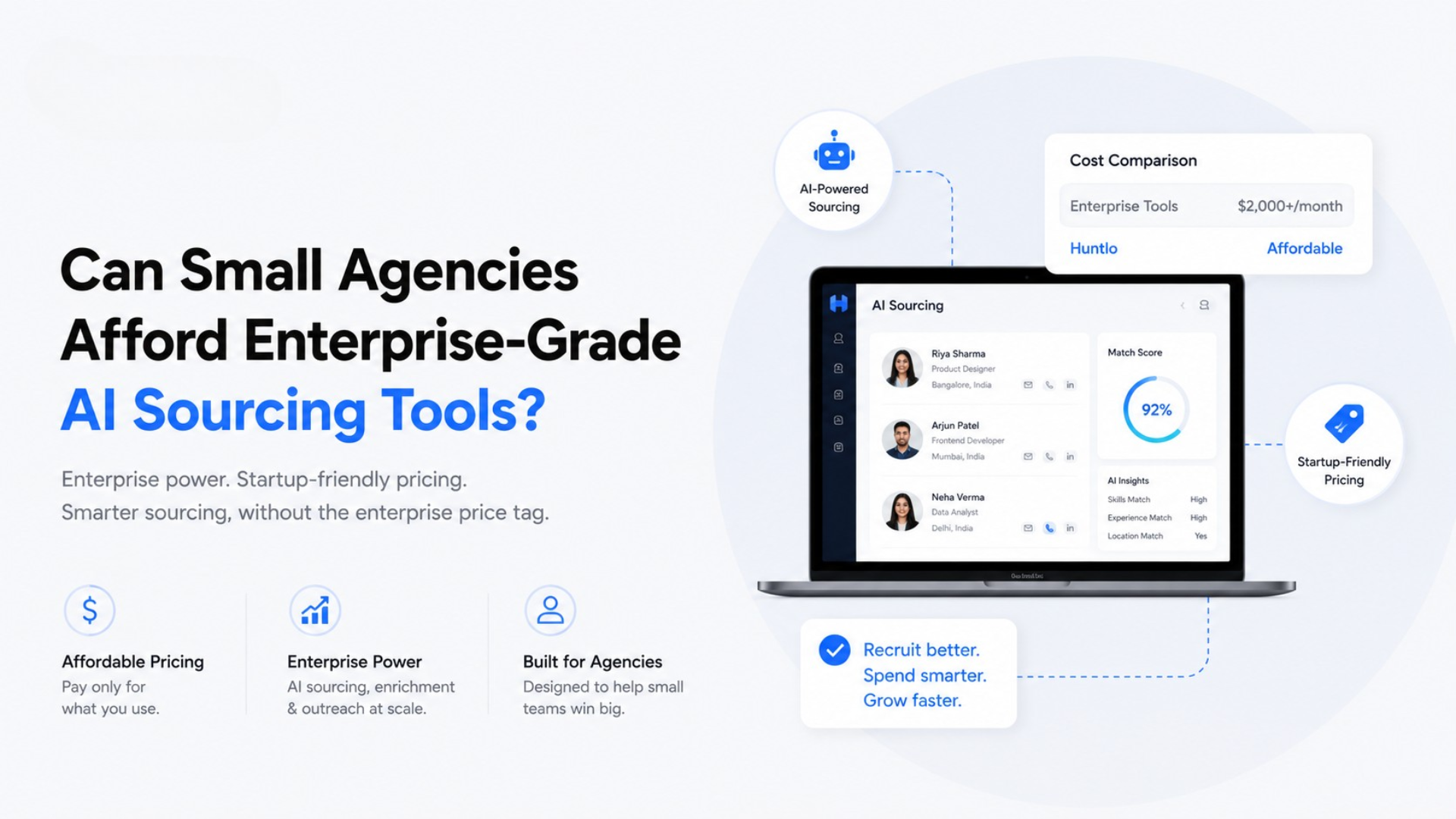
Small agencies can increasingly afford enterprise-grade AI sourcing capabilities, but they often cannot afford traditional enterprise software economics. The distinction matters because the features that once required large annual contracts are becoming available through smaller AI-native platforms, modular plans, usage-based pricing, and connected recruiting workflows.
The affordability question is therefore no longer simply about whether an agency can buy a famous enterprise platform.
The better question is whether the agency can access the sourcing capability it needs at a cost that improves placement economics.
A small agency may not need a complex talent-intelligence suite built for a multinational company.
It may need to describe a role in natural language, discover relevant passive candidates, identify verified contact routes, run personalized outreach, understand responses, and move interested candidates toward qualification.
If one system can reduce several hours of recruiter work across that process, the tool may be affordable even when the monthly subscription initially appears expensive.
The opposite can also be true.
A low-cost AI sourcing subscription may become expensive if candidate data is poor, contact information is inaccurate, recruiters still need several additional tools, or the software produces large lists without helping the agency create qualified conversations.
The real cost of AI sourcing is not the price shown on the pricing page.
It is the complete cost of turning a hiring requirement into a candidate who can realistically be placed.
Why Enterprise Recruiting Tools Have Traditionally Been Difficult for Small Agencies to Buy
Traditional enterprise recruiting software was built around enterprise buying behavior.
Large organizations often prefer annual agreements because they provide budget predictability. They may need centralized administration, advanced security controls, complex integrations, custom reporting, implementation support, and large numbers of user seats.
The software contract reflects these requirements.
A small agency may not need most of them.
The agency may have four recruiters.
It may work across a few specialist markets.
Its biggest problem may be finding qualified candidates quickly enough to submit them before competing agencies.
The business does not need a six-month technology transformation.
It needs better sourcing this week.
Traditional enterprise contracts can create several barriers.
The first is the annual commitment.
A small agency may be profitable but still prefer monthly flexibility because hiring demand changes. Losing one major client can affect the agency’s software budget much more dramatically than it would affect a large corporate talent-acquisition department.
The second barrier is seat-based pricing.
An agency may want every recruiter to use the system, but adding seats can quickly increase the annual cost.
The third is implementation.
Software that requires extensive configuration may consume the same recruiter time the agency is trying to save.
The fourth is feature mismatch.
A platform may include advanced workforce analytics, internal mobility, enterprise governance, and large-scale reporting. These can be valuable features for large employers, but a small agency may mainly need candidate discovery and engagement.
The fifth is software stacking.
The sourcing platform may solve only one part of the workflow. The agency still needs separate tools for contact enrichment, email sequencing, candidate relationship management, scheduling, screening, and reporting.
The result is that the visible sourcing subscription becomes only one part of the actual technology cost.
What Does “Enterprise-Grade” Actually Mean in AI Sourcing?
The phrase enterprise-grade is often used as a synonym for expensive.
That is not very useful.
A sourcing tool should not be considered enterprise-grade simply because it requires a sales call and an annual contract.
The more useful definition focuses on capability.
An enterprise-grade sourcing system should help recruiters search a broad candidate market. It should understand complex hiring requirements. It should surface passive professionals rather than only active applicants. It should support reliable candidate data, team collaboration, security, and a workflow that can operate consistently at meaningful volume.
AI adds another layer.
The system may allow recruiters to search using natural language rather than constructing long Boolean strings.
It may interpret transferable experience.
It may compare candidate evidence with role requirements.
It may help rank profiles.
It may identify why a candidate appears relevant.
It may support contact discovery and personalized engagement.
These capabilities were once concentrated inside expensive recruiting stacks.
They are increasingly available to smaller teams.
For example, SeekOut publishes a Recruit Core plan starting at $149 per month when billed annually or $179 month to month, while its larger team and enterprise offerings remain custom-priced. That pricing structure illustrates how capabilities associated with enterprise sourcing are increasingly being offered through entry points that smaller recruiting teams can at least evaluate without immediately entering a large enterprise contract.
This does not mean every small agency should buy the same tool.
It shows that the boundary between small-team software and enterprise sourcing technology is moving.
The Wrong Question Is “How Much Does the Tool Cost?”
Suppose an AI sourcing platform costs $500 per month.
One agency may consider that expensive.
Another may consider it extremely cheap.
The difference depends on what the software changes.
Imagine the first agency has two recruiters who mainly fill common roles from active applicants. The recruiters already receive enough qualified candidates through existing channels. They make only a few placements each month, and proactive sourcing is not a major bottleneck.
An expensive AI sourcing platform may add limited value.
Now imagine another agency recruits difficult technical roles.
A recruiter spends three hours every day searching for passive candidates, another hour finding contact information, and more time writing outreach.
If the AI system reduces this work significantly and helps the agency create one additional placement, the economics can change immediately.
The subscription price is the wrong unit of analysis.
The agency should calculate cost against recruiter capacity and placement outcomes.
How much recruiter time does the tool save?
How many relevant candidates does it produce?
How many additional conversations begin?
How many candidate submissions improve?
How many placements become possible?
How many other subscriptions can the agency remove?
The affordable tool is not always the cheapest tool.
It is the tool whose cost is lower than the value of the workflow improvement.
Small Agencies Should Calculate the Cost of Manual Sourcing
Manual sourcing feels free because the agency already pays the recruiter’s salary or commission.
It is not free.
Every hour spent constructing searches, opening profiles, checking relevance, finding contact information, copying data, and preparing outreach has an opportunity cost.
A recruiter who spends twenty hours each week on repetitive sourcing activity has less time for candidate conversations.
They have less time to understand client requirements.
They have less time to develop new business.
They have less time to manage active processes.
The agency should calculate the complete sourcing workload.
How many hours does each recruiter spend finding candidates?
How much time goes into contact research?
How much time goes into writing first messages?
How much time is spent moving candidate information between systems?
How much time is lost checking whether someone replied?
The answer is often larger than the software budget.
This is why Huntlo’s guide to reducing recruiter burnout with workflow automation matters for small agencies. Repetitive workflow work does not only create fatigue. It limits the number of searches and client relationships each recruiter can handle.
An AI sourcing tool becomes more affordable when it removes expensive manual work.
Agency Economics Are Different From Corporate Recruiting Economics
A corporate recruiting team usually evaluates technology against hiring efficiency.
A staffing agency evaluates technology against revenue.
This creates an important difference.
A successful placement may generate a fee worth many months of software cost.
For permanent recruitment, the agency may earn a percentage of the candidate’s first-year salary.
For contract staffing, the economics may depend on ongoing margin.
For retained search, the payment model may be different again.
The agency should therefore connect technology investment with placement probability.
Suppose a tool costs several thousand dollars per year.
If it helps the agency make one additional valuable placement, the investment may already be justified.
This does not mean agencies should accept every vendor claim about productivity.
The agency needs evidence from its own workflow.
A tool may find more candidates without finding better candidates.
It may generate more outreach without creating more replies.
It may create more replies without producing qualified submissions.
The ROI chain should remain visible.
Sourcing should create relevant candidates.
Relevant candidates should create conversations.
Conversations should create qualified submissions.
Submissions should create interviews.
Interviews should contribute to placements.
The technology needs to improve this chain.
Why Per-Seat Pricing Can Punish Small Agencies
Seat-based pricing appears simple.
The company pays for each recruiter who uses the platform.
The problem is that small agencies often need broad adoption.
If only one recruiter has access to the AI sourcing tool, that person can become the internal sourcing department.
Every other recruiter sends requests.
The user runs searches.
Candidate lists are distributed.
The workflow becomes centralized around the software license rather than the client requirement.
This can create a new bottleneck.
The agency may therefore need to compare the cost of one premium seat with the value of several lower-cost seats.
A tool that costs more per account but supports the whole team may create better operational value.
Usage-based pricing can solve some of this problem.
The agency pays according to searches, enrichments, outreach volume, AI actions, or another activity.
This can work well when demand changes.
It can also create unpredictable costs.
The best pricing model depends on how the agency recruits.
A high-volume staffing firm may prefer predictable capacity.
A boutique executive-search agency may prefer paying for lower volume but deeper candidate work.
There is no universally affordable pricing model.
There is only a pricing model that matches the agency’s workflow.
Annual Contracts Create a Different Risk for Small Firms
Large companies can absorb software mistakes.
Small agencies feel them immediately.
An enterprise may buy a sourcing platform and discover that adoption is weak. The contract becomes an uncomfortable budget line.
A five-person agency may experience the same mistake as a meaningful cash-flow problem.
This is why flexibility has economic value.
Monthly pricing, free trials, pilot periods, and smaller initial commitments can make AI sourcing more accessible even when the monthly rate is higher.
The agency is buying the ability to learn.
Does the candidate database cover the roles the agency recruits?
Does AI search understand the niche?
Are contact details accurate?
Do recruiters actually use the system?
Does the workflow create more candidate conversations?
A long contract should ideally follow evidence.
It should not be the price of discovering whether the tool works.
Small agencies should be particularly cautious when vendors require large commitments before allowing realistic testing with actual roles.
The Cost of the Sourcing Tool May Be Only the Beginning
Recruiting software is often evaluated one subscription at a time.
The agency buys a sourcing platform.
Then it needs contact enrichment.
Then it needs email sequencing.
Then it needs a CRM.
Then it needs scheduling.
Then it needs screening.
Each product may appear affordable individually.
The stack becomes expensive collectively.
The agency also pays an integration tax.
Recruiters export profiles.
They import contacts.
They copy notes.
They check multiple dashboards.
They update candidate stages manually.
The software cost and the workflow cost grow together.
This is why small agencies should compare tool stacks with connected systems rather than comparing sourcing features alone.
A platform that costs more but replaces three subscriptions may be cheaper.
A system that costs less but creates several manual handoffs may be more expensive.
Huntlo’s guide to what an applicant tracking system is versus a sourcing tool explains why different recruiting systems solve different parts of the process.
The agency needs to understand whether it is buying a feature or improving a workflow.
Candidate Database Size Is Not the Same as Agency Value
Sourcing vendors often promote the number of candidate profiles available.
Hundreds of millions.
Sometimes more.
Large coverage sounds enterprise-grade.
The agency should ask a more specific question.
Does the platform have strong coverage for the people we actually recruit?
A specialist cybersecurity agency does not need the largest possible global candidate database.
It needs deep coverage of cybersecurity professionals in the markets its clients hire from.
A healthcare staffing agency needs different data.
A local sales-recruitment firm needs different data again.
The useful test is role-based.
The agency should take several difficult searches from the previous six months and run them through the platform.
Does the system find candidates the recruiters missed?
Does it understand adjacent titles?
Does it surface professionals outside obvious search results?
Are the profiles current?
Can the recruiter explain why the candidates are relevant?
A billion profiles create no value if the agency still cannot fill its hardest role.
AI Search Can Reduce the Skill Gap Between Recruiters
Traditional candidate sourcing rewards search expertise.
Experienced sourcers know how titles vary.
They understand Boolean logic.
They know which companies produce relevant talent.
They recognize adjacent experience.
Small agencies may not have dedicated sourcing specialists.
Every recruiter may need to find their own candidates.
AI search can reduce some of this skill gap.
A recruiter can describe the hiring requirement in natural language.
The system can interpret the request and help identify relevant profiles.
This does not eliminate sourcing expertise.
The recruiter still needs to understand the role.
They need to recognize strong candidates.
They need to refine the search.
The difference is that advanced search becomes easier to begin.
Huntlo’s guide to Boolean search in recruiting and why AI tools are replacing parts of it explains why natural-language candidate discovery can make sophisticated sourcing more accessible.
For a small agency, this accessibility has economic value.
The business does not need to hire a dedicated sourcing expert for every desk.
AI Matching Can Make Small Teams More Selective
One of the biggest risks in AI sourcing is candidate volume.
The system can find people quickly.
The recruiter receives hundreds of profiles.
Now someone needs to review them.
The agency has replaced a search problem with a review problem.
Enterprise-grade AI should help prioritize.
The system should compare candidate evidence with the hiring requirement and explain why certain profiles appear relevant.
This allows a smaller team to focus on the strongest possibilities.
Huntlo’s guide to how AI candidate matching actually works explains why matching should use several professional signals rather than simple keyword overlap.
This capability is especially important for agencies.
Speed matters.
The first agency to submit a strong candidate may gain an advantage.
The recruiter does not need the largest possible list.
They need a short list worth acting on.
Contact Enrichment Can Change the Affordability Calculation
Finding a candidate is only one stage.
The agency still needs to reach them.
Traditional workflows often require another subscription for contact discovery.
The recruiter copies the candidate’s name and employer into the enrichment tool.
Possible email addresses are returned.
The recruiter verifies them.
The candidate is moved into outreach.
This creates more cost and more manual work.
An AI sourcing platform that includes or connects contact discovery can improve the economics.
The agency should still evaluate data quality carefully.
A large number of email addresses is not automatically valuable.
Incorrect contacts create bounces.
Outdated work emails waste time.
Wrong identity matches damage trust.
Huntlo’s guide to how AI recruiting tools find verified contact details explains the difference between discovering a possible address and establishing stronger confidence that the contact route is usable.
For small agencies, every failed contact matters.
The recruiter has limited time and a limited candidate pool.
Contact quality can be more important than maximum coverage.
Personalized Outreach Can Help Agencies Compete With Larger Brands
Large employers have one natural advantage in candidate outreach.
Candidates may already know the company.
A small staffing agency often needs to establish credibility quickly.
The candidate may not recognize the recruiter or agency.
The message needs to explain why the contact is relevant.
AI personalization can help.
The system can identify the connection between the candidate’s experience and the role.
The recruiter can use that evidence to create a more specific message.
This allows a small agency to run more thoughtful outbound recruiting without requiring hours of manual profile research.
Huntlo’s guide to whether candidates respond better to AI-personalized outreach explains why the benefit comes from relevance rather than simply adding candidate details.
This distinction matters for agency economics.
Sending more messages is cheap.
Creating more qualified candidate conversations is valuable.
Small Agencies Should Avoid Paying for AI That Only Writes Messages
Generative AI has made text creation inexpensive.
A recruiting platform should not justify a large premium simply because it can generate outreach messages.
The stronger value appears when AI connects several parts of the workflow.
It understands the hiring requirement.
It helps find relevant candidates.
It identifies why they match.
It supports contact discovery.
It creates outreach around the candidate-role connection.
It understands candidate responses.
It helps move interested people toward qualification.
The closer the technology gets to this workflow, the easier it becomes to evaluate business value.
A standalone message generator may save a few minutes.
A connected sourcing and engagement system can change recruiter capacity.
Small agencies should be careful not to pay enterprise prices for AI features that have become commodities.
The value should come from data, workflow, accuracy, and execution.
Can Free AI Tools Replace Enterprise Sourcing Software?
Free AI tools can help with parts of recruiting.
They can rewrite job descriptions.
They can create Boolean searches.
They can draft outreach.
They can summarize notes.
They may help recruiters think through target companies or adjacent titles.
These are useful capabilities.
They do not automatically replace a sourcing platform.
A general AI assistant may not have access to a current professional candidate database.
It may not provide verified candidate identity.
It may not find contact information.
It may not maintain candidate workflow state.
It may not understand who has already been contacted.
The agency can build a low-cost process using several tools.
The hidden cost is orchestration.
Someone needs to move the information.
For a solo recruiter, this may be acceptable.
For a growing agency, the manual workflow can become the bottleneck.
The decision should therefore depend on volume.
A recruiter making a few highly targeted searches may succeed with a lightweight stack.
An agency running many concurrent searches may need a more connected system.
The Cheapest Tool Can Become Expensive Through Poor Adoption
A platform creates no value when recruiters do not use it.
This sounds obvious.
It is one of the most common problems in recruiting technology.
The agency owner buys software.
One recruiter becomes enthusiastic.
Another continues using the old workflow.
A third logs in once.
The agency pays for the tool without changing how recruiting happens.
Small agencies should evaluate usability aggressively.
How quickly can a recruiter run the first useful search?
Does the system fit the existing workflow?
Can the team understand why candidates are recommended?
Does the tool require constant administration?
Does it create another dashboard recruiters need to remember?
AI sourcing should reduce work.
If the system requires a specialist operator, a small agency may struggle to achieve value.
Ease of adoption is not a minor product feature.
It is part of affordability.
Enterprise Features Small Agencies May Not Need
Small agencies sometimes overbuy because enterprise feature lists look impressive.
Advanced workforce planning may not matter.
Internal mobility may not matter.
Complex global permissions may not matter.
Deep corporate analytics may not matter.
Custom implementation services may not matter.
The agency should separate capability from complexity.
It may need excellent candidate search.
It may need passive candidate coverage.
It may need reliable enrichment.
It may need personalized outreach.
It may need team collaboration.
It may need basic security and privacy controls.
Everything else should justify its cost.
Buying fewer features can be a strategic advantage.
Small agencies can change workflows faster than large enterprises.
They do not need to reproduce the enterprise recruiting stack.
They need the capabilities that improve placements.
When a Small Agency Should Not Buy an AI Sourcing Tool
AI sourcing is not automatically a good investment.
An agency should not buy advanced sourcing software if it has no clear sourcing problem.
If most placements come from a strong existing database, referrals, and inbound applicants, the tool may create unnecessary cost.
The agency should also avoid buying when recruiters do not have enough open roles to use the capacity.
A powerful sourcing platform with no client demand will not create revenue by itself.
Poorly defined job requirements are another warning sign.
AI can search faster.
It cannot rescue a client brief that nobody understands.
The agency may also need to improve candidate engagement before increasing sourcing volume.
Finding more people does not help when outreach is weak.
The technology should address the actual bottleneck.
Sometimes that bottleneck is sourcing.
Sometimes it is client acquisition.
Sometimes it is recruiter follow-up.
Sometimes it is screening.
The agency should diagnose before buying.
When Enterprise-Grade AI Sourcing Becomes Easy to Justify
The investment becomes easier to justify when recruiters spend large amounts of time on manual candidate discovery.
It also becomes valuable when the agency works on hard-to-fill roles.
Passive candidate sourcing creates another strong use case.
If the right people rarely apply, proactive discovery becomes essential.
Multiple concurrent searches can strengthen the case because saved recruiter time compounds across roles.
The economics also improve when the system replaces several tools.
An agency paying separately for sourcing, enrichment, outreach, and workflow automation may benefit from consolidation.
The strongest case appears when the technology contributes directly to placement capacity.
If each recruiter can manage more quality searches without reducing candidate experience, the agency can grow without increasing headcount at the same rate.
That is a more meaningful form of scalability than simply sending more messages.
How Small Agencies Should Run a Real AI Sourcing Pilot
The agency should begin with real roles.
Not easy roles created for the demo.
Not hypothetical searches.
Use the difficult vacancies the team is currently struggling to fill.
The pilot should test several parts of the workflow.
Can the system understand the requirement?
Does it find relevant candidates?
Does it surface people the recruiters missed?
How much manual review is required?
Are contact details usable?
Does personalized outreach create responses?
How much recruiter time is saved?
The agency should compare the new process with the old one.
The objective is not to prove that the AI works.
The objective is to discover whether it works for this agency.
A successful demo can show impressive features.
A successful pilot shows improved recruiting economics.
How to Calculate ROI Without Believing Vendor Hype
The agency can begin with recruiter time.
Estimate the number of sourcing hours saved each month.
Then examine software consolidation.
Which existing subscriptions could be reduced or removed?
Next, examine candidate outcomes.
Did the tool increase the number of relevant candidates found?
Did positive response rates improve?
Did more candidates reach screening?
Did submissions improve?
Did placements increase?
The agency should also measure errors.
How many irrelevant profiles appeared?
How many contact details were wrong?
How often did recruiters need to correct AI-generated information?
The cost side should include more than the subscription.
Include onboarding.
Include implementation.
Include additional usage charges.
Include other tools that remain necessary.
Include the cost of unused seats.
The value side should remain conservative.
A vendor may claim that recruiters become ten times faster.
The agency does not need that claim.
It needs to know whether the software creates enough measurable improvement to justify its own cost.
Why AI-Native Tools Are Changing the Market
Traditional recruiting platforms often added AI to existing software.
AI-native platforms can begin from a different assumption.
The recruiter should be able to describe an objective.
The system should help execute more of the workflow.
This can reduce the need for complex interfaces and specialized search knowledge.
It can also change pricing.
A smaller team may gain access to sophisticated search without buying a large implementation package.
The technology market is already showing this shift through lower-cost entry plans, modular capabilities, and more accessible natural-language search.
The important change is not that every enterprise platform has become cheap.
It is that enterprise-level capability is no longer available only through traditional enterprise purchasing.
Small agencies have more choices.
That makes evaluation more important.
How an AI Hiring OS Changes the Cost Equation
A sourcing tool solves candidate discovery.
An AI Hiring OS attempts to connect discovery with what happens next.
The system can help interpret the hiring requirement.
AI can find relevant candidates.
Candidate matching can help prioritize them.
Contact information can support engagement.
Personalized outreach can begin.
Responses can influence the workflow.
Interested candidates can move toward screening.
Qualified candidates can move toward interviews.
Huntlo’s guide to how an AI Hiring OS connects sourcing, screening, and interviews explains why the value appears in the handoffs between stages.
For a small agency, these handoffs are expensive.
Large companies can assign different specialists to sourcing, coordination, operations, and recruiting.
A small agency may have one recruiter doing everything.
Connected automation can therefore create disproportionate value for smaller teams.
The technology is not replacing a large operations department.
It is giving the agency capabilities it may never have been able to hire.
Where Huntlo Fits for Small Recruiting Agencies
Huntlo approaches AI recruiting as a connected workflow rather than a collection of isolated features.
This matters for small agencies because software fragmentation creates both direct and hidden costs.
The recruiting process can begin with the hiring requirement.
AI can help discover relevant professionals.
Candidate matching can help explain why certain profiles deserve attention.
Available contact information can support engagement through channels including email and WhatsApp.
AI-personalized outreach can help the agency explain the candidate-role connection.
Responses can influence what happens next.
Interested candidates can move toward qualification.
AI voice capabilities can support initial screening.
Qualified candidates can move toward interview scheduling.
The objective is not to give a small agency the most complicated enterprise recruiting stack possible.
The objective is to provide the workflow capability required to compete.
A small agency does not win because it owns more software.
It wins because it finds strong candidates quickly, creates relevant conversations, submits qualified people, and helps clients hire.
Huntlo’s AI Hiring OS model is designed around that movement.
For agencies evaluating the platform, the right question is not whether Huntlo has the longest enterprise feature list.
The question is whether the connected workflow reduces enough sourcing, outreach, screening, and coordination work to improve recruiter capacity and placement economics.
That is the affordability test that matters.
The Real Competitive Advantage for Small Agencies
Large recruiting firms have more recruiters.
They may have stronger brands.
They may have larger candidate databases.
They may have bigger technology budgets.
Small agencies have a different advantage.
They can move faster.
A recruiter can understand a client requirement and change the search immediately.
The agency can experiment with new workflows without a long implementation process.
Decisions can happen quickly.
AI sourcing can strengthen this advantage.
The small agency gains more discovery capacity without becoming a large organization.
It can search wider markets.
It can research candidates faster.
It can create more relevant outreach.
It can reduce repetitive administration.
The objective should not be to copy the technology stack of a global staffing company.
The objective should be to use AI to make a small team unusually productive.
Common Mistakes Small Agencies Make When Buying AI Sourcing Software
The first mistake is choosing the tool with the largest candidate database without testing the agency’s actual niche.
The second is comparing monthly prices without calculating recruiter time.
The third is buying a sourcing platform while ignoring the cost of enrichment, outreach, and other required tools.
The fourth is accepting a long annual contract before running realistic searches.
The fifth is paying for enterprise features the agency will never use.
The sixth is assuming that more candidate profiles automatically create more placements.
The seventh is buying AI because competitors are buying AI.
The eighth is failing to measure positive candidate responses and qualified submissions.
The ninth is allowing one software seat to become a team bottleneck.
The tenth is ignoring recruiter adoption.
The final mistake is automating the wrong problem.
Technology should solve the agency’s real constraint.
Conclusion: Small Agencies Can Afford Enterprise Capability Without Buying an Enterprise Stack
Small recruiting agencies have historically faced a technology disadvantage.
The strongest sourcing systems were expensive.
Contracts were long.
Pricing was built around seats.
Implementation was designed for large teams.
The software stack expanded one tool at a time.
AI is changing the economics.
Natural-language candidate search can reduce dependence on complex Boolean expertise.
AI matching can help smaller teams review candidates faster.
Contact enrichment can reduce manual research.
Personalized outreach can help agencies create more relevant conversations.
Connected workflows can reduce the need to move candidates between several systems.
This does not mean every AI sourcing tool is affordable.
A small agency can still overpay.
It can buy too many features.
It can enter the wrong contract.
It can pay for poor data.
It can automate low-quality outreach.
It can buy software that recruiters never use.
The affordability question needs to remain connected with business outcomes.
How much manual work disappears?
How many relevant candidates are found?
How many candidate conversations improve?
How many other tools become unnecessary?
How many additional searches can each recruiter handle?
Does the technology contribute to more placements?
If the answer is clear, an AI sourcing tool costing hundreds of dollars per month may be far more affordable than a manual workflow.
If the answer is unclear, even a cheap subscription can be expensive.
Small agencies do not need enterprise software for the sake of owning enterprise software.
They need enterprise-grade capability where it changes recruiting outcomes.
The strongest technology strategy is therefore not to build the largest stack.
It is to find the smallest set of connected capabilities that helps the agency move from a difficult hiring requirement to a qualified candidate faster.
That is how AI can change the competitive position of small recruiting teams.
The agency remains small.
Its sourcing capacity does not have to.
Frequently Asked Questions
Can small recruiting agencies afford AI sourcing tools?
Yes. Many AI sourcing capabilities are increasingly available through lower-cost entry plans, smaller-team subscriptions, modular products, and usage-based pricing. Affordability still depends on hiring volume, recruiter time saved, software consolidation, and placement outcomes.
How much should a small agency spend on recruiting software?
There is no universal budget. The agency should compare software cost with recruiter time, existing subscriptions, candidate quality, response rates, qualified submissions, and placement revenue.
Are enterprise AI sourcing tools worth the cost?
They can be when the agency recruits difficult roles, depends on passive candidates, runs multiple concurrent searches, or spends significant recruiter time on manual sourcing.
Is AI sourcing cheaper than hiring another recruiter?
Sometimes, but the comparison depends on the workflow. AI can increase the capacity of existing recruiters, but it does not replace every part of recruiting, relationship management, client work, or human judgment.
Can free AI tools replace paid sourcing software?
Free AI tools can help with search strategy, outreach writing, and research, but they may not provide current candidate databases, contact enrichment, workflow state, team collaboration, or integrated recruiting execution.
Should a small agency choose monthly or annual pricing?
Monthly pricing provides more flexibility for testing and changing demand. Annual pricing may reduce the effective monthly cost when the agency already has evidence that the tool performs well.
What should an agency test before buying an AI sourcing tool?
The agency should test real difficult roles, candidate relevance, niche-market coverage, contact accuracy, recruiter usability, outreach performance, workflow integration, and measurable time savings.
Does a larger candidate database mean a better sourcing tool?
No. The most useful database is the one with strong, current coverage of the talent markets the agency actually recruits.
Can AI sourcing help boutique recruitment agencies?
Yes. Boutique agencies can use AI to expand candidate discovery, reduce manual research, and create more relevant outreach while keeping human attention focused on relationships and specialist judgment.
What is the biggest hidden cost of recruiting software?
The biggest hidden costs often include poor adoption, overlapping subscriptions, manual data movement, unused seats, inaccurate candidate data, and long contracts for tools that do not improve placements.
Related Topics
Learn which platforms are designed around the needs of agency recruiting teams in Best AI Recruiting Tools for Staffing Agencies in 2026.
Understand how AI can automate repetitive candidate discovery in What Is Candidate Sourcing Automation?.
Explore how AI evaluates candidate relevance before recruiters begin outreach in How Does AI Candidate Matching Actually Work?.
See why AI search is changing traditional sourcing methods in What Is Boolean Search in Recruiting (And Why AI Tools Are Replacing It)?.