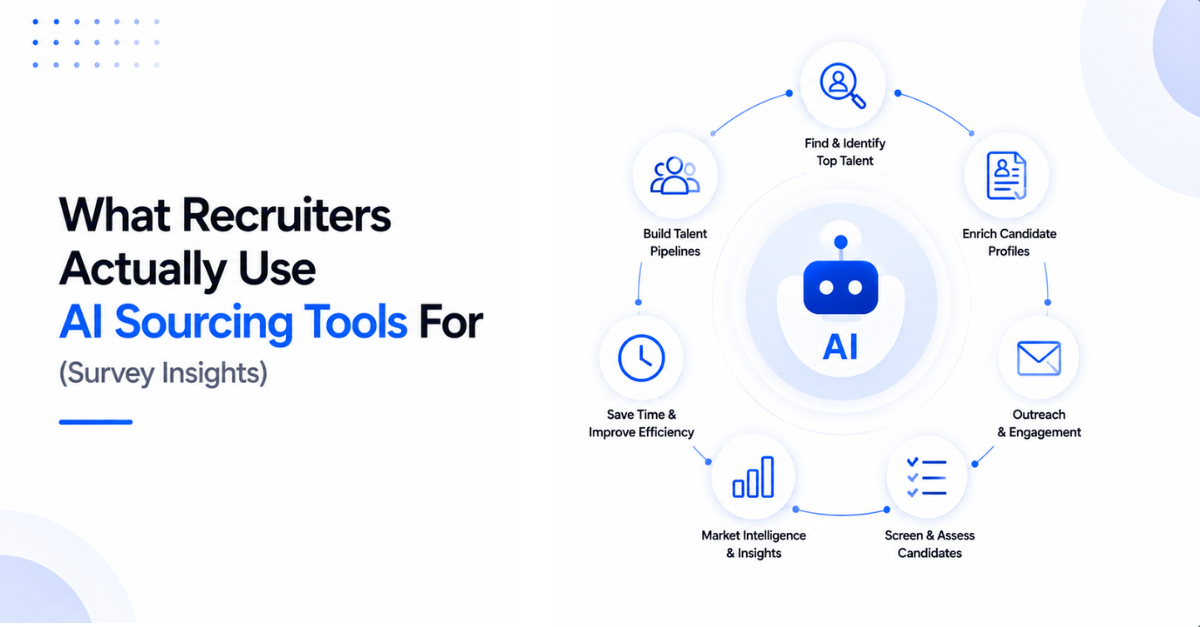
AI sourcing tools are most commonly used for candidate discovery, passive talent identification, and recruiter productivity. However, many recruiting teams quickly expand their use of AI into candidate engagement, follow-ups, qualification, scheduling, and workflow automation. The biggest value often comes not from finding candidates, but from reducing manual recruiting work across the hiring process.
Recruiting technology adoption has accelerated rapidly over the last few years. Yet much of the discussion around AI sourcing tools still focuses on vendor capabilities rather than recruiter behavior.
Understanding how recruiters actually use AI provides a more realistic picture of where automation creates value today—and where recruiting technology is heading next.
Introduction
The conversation around AI in recruiting often starts with sourcing.
Vendors promise:
Better candidate matching
Faster candidate discovery
Larger talent pools
More accurate searches
These capabilities matter. But they only tell part of the story.
Once recruiters begin using AI sourcing tools, many discover that sourcing is only one component of the recruiting process. The real bottlenecks often appear elsewhere:
Candidate outreach
Follow-up management
Candidate screening
Interview coordination
Administrative work
Recruiting operations
As a result, recruiter adoption patterns are evolving.
Teams that initially adopt AI for candidate discovery frequently expand automation into broader recruiting workflows.
This article explores the most common ways recruiters use AI sourcing tools today, what tasks remain human-led, and what these usage patterns reveal about the future of recruiting automation.
The Growing Adoption of AI in Recruiting
AI has moved from an experimental technology to a practical recruiting tool.
Why Are Recruitors Embracing AI?
Recruiters face growing pressure to:
Fill roles faster
Manage larger hiring volumes
Improve candidate experiences
Increase recruiter productivity
Reduce administrative workload
At the same time, hiring teams are often expected to achieve these goals without increasing headcount.
AI helps address these challenges by automating repetitive and time-consuming recruiting activities.
Key Adoption Trends
Across staffing agencies, enterprise talent acquisition teams, startups, and GCC hiring teams, recruiters increasingly use AI to:
Source candidates
Manage outreach
Track responses
Screen applicants
Coordinate interviews
Maintain talent pipelines
The result is higher recruiter capacity and improved hiring efficiency.
Survey Finding #1 — Candidate Discovery Remains the Top Use Case
For most recruiters, sourcing remains the entry point into AI adoption.
Talent Search
AI sourcing tools help recruiters:
Search talent pools faster
Identify qualified candidates
Surface hidden talent
Improve search precision
Instead of manually reviewing thousands of profiles, recruiters can focus on evaluating highly relevant candidates.
Passive Candidate Identification
One of the biggest advantages of AI sourcing tools is their ability to uncover passive candidates.
Recruiters frequently use AI to:
Find professionals not actively job hunting
Identify niche skill combinations
Expand candidate pools
Discover overlooked talent
Candidate Discovery Use Cases
Recruiter Benefit
Talent Search
Faster sourcing
Candidate Matching
Better relevance
Passive Candidate Discovery
Larger talent pools
Talent Intelligence
Improved decision-making
Search Automation
Reduced manual effort
Despite rapid advancements elsewhere, candidate discovery remains the most common AI recruiting use case.
Survey Finding #2 — Recruiters Use AI to Save Time
When recruiters discuss AI adoption, productivity consistently emerges as a major motivation.
Reducing Manual Sourcing
Traditional sourcing often requires:
Multiple databases
Repetitive searches
Manual profile reviews
Spreadsheet tracking
AI significantly reduces these activities.
Productivity Improvements
Recruiters increasingly use AI to:
Generate candidate lists
Organize sourcing workflows
Prioritize prospects
Eliminate repetitive tasks
The objective isn't simply finding more candidates.
It's enabling recruiters to spend more time on activities that require judgment and relationship-building.
Survey Finding #3 — Candidate Engagement Is Becoming a Major Use Case
Many recruiting teams discover that candidate engagement consumes more time than sourcing itself.
Outreach Automation
Recruiters use AI to support:
Personalized outreach
Message generation
Campaign management
Multi-channel communication
Automation improves consistency while reducing manual effort.
Follow-Up Automation
Following up with candidates is one of recruiting's most repetitive tasks.
Recruiters increasingly automate:
Reminder messages
Re-engagement campaigns
Candidate nurturing
Response tracking
See How Leading Recruiting Teams Automate Candidate Engagement, Qualification, and Follow-Ups With Huntlo
Modern recruiting teams increasingly recognize that candidate engagement often creates more hiring impact than sourcing volume alone.
Survey Finding #4 — Qualification Is Emerging as a Priority
Candidate sourcing generates opportunities.
Qualification determines which opportunities move forward.
Screening Automation
Recruiters increasingly use AI to:
Collect candidate information
Verify qualifications
Conduct preliminary screening
Assess role fit
This helps reduce screening workload while maintaining consistency.
Candidate Assessment
AI is frequently used to support:
Skills evaluation
Experience verification
Candidate ranking
Qualification workflows
Importantly, recruiters typically use AI to assist—not replace—qualification decisions.
Human review remains essential for final evaluation.
Survey Finding #5 — Administrative Work Is a Bigger Problem Than Sourcing
One of the most interesting adoption trends is where recruiters spend their time after sourcing.
Scheduling
Interview coordination remains a major administrative burden.
Recruiters use automation to:
Coordinate availability
Schedule interviews
Send reminders
Manage confirmations
Coordination
Recruiting involves multiple stakeholders:
Candidates
Hiring managers
Interviewers
Recruiters
AI helps simplify communication across these groups.
Status Updates
Recruiters frequently spend hours updating:
Candidate status
Pipeline progression
Hiring manager reports
Internal systems
Automation increasingly reduces this workload.
What Recruiters Still Prefer Humans to Handle
Despite growing AI adoption, recruiters continue to value human judgment.
Relationship Building
Strong candidate relationships remain difficult to automate.
Recruiters continue to lead:
Trust-building
Candidate persuasion
Career conversations
Offer negotiations
Final Decision-Making
Hiring decisions typically require:
Context
Nuance
Organizational understanding
AI can provide insights, but final decisions remain human-led.
Stakeholder Management
Recruiters continue to play a critical role in:
Managing hiring managers
Aligning stakeholders
Navigating organizational priorities
Influencing hiring outcomes
These activities remain uniquely human.
What These Insights Reveal About the Future of Recruiting
The most important trend isn't AI adoption itself.
It's where adoption is expanding.
From Sourcing Automation to Workflow Automation
Recruiters often begin with sourcing automation.
They quickly discover opportunities to automate:
Engagement
Qualification
Follow-ups
Scheduling
Coordination
This progression reflects a broader shift in recruiting technology.
Increasing Recruiter Capacity
The goal is no longer simply finding more candidates.
The goal is increasing recruiter capacity.
Recruiters want to:
Handle more requisitions
Reduce manual work
Improve candidate experiences
Accelerate hiring outcomes
Workflow automation plays a critical role in achieving these goals.
AI Sourcing Tools vs Agentic AI Recruiting Infrastructure
The evolution of recruiter behavior highlights an important distinction.
AI Sourcing Tools
Primarily focus on:
Candidate discovery
Search automation
Talent intelligence
Candidate matching
Agentic AI Recruiting Infrastructure
Extends automation into:
Candidate engagement
Qualification
Follow-ups
Scheduling
Workflow execution
Recruiting operations
Discover How Huntlo Helps Recruiters Automate the Work That Happens After Sourcing
The next phase of recruiting automation focuses less on finding candidates and more on moving candidates efficiently through the hiring process.
Key Takeaways for Recruiting Leaders
Where AI Creates Value Today
Recruiters most commonly use AI for:
Candidate discovery
Passive candidate sourcing
Outreach automation
Follow-up management
Screening support
Scheduling coordination
Administrative efficiency
Learn How Agentic AI Recruiting Infrastructure Increases Recruiter Capacity Without Increasing Headcount
Organizations that automate recruiting workflows can often achieve greater hiring efficiency while allowing recruiters to focus on high-value human interactions.
Conclusion
The common assumption is that recruiters use AI primarily for sourcing.
The reality is more nuanced.
While candidate discovery remains the most common starting point, many recruiters quickly expand AI adoption into:
Engagement
Qualification
Follow-ups
Scheduling
Workflow management
This shift reflects a broader transformation in recruiting technology.
The future of AI recruiting isn't simply helping recruiters find candidates.
It's helping recruiters move candidates through the hiring process with less manual effort and greater efficiency.
As recruiting automation evolves, the greatest opportunities may lie not in sourcing itself, but in everything that happens afterward.
Frequently Asked Questions
How do recruiters use AI sourcing tools?
Recruiters primarily use AI sourcing tools for candidate discovery, passive talent identification, candidate matching, and search automation. Many teams also expand usage into engagement and workflow automation.
What recruiting tasks are most commonly automated?
Commonly automated tasks include sourcing, outreach, follow-ups, scheduling, candidate tracking, and administrative coordination.
Do recruiters trust AI recruiting software?
Most recruiters use AI as a support tool rather than a replacement for decision-making. Human judgment remains critical for hiring decisions and relationship management.
Can AI replace recruiters?
No. AI can automate repetitive tasks, but relationship-building, stakeholder management, candidate assessment, and hiring decisions still require human expertise.
What are the biggest benefits of AI sourcing?
The primary benefits include faster candidate discovery, improved recruiter productivity, reduced administrative workload, and increased recruiter capacity.