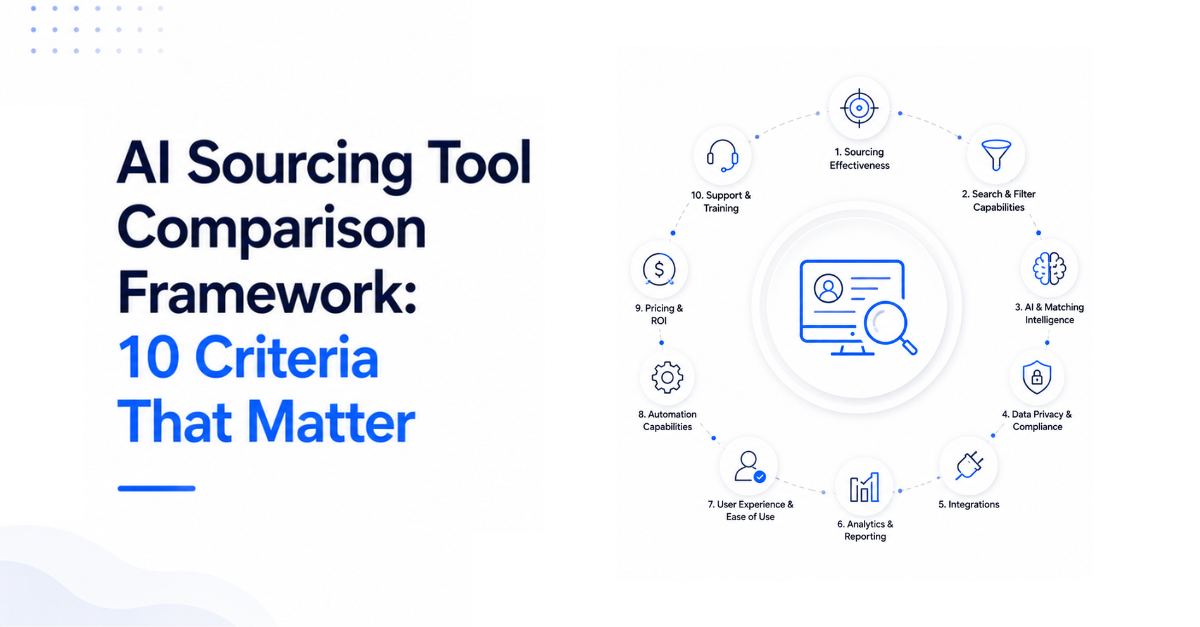
Choosing an AI sourcing tool is no longer as simple as comparing candidate databases or search filters. While sourcing capabilities remain important, modern recruiting teams should also evaluate candidate engagement, workflow automation, recruiter productivity, and hiring outcomes. The best sourcing platform is not necessarily the one that finds the most candidates—it's the one that contributes most to successful hires.
Recruiting technology buyers face a common challenge.
Almost every AI sourcing vendor claims to offer:
Better candidate matching
Faster sourcing
Larger talent pools
AI-powered recruiting workflows
At first glance, many platforms appear remarkably similar.
As a result, recruiters often compare sourcing tools using feature checklists alone.
This is where many buying decisions go wrong.
The recruiting technology market has evolved beyond candidate discovery. Today's recruiting teams are under pressure to improve hiring velocity, increase recruiter capacity, reduce administrative work, and improve candidate conversion rates.
Those outcomes require more than sourcing.
This guide provides a practical framework for comparing AI sourcing tools based on what actually matters: recruiting performance.
Why Most Recruiters Compare AI Sourcing Tools Incorrectly
Many recruiting software evaluations focus on features rather than outcomes.
Feature-Driven Evaluations
Traditional comparisons often focus on:
Candidate database size
Search filters
Boolean capabilities
AI matching features
Talent intelligence data
While these factors matter, they don't necessarily translate into better hiring results.
The Problem With Vendor Comparisons
When every platform claims:
Millions of candidate profiles
AI-powered matching
Automated sourcing
Differentiation becomes difficult.
The result is that recruiters frequently compare capabilities that have become increasingly commoditized while ignoring the factors that have the biggest impact on hiring success.
The better question is:
Which platform improves recruiter productivity and hiring outcomes?
Criterion #1 — Candidate Discovery Quality
Candidate discovery remains the foundation of sourcing software.
However, quantity should not be confused with quality.
Search Accuracy
Evaluate how effectively the platform surfaces relevant candidates.
Questions to ask:
Are search results precise?
Does the platform understand role context?
Does it identify transferable skills?
Candidate Relevance
The best sourcing tools prioritize quality over volume.
Look for platforms that consistently surface candidates who align with actual hiring requirements rather than generating large volumes of loosely related profiles.
Criterion #2 — Data Coverage and Freshness
Candidate databases are only valuable when the information remains accurate.
Candidate Database Quality
Evaluate:
Profile completeness
Contact information availability
Geographic coverage
Industry specialization
Profile Accuracy
Outdated candidate data creates recruiter frustration and reduces productivity.
Questions to evaluate:
How frequently is data refreshed?
How accurate are contact details?
How current are employment records?
Evaluation Factor
Why It Matters
Data Freshness
Improves outreach effectiveness
Contact Accuracy
Reduces wasted effort
Profile Completeness
Improves candidate evaluation
Talent Coverage
Expands sourcing opportunities
Criterion #3 — AI Matching Accuracy
Most vendors claim superior matching capabilities.
Few explain how matching actually works.
Skill Matching
Strong matching systems evaluate:
Technical skills
Functional expertise
Experience relevance
Career progression
Role Fit Assessment
Advanced AI recruiting tools should identify candidates who may not be obvious keyword matches but still represent strong hiring prospects.
Questions to ask:
Does matching rely primarily on keywords?
Can the system identify adjacent skills?
How accurate are recommendations?
Criterion #4 — Candidate Engagement Capabilities
Finding candidates is only the beginning.
Candidate engagement determines whether those candidates enter the hiring process.
Outreach Automation
Evaluate whether the platform supports:
Personalized outreach
Automated sequences
Multi-touch campaigns
Communication tracking
Response Management
Recruiters often underestimate the operational effort required after outreach begins.
Questions to ask:
Can candidate responses be managed efficiently?
Are conversations centralized?
Does the platform support engagement workflows?
See How Huntlo Extends Automation Beyond Candidate Discovery
Modern recruiting teams increasingly automate candidate engagement, follow-ups, and qualification—not just sourcing.
Criterion #5 — Candidate Qualification Automation
Candidate qualification often consumes more recruiter time than sourcing itself.
Screening Workflows
Evaluate whether the platform can support:
Pre-screening workflows
Qualification questions
Candidate information collection
Automated assessment processes
Prequalification Processes
Strong qualification systems help recruiters focus only on candidates who meet core hiring requirements.
Questions to ask:
Can qualification be automated?
Does the system reduce screening workload?
How does candidate information flow into workflows?
Qualification Capability
Recruiting Impact
Automated Screening
Reduces recruiter workload
Candidate Prequalification
Improves pipeline quality
Information Collection
Speeds evaluation
Workflow Routing
Improves efficiency
See How Huntlo Goes Beyond Sourcing With Candidate Engagement, Qualification, and Workflow Automation
Recruiting teams often discover that qualification and engagement create larger bottlenecks than sourcing itself.
Criterion #6 — Workflow Automation
This is one of the most overlooked evaluation areas.
Follow-Up Automation
Recruiters spend significant time managing follow-ups.
Evaluate whether the platform can automate:
Candidate reminders
Follow-up sequences
Status updates
Engagement continuity
Pipeline Movement
Candidate progression should not depend entirely on manual recruiter actions.
Questions to ask:
Can workflows advance automatically?
Are recruiting processes configurable?
Does automation reduce repetitive work?
Criterion #7 — Interview Coordination
Scheduling remains one of recruiting's largest administrative burdens.
Scheduling Automation
Look for capabilities such as:
Calendar synchronization
Self-service scheduling
Interview coordination workflows
Automated reminders
Candidate Communication
Interview communication should be timely and consistent.
Questions to evaluate:
How much scheduling effort is eliminated?
Can candidate communication be automated?
Does the system reduce coordination delays?
Criterion #8 — ATS and CRM Integration
Recruiting technology rarely operates in isolation.
Data Synchronization
Evaluate how well the platform integrates with existing systems.
Questions include:
Does data sync automatically?
Is duplicate data minimized?
Are updates reflected across systems?
Workflow Continuity
Disconnected systems create operational friction.
Look for solutions that support seamless recruiting workflows rather than creating additional administrative work.
Integration Area
Evaluation Question
ATS Integration
Is candidate data synchronized automatically?
CRM Integration
Are engagement activities tracked consistently?
Workflow Connectivity
Can processes continue across systems?
Reporting Integration
Are analytics centralized?
Criterion #9 — Recruiter Productivity Impact
Ultimately, recruiting technology should improve recruiter effectiveness.
Time Saved
Measure:
Hours saved per recruiter
Reduction in manual activities
Administrative workload improvements
Capacity Expansion
The most valuable recruiting technology increases recruiter capacity.
Questions to ask:
Can recruiters manage more requisitions?
Can hiring volume increase without additional headcount?
Does automation reduce operational overhead?
Measure the Impact of Recruiting Automation on Recruiter Capacity and Hiring Velocity
The best recruiting platforms create operational leverage—not just sourcing efficiency.
Criterion #10 — Hiring Outcome Metrics
This is arguably the most important evaluation category.
Time-to-Hire
Does the platform accelerate hiring processes?
Candidate Conversion Rates
Does it improve candidate progression through the funnel?
Hiring Velocity
Can teams move from sourcing to hiring more efficiently?
Outcome Metrics To Compare
Outcome Metric
Why It Matters
Time-to-Hire
Measures hiring efficiency
Candidate Conversion Rate
Measures funnel effectiveness
Recruiter Productivity
Measures operational impact
Hiring Velocity
Measures recruiting speed
Recruiter Capacity
Measures scalability
Cost-per-Hire
Measures financial efficiency
These metrics often reveal more value than feature comparisons alone.
Why Sourcing Alone Is No Longer Enough
The recruiting technology landscape is changing.
Historically, candidate discovery represented one of recruiting's biggest challenges.
Today, candidate availability is rarely the primary constraint.
The larger challenge is managing recruiting execution at scale.
Recruiters spend significant time on:
Candidate engagement
Follow-ups
Qualification
Scheduling
Coordination
As sourcing becomes increasingly automated, workflow execution becomes the next major area for optimization.
The Shift Toward Recruiting Execution
The most forward-thinking recruiting teams are no longer asking:
"How do we find more candidates?"
They're asking:
"How do we move candidates through the hiring process more efficiently?"
That shift is changing how recruiting technology should be evaluated.
The Future of Evaluation: Agentic AI Recruiting Infrastructure
Recruiting technology is moving beyond sourcing.
Beyond Candidate Discovery
Future recruiting systems will increasingly automate:
Candidate engagement
Qualification
Follow-ups
Scheduling
Recruiting operations
End-to-End Recruiting Automation
This is where Agentic AI Recruiting Infrastructure emerges as a new category.
Rather than simply helping recruiters find candidates, AI agents can execute portions of the recruiting workflow autonomously.
This expands recruiter capacity while reducing operational workload.
Discover Why Leading Recruiting Teams Are Moving From Sourcing Tools to Agentic AI Recruiting Infrastructure
The next generation of recruiting technology will focus less on finding candidates and more on executing recruiting workflows at scale.
Final Verdict
Comparing AI sourcing tools solely on candidate databases, search filters, and matching algorithms is no longer enough.
While candidate discovery remains important, the highest-value recruiting platforms improve what happens after sourcing.
The most effective evaluation framework should consider:
Candidate discovery quality
Data freshness
Matching accuracy
Candidate engagement
Qualification automation
Workflow automation
Interview coordination
System integrations
Recruiter productivity
Hiring outcomes
The best sourcing tool is not necessarily the platform that finds the most candidates.
It's the platform that helps recruiters convert candidates into hires more efficiently.
As recruiting technology evolves, organizations are increasingly evaluating solutions based on execution, automation, and outcomes rather than sourcing features alone.
Frequently Asked Questions
What is the best AI sourcing tool?
The best AI sourcing tool depends on your hiring goals. Recruiters should evaluate candidate discovery quality, workflow automation, recruiter productivity impact, and hiring outcomes rather than focusing solely on database size.
How should recruiters compare sourcing software?
Recruiters should use a structured framework that evaluates search quality, candidate engagement, qualification capabilities, workflow automation, integrations, and recruiting outcomes.
What metrics matter most when evaluating recruiting technology?
Key metrics include time-to-hire, recruiter productivity, candidate conversion rates, hiring velocity, recruiter capacity, and cost-per-hire.
How accurate are AI sourcing tools?
Accuracy varies significantly between platforms. Factors such as data quality, matching algorithms, search relevance, and candidate freshness all influence results.
What are the limitations of sourcing software?
Most sourcing tools focus primarily on candidate discovery. They often provide limited support for candidate engagement, qualification, scheduling, and recruiting operations.