AI interview screening is often described as a simple replacement for the first recruiter call. A candidate answers several questions, artificial intelligence analyzes the conversation, and the system produces a score showing whether the person should move forward.
The reality is more complicated because an interview answer does not have one objectively correct score. A candidate can give a technically accurate response but fail to provide evidence of real experience. Another person may communicate less confidently while describing stronger work. A third candidate may be excellent for the role even though their background does not follow the expected career path.
An AI screening system therefore needs more than the ability to convert speech into text.
It needs to understand what the company is hiring for, which questions are relevant to that requirement, what evidence should appear in a strong response, which criteria are essential, and how the candidate’s answers should influence the recommendation.
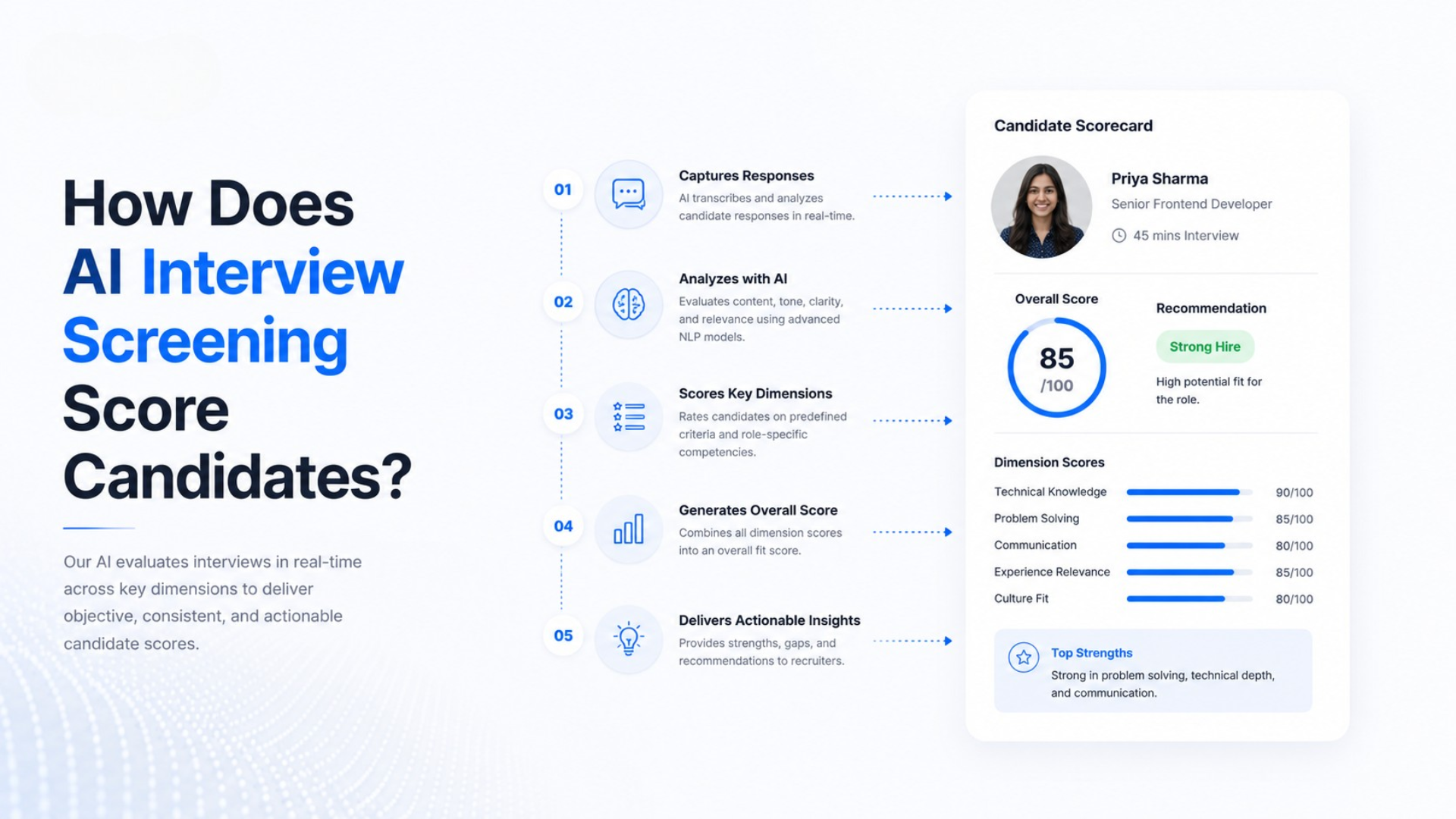
AI interview screening typically scores candidates by comparing evidence found in their responses with predefined role criteria, structured questions, and qualification requirements. Depending on the platform, the system may analyze whether the candidate answered the question, identify relevant skills or experience, evaluate the completeness of the evidence, flag missing requirements, summarize strengths and gaps, and create a score or recommendation for recruiter review.
The important distinction is that the system should evaluate job-relevant evidence.
It should not simply decide that one candidate “sounds better” than another.
This distinction becomes especially important as AI voice screening and automated interview tools become more common. Recruiting teams may use them to handle repetitive first-round qualification, support high-volume hiring, screen candidates across time zones, or reduce the amount of recruiter time spent asking the same questions.
The technology can improve recruiting capacity.
It can also create serious problems when companies do not understand what the score represents.
A number such as 84% can look scientific even when the underlying hiring criteria are poorly defined. A candidate may receive a lower score because the system expected a specific keyword rather than meaningful evidence. Recruiters may trust the ranking without understanding why one person appeared above another.
Understanding how AI interview screening scores candidates is therefore essential before using the score to influence hiring decisions.
What Is AI Interview Screening?
AI interview screening is the use of artificial intelligence to support the early evaluation of candidates through structured written, audio, or video responses.
The exact process varies between platforms.
Some systems ask candidates to record answers to predefined questions. Others conduct conversational voice interviews where the AI asks a question, listens to the answer, and continues the interaction. Some systems support recruiter-led interviews by creating transcripts, summaries, and structured evaluation notes.
The purpose is usually to make early-stage screening more consistent or scalable.
A recruiter screening 100 candidates manually may need to conduct 100 similar conversations. The role is explained repeatedly. The same qualification questions are asked. Notes are written. Basic information is collected. Candidates are then prioritized for deeper evaluation.
AI can support parts of this repetitive process.
The system may ask every candidate the same core questions, collect responses at a convenient time, structure the information, and help the recruiting team identify which people deserve closer review.
This does not mean the AI should make the final hiring decision.
Interview screening is usually one stage of a larger process. The purpose is to gather job-relevant information and help determine who should receive the next level of human attention.
Huntlo’s broader guide to AI candidate screening and how accurate it is explains the wider category. Interview screening is a more specific workflow because the AI is working with candidate responses rather than only comparing resumes and profiles.
The Score Begins With the Hiring Requirement
Before an AI system can score a candidate, it needs to know what the company wants.
This may sound obvious, but it is one of the most important parts of the entire process.
Imagine a company is hiring a customer success manager. The job description says the person should have five years of experience, strong communication skills, knowledge of SaaS, experience with enterprise customers, and the ability to reduce churn.
Which of these criteria matters most?
Would a candidate with four years of exceptional enterprise experience be rejected because they lack the fifth year? Is SaaS experience essential, or could someone from another subscription business succeed? What evidence would demonstrate an ability to reduce churn?
An AI system cannot answer these questions responsibly without a clear scoring framework.
The hiring requirement needs to be translated into evaluation criteria.
Some criteria may be mandatory. The candidate may need a particular certification, legal work authorization, language capability, location, or technical qualification.
Other criteria may be weighted. Experience with enterprise customers may matter more than experience with one specific software platform.
Some criteria may require evidence from the interview. The candidate may need to explain how they handled a difficult customer, improved a process, led a project, or solved a technical problem.
The quality of the screening score depends heavily on this foundation.
If the company has not defined what good looks like, AI cannot create clarity from confusion.
It can only automate the confusion.
The System Converts the Role Into Screening Criteria
Once the hiring requirement is understood, the system needs a structured framework for evaluating candidates.
A simple framework may include mandatory qualification questions.
Does the candidate have the required work authorization?
Can they work in the required location?
Are they available within the necessary timeline?
Does their compensation expectation fit the approved range?
These questions are relatively straightforward because the candidate provides information that can be compared with a defined requirement.
More complex criteria require deeper evaluation.
A sales candidate may need experience closing enterprise deals.
An engineering candidate may need to explain how they solved a scaling problem.
A recruiter may need to demonstrate experience sourcing passive candidates for difficult roles.
A manager may need to provide evidence of handling poor performance.
The AI system may create or use questions designed to reveal this evidence.
The score should then connect the answer with the underlying criterion.
This is different from asking generic interview questions and allowing AI to decide whether the response sounded impressive.
The strongest screening systems begin with the job requirement and work backward toward the evidence needed to evaluate it.
Structured Questions Make AI Scoring More Consistent
AI interview scoring works best when candidates are evaluated through a structured process.
A structured interview asks candidates a consistent set of core questions connected with the role.
This creates a clearer basis for comparison.
If Candidate A is asked about leadership, Candidate B is asked about technical skills, and Candidate C spends most of the conversation discussing compensation, comparing the three interviews becomes difficult.
A structured process ensures that every candidate has an opportunity to provide evidence around the important criteria.
This does not mean the interview must feel robotic.
Follow-up questions can still be useful.
A candidate may provide an incomplete answer, and the system may ask for more detail. Another response may introduce relevant information that deserves clarification.
However, the core evaluation framework should remain connected with the same hiring requirements.
Consistency is one of the main potential advantages of AI-supported screening.
Recruiters are human. Energy levels change. Interviews happen at different times of the day. One candidate may receive more follow-up questions than another. A structured AI workflow can reduce some of this variation.
The value comes from consistency around relevant evidence.
Consistency around bad questions simply makes a bad process more scalable.
The Candidate Provides a Response
The next stage begins when the candidate answers the screening question.
In a voice-based system, the response may first be converted from speech into text.
The platform may also preserve the original audio for appropriate review, depending on the product, process, and candidate consent.
The transcript becomes a major source of information for the AI system.
The technology can analyze what the candidate said and compare the response with the evaluation criteria.
Suppose the question asks:
“Tell me about a time you reduced customer churn.”
One candidate says they worked closely with customers and always tried to provide good service.
Another candidate explains that their company had a high cancellation rate among new enterprise customers, describes how they identified an onboarding problem, explains the changes they introduced, and provides the resulting improvement.
Both candidates answered the question.
The second response contains more job-relevant evidence.
A well-designed AI screening system may identify the problem, the candidate’s action, the context, and the outcome.
The system can then compare this evidence with the role requirement.
This is more useful than simply counting keywords.
AI Extracts Evidence From the Answer
Evidence extraction is one of the most important parts of AI interview screening.
The system attempts to identify information inside the candidate’s response that relates to the scoring criteria.
For an experience question, the AI may look for the situation the candidate faced, the responsibility they personally held, the actions they took, and the outcome.
For a technical question, the system may identify the candidate’s approach, understanding of the problem, trade-offs considered, and evidence of practical experience.
For a sales role, the system may look for deal size, customer type, sales cycle, personal responsibility, obstacles, and results.
For a recruiting role, the system may identify sourcing channels, hiring difficulty, candidate volume, outreach strategy, conversion, and final hiring outcomes.
The purpose is not to reward the longest answer.
A candidate can speak for five minutes without providing useful evidence.
Another can give a concise response that clearly demonstrates relevant experience.
The system should ideally evaluate the relationship between the answer and the criterion.
This is where modern language models can provide more value than rigid keyword systems.
A candidate may describe relevant experience without using the exact words expected by the job description.
AI can attempt to interpret the meaning.
However, interpretation introduces uncertainty.
The system may misunderstand an answer, give too much importance to one detail, or infer experience the candidate did not actually claim.
This is why evidence should remain reviewable.
Recruiters should be able to understand what information influenced the score.
AI May Evaluate Answer Completeness
A candidate response can be relevant without being complete.
Imagine a manager is asked how they handled an underperforming employee.
The candidate explains that they held regular meetings and eventually performance improved.
The answer provides some information.
Important details remain missing.
What was the performance problem?
How did the candidate diagnose it?
What expectations were set?
What support was provided?
How was improvement measured?
A screening system may identify these gaps.
Depending on the platform, it may ask a follow-up question or reduce the strength of the evidence.
This is where conversational AI screening can differ from a static questionnaire.
A static system records the first answer and moves forward.
A conversational system may recognize that the candidate has not provided enough information and ask for clarification.
The quality of these follow-ups matters.
The system should not repeatedly pressure candidates to produce a preferred answer.
The purpose should be to collect enough evidence for a fair evaluation.
Mandatory Criteria May Be Scored Separately
Not every part of an AI screening score needs complex language analysis.
Some criteria are factual.
The candidate may need to work a particular shift.
The role may require a specific professional license.
The person may need to speak a particular language.
The company may have a fixed location requirement.
The candidate may need experience with a legally required qualification.
These criteria can be evaluated separately from broader interview answers.
A candidate who does not meet a genuine mandatory requirement may be flagged for recruiter review or excluded according to the company’s process.
The important word is genuine.
Recruiting teams often treat preferences as mandatory requirements.
A hiring manager may say that five years of experience is essential when a strong candidate with four years could succeed.
A company may require experience from a particular industry even though the underlying skills are transferable.
AI can make these filters more efficient.
It can also make unnecessary exclusion more efficient.
Recruiters should therefore review which requirements are truly non-negotiable before allowing them to heavily influence candidate scores.
Different Criteria Can Receive Different Weights
Most roles involve several requirements, and those requirements are not equally important.
A software engineering role may place significant weight on technical problem-solving and less weight on experience with one specific internal tool.
A sales role may prioritize evidence of selling to a particular customer segment over a preferred educational background.
A recruiting role may value difficult sourcing experience more than familiarity with one ATS.
AI screening systems can reflect these differences through weighting.
Suppose the total score considers technical capability, relevant experience, communication of evidence, and availability.
The company may decide that technical capability and experience should influence the recommendation much more heavily than availability.
The exact method varies by platform.
Some systems use explicit weighted scorecards.
Others create broader recommendations based on the relationship between candidate evidence and the role criteria.
The important principle is transparency.
Recruiters should understand which criteria influence the result.
A candidate should not receive a lower overall score because the system gave excessive importance to a minor preference.
How AI May Score Behavioral Answers
Behavioral questions ask candidates to describe how they handled previous situations.
The underlying assumption is that past behavior can provide useful evidence about how someone may approach similar challenges.
AI can analyze these responses by identifying the structure and relevance of the evidence.
Did the candidate describe a real situation?
Was their personal responsibility clear?
Did they explain the action they took?
Was there an outcome?
Does the example connect with the competency being evaluated?
Consider a question about conflict management.
A weak response may contain general statements about always communicating openly.
A stronger response may describe a specific disagreement, explain the candidate’s role, show how they approached the conversation, and describe what happened afterward.
The AI may identify that the second response contains stronger evidence.
However, the system should be careful about rewarding storytelling ability over actual capability.
Some candidates are naturally more polished interviewers.
Others may have strong experience but communicate it less smoothly.
The score should focus on the evidence relevant to the role rather than whether the candidate gave the most impressive performance.
How AI May Score Technical Answers
Technical screening can involve more specific evaluation criteria.
A candidate may be asked to explain a concept, solve a problem, describe an architecture, review a scenario, or discuss a previous technical decision.
The AI may compare the response with expected concepts or a role-specific rubric.
A strong answer may demonstrate correct understanding, practical reasoning, awareness of trade-offs, and relevant experience.
A weak answer may contain serious factual errors or fail to address the question.
Technical scoring can be useful, but it also requires caution.
There may be several correct approaches to a problem.
An AI system should not assume that one model answer is the only acceptable response.
The evaluation framework should allow for alternative reasoning when the candidate can justify it.
This is particularly important for senior roles.
Experienced professionals often make decisions based on context and trade-offs rather than one universal best practice.
The more complex the role, the less appropriate a simplistic right-or-wrong scoring model becomes.
How AI May Score Experience-Based Answers
Experience questions attempt to determine whether the candidate has actually done work relevant to the role.
A recruiter may ask about the largest team the candidate managed, the type of customers they worked with, the scale of a system they built, or the difficulty of the roles they recruited.
AI can extract details from the answer.
The system may identify numbers, time periods, responsibilities, industries, technologies, team sizes, outcomes, and other relevant information.
This can make recruiter review faster.
Instead of reading an entire transcript, the recruiter may receive a structured summary showing the evidence connected with each criterion.
However, the system should distinguish between personal contribution and team contribution.
Candidates naturally use words such as “we” when describing work.
The AI may need to identify what the candidate personally did.
A strong follow-up question can help.
“What was your specific responsibility?”
This creates more useful evidence than simply assuming the candidate led everything the team accomplished.
What an AI Interview Score Actually Means
AI interview scores often appear more precise than they really are.
A candidate may receive 82 out of 100.
Another may receive 74.
The recruiter may naturally assume that the first candidate is better.
The meaning depends entirely on how the system created the score.
The number may represent the percentage of criteria the candidate appeared to satisfy.
It may be a weighted combination of several competency scores.
It may represent similarity between the candidate’s responses and an expected answer framework.
It may be a platform-specific ranking measure.
The recruiter needs to know what the score means before using it.
An 82 does not necessarily mean the candidate has an 82% chance of succeeding in the job.
It does not mean they are objectively 8% better than the person who received 74.
The score is a structured interpretation of available interview evidence.
Its best use is often prioritization.
The system can help recruiters identify which interviews deserve immediate review, which candidates appear to meet the core criteria, and where important questions remain unanswered.
The score should guide attention.
It should not create false certainty.
Why Two Similar Candidates Can Receive Different Scores
Candidates with similar resumes may receive different AI screening scores because the interview provides new evidence.
One candidate may clearly demonstrate relevant experience.
The other may describe responsibilities without showing personal contribution.
One may meet all mandatory requirements.
Another may have an availability conflict.
One may provide specific outcomes.
Another may answer in general terms.
The difference can be useful because resumes do not reveal everything.
This is one reason candidate matching and interview screening should remain separate stages.
Huntlo’s guide to how AI candidate matching actually works explains how systems compare profiles and requirements before deeper candidate interaction.
Matching estimates who may be relevant.
Screening collects additional evidence.
A high candidate match should not guarantee a high interview score.
If it does, the interview may not be adding much information.
Why AI Should Not Score Candidates Based on Accent
An AI screening system should evaluate job-relevant evidence.
Accent is not a measure of candidate quality.
A person may speak English, Hindi, Spanish, Arabic, or another language with a particular accent while communicating effectively for the role.
The same principle applies to vocal characteristics that do not relate to job performance.
Recruiting teams should be cautious of systems that claim to evaluate personality, honesty, emotion, confidence, or capability from facial expressions, voice patterns, or other weak proxies.
The relevant question is what the candidate said and whether the response provides evidence connected with the job.
For roles where spoken communication is genuinely important, communication can be evaluated against clearly defined job requirements.
The standard should remain relevant to the work.
The system should not reward one style of speaking simply because it resembles historical candidates.
Why AI Should Not Treat Confidence as Competence
Confident candidates often perform well in interviews.
That does not automatically mean they will perform well in the job.
A candidate may speak fluently and provide weak evidence.
Another may be nervous but describe excellent work.
AI screening should avoid turning presentation style into a substitute for capability.
The evaluation should focus on the content relevant to the role.
Did the candidate answer the question?
Did they demonstrate the required knowledge?
Did they provide credible evidence?
Were they able to explain their reasoning?
For roles where communication is central, the ability to communicate clearly may be relevant.
Even then, the system should evaluate the actual requirement rather than a vague concept of confidence.
This is one reason transparent scorecards are important.
Recruiters should know what the system is measuring.
How AI Handles Missing or Unclear Answers
Candidates do not always answer questions directly.
They may misunderstand the question, provide too little detail, experience technical problems, or discuss something unrelated.
A well-designed system should not automatically interpret every incomplete answer as lack of capability.
The AI may ask for clarification.
It may identify the criterion as insufficiently evidenced.
It may flag the answer for recruiter review.
The difference between “candidate lacks the skill” and “the interview did not provide enough evidence” is important.
Recruiting systems often collapse these two situations.
That can create unfair decisions.
Absence of evidence is not always evidence of absence.
The score should ideally preserve uncertainty.
A recruiter can then decide whether another conversation is appropriate.
How AI Screening Can Improve Consistency
Recruiters conduct many interviews under different conditions.
One candidate speaks with the recruiter early in the morning.
Another speaks at the end of a difficult day.
One receives several follow-up questions.
Another receives fewer because the recruiter is running late.
Structured AI screening can reduce some of this variation.
Every candidate can receive the same core questions.
The same criteria can be used.
Responses can be documented consistently.
The recruiter can review structured evidence rather than relying entirely on memory.
This can improve process consistency.
However, consistency should not be confused with fairness automatically.
If the questions are poor, the same poor questions are asked consistently.
If the criteria contain unnecessary barriers, the same barriers are applied consistently.
AI can standardize a process.
Recruiting teams still need to ensure the process deserves to be standardized.
How AI Screening Can Reduce Recruiter Workload
Early-stage screening can consume a large amount of recruiter time.
A recruiter may conduct dozens of similar calls for one role.
Many conversations collect the same basic information.
AI screening can support this stage by allowing candidates to provide structured responses before a deeper recruiter conversation.
The system can organize the evidence and help prioritize candidates.
Recruiters can then spend more time with people who need meaningful evaluation.
This can be particularly useful in high-volume hiring, staffing agencies, and recruiting teams managing several active roles.
The larger workflow benefit is discussed in Huntlo’s guide to reducing recruiter burnout with workflow automation.
The objective should not be to remove every recruiter conversation.
It should be to reduce repetitive screening work so recruiter attention is available where it creates more value.
How AI Screening Affects Time-to-Hire
Screening often creates a bottleneck.
Candidate sourcing may be fast.
Applications may arrive quickly.
The recruiting team still needs time to review and qualify everyone.
Strong candidates can wait for days before the first meaningful step.
AI screening can reduce this delay by making early qualification more available.
Candidates may be able to complete screening outside normal recruiter working hours.
Responses can be structured quickly.
Recruiters can review stronger candidates sooner.
Huntlo’s guide on reducing time-to-hire with AI sourcing and screening explains how delays across candidate discovery and qualification affect the broader hiring process.
The important measure is not how quickly the AI produces a score.
The useful measure is whether qualified candidates reach the next meaningful stage faster.
How Staffing Agencies Can Use AI Interview Screening
Staffing agencies often manage screening at significant volume.
A recruiter may work across several client mandates while repeatedly collecting similar qualification information from candidates.
AI interview screening can help structure this work.
Candidates can answer role-specific questions.
The system can summarize relevant experience.
Recruiters can review evidence before deciding where to invest deeper attention.
The workflow can be especially useful when the agency receives many candidates for similar roles or needs to qualify talent across time zones.
However, agencies need to protect candidate relationships.
The candidate should understand the process.
The screening experience should be appropriate for the role.
Strong candidates should still receive human attention when the relationship requires it.
AI should increase recruiter capacity.
It should not make the agency feel unavailable.
How RPO Teams Can Use AI Screening at Scale
Recruitment Process Outsourcing providers often manage hiring processes across several roles, locations, and business units.
Consistency becomes difficult at scale.
Different recruiters may screen similar candidates in different ways.
AI-supported structured screening can create a more consistent evidence framework.
The system can help collect similar information across candidates and make recruiter review easier.
This can be particularly valuable when hiring volume changes quickly.
The RPO provider may need to expand screening capacity without immediately increasing recruiter headcount at the same rate.
The technology should still fit the client’s hiring criteria and governance requirements.
One universal AI score should not be applied across every company and role.
The evaluation framework needs to reflect the actual hiring context.
How AI Interview Screening Fits Into a Larger Workflow
Interview screening should not exist as an isolated step.
The candidate has already entered the recruiting process through an application, sourcing activity, referral, or previous relationship.
After screening, something needs to happen.
A qualified candidate may move toward a recruiter conversation or interview.
A candidate with unclear evidence may require human review.
A person who does not meet a genuine mandatory requirement may leave the process through the appropriate candidate communication.
When systems are disconnected, recruiters manually manage these transitions.
The screening platform produces a score.
The recruiter opens another system.
The candidate record is updated.
Another message is sent.
Scheduling begins somewhere else.
This is where the idea of an AI Hiring OS becomes relevant.
The larger opportunity is connecting candidate discovery, engagement, screening, and interview movement rather than automating one stage while leaving recruiters to coordinate everything around it.
Where Huntlo Fits Into AI Interview Screening
Huntlo approaches AI screening as part of the broader recruiting workflow.
Candidate discovery is only the beginning.
Relevant candidates need to be engaged.
Interested candidates need to be qualified.
Qualified candidates need to move toward interviews.
Huntlo’s agentic AI recruiting infrastructure is designed around reducing more of the manual work between these stages.
AI can support candidate discovery and outreach, while AI voice capabilities can support initial screening conversations. Candidate responses can be structured around the hiring requirement, helping recruiting teams review relevant evidence and decide who should move forward.
The important value is workflow continuity.
A candidate who shows interest should not disappear into another disconnected system.
A completed screening should create a clear next action.
A qualified candidate should be able to move toward interview scheduling without requiring the recruiter to manually restart the process at every stage.
The recruiter remains responsible for important decisions.
AI supports the repetitive execution and information organization around those decisions.
Why Agentic AI Changes Interview Screening
Traditional screening software often ends when the interview is complete.
The system produces a recording, transcript, summary, or score.
The recruiter handles everything next.
Agentic AI creates the possibility of a more connected process.
Candidate interest can lead toward screening.
The screening can collect role-relevant evidence.
The result can influence the next workflow step.
Qualified candidates can move toward interviews.
Unclear cases can be surfaced for human attention.
Huntlo’s guide to agentic recruiting explains this shift from isolated AI tasks toward multi-step recruiting workflows.
For interview screening, the important change is that the score does not need to become another result waiting in another dashboard.
It can become structured information inside the candidate journey.
What Recruiters Should Review Before Trusting an AI Score
Recruiters should first understand the criteria.
What is the system actually evaluating?
They should understand the weighting.
Which requirements influence the score most strongly?
They should review the evidence.
Can the recruiter see which candidate responses supported the recommendation?
They should understand uncertainty.
Does the system distinguish between missing evidence and confirmed lack of qualification?
They should examine candidate differences.
Does the technology appear to reward one communication style unnecessarily?
They should test real hiring outcomes.
Do candidates who receive stronger screening recommendations actually perform well in later stages?
The recruiter should never need to trust a score simply because the platform uses AI.
A useful system should help the recruiting team understand the candidate more efficiently.
It should not make the decision more mysterious.
How to Measure Whether AI Interview Screening Is Working
The first measure should be screening quality.
Do candidates recommended by the system generally meet the real role requirements after recruiter review?
The second is time.
Does the technology reduce the delay between candidate interest and initial qualification?
The third is recruiter effort.
Are recruiters spending less time repeating basic screening conversations?
The fourth is candidate progression.
Do qualified screened candidates move successfully into interviews?
The fifth is consistency.
Are similar candidates being evaluated against the same core criteria?
The sixth is candidate experience.
Do candidates understand the process, complete it successfully, and receive appropriate next steps?
The team should also monitor false negatives.
Are strong candidates being screened out because of poor criteria or weak system interpretation?
The goal is not to maximize the number of candidates rejected automatically.
The goal is to improve how recruiter attention is allocated.
Common Mistakes With AI Interview Scoring
The first mistake is using an unclear hiring requirement.
The second is treating every criterion as equally important.
The third is trusting a precise score without understanding what it means.
The fourth is evaluating presentation style instead of job-relevant evidence.
The fifth is assuming that a missing answer proves a missing skill.
The sixth is allowing AI to make important decisions without appropriate review.
The seventh is using the same screening framework for every role.
The eighth is failing to test whether screening recommendations connect with later hiring outcomes.
The final mistake is automating the interview while leaving the rest of the workflow disconnected.
A score creates limited value when the recruiter still needs to manually coordinate every next step.
Conclusion: The Best AI Interview Score Explains the Evidence
AI interview screening scores candidates by comparing their responses with structured role criteria.
The system may identify mandatory qualifications, extract evidence from answers, evaluate completeness, compare experience with the requirement, and create a score or recommendation for recruiter review.
The strongest systems do not simply decide that one candidate sounds better than another.
They help recruiters understand what evidence exists.
A good score should make the hiring process clearer.
The recruiter should be able to see why a candidate performed strongly, where important information is missing, and which criteria require deeper evaluation.
The technology can create significant value.
It can reduce repetitive first-round screening.
It can give candidates more flexibility.
It can structure information consistently.
It can help recruiting teams reach strong candidates faster.
However, the score remains an interpretation of available evidence.
It is not an objective measure of human potential.
A candidate may communicate differently.
An answer may be incomplete.
A requirement may be wrong.
An unusual background may create value that the scoring framework did not anticipate.
The best use of AI interview screening is therefore not automatic hiring.
It is better prioritization.
AI can collect and organize more information.
Recruiters can use that information to decide where deeper human attention belongs.
The future of screening will not be defined by the system that produces the most precise-looking number.
It will be defined by the system that helps recruiters understand candidates more clearly and move the right people forward with less unnecessary work.
Frequently Asked Questions
How does AI interview screening score candidates?
AI interview screening typically compares candidate responses with predefined role criteria, extracts relevant evidence, identifies whether requirements are met, and creates a score or recommendation for recruiter review.
What does an AI interview score mean?
The meaning varies by platform. A score may represent criteria matched, weighted competency results, evidence strength, or another platform-specific measure. It should not automatically be interpreted as the probability that a candidate will succeed.
Does AI analyze what candidates say during interviews?
Yes. Many systems convert spoken responses into text and analyze the content for information relevant to the hiring criteria.
Can AI ask follow-up interview questions?
Conversational AI systems may ask follow-up questions when an answer requires clarification or additional evidence.
Does AI interview screening evaluate facial expressions?
Approaches vary between products, but recruiting teams should be cautious about systems that attempt to infer personality, honesty, emotion, or job capability from facial expressions or other weak proxies. Evaluation should focus on job-relevant evidence.
Can AI interview screening be biased?
Yes. Problems can come from hiring criteria, historical data, system design, language interpretation, or inappropriate evaluation signals. Human oversight and ongoing testing remain important.
Can AI reject candidates automatically?
Technical capability and responsible hiring practice are different questions. Important hiring decisions should include appropriate human oversight, clear criteria, and consideration of applicable requirements.
Is AI interview screening accurate?
Accuracy depends on the role, questions, scoring criteria, candidate information, and system design. Teams should test recommendations against recruiter review and later hiring outcomes.
Can AI interview screening replace recruiter calls?
It can reduce repetitive early qualification work, but many candidates and roles still benefit from human conversations. The best approach depends on the hiring context.
How should recruiters evaluate AI screening software?
Recruiters should examine scoring transparency, role customization, evidence visibility, candidate experience, language support, workflow integration, human oversight, and whether recommendations improve actual hiring outcomes.
Related Topics
Understand the broader category of automated candidate evaluation in What Is AI Candidate Screening and How Accurate Is It?.
Learn how AI evaluates candidate relevance before the interview stage in How Does AI Candidate Matching Actually Work?.
Explore how sourcing and screening can reduce delays across the hiring process in How to Reduce Time-to-Hire With AI Sourcing and Screening.