An AI sourcing vendor gives your recruiting team a demonstration.
The recruiter enters a role.
The system searches millions of profiles.
Within seconds, hundreds of candidates appear.
Each person has a match score.
The interface looks modern.
The AI explains why candidates may fit.
Contact details are available.
The vendor shows an outreach feature.
The demonstration ends.
Everyone is impressed.
Three months later, the recruiting team has a problem.
Recruiters still use their old sourcing methods.
The AI search produces too many irrelevant candidates for difficult roles.
Contact details are inconsistent.
The strongest recruiters do not trust the match scores.
Candidate information needs manual checking.
Outreach happens in another system.
The tool technically works.
The purchase does not.
This is one of the most common mistakes in recruiting technology.
The buyer evaluates the product.
They do not evaluate what happens when the product enters the real recruiting workflow.
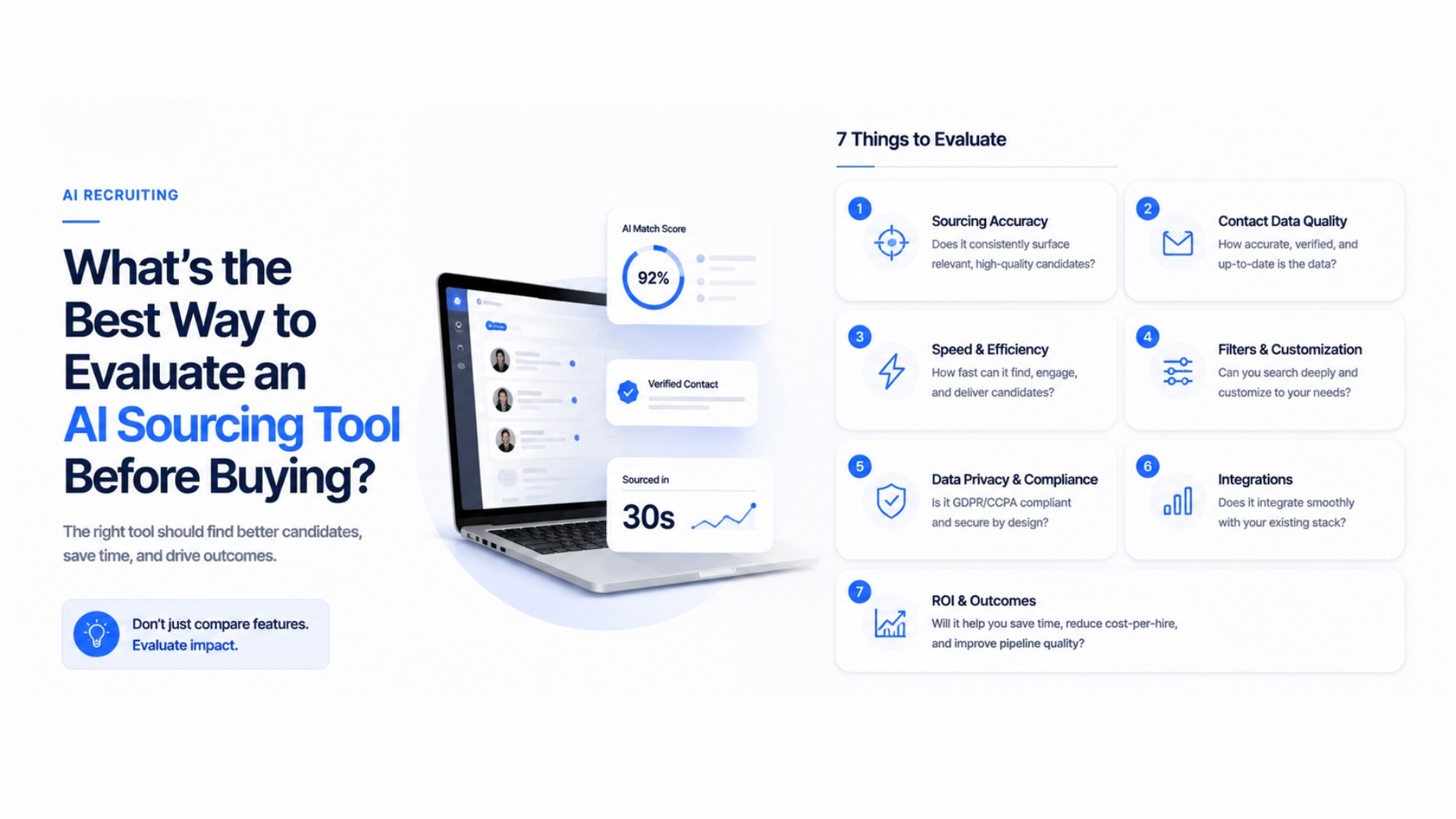
The best way to evaluate an AI sourcing tool is to test it on real hiring problems, compare the results with your current process, involve the recruiters who will actually use it, and measure candidate relevance, data quality, recruiter effort, workflow impact, and downstream hiring outcomes.
The trial should not answer only one question.
Can the software find candidates?
It should answer several.
Does it find the right candidates?
Does it find people we would otherwise miss?
Can recruiters trust the information?
Can they act on the results?
Does the platform remove work or create new work?
Does it fit the rest of the recruiting process?
Will recruiters actually use it?
Does the value justify the cost?
These questions are more difficult than comparing feature lists.
They are also much more likely to prevent an expensive mistake.
Start With the Recruiting Problem, Not the Vendor
A sourcing-tool evaluation should begin before the first demo.
The team needs to define why it is considering new software.
This sounds obvious.
Many buying processes skip it.
A recruiting leader hears about an AI sourcing platform.
A competitor uses one.
A recruiter requests access.
The company begins evaluating products without clearly defining the problem.
The result is feature-driven buying.
One vendor has a larger database.
Another has better AI search.
Another has contact enrichment.
Another has outreach.
Another has agents.
The team becomes distracted by capabilities.
The original hiring problem becomes unclear.
The first question should be simple.
What is currently failing?
Recruiters may spend too long building searches.
The existing database may produce weak candidates.
Passive talent may be difficult to find.
Technical roles may take weeks to source.
Contact information may be unreliable.
Recruiters may need several tools to move from discovery to outreach.
Candidate follow-ups may be inconsistent.
The team may simply lack enough sourcing capacity.
These are different problems.
They require different solutions.
A tool can be excellent and still be the wrong purchase.
If the team’s real bottleneck is candidate screening, buying another sourcing database may increase the number of candidates while making the downstream problem worse.
If the problem is weak candidate discovery, a broad recruiting platform with average search may not solve it.
Define the problem first.
Evaluate the product against that problem.
Write Down the Current Baseline
You cannot prove improvement if you do not know the current performance.
Before testing a new sourcing tool, record how the existing process works.
How long does it take to build a shortlist?
How many profiles does a recruiter review before finding a relevant candidate?
How many sourced candidates are accepted by the hiring manager?
How many have usable contact information?
How many respond?
How many become qualified conversations?
How many reach interviews?
How many recruiter hours are required?
The baseline does not need to be perfect.
It needs to be useful.
Suppose the current process takes six recruiter hours to identify ten candidates the hiring manager accepts.
The new AI tool completes the search in twenty minutes.
That sounds impressive.
The hiring manager accepts only one candidate.
The tool is faster.
The workflow is not better.
Now imagine another platform takes one hour.
The hiring manager accepts eight candidates.
Several were not found through the current sourcing method.
The second tool may create far more value.
Without a baseline, teams often confuse speed with improvement.
Do Not Test the Tool Only on Easy Roles
This is one of the most important rules.
A vendor demonstration often uses a role that produces attractive results.
A software engineer in a major technology hub.
A sales leader at a known type of company.
A common job title with abundant professional data.
The tool returns hundreds of candidates.
The search looks powerful.
That does not reveal how the platform performs when your recruiters actually need it.
The evaluation should include difficult roles.
Choose vacancies that represent real sourcing pain.
A niche technical role.
A role with inconsistent titles.
A search requiring several skill combinations.
A role in a difficult location.
A senior position.
A position where the ideal candidate is unlikely to be actively applying.
If the team hires several different types of people, test more than one category.
A platform may perform extremely well for software engineering and poorly for healthcare.
Another may be strong for executive search but weak for high-volume recruiting.
The goal is not to determine whether the tool can source candidates.
The goal is to determine whether it can source your candidates.
Huntlo’s guide to Do AI Recruiting Tools Work for Niche or Highly Technical Roles? explains why difficult roles reveal whether a system genuinely understands skills, career context, and adjacent experience or simply automates keyword matching.
A difficult search is not an unfair test.
It is usually the reason the team is considering new technology.
Use Real Job Requirements
Do not create an artificial trial role that nobody is actually hiring for.
Use current or recently completed vacancies.
The recruiter should provide the same information they would normally receive.
The job description.
Hiring-manager notes.
Mandatory requirements.
Preferred requirements.
Location constraints.
Compensation considerations where relevant.
Known target companies.
Reasons previous candidates were rejected.
This creates a realistic test.
It also reveals whether the AI can work with the quality of hiring information your team actually has.
Some tools perform well when given a perfectly structured requirement.
Real recruiting rarely begins that way.
The job description may be vague.
The hiring manager may list too many requirements.
The role may contain conflicting expectations.
A useful AI sourcing tool should help recruiters navigate this complexity.
It should not require the team to create an unrealistic laboratory environment before the search works.
Define What a Good Candidate Means Before Searching
A sourcing evaluation can become subjective very quickly.
The tool returns candidates.
One recruiter likes them.
Another does not.
The hiring manager changes the requirements.
The team cannot determine whether the platform performed well.
Before running the search, define the evaluation criteria.
Which requirements are genuinely mandatory?
Which are preferences?
What evidence would make a candidate worth contacting?
What would make someone clearly irrelevant?
Which adjacent backgrounds are acceptable?
What uncertainties require human review?
This does not mean creating a rigid formula.
It means creating enough consistency to judge the results.
The exercise can also reveal problems with the vacancy itself.
If the hiring manager cannot explain what makes a candidate relevant, the AI tool is being asked to solve an unclear problem.
The quality of the evaluation depends on the quality of the criteria.
Compare the Tool Against the Current Method
The AI platform should not be tested in isolation.
The relevant question is whether it improves on what the team already does.
Run the same search using the existing process.
This may involve a professional network.
An internal database.
A traditional sourcing platform.
Manual Boolean search.
Another AI tool.
Then compare the results.
How quickly did each method produce a usable shortlist?
How many candidates were genuinely relevant?
How much overlap existed?
Did the AI find people the current process missed?
Did it rank strong candidates higher?
How much manual cleanup was required?
This type of comparison is much more useful than asking whether the AI results “look good.”
Candidate sourcing is ultimately a ranking and discovery problem.
One useful external benchmark published in 2025 compared AI sourcing systems through human judgments of candidate relevance rather than relying only on vendor-defined metrics. The study used expert preferences to compare search results, reinforcing the importance of evaluating sourcing quality through human review of actual candidates.
Your internal test does not need to become an academic study.
The principle is valuable.
Judge the candidates.
Not the animation that appears while the AI searches.
Evaluate the Top Results First
Recruiters do not have unlimited time.
The quality of the first results matters more than the total number of profiles available.
A platform may claim access to hundreds of millions of candidates.
That number says little about recruiter productivity.
The real question is what appears at the top.
Review the first ten or twenty candidates.
How many are clearly relevant?
How many are plausible but need investigation?
How many are obviously wrong?
How many contain incorrect assumptions?
How many would the recruiter genuinely contact?
This is a useful measure because it reflects the real workflow.
A recruiter should not need to review 500 profiles to find ten good people.
If the AI claims to rank candidates intelligently, the strongest evidence should appear early.
Huntlo’s AI Sourcing Tool Comparison Framework: 10 Criteria That Matter explains why search quality should be evaluated through recruiter productivity and hiring outcomes rather than database size or feature volume.
The top of the ranking is where the AI earns trust.
Measure Precision, Not Candidate Volume
A large candidate list can create the illusion of success.
The recruiter searches for a rare role.
The tool returns 8,000 people.
This may look better than a platform returning 300.
It may also mean the search is too broad.
The useful metric is precision.
How many of the reviewed candidates are genuinely relevant?
Suppose the recruiter reviews twenty profiles.
Fifteen are strong.
That is useful.
Suppose they review twenty profiles and only two are relevant.
The platform has created more work.
Candidate volume matters when the market is genuinely large.
It should not become the main measure of AI sourcing quality.
For most recruiting teams, the objective is not to discover the maximum number of human beings.
It is to identify the right people with the minimum unnecessary review.
Test Whether the Tool Finds Candidates You Missed
An AI sourcing tool should ideally add discovery value.
If every candidate already appears at the top of the team’s existing searches, the platform may still save time.
The value is more limited.
Run a comparison.
Take the AI shortlist.
Compare it with the current sourcing method.
Which candidates are new?
Why were they missed before?
Did they have an unusual title?
An adjacent skill set?
A different career path?
Experience at a less obvious company?
A profile written using different terminology?
This is where AI sourcing can become genuinely valuable.
The strongest systems can help recruiters search beyond exact keywords.
They can interpret context.
They can identify related experience.
They can surface candidates who would be difficult to find through rigid Boolean logic.
Huntlo’s guide to What Is Boolean Search in Recruiting (And Why AI Tools Are Replacing It) explores why natural-language and contextual search can widen discovery beyond recruiter-built keyword combinations.
The evaluation should test whether that promise is real.
Look Closely at False Positives
A false positive is a candidate the system ranks highly who is not actually relevant.
Every sourcing tool produces some.
The pattern matters.
Does the AI repeatedly confuse company experience with personal expertise?
Does it assume that mentioning a technology means deep experience?
Does it overvalue prestigious employers?
Does it misunderstand seniority?
Does it ignore location constraints?
Does it treat adjacent skills as identical?
Does it rank people with the right title but wrong responsibilities?
These errors reveal how the system thinks.
One irrelevant candidate is not a reason to reject a tool.
Repeated error patterns are important.
A recruiter should be able to understand where the AI becomes unreliable.
This matters because errors create work.
A weak match is not only one bad search result.
The recruiter may review the profile.
Find contact information.
Send outreach.
Receive a reply.
Conduct a screen.
Only then discover the mismatch.
The cost of a false positive can travel through the entire recruiting workflow.
Test for False Negatives Too
False negatives are more difficult.
The tool fails to surface a strong candidate.
The recruiter may never know.
One way to test this is to use known examples.
Take a recently filled role.
Give the AI the original requirement.
Does it find the person who was hired?
Does it find other finalists?
Where does it rank them?
Why?
Now use a current search.
Ask an experienced recruiter to manually identify several strong candidates.
Does the AI surface them?
This is not a perfect test.
A tool does not need to rank every good candidate identically to a human.
The exercise can reveal blind spots.
If the platform consistently misses candidates with unusual titles or non-traditional backgrounds, that matters.
If it only finds people from obvious companies, that matters.
If it ignores strong candidates because one keyword is missing, that matters.
The best sourcing system should improve discovery without becoming another rigid filter.
Evaluate the Match Explanation
A match score alone is not enough.
The system says a candidate is a 94% fit.
Why?
The recruiter should be able to inspect the reasoning.
Which requirements are supported by direct evidence?
Which are inferred?
Which are missing?
What parts of the career history matter?
Why does the system believe an adjacent skill is relevant?
This is especially important for difficult roles.
A candidate with an unusual background may be highly valuable.
The recruiter needs enough explanation to understand the recommendation.
The same is true when the system appears wrong.
Can the recruiter see why the mistake happened?
Explainability does not make the AI automatically correct.
It makes the output easier to evaluate.
Recent work on AI-driven candidate assessment has emphasized structured, role-specific, interpretable outputs rather than shallow keyword scores, reflecting the wider need for AI hiring systems to provide evidence that humans can review.
The buyer should therefore ask the vendor to show more than a score.
Show the evidence.
Test Candidate Data Accuracy
A relevant candidate with inaccurate information is not fully actionable.
Review a sample of profiles.
Is the current employer correct?
Is the job title current?
Are employment dates accurate?
Are skills directly supported?
Are locations reliable?
Are profile links correct?
Has the system merged information from different people?
Data quality matters because AI can make incorrect information look convincing.
A polished candidate summary may create confidence.
The underlying fact may still be wrong.
Huntlo’s guide to What Happens If an AI Sourcing Tool Gets a Candidate's Data Wrong? explains why one incorrect data point can affect matching, outreach, screening, and recruiter judgment.
During the trial, verify a sample manually.
Do not assume a confident interface means accurate data.
Test Contact Data Separately From Candidate Search
A platform can be excellent at candidate discovery and weak at contact enrichment.
These are different capabilities.
Take a sample of relevant candidates.
Check whether the tool provides usable contact information.
Are email addresses available?
Are they current?
How often do they bounce?
Does the platform provide multiple possible addresses without confidence information?
Does it distinguish personal and professional contact details?
How does it handle verification?
The goal is not to count how many fields appear on the profile.
The goal is to determine whether recruiters can actually reach the candidate.
A candidate database with strong search but poor contactability may require another tool.
That may still be acceptable.
The buyer should understand the real workflow and total cost.
Measure Actionability
This is one of the most useful evaluation concepts.
A candidate can be relevant without being actionable.
The profile looks strong.
The information is old.
There is no reliable contact route.
The candidate cannot be exported.
The recruiter cannot add them to an outreach workflow.
The tool has found a person.
It has not helped recruiting move forward.
Ask what happens after discovery.
Can the recruiter save the candidate?
Organize them?
Enrich the profile?
Contact them?
Move them into the existing recruiting system?
Collaborate with teammates?
Track what happened?
Avoid duplicate outreach?
The best sourcing result is not simply a profile.
It is a candidate the recruiting team can act on.
Test the Workflow After the Search
Many sourcing evaluations stop too early.
The recruiter finds candidates.
Everyone declares success.
The real work begins next.
The recruiter needs to contact them.
Follow up.
Manage replies.
Qualify interest.
Move candidates toward interviews.
If the new sourcing tool creates another disconnected candidate list, the team may simply add one more interface to the technology stack.
This is why buyers should map the complete workflow.
Candidate discovered.
What happens next?
Does the recruiter export a CSV?
Copy information manually?
Move to another outreach platform?
Check another tool for contact details?
Update the ATS?
Create a spreadsheet?
The sourcing tool may save one hour and create forty minutes of downstream work.
The net improvement is much smaller than the demo suggests.
Huntlo’s guide to What's the Difference Between AI Sourcing and AI Recruiting? explains why candidate discovery should be evaluated separately from the wider process of engagement, qualification, screening, and workflow progression.
The buyer should know where the platform stops.
Test Integrations With Real Workflows
A vendor may say the platform integrates with your ATS or CRM.
Do not treat the existence of an integration logo as proof.
Test the actual workflow.
Which fields move?
In which direction?
How quickly?
Are duplicates created?
Does candidate history remain visible?
Can recruiters update records without manual work?
What happens when the same person already exists?
Can the team control which information is transferred?
An integration that technically exists may still be operationally weak.
The buyer should involve recruiting operations or the people who manage the current systems.
Recruiters often discover integration problems after the contract is signed.
By then, the workflow has already been designed around assumptions.
Test the assumptions first.
Measure Recruiter Time Saved
This sounds simple.
It is often measured badly.
A vendor says the AI search takes thirty seconds.
The team concludes that sourcing time has fallen dramatically.
The recruiter may still spend hours reviewing results.
Correcting data.
Finding contact details.
Exporting candidates.
Writing outreach.
Moving information.
The relevant measure is total recruiter effort.
How much time is required to move from a hiring requirement to an actionable shortlist?
Then measure the next stage if the tool supports it.
How much time is required to move from shortlist to qualified candidate?
The broader the product’s claims, the broader the evaluation should be.
A sourcing platform should be measured on sourcing work.
A recruiting automation platform should be measured across the workflow it claims to improve.
Involve Average Recruiters, Not Only Power Users
Every recruiting team has people who enjoy new technology.
They learn quickly.
They explore every feature.
They create sophisticated workflows.
They are useful evaluators.
They should not be the only evaluators.
The real question is whether the team will adopt the product.
Include recruiters with different levels of technical comfort.
Give them the same role.
Observe what happens.
Can they understand the search?
Can they refine results?
Do they trust the recommendations?
Do they return to the tool without being reminded?
Do they use it after the initial excitement disappears?
A platform that performs brilliantly for one power user and poorly for the rest of the team may struggle after purchase.
Adoption is part of product value.
Unused software has zero recruiting ROI.
Do Not Overtrain Recruiters During the Trial
The team needs enough training to use the platform properly.
The vendor should not need to operate the product for them.
This is a useful test.
A vendor specialist may produce exceptional results.
They know every feature.
They know how to phrase searches.
They know which settings to change.
The recruiter buys the platform.
The results become weaker.
During the evaluation, allow the vendor to provide normal onboarding.
Then let recruiters work independently.
If every successful search requires expert intervention, the buyer should know that before signing.
The goal is not to test whether the vendor can use the tool.
It is to test whether your team can.
Measure Hiring-Manager Acceptance
Recruiters should review candidate quality.
Hiring managers should review a sample too.
This is especially important for specialist roles.
Take a defined shortlist.
Remove unnecessary vendor branding if possible.
Ask the hiring manager to assess the candidates.
How many would they genuinely consider?
How many are clearly wrong?
Why?
The reasons are valuable.
The tool may repeatedly misunderstand one technical requirement.
The hiring manager may reveal that the original brief was unclear.
The AI may find strong adjacent candidates the manager had not considered.
Hiring-manager acceptance is not a perfect metric.
Managers can also have inconsistent preferences.
It remains useful because sourced candidates eventually need to survive stakeholder review.
Continue the Test Into Candidate Response
A candidate can look perfect on a screen.
The recruiting outcome depends on whether the person can be engaged.
If the trial allows enough time, contact a sample of candidates through the normal process.
Measure response.
Do candidates reply?
Are the contact details usable?
Do the people confirm that the opportunity is relevant?
Do positive responses become qualified conversations?
This creates a stronger evaluation.
The sourcing tool is no longer being judged only on profile appearance.
It is being judged on whether the discovered candidates create real recruiting movement.
Huntlo’s article on What Recruiters Actually Use AI Sourcing Tools For explains why candidate discovery often becomes valuable only when the wider workflow can turn relevant profiles into conversations and hiring progress.
The further the test moves into the real funnel, the more reliable the buying decision becomes.
Test the Tool for Data Privacy and Governance
AI sourcing involves professional data.
Buyers should understand how that data is collected, processed, stored, and used.
Where does candidate information come from?
What is the vendor’s legal basis for processing?
How are deletion or correction requests handled?
How long is information retained?
Is customer data used to train models?
What happens to uploaded job descriptions?
What access controls exist?
What audit records are available?
Which subprocessors are involved?
The exact requirements depend on the organization and jurisdictions involved.
The buyer should involve legal, privacy, security, or procurement teams where appropriate.
This should happen before the final purchasing stage.
Not after the recruiting team has already decided emotionally that it wants the tool.
Ask What the AI Is Actually Allowed to Decide
Some products assist search.
Others rank candidates.
Others automate outreach.
Others support screening.
The buyer needs to understand the boundary.
What does the AI recommend?
What does it execute automatically?
What requires recruiter approval?
Can the team configure those boundaries?
What happens when the AI is uncertain?
Can recruiters inspect and override decisions?
A modern AI recruiting platform should not be evaluated only on intelligence.
It should be evaluated on control.
Recruiting teams need to know what the system does when nobody is watching.
Test the Free Trial Like a Pilot, Not a Playground
Many teams waste free trials.
Recruiters log in.
Run several searches.
Explore the interface.
Become busy.
The trial expires.
The team has no useful conclusion.
A better trial has structure.
Select the roles before access begins.
Define the baseline.
Assign recruiters.
Agree on evaluation criteria.
Set the timeline.
Run comparable searches.
Review candidate quality.
Verify data.
Test downstream workflows.
Collect recruiter feedback.
Measure outcomes.
The trial becomes a small pilot.
Huntlo’s guide to How to Avoid Wasting Your AI Sourcing Tool's Free Trial explains why buyers should enter a trial with defined roles, success criteria, and workflow tests rather than casually exploring features.
A short structured trial can reveal more than a long unstructured one.
Do Not Let the Vendor Choose Every Test
The vendor should help.
They should explain the product.
They should show best practices.
They should answer questions.
The buyer should control the core evaluation.
Use your roles.
Your recruiters.
Your current workflow.
Your candidate criteria.
Your success metrics.
A vendor-created search may be optimized for the platform.
That is useful for learning what the product can do.
It does not prove what your team will achieve.
The strongest vendors should be comfortable with realistic testing.
They should not need every role to be simplified before the product performs.
Ask for Proof of the Claims That Matter
AI sourcing marketing contains large claims.
Faster hiring.
Better candidates.
Millions of profiles.
Improved productivity.
Higher response rates.
Do not challenge every marketing sentence.
Focus on the claims connected with your buying decision.
If the vendor claims better candidate relevance, test relevance.
If it claims accurate contact data, test contact data.
If it claims recruiter time savings, measure time.
If it claims workflow automation, run the workflow.
If it claims integration, use the integration.
If it claims better hiring outcomes, ask how those outcomes were measured.
A 2026 buyer guide from SmartRecruiters warns that AI can amplify flaws in an existing hiring process if organizations move too quickly without the right evaluation and safeguards.
The lesson is simple.
A capability should be proven in the environment where it will be used.
Evaluate Pricing Against the Work Removed
The cheapest tool is not automatically the best value.
The most expensive tool is not automatically the most powerful.
Pricing should be compared with operational impact.
How much recruiter time is removed?
How many additional roles can the team support?
Does the platform replace another subscription?
Does it reduce the need for separate contact enrichment?
Does it improve hiring-manager acceptance?
Does it create more qualified conversations?
Does it reduce time to shortlist?
Does it require expensive implementation?
Does usage pricing become unpredictable?
The complete cost matters.
Subscription.
Seats.
Credits.
Contact data.
Outreach volume.
Integrations.
Implementation.
Training.
Additional tools still required.
Huntlo’s guide to AI Sourcing Tool Pricing: What's Actually Worth Paying For explains why a low subscription price can still produce poor economics when recruiters need additional software and manual work to complete the hiring process.
The correct question is not whether the tool is expensive.
It is whether the value created exceeds the total cost.
Calculate ROI Conservatively
Do not build the business case using perfect assumptions.
Suppose the vendor claims the tool saves ten hours per recruiter every week.
Your trial suggests four.
Use four.
Suppose the tool could theoretically replace three subscriptions.
Your team still needs two of them.
Count only the one that can realistically be removed.
Suppose the platform increases candidate response in one test.
Do not assume the same improvement across every role and market.
A conservative ROI case is more useful than an impressive one.
The goal is not to justify the purchase.
The goal is to decide whether the purchase should happen.
Look at What Happens When the AI Is Wrong
Every AI system will produce errors.
The buying decision should consider error recovery.
Can the recruiter correct a candidate profile?
Can they change the search logic?
Can they explain why a result is wrong?
Does the system learn from feedback?
Can automation be stopped?
Can incorrect data be removed?
Can the team audit what happened?
How quickly does support respond?
A tool should not be judged only by its best output.
It should be judged by how manageable the failures are.
This becomes more important as the platform automates more of the recruiting workflow.
A bad search result is inconvenient.
A bad automated action can affect a candidate.
Evaluate Support During the Trial
The trial is also a test of the vendor.
How quickly do they respond?
Do they understand recruiting?
Can they explain product limitations?
Do they investigate bad results?
Do they provide specific answers?
Do they pressure the team to sign before the evaluation is complete?
A strong product with weak support can become difficult to implement.
This is especially relevant for newer AI systems.
The technology may evolve quickly.
The team may need help with workflow design, integrations, and evaluation.
The buyer is not only purchasing software.
They are entering a relationship with the company that maintains it.
Ask About the Product Roadmap Carefully
Roadmaps are useful.
They are not current features.
A vendor says an integration is coming.
A new data source is planned.
A screening capability will launch soon.
The buyer should separate present value from future possibility.
Would you still buy the product if the roadmap were delayed?
If the answer is no, the purchase depends on something that does not yet exist.
Evaluate the product available today.
Treat future capabilities as potential upside.
Check Whether the Tool Solves One Stage or the Wider Workflow
Some teams need a specialized sourcing product.
That is enough.
They already have strong systems for outreach, CRM, screening, and scheduling.
Other teams have a different problem.
The workflow is fragmented.
Candidates are found in one platform.
Contact data comes from another.
Outreach happens elsewhere.
Follow-ups depend on recruiters.
Screening is separate.
The buyer should determine whether adding another point solution improves the process or increases fragmentation.
Huntlo’s guide to AI Sourcing Tools Are All the Same — Here's Why That's Wrong explains why sourcing platforms differ not only in search quality but also in data, workflow coverage, engagement capabilities, and the amount of manual work left for recruiters.
The best product depends on the operating model.
Not every team needs the broadest platform.
Every team needs to understand the trade-off.
Where Huntlo Fits Into the Evaluation
Huntlo should be evaluated with the same standard.
Do not judge the platform only by whether it can find candidates.
Use a real difficult role.
Test the relevance of the shortlist.
Review the evidence behind candidate matching.
Check candidate and contact information.
See whether the system finds people existing searches missed.
Then continue.
Can relevant candidates move into outreach?
Can communication happen across channels such as email and WhatsApp?
Can follow-ups continue without manual recruiter effort?
Can interested candidates move toward qualification?
Can AI voice screening collect structured information?
Can the workflow progress toward interviews without recruiters manually connecting every stage?
This is the difference between evaluating a sourcing feature and evaluating a recruiting workflow.
For a team that needs only candidate discovery, a specialized sourcing tool may be enough.
For a team whose bottleneck continues after discovery, the evaluation should continue after the candidate appears.
The best test of Huntlo or any other AI recruiting platform is whether the system reduces the amount of manual work required to move relevant candidates toward meaningful hiring conversations.
A Simple Decision Rule
At the end of the evaluation, the team should be able to answer five questions.
Does the tool find relevant candidates?
Does it find useful candidates we would otherwise miss?
Does it provide enough accurate information to act?
Does it reduce total recruiter work?
Does the value justify the total cost?
If the answers are unclear, the evaluation is not finished.
If several answers are no, the team should not buy the tool because the interface looks impressive.
The strongest purchasing decision is often the easiest to explain.
The tool solves a known problem.
The trial proved the improvement.
Recruiters want to use it.
The workflow is better.
The economics make sense.
That is enough.
Common Mistakes When Evaluating AI Sourcing Tools
The first mistake is beginning with vendor features instead of the recruiting problem.
The second is testing only easy roles.
The third is using artificial vacancies instead of real hiring requirements.
The fourth is failing to record the current baseline.
The fifth is measuring search speed without measuring candidate relevance.
The sixth is counting profiles instead of reviewing the quality of top results.
The seventh is ignoring false negatives.
The eighth is trusting match scores without examining evidence.
The ninth is assuming polished candidate summaries contain accurate information.
The tenth is treating candidate discovery and contactability as the same capability.
The eleventh is stopping the trial before outreach and qualification.
The twelfth is accepting integration claims without testing the real workflow.
The thirteenth is allowing only the most technical recruiter to evaluate the platform.
The fourteenth is using the trial casually.
The fifteenth is building an ROI case around vendor assumptions.
The final mistake is buying software that improves one stage while making the overall recruiting workflow more complicated.
Conclusion: Evaluate the Hiring Outcome, Not the AI Demo
The best way to evaluate an AI sourcing tool is to make the test look like real recruiting.
Use real roles.
Use difficult roles.
Use actual recruiters.
Define what a good candidate means.
Record the current baseline.
Compare the new platform with the existing process.
Review the top results.
Measure relevance.
Look for candidates the current process missed.
Study false positives.
Test for false negatives.
Inspect match explanations.
Verify candidate data.
Test contact information.
Measure recruiter time.
Continue into outreach when possible.
Test integrations.
Evaluate adoption.
Understand privacy and control.
Calculate ROI conservatively.
The purpose of the evaluation is not to discover whether the AI is impressive.
Most modern AI sourcing tools can produce an impressive moment.
The recruiter describes a role.
The system returns candidates.
The real question is what happens after the moment.
Are the candidates good?
Can the recruiter trust the information?
Can the team reach them?
Do they respond?
Do hiring managers accept them?
Does the workflow become easier?
Does the organization produce better recruiting outcomes with less unnecessary work?
That is the standard.
The best AI sourcing tool is not the one with the largest database.
The most features.
The most advanced language.
The fastest demo.
It is the one that improves the part of recruiting your team actually needs to improve.
A good evaluation proves that before the contract is signed.
Frequently Asked Questions
What is the best way to test an AI sourcing tool?
Use real vacancies, including difficult roles, compare the tool with the current sourcing process, involve actual recruiters, and measure candidate relevance, data accuracy, recruiter effort, contactability, and downstream outcomes.
How long should an AI sourcing tool trial last?
The trial should be long enough to test several real searches and observe how candidates move into the next recruiting stage. A shorter structured pilot is often more useful than a longer unstructured trial.
What metrics should be used to evaluate AI sourcing software?
Useful metrics include time to actionable shortlist, relevance of top results, hiring-manager acceptance, recruiter hours per qualified candidate, contact data accuracy, candidate response, qualified conversations, and total workflow cost.
Should database size matter when comparing sourcing tools?
Database size can matter, but it should not be the primary metric. A large database creates little value if recruiters need to review hundreds of irrelevant profiles before finding strong candidates.
How do you test AI sourcing accuracy?
Define candidate criteria before searching, review the top results, compare them with known good candidates, analyze repeated false-positive patterns, and check whether the tool misses strong candidates found through other methods.
Should recruiters trust AI match scores?
Match scores should be treated as prioritization signals rather than proof of candidate quality. Recruiters should review the evidence behind the score and understand which requirements are directly supported and which are inferred.
How important is candidate data quality?
It is critical. Incorrect titles, employers, skills, locations, or contact information can affect matching, outreach, screening, and recruiter decisions.
Should a sourcing tool be tested beyond candidate discovery?
Yes, especially if the vendor claims to improve recruiting outcomes. Buyers should test what happens after discovery, including contact enrichment, outreach, follow-ups, integrations, qualification, and workflow progression where supported.
How should recruiters calculate AI sourcing ROI?
Compare total software cost with realistic improvements in recruiter time, candidate quality, hiring-manager acceptance, tool consolidation, qualified conversations, and hiring speed. Use conservative assumptions based on the trial.
What is the biggest mistake buyers make when evaluating AI sourcing tools?
The biggest mistake is judging the product through a polished demo or casual trial instead of testing it against real hiring problems and measurable recruiting outcomes.
Related Topics
Build a structured vendor shortlist before beginning product trials with AI Sourcing Tool Shortlist: How to Narrow Down Your Options.
Compare sourcing platforms using criteria that reflect recruiter productivity and hiring outcomes in AI Sourcing Tool Comparison Framework: 10 Criteria That Matter.
Avoid wasting limited product access by structuring the trial before it begins in How to Avoid Wasting Your AI Sourcing Tool's Free Trial.