AI sourcing tools promise a faster way to discover candidates, reduce recruiter workload, and improve hiring outcomes.
So teams sign up for a free trial.
They upload a few job descriptions, search for candidates, test filters, and evaluate the platform based on one question:
"Can this AI find candidates?"
But that is where many teams make their first mistake.
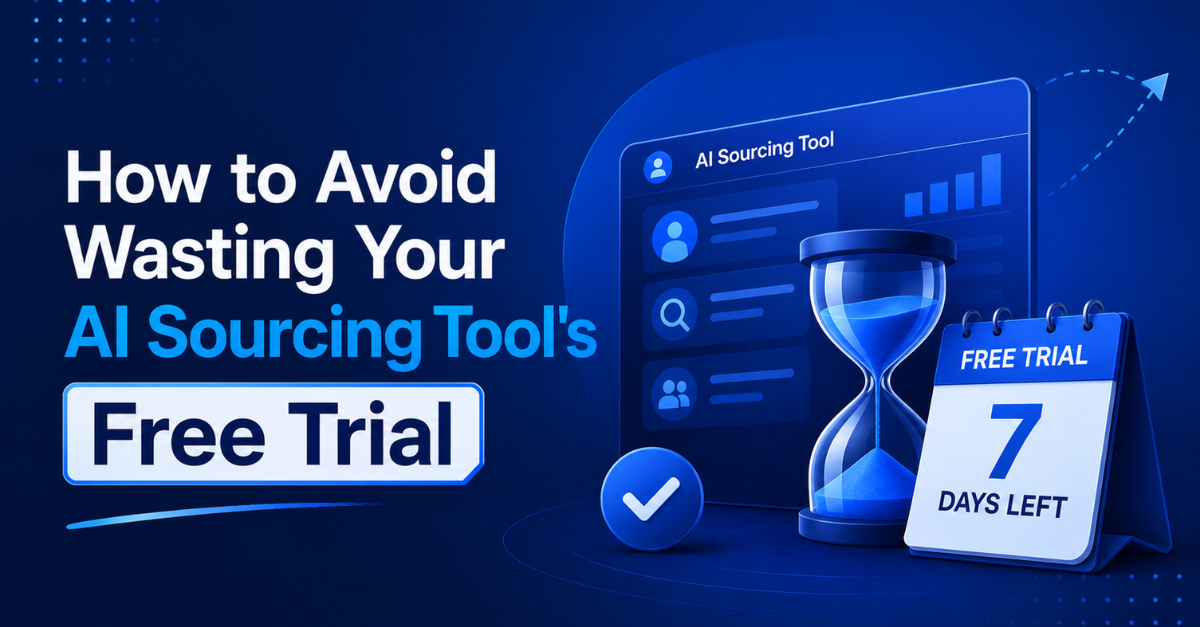
An AI sourcing tool free trial is not meant to test whether AI can search a database.
It is meant to answer a bigger question:
"Can this AI system improve the way we recruit?"
Because finding candidates is only one part of hiring.
A successful AI recruiting platform should help teams:
Discover qualified talent
Improve candidate engagement
Reduce manual work
Speed up hiring workflows
Increase recruiter productivity
The best AI sourcing evaluations focus on outcomes, not features.
Why Most AI Tool Trials Fail
Companies often enter AI sourcing software trials with excitement but without a clear evaluation framework.
The result?
They spend two weeks testing features and still cannot answer:
Did the tool improve hiring?
Did recruiters save time?
Did candidate quality improve?
Is the platform worth investing in?
A free trial becomes a product demo instead of a business experiment.
The Wrong Way to Evaluate AI Recruiting Tools
Many teams focus on:
Number of profiles found
Search filters
AI matching features
Database size
Interface experience
These things matter.
But they do not prove recruiting impact.
A tool can find thousands of profiles and still fail if:
Candidates do not respond
Recruiters cannot manage follow-ups
Screening remains manual
Hiring managers still wait weeks
The real evaluation should measure the complete recruiting workflow.
Mistake #1 — Testing Features Instead of Results
One of the biggest AI sourcing tool trial mistakes is measuring activity instead of outcomes.
Vanity Metrics vs Business Metrics
Vanity Metric
Better Success Metric
Profiles discovered
Qualified candidates
Searches completed
Interviews scheduled
Messages sent
Candidate responses
AI matches generated
Successful hires
Database size
Pipeline quality
A powerful AI recruiter tool is not valuable because it produces more activity.
It is valuable because it improves hiring performance.
Mistake #2 — Not Using Real Hiring Scenarios
A common mistake is testing AI recruitment software with random jobs.
This creates misleading results.
AI performs best when evaluated against real problems.
Use:
Active job openings
Difficult-to-fill roles
Historical hiring challenges
Existing candidate pipelines
For example:
Instead of asking:
"Can AI find software engineers?"
Ask:
"Can AI help us find qualified backend engineers faster than our current process?"
The second question creates measurable results.
Mistake #3 — Measuring Only Candidate Discovery
Candidate sourcing is only the beginning.
Traditional recruiting looks like:
Search → Find → Message → Follow-up → Screen → Schedule → Hire
Most AI sourcing tools optimize the first step.
But recruiters lose time in the steps after sourcing.
Common bottlenecks include:
Writing personalized outreach
Managing candidate responses
Following up consistently
Screening candidates
Coordinating interviews
A complete AI recruiting platform should improve the entire workflow.
Mistake #4 — Ignoring Workflow Integration
An AI sourcing tool cannot deliver maximum value if it exists separately from your recruiting process.
Before buying, evaluate:
Does it fit your existing workflow?
Consider:
ATS integration
Recruitment CRM connection
Candidate data flow
Recruiter collaboration
Hiring manager visibility
The best AI hiring tools do not create another place recruiters have to work.
They become part of the existing operation.
Mistake #5 — No Clear Trial Success Metrics
Before starting a free trial, define what success looks like.
A strong AI sourcing tool evaluation should track:
Speed
Time saved per recruiter
Reduction in manual sourcing hours
Faster candidate delivery
Quality
Qualified candidate percentage
Interview conversion rate
Hiring manager satisfaction
Engagement
Candidate response rate
Outreach performance
Follow-up completion
Business Impact
Time-to-hire
Cost-per-hire
Recruiter productivity
Without baseline metrics, teams often make decisions based on opinions.
The AI Sourcing Trial Checklist
Use this framework before choosing an AI recruiting platform.
1. Accuracy
Can the platform identify candidates that actually match your requirements?
Check:
Skill relevance
Experience match
Role alignment
Candidate quality
2. Speed
Measure:
How quickly recruiters create pipelines
How much manual work is removed
How fast candidates move through stages
3. Engagement
Candidate sourcing does not matter if candidates disappear.
Evaluate:
Outreach quality
Personalization
Response rates
Follow-up automation
4. Automation
Ask:
What does the AI actually automate?
Good automation helps with:
Candidate discovery
Candidate prioritization
Outreach
Follow-ups
Screening support
Scheduling
Mistake #6 — Having No Recruiter Adoption Plan
Even the best AI recruiting tools fail when teams do not adopt them.
Common adoption problems:
Recruiters are not trained
Existing workflows remain unchanged
Teams use AI only occasionally
No ownership exists
AI implementation is not just a software rollout.
It is a workflow transformation.
The goal is not:
"Give recruiters an AI tool."
The goal is:
"Create a better recruiting operating system."
Mistake #7 — Buying Sourcing Instead of Solving Hiring
Many companies discover during trials that sourcing was not their biggest problem.
The real issues were:
Slow candidate communication
Poor qualification
Missed follow-ups
Interview delays
Manual coordination
Finding candidates faster does not automatically create faster hiring.
Recruiting success requires connected workflows.
How to Run a Better AI Sourcing Tool Free Trial
A better trial process looks like this:
Step 1: Choose Real Roles
Pick jobs where your current process struggles.
Step 2: Define Success Metrics
Measure improvement against your current workflow.
Step 3: Test End-to-End
Do not stop at sourcing.
Test:
Discovery
Engagement
Qualification
Coordination
Step 4: Involve Recruiters
The people using the system should evaluate it.
Step 5: Document Results
Capture:
Time saved
Candidate quality
Recruiter feedback
Business impact
The Future of AI Recruiting Evaluation
The future of AI recruiting is moving beyond standalone tools.
Traditional AI sourcing:
Find candidates faster.
Modern AI recruiting:
Build intelligent workflows that move candidates from discovery to hire.
This is where Agentic AI Recruiting Infrastructure changes the category.
Instead of separate tools for every recruiting task, AI agents can support the entire hiring workflow.
From:
Search → Outreach → Qualification → Coordination → Execution
Recruiters spend less time managing tasks and more time making hiring decisions.
Final Thoughts
A free trial should not answer:
"Can AI find candidates?"
Every modern AI sourcing platform can help with discovery.
The better question is:
"Can this AI system improve our recruiting operation?"
The winning AI recruiting platforms will not just provide better searches.
They will help teams create faster, smarter, and more scalable hiring workflows.
That is the future of Agentic AI Recruiting Infrastructure.
FAQs
1. How should I test an AI sourcing tool?
Test it using real job requirements, real hiring challenges, and measurable recruiting outcomes instead of only exploring features.
2. What should I measure during an AI recruiting trial?
Track candidate quality, response rates, recruiter time saved, interview conversion, and overall hiring impact.
3. How long should an AI sourcing tool trial last?
The timeline depends on hiring volume, but the trial should be long enough to test real workflows and collect meaningful data.
4. Why do AI recruiting trials fail?
They often fail because teams test features instead of outcomes, use unrealistic scenarios, or lack success metrics.
5. Is AI sourcing worth paying for?
AI sourcing can create value when it improves recruiter productivity, candidate quality, and hiring speed.
6. Can AI replace sourcing teams?
AI can automate repetitive sourcing tasks, but recruiters remain essential for strategy, relationships, and decision-making.
7. What is Agentic AI recruiting?
Agentic AI recruiting uses AI agents to execute recruiting workflows such as sourcing, engagement, qualification, and coordination.
8. How do recruiters calculate AI ROI?
Compare before-and-after performance using metrics like recruiter hours saved, faster hiring cycles, better candidate conversion, and reduced hiring costs.
9. What makes a good AI recruiting platform?
A strong platform combines candidate intelligence, automation, workflow execution, and measurable recruiting outcomes.
10. How do I choose an AI recruiting platform?
Choose based on workflow fit, integration, measurable ROI, recruiter adoption, and the ability to scale beyond sourcing.
CTA
Stop testing AI features. Start measuring recruiting outcomes.
See how Huntlo turns AI capabilities into complete recruiting workflows.
→ Book a Demo
Internal Links to Add:
AI Recruiting Infrastructure
Candidate Engagement Automation
Recruiting Workflow Automation
AI Recruiting Agents
Automated Outreach
Candidate Qualification
Interview Scheduling
Related Reads: