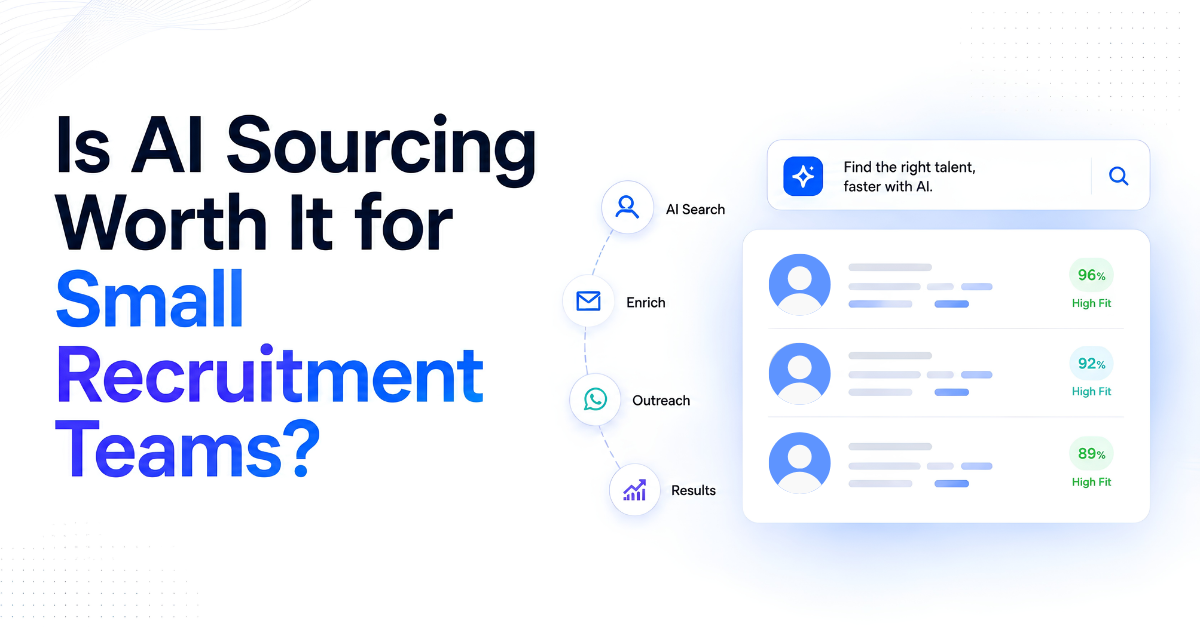
AI sourcing can be worth it for small recruitment teams, but not because it solves the biggest hiring problem most teams face. While AI sourcing tools improve candidate discovery speed, small recruiting teams are usually constrained by execution capacity—follow-ups, engagement, screening, coordination, and managing multiple open roles at once.
In other words, sourcing is not the bottleneck. Recruitment execution is.
Most AI sourcing platforms focus heavily on one promise: helping recruiters find more candidates faster. That is useful, but incomplete. Because in small teams, more candidates often translate into more operational workload—not better hiring outcomes.
The real ROI comes when AI sourcing is combined with recruiting workflow automation that supports the entire hiring lifecycle.
Why Small Recruitment Teams Are Considering AI Sourcing
Small recruitment teams operate in a high-pressure environment where every recruiter is expected to handle full-cycle hiring.
Unlike enterprise talent acquisition teams, there are no separate roles for sourcing, coordination, and operations.
Growing Hiring Demands
Startups, staffing agencies, and fast-growing companies often need to fill multiple roles simultaneously with limited recruiters. This creates constant pressure to improve speed and output.
Limited Recruiter Bandwidth
Most recruiters don’t struggle because they lack access to candidates. They struggle because they lack time.
Time gets consumed by:
Candidate outreach
Follow-ups
Screening calls
Scheduling interviews
Client coordination
Pipeline management
So when AI sourcing enters the picture, it feels like a direct productivity upgrade. But the reality is more complex.
What AI Sourcing Tools Actually Do
AI sourcing tools primarily focus on candidate discovery and matching.
Candidate Discovery
They scan large talent pools and identify potential candidates based on:
Skills and experience
Job titles and industries
Location and availability
Profile similarity to job descriptions
This reduces manual searching across platforms.
Talent Matching
Most tools use algorithms or machine learning models to match candidates with job requirements.
This helps prioritize candidates, but does not guarantee hiring success.
Search Automation
AI sourcing tools also automate:
Boolean search creation
Candidate recommendations
Similar profile suggestions
Talent pool generation
This improves sourcing efficiency but does not address downstream recruiting work.
The Benefits of AI Sourcing for Small Teams
AI sourcing does provide real value when used correctly.
Faster Candidate Discovery
Recruiters can build talent pipelines faster, reducing time spent on manual searching.
Larger Talent Pools
AI helps uncover candidates recruiters might not find manually.
Reduced Manual Work
Automated search reduces repetitive sourcing tasks.
Area
Traditional Sourcing
AI Sourcing
Candidate discovery speed
Slow
Fast
Talent pool size
Limited
Expanded
Search effort
High
Low
Consistency
Variable
Standardized
But these improvements only apply to one stage of recruiting.
The Hidden Problem Recruiters Don’t Expect
The biggest misconception is this:
If sourcing becomes faster, hiring becomes easier.
In reality, faster sourcing often increases workload.
More Candidates = More Work
If a recruiter previously sourced 50 candidates per week and AI increases that to 200+, they now face:
More outreach messages
More screening conversations
More follow-ups
More interview coordination
More pipeline tracking
So instead of freeing time, sourcing often shifts the bottleneck downstream.
Where Small Recruitment Teams Actually Lose Time
Recruiters rarely spend most of their time sourcing.
The real time drains happen after sourcing.
Candidate Engagement
Maintaining communication and interest across candidates requires continuous effort.
Follow-Ups
Many candidates drop off simply due to inconsistent follow-ups.
Candidate Qualification
Every candidate requires screening, validation, and context gathering.
Interview Coordination
Scheduling across candidates, clients, and hiring managers is highly manual.
Activity
Time Impact
Sourcing
Medium
Outreach
High
Follow-ups
Very High
Screening
High
Scheduling
High
Coordination
High
This is why sourcing improvements alone rarely transform outcomes.
Calculating the Real ROI of AI Sourcing
To evaluate AI sourcing properly, recruiters need to look beyond “time saved in search.”
Time Saved (Sourcing Stage)
Yes—AI reduces sourcing time significantly.
Time Added (Downstream Work)
But additional candidates create:
More outreach volume
More screening time
More coordination effort
If these are not automated, total recruiter workload often increases.
Real ROI Question
The correct question is not:
Can we find more candidates faster?
It is:
Can we move candidates through the hiring process more efficiently?
Key outcomes include:
Time-to-hire
Recruiter capacity
Candidate conversion rates
Hiring velocity
Cost per hire
AI Sourcing vs Recruiting Automation
This distinction is where most teams get clarity.
Discovery vs Execution
AI sourcing improves:
Candidate discovery
Talent identification
Pipeline creation
Recruiting automation improves:
Engagement
Qualification
Follow-ups
Scheduling
Workflow execution
Comparison Table
Capability
AI Sourcing Tools
Recruiting Automation
Candidate discovery
Yes
Partial
Matching
Yes
Partial
Outreach automation
Limited
Yes
Follow-ups
Limited
Yes
Screening
No
Yes
Scheduling
No
Yes
Workflow execution
No
Yes
What Small Recruiting Teams Should Automate First
Instead of starting with sourcing, small teams get better ROI from automating execution first.
1. Follow-ups
Most lost candidates are not rejected—they are just not followed up consistently.
2. Candidate qualification
Early screening can be partially automated with structured workflows.
3. Scheduling
Interview coordination is one of the biggest hidden time drains.
4. Workflow management
Ensuring candidates move through stages without manual tracking.
5. Sourcing (last priority)
Once execution is automated, sourcing scale becomes valuable.
Final Verdict: Is AI Sourcing Worth It?
Yes—but only in the right context.
AI sourcing is useful for improving candidate discovery speed, but it does not solve the core constraint for small recruitment teams.
The real limitation is not “finding candidates.”
It is managing and moving candidates through the hiring process efficiently.
That is why sourcing alone rarely improves hiring outcomes at scale.
The strongest results come when sourcing is paired with recruiting workflow automation and execution systems that reduce manual coordination effort.
In modern recruiting environments, teams don’t just need more candidates.
They need more capacity to convert candidates into hires.
That shift—from sourcing to execution—is where real recruiting ROI is created.
Frequently Asked Questions
1. Is AI sourcing worth the cost for small teams?
Yes, but only if paired with automation for engagement and workflow management. Otherwise, it increases downstream workload.
2. How much time does AI sourcing save recruiters?
It significantly reduces search time, but total time savings depend on how downstream recruiting tasks are handled.
3. Can AI sourcing replace recruiters?
No. It assists with discovery but does not handle engagement, judgment, or hiring decisions.
4. What are the limitations of AI sourcing tools?
They mainly stop at candidate discovery and do not solve engagement, screening, or coordination challenges.
5. What should small recruiting teams automate first?
Follow-ups, scheduling, and candidate qualification typically deliver higher ROI than sourcing alone.
Related Topics
AI sourcing tools are all the same — here’s why that’s wrong
Recruitment automation vs traditional recruiting
Why recruiting operations matter more than sourcing
What is Agentic AI Recruiting?
Candidate engagement automation in recruiting