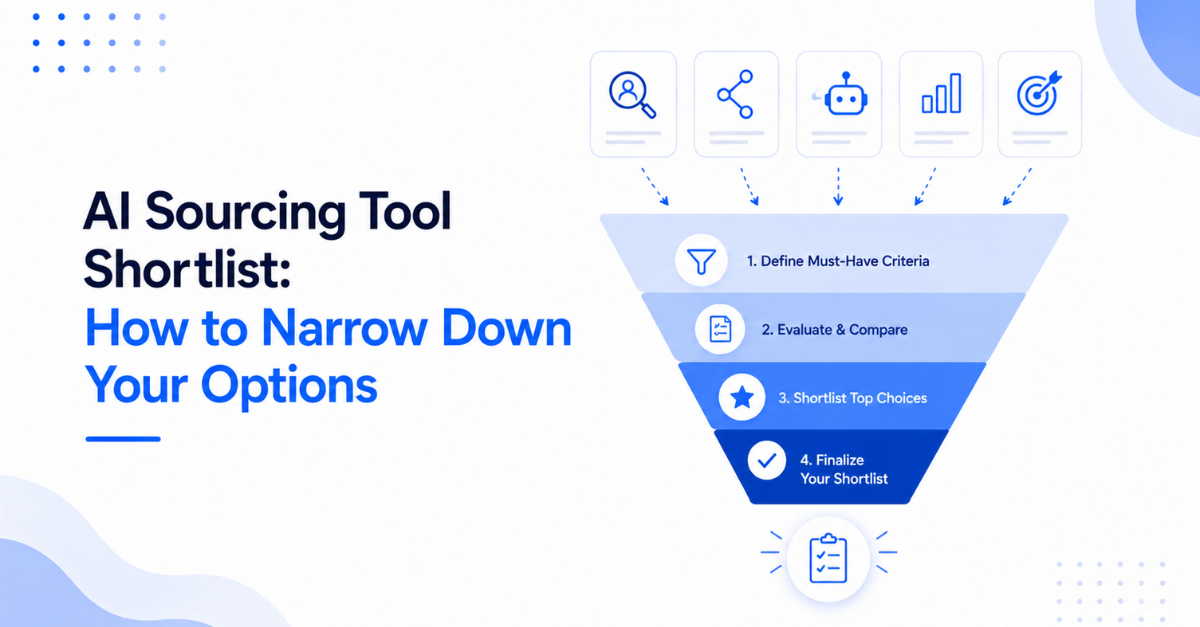
An effective AI sourcing tool shortlist should focus on business outcomes rather than vendor claims. Recruiters should define hiring objectives, identify non-negotiable requirements, evaluate recruiter productivity impact, assess candidate engagement and workflow automation capabilities, and narrow the list to three finalists before running a structured pilot program.
Recruiting technology has evolved rapidly, and the number of AI sourcing vendors has grown just as quickly. Creating a structured shortlist helps recruiting teams avoid lengthy evaluations, reduce buying risk, and focus on platforms that improve actual hiring outcomes.
Introduction
Building an AI sourcing tool shortlist has become more difficult than ever.
Nearly every recruiting technology vendor claims to offer:
AI-powered sourcing
Better candidate matching
Faster talent discovery
Recruitment automation
Improved recruiter productivity
As a result, recruiting leaders often find themselves evaluating dozens of platforms that appear remarkably similar on the surface.
The challenge is that most buying decisions focus heavily on sourcing features while overlooking what happens after candidates are identified. Candidate engagement, qualification, scheduling, workflow automation, and recruiting operations often have a greater impact on hiring outcomes than sourcing alone.
This creates a common problem. Teams spend months evaluating vendors, only to discover that the chosen platform improves candidate discovery but does little to improve recruiter capacity or hiring velocity.
This guide provides a practical framework for creating an AI sourcing tool shortlist. Instead of comparing vendor marketing claims, you'll learn how to identify the platforms most likely to improve recruiter productivity, candidate conversion, and recruiting efficiency.
Why Evaluating AI Sourcing Tools Has Become So Difficult
Why Are There So Many Similar Vendors?
The recruiting technology market has expanded significantly over the last few years.
Most AI sourcing tools promote similar benefits:
Common Vendor Claim
What It Usually Means
AI candidate matching
Automated profile recommendations
Larger talent pools
Access to broader candidate databases
Faster sourcing
Reduced manual search effort
Recruiting automation
Partial workflow automation
Improved productivity
Less time spent sourcing
Because messaging is often similar, recruiters struggle to distinguish meaningful differences.
Why Product Messaging Creates Confusion
Most vendor comparisons focus on:
Database size
Search filters
Matching algorithms
Integrations
User interface
While these capabilities matter, they rarely determine hiring outcomes.
The most successful recruiting teams evaluate technology based on:
Recruiter productivity
Candidate response rates
Qualification efficiency
Hiring velocity
Workflow automation impact
Step 1 — Define Your Recruiting Objectives
Before evaluating vendors, clarify what you're trying to improve.
What Are Agency Recruiting Goals?
Staffing firms and recruitment agencies often prioritize:
Faster placements
Recruiter capacity
Revenue per recruiter
Candidate redeployment
Multi-client workflow management
What Are In-House Hiring Goals?
Corporate recruiting teams often focus on:
Time-to-hire
Hiring manager collaboration
Candidate experience
Talent pipeline development
Workforce planning
Objective Framework
Recruiting Goal
Primary Metric
Faster hiring
Time-to-hire
Increased productivity
Recruiter capacity
Better engagement
Candidate response rate
Higher efficiency
Cost-per-hire
Improved conversion
Interview-to-hire ratio
Without defined objectives, every vendor demo starts to look equally compelling.
Step 2 — Identify Non-Negotiable Requirements
Not every platform fits every recruiting environment.
Create a list of requirements that immediately eliminate unsuitable vendors.
Integration Requirements
Evaluate compatibility with:
ATS platforms
CRM systems
Email providers
Scheduling tools
HR technology stack
Compliance Requirements
Consider:
GDPR compliance
Data privacy controls
Audit trails
Security certifications
Candidate consent management
Scalability Requirements
Assess whether the platform can support:
Future hiring growth
Additional recruiters
Multiple business units
Global hiring initiatives
Shortlist Filter Example
Requirement
Must Have?
ATS integration
Yes
Multi-user support
Yes
Automated outreach
Yes
Interview scheduling
Preferred
AI qualification
Preferred
This exercise often reduces a long vendor list by 30–50%.
Step 3 — Separate Must-Have Features From Nice-to-Have Features
One of the biggest evaluation mistakes is treating every feature equally.
Core Sourcing Requirements
Most recruiting teams need:
Candidate search
AI matching
Talent discovery
Candidate enrichment
Workflow Automation Requirements
Increasingly, recruiters also require:
Outreach automation
Follow-up automation
Candidate qualification
Scheduling automation
Pipeline progression
Feature Prioritization Matrix
Feature
Priority
Candidate sourcing
Must Have
AI matching
Must Have
Candidate outreach
Must Have
Follow-up automation
High
Qualification automation
High
Scheduling automation
Medium
Analytics dashboard
Medium
The goal is not to find the platform with the most features.
The goal is to find the platform that solves your biggest recruiting bottlenecks.
Step 4 — Evaluate Recruiter Productivity Impact
Many sourcing software evaluations overlook recruiter productivity entirely.
How Much Time Does the Tool Save?
Measure:
Hours spent sourcing
Hours spent messaging
Hours spent following up
Administrative workload
Does It Expand Recruiter Capacity?
A useful evaluation question is:
Can one recruiter manage more requisitions with this platform?
Consider this example:
Activity
Manual Process
Automated Process
Candidate sourcing
8 hrs/week
3 hrs/week
Outreach
5 hrs/week
1 hr/week
Follow-ups
4 hrs/week
30 min/week
Scheduling
3 hrs/week
30 min/week
The value comes from cumulative time savings across the recruiting workflow.
Step 5 — Assess Candidate Engagement Capabilities
Finding candidates is only the beginning.
How Does the Platform Handle Outreach?
Evaluate:
Personalized messaging
Automated campaigns
Multi-step sequences
Email delivery controls
Does It Automate Follow-Ups?
Many recruiters lose candidates simply because follow-ups never happen.
Look for:
Automated reminders
Sequence management
Response tracking
Conversation workflows
Can It Handle Responses Efficiently?
The platform should help recruiters:
Identify interested candidates
Route conversations
Prioritize responses
Reduce manual administration
Download Huntlo's AI Recruiting Vendor Shortlist Scorecard to compare candidate engagement capabilities across vendors consistently.
Step 6 — Evaluate Workflow Automation
The biggest differences between recruiting platforms often emerge after sourcing.
Can It Automate Candidate Qualification?
Evaluate whether the platform supports:
Screening questions
Prequalification workflows
Candidate assessments
Automated routing
Does It Support Scheduling Automation?
Interview coordination consumes significant recruiter time.
Assess:
Calendar integrations
Scheduling workflows
Candidate reminders
Rescheduling support
How Does It Manage Recruiting Operations?
Modern recruiting teams increasingly seek:
Workflow orchestration
Process automation
Status updates
Operational visibility
Workflow Evaluation Checklist
Capability
Evaluate
Candidate sourcing
✓
Candidate engagement
✓
Qualification automation
✓
Follow-up automation
✓
Scheduling automation
✓
Recruiting operations
✓
See how Huntlo helps recruiters automate engagement, qualification, scheduling, and recruiting operations—not just sourcing.
Step 7 — Reduce the List to Three Finalists
At this point, most teams should narrow their shortlist to three vendors.
Why Three Vendors?
Three finalists provide:
Meaningful comparison
Manageable evaluation effort
Faster decision-making
Anything beyond three often slows purchasing without improving outcomes.
Example Scoring Framework
Evaluation Area
Weight
Candidate sourcing
20%
Candidate engagement
20%
Workflow automation
20%
Productivity impact
20%
Hiring outcomes
20%
Score each vendor consistently.
The highest score should reflect the greatest expected hiring impact—not simply the largest feature set.
Step 8 — Run a Pilot Program
A pilot is the most reliable way to validate recruiting software.
What Should a Pilot Measure?
Track:
Time saved
Response rates
Recruiter adoption
Candidate conversion
Hiring velocity
Recommended Pilot Duration
Team Size
Pilot Length
Small team
2–4 weeks
Mid-sized team
4–6 weeks
Enterprise team
6–8 weeks
Compare Real Outcomes
Instead of evaluating:
Search speed
Database size
Demo quality
Evaluate:
Recruiter productivity
Candidate engagement
Qualification efficiency
Workflow improvements
The pilot should confirm whether the platform creates measurable recruiting value.
Common Mistakes When Shortlisting AI Sourcing Tools
Choosing Based on Features Alone
Features do not guarantee results.
Many organizations buy software with extensive capabilities that recruiters never use.
Ignoring Recruiting Operations
Most recruiting work happens after sourcing.
Failing to evaluate:
Engagement
Qualification
Scheduling
Follow-ups
creates an incomplete assessment.
Evaluating Individual Tasks Instead of Workflows
Recruiters rarely work in isolated activities.
Technology should improve the end-to-end recruiting process.
Overlooking Recruiter Adoption
The best platform is useless if recruiters avoid using it.
Ease of adoption matters.
Why the Best Option May Not Be a Sourcing Tool
Recruiting technology is evolving beyond candidate discovery.
Why Is Sourcing No Longer Enough?
Most sourcing tools help recruiters:
Find candidates
Search databases
Generate talent lists
But recruiting teams increasingly need help with:
Candidate engagement
Qualification
Scheduling
Follow-ups
Recruiting operations
The Rise of Agentic AI Recruiting Infrastructure
A new category is emerging: Agentic AI Recruiting Infrastructure.
Rather than focusing solely on sourcing, these platforms support:
Candidate discovery
Candidate engagement
Qualification workflows
Interview coordination
Recruiting workflow execution
The goal is not simply to find more candidates.
The goal is to move candidates through the hiring process with less manual effort and greater consistency.
Conclusion
Creating an AI sourcing tool shortlist is not about identifying the vendor with the largest database or the most impressive AI claims.
It's about identifying the platform most likely to improve recruiting outcomes.
The strongest evaluation frameworks focus on:
Recruiting objectives
Non-negotiable requirements
Recruiter productivity
Candidate engagement
Workflow automation
Hiring outcomes
As recruiting technology continues to evolve, many organizations are discovering that sourcing alone is only one part of the hiring process.
Platforms focused on recruiting automation and infrastructure, such as Huntlo, demonstrate how AI is expanding beyond candidate discovery into engagement, qualification, scheduling, and recruiting workflow execution.
Compare your current recruiting workflows against modern Agentic AI Recruiting Infrastructure and identify where automation can create the greatest hiring impact.
Frequently Asked Questions
1. How do recruiters shortlist sourcing tools?
Recruiters should define hiring goals, establish non-negotiable requirements, score vendors against evaluation criteria, and narrow the list to three finalists before running a pilot.
2. What is the best AI sourcing software?
The best solution depends on your hiring objectives. Evaluate platforms based on recruiter productivity, candidate engagement, workflow automation, and hiring outcomes rather than sourcing features alone.
3. How many vendors should be shortlisted?
Most recruiting teams should limit their shortlist to three vendors. This provides meaningful comparison while keeping the evaluation process manageable.
4. What criteria matter most when evaluating sourcing software?
Candidate discovery, recruiter productivity, engagement automation, qualification workflows, scheduling capabilities, and hiring outcomes are among the most important evaluation criteria.
5. How do staffing agencies compare recruiting technology?
Agencies often prioritize recruiter productivity, placement velocity, candidate redeployment, and multi-client workflow management when evaluating platforms.
6. What is recruiting workflow automation?
Recruiting workflow automation uses software to automate activities such as outreach, follow-ups, qualification, scheduling, and candidate progression through hiring stages.
7. What is Agentic AI recruiting?
Agentic AI recruiting uses autonomous AI agents to execute recruiting tasks such as sourcing, engagement, qualification, coordination, and workflow management with minimal manual intervention.
8. How do recruiting teams measure software ROI?
Common metrics include recruiter time saved, candidate response rates, time-to-hire, recruiter capacity, cost-per-hire, and candidate conversion rates.
9. What should recruiters automate first?
Many teams begin with sourcing and outreach, then expand into follow-ups, qualification, scheduling, and recruiting operations.
10. What comes after sourcing automation?
The next stage is recruiting execution automation, including candidate engagement, qualification, scheduling, workflow orchestration, and recruiting operations management.