Marcus is a Staff Software Engineer at a cloud infrastructure company. Over two months, he received thirty-one recruiter messages about various roles. He responded to four. Three of those four responses came not to the first message from the recruiter but to a follow-up. The recruiter from a logistics company sent an initial message that was solid but not compelling, a brief mention of his open-source contributions to a Kubernetes operator he maintained. Marcus read it, noted it was better than average, and moved on. Three days later, the same recruiter sent a second message. This one referenced a commit Marcus had pushed the previous evening, noted that it addressed a scaling bottleneck the recruiter's team was also facing, and asked whether Marcus had considered applying his approach to distributed state management at scale. Marcus responded within two hours. He was not responding to a follow-up. He was responding to a recruiter who had demonstrated that they were paying attention to his work in real time. The first message opened the door. The follow-up walked through it. Marcus eventually accepted an offer from that company, and when his new manager asked what had
impressed him most about the recruiting process, he said it was not the first message. It was the second. That pattern, where the follow-up rather than the first contact drives the candidate's decision to engage, is far more common than most recruiters realize, and it has profound implications for how recruiting time, effort, and technology should be allocated.
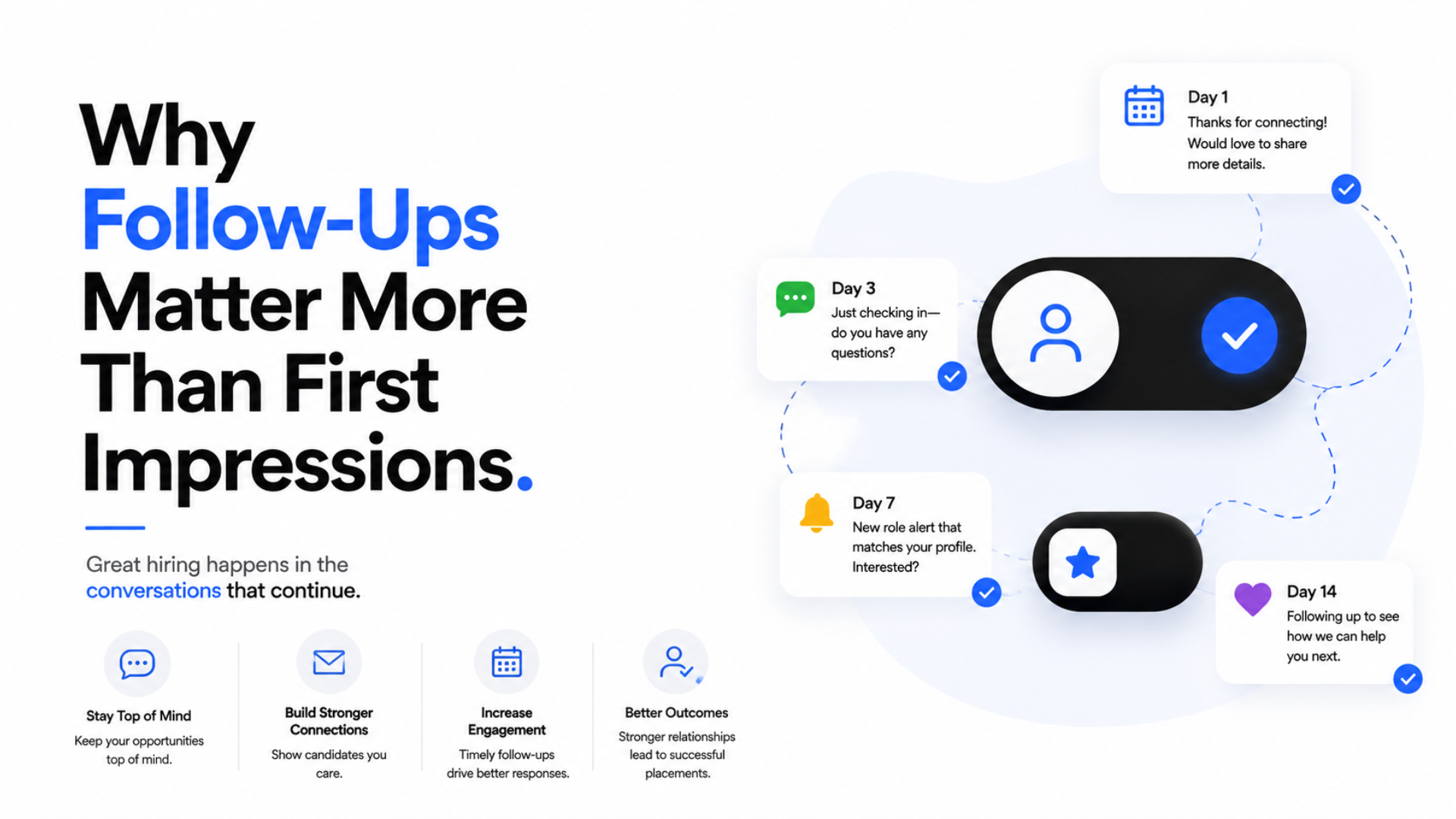
The recruiting industry has an intense focus on first impressions. Message templates are refined for hours. A/B testing is applied to subject lines and opening sentences. Response rates to initial outreach are tracked as the primary measure of recruiter effectiveness. This focus is not irrational. The first message determines whether the candidate engages at all, and without engagement, nothing else matters. But the focus on first impressions creates a systematic blind spot: the follow-up messages that convert initial interest into active engagement are treated as secondary, operational tasks rather than as the strategically important interactions they actually are. The data tells a different story from the one the industry's focus on first impressions would suggest. According to SHRM's talent acquisition research, sixty to seventy percent of candidates who eventually engage with a recruiter respond not to the first message but to a second or third follow-up, meaning that the majority of hiring outcomes are determined not by the quality of the initial outreach but by the quality and timing of the follow-up. This finding should fundamentally reorient how recruiting organizations allocate their attention and resources. Understanding the difference between AI sourcing and AI recruiting helps clarify the distinction. Sourcing generates the first contact. The follow-up is where recruiting actually happens, because it is where the candidate's initial curiosity is either converted into genuine interest or allowed to fade. Huntlo's platform is built around the recognition that follow-up quality is the primary driver of hiring outcomes, providing the intelligence and automation needed to ensure that every follow-up is timely, relevant, and personalized, turning the follow-up from an afterthought into the most powerful tool in the recruiter's arsenal.
The First Impression Fallacy: Why Opening Messages Are Overrated
The first impression fallacy is the belief that the initial outreach message is the most important interaction in the recruiting process and therefore deserves the most attention, investment, and optimization. This belief is intuitively appealing but empirically wrong, and it leads recruiting organizations to misallocate their resources in ways that undermine their hiring outcomes. The initial outreach message serves one primary function: it captures enough of the candidate's attention to create a positive first impression that makes the candidate receptive to future communication. This is a valuable function, but it is a limited one. A strong first message increases the probability that the candidate will read a second message. It does not, by itself, convert the candidate from passive observer to active participant. That conversion happens in the follow-up, where the recruiter has the opportunity to demonstrate sustained interest, provide additional context, and build the kind of personal connection that motivates a busy professional to invest time in a conversation about a career opportunity they were not actively seeking. The reason first impressions are overrated is that they are evaluated in isolation. A candidate who receives a single message, however well-crafted, has very limited information on which to base a decision to engage. They do not know whether the
recruiter is genuinely interested in them specifically or is running a volume campaign. They do not know whether the opportunity is real and well-defined or vague and exploratory. They do not know whether the recruiter will be responsive and respectful of their time or will disappear after one exchange. According to McKinsey's organizational insights, candidates who receive only a first message and no follow-up interpret the absence of follow-up as a signal that the recruiter's interest was superficial, regardless of how strong the first message was. The follow-up is what transforms a potentially superficial interaction into a genuinely interested one.
The practical implication of the first impression fallacy is that recruiting organizations invest disproportionately in first-message quality while underinvesting in follow-up quality. Recruiters spend hours crafting and refining initial outreach templates but send follow-ups that are generic, poorly timed, or entirely absent. This imbalance is visible in the data. Research on how many followups one hire actually needs shows that while the optimal number varies by context, the quality differential between the first message and the follow-up is the strongest predictor of whether a candidate engages. A candidate who receives a strong first message followed by a weak or absent follow-up concludes that the recruiter's initial effort was performative. A candidate who receives a good first message followed by an even better follow-up, one that demonstrates continued attention, deeper research, and genuine curiosity about the candidate's situation, concludes that the recruiter is serious and that the opportunity is real. The follow-up is the evidence that the first impression was accurate. Without it, the first impression is just a claim, and candidates are understandably skeptical of claims from recruiters they do not know. The teams that simply add more tools while maintaining this first-impression-centric approach often discover they have more tools but the same hiring problems, because the tools optimize the wrong end of the engagement funnel. Huntlo's platform corrects this imbalance by providing AI-powered follow-up intelligence that ensures the second, third, and subsequent interactions are at least as strong as the first, whether the recruiter is hiring for generalist roles or for niche and technical roles where the follow-up quality required to impress a sophisticated candidate is exceptionally high.
What Makes a Follow-Up Powerful: Relevance, Timing, and Progression
Not all follow-ups are created equal. The follow-ups that convert candidates share three characteristics that distinguish them from the generic check-in messages that candidates ignore or resent. The first characteristic is relevance. A powerful follow-up demonstrates that the recruiter has been paying attention to the candidate's professional life since the initial contact. It references something new, a recent project, a published article, a conference talk, a career move, or a shift in the candidate's professional focus that has occurred since the first message was sent. This signal of ongoing attention is extraordinarily powerful because it communicates that the recruiter's interest is not performative but genuine, sustained by real observation rather than by an automated reminder. The second characteristic is timing. A powerful follow-up arrives at a moment when the candidate is most likely to be receptive, which is not a fixed interval after the first message but a dynamic timing that accounts for the candidate's
professional rhythm, their recent activity patterns, and the signals they have emitted about their current availability and openness. According to LinkedIn's recruiting resources, follow-ups sent at AI-optimized times, based on candidate activity signals rather than fixed schedules, produce forty to sixty percent higher response rates than follow-ups sent at standard intervals, because they arrive when the candidate is actually available and receptive rather than at a time determined solely by the recruiter's workflow. The third characteristic is progression. A powerful follow-up advances the conversation beyond where the first message left it. It does not repeat the same pitch or ask the same question. It introduces a new dimension of the opportunity, connects the candidate's situation to a specific aspect of the role, or poses a question that deepens the dialogue. The candidate experiences the follow-up not as a reminder but as a development, which is far more likely to elicit a thoughtful response.
The combination of relevance, timing, and progression is what separates a follow-up that converts from a follow-up that annoys. Candidates are not opposed to follow-ups. They are opposed to follow-ups that waste their time with generic content, arrive at inconvenient moments, or fail to advance the conversation beyond the initial exchange. When a follow-up demonstrates relevance, timing, and progression, the candidate does not experience it as a follow-up at all. They experience it as a continuation of a conversation they are already interested in, which is precisely the frame of mind that produces engagement. The recruiters asking whether AI will replace their jobs should take note: the ability to craft follow-ups with these three characteristics at scale is precisely where AI provides the greatest value, because AI can monitor candidate signals for relevance, optimize timing based on activity patterns, and analyze conversation history to determine the most effective progression, all while the recruiter focuses on the relational aspects of the interaction that require human judgment and authenticity. An agentic AI recruiting platform like Huntlo provides this capability by maintaining a continuous intelligence layer for every candidate, tracking their professional activity, engagement signals, and conversation history, and generating follow-up recommendations that are calibrated for relevance, optimized for timing, and designed for progression. The recruiter reviews, refines, and delivers the follow-up with their own voice and judgment. The candidate experiences a recruiter who is remarkably attentive, well-timed, and conversationally skilled. The AI makes the follow-up powerful. The recruiter makes it personal.
The Follow-Up Multiplier Effect Across the Hiring Pipeline
The impact of follow-up quality extends far beyond the initial outreach phase. Follow-ups matter at every stage of the hiring pipeline, and the cumulative effect of consistent, high-quality follow-ups across all stages is the single largest driver of overall hiring outcomes. In the post-screening phase, a follow-up that provides specific feedback from the screening call and connects it to the next steps demonstrates respect for the candidate's time and investment in the process. In the interview preparation phase, a follow-up that offers tailored guidance and addresses the candidate's specific questions about the interview format reduces candidate anxiety and increases interview performance, which benefits both the candidate and the employer. In the post-interview phase, a follow-up that provides a clear timeline for decision-making
and maintains engagement while the internal deliberation proceeds prevents the candidate disengagement that leads to withdrawal or acceptance of competing offers. In the offer phase, a follow-up that addresses the candidate's priorities and concerns with specificity and transparency converts a financial negotiation into a relationship-deepening conversation that dramatically increases acceptance probability. According to Gartner's HR trends research, organizations that maintain high follow-up quality across all pipeline stages report twenty-five to forty percent higher overall conversion rates from first contact to accepted offer, compared to organizations that prioritize first-impression quality but allow follow-up quality to degrade at later stages. The multiplier effect means that each high-quality follow-up does not just add incremental value. It compounds the value of every previous interaction by reinforcing the candidate's trust, maintaining their emotional investment, and deepening their connection to the opportunity.
The operational challenge of maintaining follow-up quality across all pipeline stages is where most recruiting organizations encounter the limits of manual effort. A recruiter managing thirty active candidates at different stages of the pipeline must track each candidate's stage, remember the content of prior interactions, and craft follow-ups that are relevant to the candidate's specific situation and appropriate to their current stage. Without systematic support, the recruiter will naturally prioritize the candidates at the most urgent stages, usually those closest to offer, while the candidates at earlier or less urgent stages receive generic or delayed follow-ups that erode the engagement built by earlier interactions. This is the follow-up gap, and it is the primary mechanism through which candidates are lost from pipelines that should have produced hires. The quality of the candidate intelligence that informs follow-ups is critical to closing this gap. Teams that have encountered outdated candidate data in AI tools understand that a follow-up based on stale context will miss the relevance signal that makes it effective, because the candidate's situation has evolved since the last interaction and the follow-up must reflect that evolution to feel genuine. When evaluating platforms, use the framework for evaluating an AI sourcing tool before buying to ensure that real-time context updating and stage-aware follow-up recommendations are core capabilities. The research on this point is consistent: data shows that referrals outperform cold outreach in large part because the referring employee maintains high-quality follow-up naturally, checking in with the candidate at appropriate intervals and providing relevant updates. Huntlo's platform gives every candidate this referral-quality follow-up experience by maintaining continuous engagement across all pipeline stages, with AI-powered intelligence that ensures every follow-up is relevant, well-timed, and progressively deeper, regardless of the recruiter's workload or the complexity of their pipeline.
Follow-Ups as Trust Architecture: Building Confidence Over Time
The deepest reason follow-ups matter more than first impressions is that hiring decisions are trust decisions, and trust is not built in a single interaction. Trust is built through a sequence of interactions that demonstrate consistency, reliability, and genuine interest over time. The first impression creates the possibility of trust. The follow-up is where that possibility is
either realized or abandoned. Every follow-up that arrives on time, references the candidate's specific context, and advances the conversation adds a brick to the foundation of trust. Every missed follow-up, delayed follow-up, or generic follow-up removes a brick. By the time the offer stage arrives, the candidate's decision is not primarily about the role or the compensation. It is about whether they trust the organization enough to make a career transition based on the experience they have had. Candidates who have received consistent, high-quality follow-ups throughout the process arrive at the offer stage with a deep reservoir of trust that makes acceptance significantly more likely, even when competing offers are available. Candidates who have experienced follow-up inconsistency arrive with skepticism that makes them vulnerable to competing offers regardless of the financial terms. According to Deloitte's talent research, the single strongest predictor of offer acceptance is not the offer amount but the candidate's accumulated trust, and the single strongest predictor of accumulated trust is the consistency and quality of follow-up communication throughout the hiring process. This insight reframes follow-ups from an operational task to a strategic trust-building activity, which is precisely how the most effective recruiters already think about them.
Building this trust architecture at scale requires a systematic approach that goes beyond individual recruiter discipline. It requires technology that maintains awareness of every candidate's engagement history, monitors for the communication gaps that erode trust, and provides the recruiter with the intelligence and prompts needed to sustain consistent follow-up quality across the entire pipeline. According to EY's technology insights, AI-powered platforms that provide this systematic follow-up support enable recruiting organizations to build trust at a scale that was previously achievable only through the kind of high-touch, referral-quality engagement that individual recruiters could provide to a small handful of candidates. Huntlo delivers this capability by treating follow-ups not as reminders but as trust-building interactions, each one informed by the full history of the candidate's journey and designed to deepen the relationship that previous interactions have established. The first impression opens the conversation. The follow-up builds the trust that closes the hire. Huntlo ensures that no follow-up is missed, no trust is eroded, and no candidate is lost to a communication gap. Start building trust through better follow-ups with Huntlo.