Lena is a principal data scientist at an e-commerce company. She has been in conversation with a recruiter named James for eleven months. During that time, James has never once sent Lena a follow-up message. He has sent her twelve messages, and every single one of them was a connection message: a note about something specific happening in her professional world, a paper she co-authored that was gaining attention, a conference panel she was announced on, a new open-source library her team released, or a shift in her company's strategy that was visible from the outside. None of these messages asked Lena whether she was ready to explore a move. None of them pitched a role. Each one was a genuine observation that demonstrated James was paying attention to her career, not just monitoring her availability. When Lena's company announced a restructuring last month that would dissolve her team, she did not go to the job boards. She called James. She had been ready to move for three months but had not told anyone, including James, because she was waiting for the right
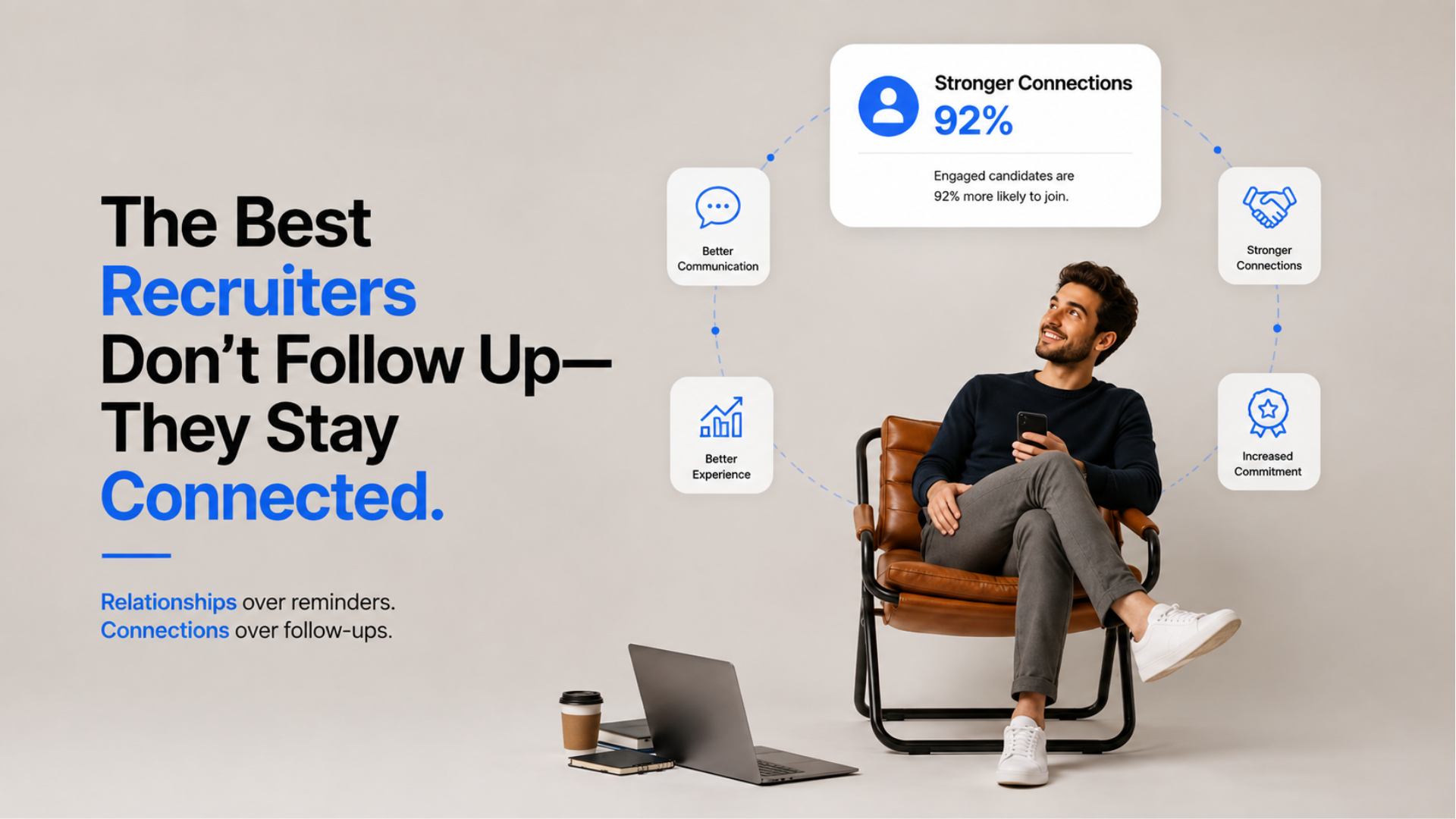
moment. That moment arrived with the restructuring announcement, and James was the first person she contacted, because over eleven months of connection messages, he had become the person she trusted most to help her navigate her next career move. James did not follow up with Lena for eleven months. He stayed connected.
The distinction between following up and staying connected is not semantic. It is structural, and it reflects a fundamentally different approach to the recruiter-candidate relationship. A follow-up is task-driven. It exists to advance a specific hiring process, to remind a candidate about an open role, to check on their interest level, or to nudge them toward a next step. The follow-up is oriented around the recruiter's objective, which is to fill a role, and the candidate experiences it as a reminder of that objective, which may or may not align with their current interests. Staying connected is relationship-driven. It exists to maintain a genuine professional relationship that is valuable to both parties regardless of whether a specific role is open. The connection is oriented around the candidate's career and professional interests, and the candidate experiences it as evidence that the recruiter values them as a professional, not just as a potential hire. This distinction has profound implications for how recruiters spend their time, how they use technology, and what outcomes they achieve. According to SHRM's talent acquisition research, recruiters who operate with a connection mindset rather than a follow-up mindset produce forty to fifty percent higher conversion rates when they do present a role, because the candidate is already engaged, already trusts the recruiter, and already views the relationship as valuable. The challenge is that staying connected requires a fundamentally different operational model than following up, and that model is impossible to sustain at scale through manual effort alone. Huntlo's platform provides the infrastructure for this model by maintaining continuous awareness of every candidate's professional trajectory and enabling the recruiter to deliver connection-quality engagement at scale. The concept is closely related to understanding the difference between AI sourcing and AI recruiting: sourcing identifies candidates, but the ongoing connection that converts them into hires over time is where the real recruiting happens.
The Follow-Up Mindset: Why It Limits Recruiting Outcomes
The follow-up mindset is the default operating mode for most recruiters, and it is easy to understand why. Recruiting is measured by hires, and hires come from active hiring processes, and active hiring processes require candidates to move through a series of steps. The follow-up is the mechanism that moves candidates through those steps, so it becomes the recruiter's primary tool for driving outcomes. The problem with this mindset is not that follow-ups are ineffective. They are effective at advancing specific hiring processes. The problem is that the follow-up mindset narrows the recruiter's view of the candidate relationship to the boundaries of a single hiring process. When a candidate is in an active process, the recruiter follows up. When the process ends, whether in a hire, a withdrawal, or a rejection, the relationship ends with it. The candidate returns to the general talent pool, and any trust, rapport, and contextual knowledge built during the process is lost. When the recruiter encounters the same candidate again for a future role, the relationship must be rebuilt from scratch, which is more expensive
and less effective than maintaining the connection continuously. According to McKinsey's organizational insights, this start-stop approach to candidate relationships costs the average enterprise recruiting organization twenty to thirty percent of its potential hiring output, because the time and effort spent rebuilding relationships with previously engaged candidates is time and effort that could have been spent advancing new relationships or deepening existing ones. The follow-up mindset also creates a pattern of behavior that candidates experience as transactional. A candidate who receives regular communication during an active hiring process and then silence for months afterward learns that the recruiter's interest is conditional on the existence of an open role, which undermines the trust that would make the candidate receptive to future outreach.
The follow-up mindset is reinforced by the tools and metrics that most recruiting organizations use. Applicant tracking systems are designed around hiring processes, not relationships. They track candidates through stages, from sourced to screened to interviewed to offered to hired, and they generate metrics that measure process efficiency: time-to-fill, stage conversion rates, and cost-per-hire. These metrics naturally incentivize the follow-up mindset, because they reward the recruiter for advancing candidates through the process and penalize them for investing time in activities, like maintaining connections with candidates who are not in an active process, that do not directly contribute to process metrics. The teams that accumulate tools optimized for this process-centric model often discover they have more tools but the same hiring problems, because the tools reinforce the follow-up mindset rather than enabling the connection mindset. Research on how many followups one hire actually needs illustrates the limitation of the follow-up approach: the answer depends on the candidate's context, their readiness, and the relationship's depth, all of which are better understood and leveraged through a continuous connection than through a sequence of task-driven follow-ups. The recruiters who recognize this limitation are the ones who begin to shift from a follow-up mindset to a connection mindset, and they are the ones who consistently outperform their peers, especially when hiring for niche and technical roles, where the candidates value long-term professional relationships over transactional hiring processes and will not engage with recruiters who demonstrate only conditional interest.
The Connection Mindset: What Staying Connected Actually Means
A recruiter with a connection mindset operates according to a different set of principles than one with a follow-up mindset. The first principle is that every candidate interaction is an investment in a long-term professional relationship, not just a step in a specific hiring process. This means the recruiter values the interaction itself, the conversation, the exchange of information, and the deepening of mutual understanding, even if it does not immediately produce a hire. The second principle is that the recruiter's interest in the candidate is genuine and unconditional, meaning it persists regardless of whether a specific role is currently open. The recruiter tracks the candidate's career, celebrates their achievements, and offers value, insights, connections, or information that is relevant to the candidate's professional development, without an immediate expectation of return. The third principle is that the recruiter provides value
before asking for value, sharing relevant industry insights, making introductions to people in their network, or providing market intelligence about the candidate's field, before ever asking the candidate to consider a specific role. These three principles produce a fundamentally different candidate experience than the follow-up approach. The candidate does not feel pursued. They feel supported. They do not feel like a name in a pipeline. They feel like a professional whose career is taken seriously by someone who pays attention. According to LinkedIn's recruiting resources, candidates who experience this connection-oriented approach rate their recruiter relationships forty to sixty percent higher in trust and satisfaction, and they are three to five times more likely to proactively reach out to the recruiter when they are ready to explore a move, because the relationship already exists and the trust is already established. The connection mindset does not mean the recruiter never presents a role. It means the role is presented within the context of an existing relationship, which makes the candidate dramatically more receptive.
The recruiters asking whether AI will replace their jobs should take particular note of the connection mindset, because the skills it requires, empathy, strategic thinking, genuine curiosity about other people's careers, and the ability to provide value without an immediate transaction, are among the most distinctly human capabilities in the recruiting profession. AI cannot replicate these skills. What AI can do, and what makes the connection mindset operationally viable at scale, is provide the intelligence and automation that supports the recruiter in maintaining continuous awareness of every candidate's professional trajectory. An agentic AI recruiting platform like Huntlo monitors candidate signals, career milestones, publications, job changes, and professional activity, and provides the recruiter with timely, relevant touchpoint recommendations that enable connection-quality engagement without the manual research that would otherwise make it impossible to sustain across a large candidate network. The AI identifies the moments when a connection message would be most valuable. The recruiter crafts and delivers the message with the authenticity and judgment that define a genuine professional relationship. The candidate experiences a recruiter who is consistently present, consistently informed, and consistently valuable, which is the experience that transforms a recruiter-candidate interaction into a lasting professional relationship. This is the model that produces the best hiring outcomes over time, because it builds a talent network of candidates who trust the recruiter and will engage immediately when the right opportunity arises, rather than requiring expensive, time-consuming re-engagement campaigns for every new role.
How to Stay Connected at Scale Without Burning Out
The obvious objection to the connection mindset is operational: how can a recruiter maintain genuine, personalized, ongoing connections with dozens or hundreds of candidates while also managing active hiring processes? The answer is that they cannot do it manually, but they can do it with the right combination of technology, process design, and strategic prioritization. The technology component is the most critical. AI-powered platforms that maintain continuous candidate intelligence, monitor professional activity signals, and generate connection recommendations can reduce the per-candidate time investment for staying connected from
twenty to thirty minutes per month to two to five minutes, because the AI handles the research, signal detection, and recommendation generation while the recruiter handles only the message refinement and delivery. This time reduction transforms the economics of the connection mindset from impractical to viable, enabling a single recruiter to maintain meaningful connections with one hundred to two hundred candidates simultaneously, compared to the fifteen to twenty candidates they could maintain through manual effort alone. According to Gartner's HR trends research, organizations that deploy AI-powered candidate relationship platforms report fifty to seventy percent increases in their re-engagement success rates, because the candidates in their talent networks are already warm, already trusting, and already receptive when a relevant role opens, eliminating the cold-start problem that makes traditional just-in-time sourcing so expensive and time-consuming.
The process design component is equally important. Staying connected at scale requires a systematic approach to categorizing candidates, defining connection cadences, and measuring relationship health. Candidates should be segmented by their potential value to the organization, their current openness to opportunities, and their engagement level, with different connection strategies applied to each segment. High-value passive candidates, the ones the organization wants to hire eventually but who are not currently looking, require a low-frequency, high-value connection approach, where the recruiter reaches out only when there is something genuinely relevant and valuable to share, avoiding the over-communication that signals desperation. Candidates in active processes require a higher-frequency, process-oriented approach that integrates connection-quality communication with the operational demands of the hiring workflow. The measurement component ensures that the connection mindset is not just an aspiration but an operational practice. Metrics like connection frequency, candidate response rates to non-role communications, and time-to-engagement when a role is presented provide the feedback loop needed to refine and improve the connection strategy over time. The quality of the intelligence that drives these connections is foundational. Teams that have struggled with outdated candidate data in AI tools understand that connection messages based on stale or inaccurate information will damage rather than build the relationship, because the candidate will recognize that the recruiter's awareness is not current. When evaluating platforms, use the framework for evaluating an AI sourcing tool before buying to ensure that real-time signal monitoring and continuous intelligence updates are core capabilities. The evidence for the connection approach is strong: data shows that referrals outperform cold outreach because the referring relationship embodies exactly the connection mindset, a sustained, trusting, value-providing relationship that makes the candidate receptive when a specific opportunity arises. Huntlo's platform enables every recruiter to provide this referral-quality connection to every candidate in their network, not just the ones they happen to know personally.
The Long-Game Payoff: Why Staying Connected Wins Over Time
The connection mindset requires patience, investment, and a willingness to provide value without an immediate return. For recruiting organizations accustomed to measuring success
in days and weeks, this long-game orientation can feel counterintuitive. But the payoff is substantial, and it compounds over time in ways that the follow-up approach cannot match. The first payoff is faster time-to-fill. When a role opens, the recruiter with a connection mindset does not start from zero. They have a network of candidates who already trust them, already understand the organization, and are already warm. The sourcing and initial engagement phases that take weeks in the traditional model are compressed to days, because the relationship already exists. The second payoff is higher offer acceptance rates. Candidates who are hired through an existing relationship, rather than a cold process, have significantly higher trust and emotional investment in the organization, which translates directly into higher acceptance rates. The third payoff is lower cost-per-hire. Maintaining an existing connection is far less expensive than building a new one from scratch, and the conversion rates from connection to hire are dramatically higher than the conversion rates from cold outreach to hire. According to Deloitte's talent research, organizations that systematically invest in long-term candidate connections reduce their average cost-per-hire by thirty to forty-five percent over a two-year period, because the compound effect of maintained relationships eliminates the repeated cost of sourcing and re-engaging candidates who were previously known but lost to relationship neglect.
The fourth and most strategic payoff is talent intelligence. A recruiter who stays connected to candidates over months and years develops a deep understanding of talent markets, career trajectories, compensation trends, and candidate motivations that cannot be obtained through any other method. This intelligence makes the recruiter more valuable to their organization and to the candidates they serve, because they can provide insights and guidance that go far beyond the specifics of any single role. According to EY's technology insights, the recruiters who build the strongest long-term hiring track records are not the ones who follow up most aggressively. They are the ones who stay connected most consistently, because consistency over time builds the kind of deep, trust-based relationships that produce hires when the timing is right, not just when the recruiter needs to fill a role. Huntlo's platform is built for this long-game approach, providing the continuous intelligence and systematic engagement support that make staying connected operationally viable for every recruiter, not just the few who have the time and discipline to do it manually. The best recruiters do not follow up. They stay connected. Huntlo makes staying connected possible at scale. Start building lasting candidate relationships with Huntlo.