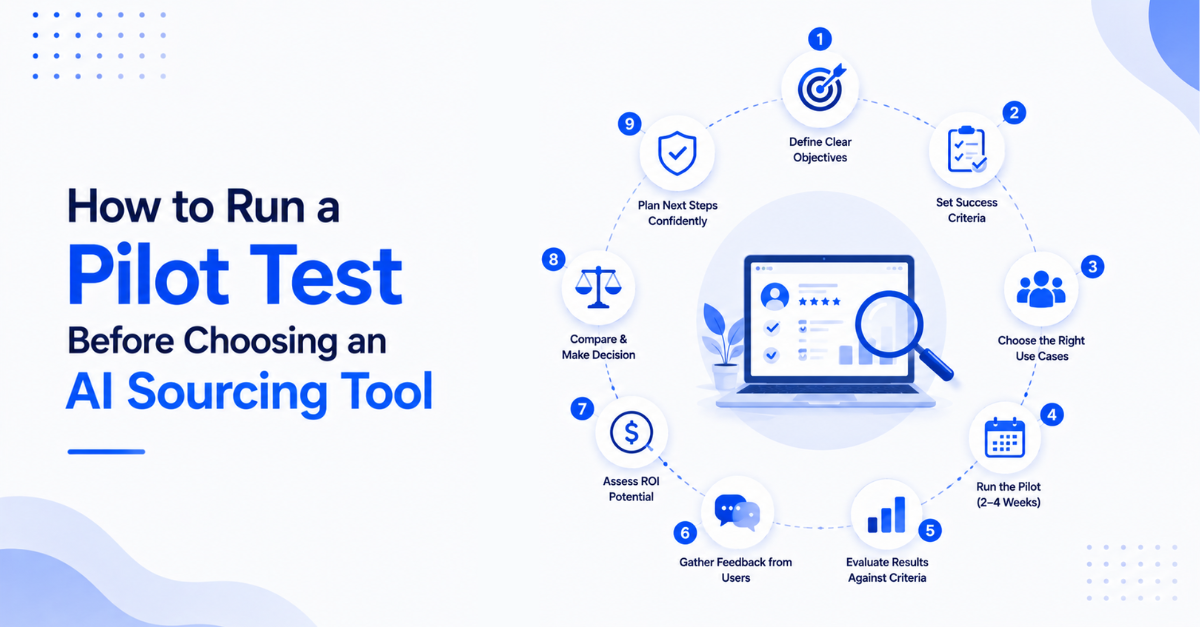
An AI sourcing tool pilot test helps recruiting teams evaluate software performance in real hiring scenarios before making a purchasing decision. Instead of relying on demos and vendor claims, recruiters can measure recruiter productivity, candidate engagement, workflow efficiency, and hiring outcomes to determine whether a platform delivers meaningful value.
Recruiting technology purchases are becoming increasingly complex.
Every AI sourcing vendor promises:
Better candidate matching
Faster sourcing
Larger talent pools
Improved recruiter productivity
The challenge is that most of these claims are difficult to validate during a product demonstration.
A polished demo can showcase ideal workflows.
A feature checklist can compare capabilities.
Neither reveals how a platform performs within your recruiting environment.
This is why many recruiting software implementations fail to meet expectations.
The evaluation process focuses on features rather than outcomes.
The solution is a structured pilot test.
A well-designed pilot allows recruiting teams to assess real-world performance, identify operational improvements, and calculate expected ROI before committing to a long-term investment.
This guide provides a step-by-step framework for running an effective AI sourcing tool pilot.
Why Most AI Sourcing Evaluations Fail
Many recruiting software decisions are made before meaningful testing occurs.
Overreliance on Product Demos
Vendor demonstrations are designed to showcase best-case scenarios.
They often highlight:
Search capabilities
Candidate discovery
Matching algorithms
Workflow features
While useful, demos rarely reflect the complexity of actual recruiting operations.
Feature-Driven Buying Decisions
Many recruiting teams compare vendors based on:
Database size
Search filters
AI capabilities
Integrations
These factors matter.
However, they don't necessarily determine hiring success.
The most important question is not:
"What features does this platform offer?"
It's:
"Will this platform improve recruiting outcomes?"
A pilot test helps answer that question objectively.
What Should an AI Sourcing Tool Pilot Test Actually Measure?
Most pilot programs focus too heavily on sourcing activity.
A more effective evaluation focuses on business outcomes.
Recruiter Productivity Improvements
Determine whether recruiters spend less time on repetitive work.
Measure:
Hours spent sourcing
Time spent screening
Administrative workload
Number of requisitions managed
Candidate Engagement Outcomes
Finding candidates is only valuable if those candidates respond.
Track:
Outreach response rates
Candidate engagement rates
Follow-up effectiveness
Candidate progression
Hiring Efficiency
Ultimately, recruiting technology should improve hiring performance.
Monitor:
Time-to-hire
Interview conversion rates
Candidate quality
Hiring velocity
Download Huntlo's AI Recruiting Software Evaluation Scorecard
A structured scorecard helps recruiters compare vendors using measurable outcomes rather than feature lists.
Step 1 — Define Clear Success Metrics
Before testing begins, establish measurable objectives.
Without defined metrics, pilot results become subjective.
Time Saved
Determine how much recruiter time the platform should save.
Examples:
Reduce sourcing time by 30%
Reduce manual follow-ups
Decrease administrative workload
Candidate Response Rates
Measure whether candidate engagement improves.
Track:
Open rates
Reply rates
Positive responses
Candidate Quality
Evaluate:
Qualified candidate percentage
Screening pass rates
Interview conversion rates
Metric Category
Example KPI
Productivity
Hours saved per recruiter
Engagement
Candidate response rate
Qualification
Qualified candidate percentage
Efficiency
Time-to-hire
Capacity
Roles managed per recruiter
Clear success criteria create an objective evaluation process.
Step 2 — Select a Representative Hiring Scenario
The pilot should reflect real recruiting challenges.
Hard-to-Fill Roles
Testing on difficult positions often reveals sourcing strengths and weaknesses.
Examples:
Software engineers
Product managers
Data scientists
Sales leadership roles
Volume Hiring Roles
For organizations focused on scale, volume hiring provides a valuable test environment.
Examples:
Customer support
Sales development
Operations hiring
Campus recruitment
The chosen roles should accurately represent future hiring needs.
Step 3 — Establish a Baseline
Before introducing new technology, understand current performance.
Current Sourcing Metrics
Track:
Candidates sourced per recruiter
Candidate response rates
Qualified candidates generated
Existing Recruiter Workload
Document:
Hours spent sourcing
Hours spent screening
Time spent scheduling
Follow-up workload
Baseline Metric
Current State
Candidates Sourced
Measure Existing Volume
Response Rate
Establish Current Benchmark
Time-to-Hire
Record Current Average
Recruiter Hours
Measure Weekly Workload
Interview Conversion
Establish Baseline Performance
Without baseline data, improvement cannot be measured accurately.
Step 4 — Run the Pilot With Multiple Recruiters
Many software evaluations involve only one recruiter.
This creates bias.
Avoid Individual Bias
Recruiting styles vary significantly.
One recruiter may excel with a platform while another struggles.
Testing with multiple participants improves reliability.
Capture Diverse Workflows
Include recruiters responsible for:
Agency recruiting
Internal hiring
Technical recruitment
Volume hiring
This creates a broader understanding of platform performance.
Recommended Pilot Team
Senior Recruiter
Junior Recruiter
Recruiting Manager
Talent Acquisition Lead
Multiple perspectives improve decision quality.
Step 5 — Measure Candidate Engagement Performance
Most sourcing evaluations stop after candidate discovery.
This is a mistake.
Outreach Effectiveness
Track:
Outreach volume
Open rates
Reply rates
Positive response rates
Response Rates
The ability to generate candidate conversations often matters more than sourcing volume.
Questions to evaluate:
Are candidates responding?
Are response rates improving?
Does outreach automation improve engagement?
Engagement Metric
Why It Matters
Open Rate
Measures message visibility
Response Rate
Measures candidate interest
Positive Reply Rate
Measures outreach quality
Conversion Rate
Measures pipeline effectiveness
Candidate engagement is one of the strongest indicators of recruiting effectiveness.
Step 6 — Measure Workflow Impact
Sourcing is only one stage of recruiting.
The pilot should evaluate what happens after candidates are identified.
Follow-Up Automation
Measure whether the platform reduces manual follow-up effort.
Track:
Automated touchpoints
Follow-up completion rates
Candidate responsiveness
Scheduling Efficiency
Evaluate:
Interview scheduling speed
Coordination effort
Candidate communication workload
Workflow Automation Assessment
Questions to ask:
Does the platform automate repetitive tasks?
Does it reduce administrative effort?
Does it help candidates move through the hiring funnel?
Many recruiting teams discover workflow improvements create greater value than sourcing improvements.
Step 7 — Calculate ROI
The final step is quantifying business impact.
Recruiter Productivity Gains
Estimate:
Hours saved per recruiter
Increased requisition capacity
Reduced manual effort
Hiring Efficiency Improvements
Measure:
Reduced time-to-hire
Improved conversion rates
Increased hiring velocity
AI Sourcing Tool ROI Framework
ROI Category
Evaluation Question
Productivity
Did recruiters save time?
Capacity
Can recruiters manage more roles?
Engagement
Did response rates improve?
Efficiency
Did hiring speed increase?
Operations
Was manual work reduced?
A pilot should demonstrate measurable business value before software investment decisions are finalized.
See How Huntlo Helps Recruiters Automate Engagement, Qualification, Follow-Ups, and Coordination—Not Just Sourcing
Recruiting teams often achieve the highest ROI when automation extends beyond candidate discovery and into workflow execution.
Common Mistakes During AI Sourcing Pilots
Many evaluations fail because they measure the wrong outcomes.
Testing Only Sourcing
Finding more candidates does not automatically improve hiring performance.
The entire recruiting workflow should be evaluated.
Ignoring Recruiting Operations
Operational work often consumes more recruiter time than sourcing.
Examples include:
Follow-ups
Scheduling
Candidate qualification
Stakeholder coordination
Using Too Short a Pilot Period
Short pilots often fail to generate meaningful data.
Most recruiting software evaluations should run long enough to capture multiple recruiting cycles.
Focusing Only on Feature Adoption
A feature being used does not necessarily mean it delivers value.
Focus on outcomes rather than activity.
Why Recruiters Should Evaluate Beyond Sourcing
The recruiting technology market is changing.
Candidate discovery is becoming increasingly automated.
The next challenge is recruiting execution.
Candidate Engagement
The ability to engage candidates consistently impacts hiring outcomes directly.
Qualification Automation
Automated qualification reduces recruiter workload while improving consistency.
Recruiting Workflow Automation
Workflow automation helps move candidates through hiring processes with less manual intervention.
This is where many organizations realize the largest productivity gains.
The Future of Vendor Evaluation
Recruiting software evaluation is evolving.
From Sourcing Tools to Recruiting Operations
Historically, recruiting technology focused on finding candidates.
Modern recruiting teams increasingly prioritize:
Workflow automation
Candidate engagement
Qualification automation
Recruiting operations
Agentic AI Recruiting Infrastructure
Agentic AI systems extend automation across recruiting workflows.
Instead of simply assisting recruiters, AI agents can execute portions of the recruiting process autonomously.
This shifts evaluation criteria from sourcing features toward operational outcomes.
Run a Live Recruiting Workflow Assessment With Huntlo
The next generation of recruiting technology is focused on execution, not just discovery.
Final Verdict
An AI sourcing tool pilot test should evaluate much more than candidate search capabilities.
The most effective pilot programs measure:
Recruiter productivity
Candidate engagement
Qualification efficiency
Workflow automation
Hiring outcomes
Operational impact
ROI
The best sourcing platform is not necessarily the one that finds the most candidates.
It's the one that helps recruiters convert candidates into hires with the least manual effort.
As recruiting technology continues to evolve, organizations are increasingly evaluating solutions based on workflow execution, recruiter capacity, and hiring performance rather than sourcing features alone.
Frequently Asked Questions
How long should an AI sourcing pilot last?
Most recruiting software pilots should run long enough to evaluate multiple hiring cycles. The goal is to collect meaningful performance data rather than relying on initial impressions.
What metrics should recruiters track during a pilot?
Key metrics include recruiter productivity, candidate response rates, qualification rates, time-to-hire, hiring velocity, and recruiter capacity.
How do staffing agencies evaluate sourcing tools?
Staffing agencies typically assess sourcing quality, candidate engagement, recruiter productivity, workflow efficiency, and placement outcomes.
What is a recruiting software proof of concept?
A proof of concept (POC) is a limited implementation designed to validate software performance before a full deployment.
How do you calculate sourcing software ROI?
ROI is measured through improvements in recruiter productivity, hiring efficiency, candidate engagement, recruiter capacity, and reductions in manual workload.