Recruitment agencies are investing heavily in AI sourcing tools.
The promise is attractive:
Find candidates faster
Reduce recruiter workload
Improve client delivery
Increase placements
Scale operations without adding more recruiters
But agency leaders are asking a more important question:
"Is this AI investment actually improving profitability?"
Because buying AI recruitment software is not the same as creating business value.
A tool that generates thousands of candidate profiles does not automatically create ROI.
The real ROI comes from improving the entire recruiting engine:
Discover → Engage → Qualify → Coordinate → Place
The agencies winning with AI are not measuring how many candidates AI finds.
They are measuring how much better their recruiting operation performs.
Why Agencies Need to Measure AI ROI
AI adoption is no longer just a technology decision.
For recruitment firms, it is a business investment.
Every AI sourcing tool impacts:
Recruiter productivity
Delivery speed
Placement capacity
Client satisfaction
Operating costs
Without measuring ROI, agencies risk:
Paying for unused software
Automating the wrong processes
Increasing tools without increasing output
The goal is not:
"Use AI because everyone is using it."
The goal is:
"Use AI because it creates measurable business improvement."
Moving Beyond AI Tool Excitement
Many agencies evaluate AI sourcing platforms by asking:
How many profiles can it find?
How advanced is the AI matching?
How large is the candidate database?
These are useful questions.
But they do not answer the bigger business question:
"Does this increase our ability to make successful placements?"
A strong AI recruiting platform should improve:
Candidate quality
Recruiter efficiency
Conversion rates
Revenue per recruiter
The Wrong Ways Agencies Measure AI Success
Many recruitment teams track the wrong numbers after adopting AI.
Measuring Candidate Volume
A common mistake:
"We sourced 10,000 candidates this month."
But:
How many were qualified?
How many replied?
How many reached interviews?
How many became placements?
Candidate volume alone does not equal recruiting success.
Measuring Activity Instead of Outcomes
Activity Metric
Better Business Metric
Profiles discovered
Qualified candidates
Searches completed
Interview conversions
Messages sent
Candidate responses
Applications generated
Placements completed
Hours spent sourcing
Revenue generated
AI should reduce activity while increasing outcomes.
The Right AI Recruiting ROI Formula
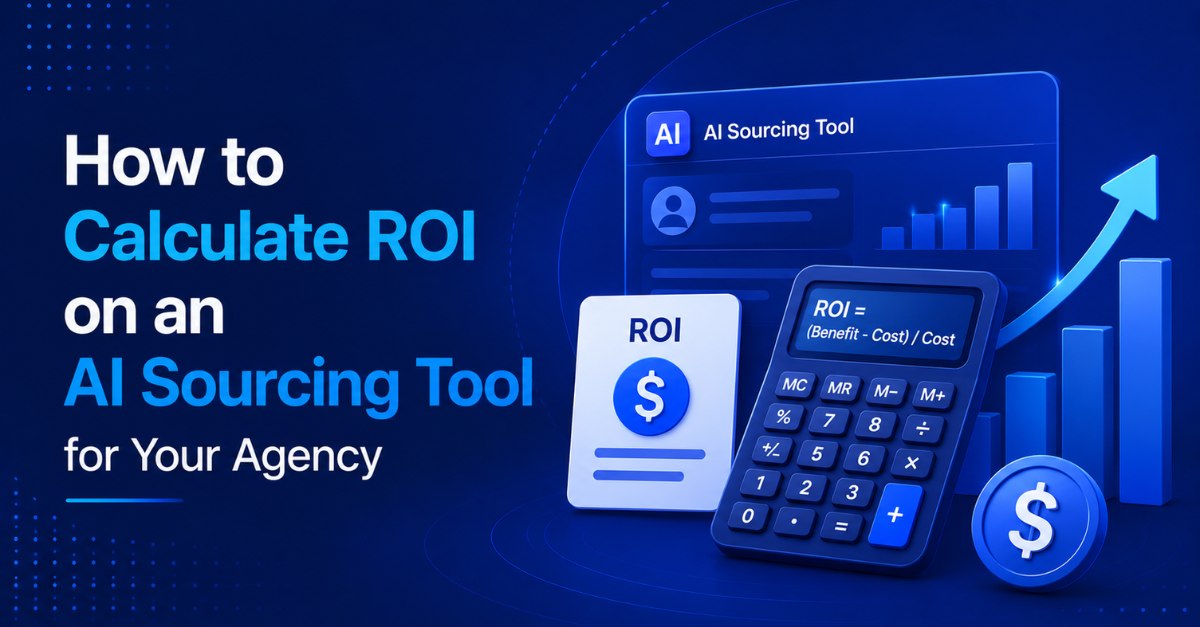
A simple way to calculate AI sourcing tool ROI:
AI ROI = Business Value Generated - AI Investment
The business value usually comes from three areas:
Cost savings
Productivity gains
Revenue growth
1. Cost Savings From Recruiter Efficiency
AI reduces repetitive manual work.
Before AI:
Recruiters spend hours on:
Searching profiles
Reviewing resumes
Writing outreach
Following up manually
After AI:
Automation handles repetitive execution.
Example:
Before AI:
5 recruiters
30 hours/week sourcing
Average recruiter cost: $25/hour
Weekly sourcing cost:
30 × 5 × $25
= $3,750
With AI:
Sourcing time reduces by 50%
New cost:
$1,875
Monthly savings:
≈ $7,500
That saved capacity can be redirected toward:
Client conversations
Candidate relationships
Closing placements
2. Productivity Gains
The biggest AI recruiting ROI often comes from capacity.
Without AI:
One recruiter manages:
10 active roles
With AI:
The same recruiter may manage:
15–20 active roles
This creates:
Higher recruiter utilization
More client accounts handled
More revenue opportunities
AI does not only save money.
It expands operational capacity.
3. Revenue Impact
For agencies, the biggest ROI driver is placements.
Example:
Before AI:
A recruiter closes:
4 placements/month
Average placement revenue:
$5,000
Monthly revenue:
$20,000
After AI:
Recruiter closes:
6 placements/month
Monthly revenue:
$30,000
Additional revenue:
$10,000/month
That is where AI investment becomes a growth strategy.
Key Metrics to Track AI Sourcing ROI
1. Recruiter Hours Saved
Measure:
Sourcing hours reduced
Manual tasks automated
Time spent per candidate
Formula:
Old sourcing time - New sourcing time = Hours saved
2. Time-to-Submit
How quickly can recruiters deliver candidates?
Track:
Before AI:
Days required to submit candidates
After AI:
Hours required
Faster submissions improve:
Client satisfaction
Fill rates
Competitive advantage
3. Candidate Response Rate
Finding candidates is only useful if they engage.
Measure:
Outreach response rate
Qualified replies
Interview acceptance
AI should improve communication quality, not just message volume.
4. Placement Rate
The ultimate agency metric.
Track:
Candidates submitted
Interviews booked
Offers accepted
Placements completed
A sourcing tool with strong ROI creates better conversion through the funnel.
5. Revenue Per Recruiter
This is where agency leaders should focus.
Ask:
Before AI:
How much revenue does each recruiter generate?
After AI:
How much revenue does each recruiter generate?
The difference shows true business impact.
Example AI Sourcing ROI Calculation
Imagine an agency with:
10 recruiters
Average recruiter cost: $5,000/month
AI tool cost: $3,000/month
Before AI:
Each recruiter spends:
40 hours/month sourcing
Total:
400 hours/month
After AI:
Sourcing reduced by 50%
Saved:
200 hours/month
If those hours create even:
2 additional placements/month
The AI investment can quickly pay for itself.
The real calculation is not:
"How much does the AI tool cost?"
It is:
"How much opportunity does inefficient recruiting cost us?"
Hidden Factors That Affect AI ROI
AI ROI depends on more than software.
1. Recruiter Adoption
A powerful platform fails if recruiters do not use it.
Successful adoption requires:
Training
Clear workflows
Team alignment
Process ownership
2. Workflow Integration
AI creates more value when connected to:
ATS
Recruitment CRM
Candidate communication systems
Hiring workflows
Disconnected tools create disconnected results.
3. Data Quality
AI performance depends on inputs.
Poor:
Job descriptions
Candidate information
Hiring requirements
Lead to poor outputs.
Better inputs create better intelligence.
Why Sourcing Alone Limits ROI
Many agencies think:
"Better sourcing = better recruiting."
But sourcing is only the first stage.
Recruiters still need to:
Engage candidates
Qualify interest
Schedule interviews
Manage follow-ups
Coordinate hiring steps
A sourcing-only approach creates a partial solution.
The future is connected recruiting workflows.
The Future: AI Recruiting Operations
The next generation of AI recruiting is moving beyond individual tools.
Traditional AI sourcing:
Find candidates faster.
Agentic AI recruiting:
Execute recruiting workflows intelligently.
AI agents can support:
Candidate discovery
Outreach personalization
Qualification
Follow-ups
Coordination
Workflow execution
This creates a complete AI recruiting operation.
Final Thoughts
The question agencies should ask is not:
"How much does an AI sourcing tool cost?"
The better question:
"How much revenue and efficiency are we losing without AI?"
AI ROI is not measured by:
Profiles generated
Searches completed
Messages sent
It is measured by:
More placements
Faster delivery
Higher recruiter capacity
Better client outcomes
The future belongs to agencies that move from AI tools to Agentic AI Recruiting Infrastructure.
FAQs
1. How do you calculate AI sourcing tool ROI?
Calculate ROI by comparing the value created through time savings, increased recruiter productivity, and additional placements against the cost of the AI platform.
2. Is AI sourcing worth it for recruitment agencies?
Yes, when AI improves measurable outcomes such as candidate quality, delivery speed, recruiter efficiency, and placement rates.
3. How much time can AI save recruiters?
The impact varies, but AI can reduce repetitive sourcing and administrative work significantly when integrated into recruiting workflows.
4. What metrics should agencies track after adopting AI?
Track:
Recruiter hours saved
Time-to-submit
Candidate response rate
Interview conversion
Placement revenue
5. Does AI reduce recruitment costs?
AI can reduce operational costs by automating repetitive work and allowing recruiters to handle more roles without increasing headcount.
6. Can AI increase placements?
AI can increase placements by helping recruiters build stronger pipelines, engage candidates faster, and reduce workflow delays.
7. How long until AI shows ROI?
Most agencies should evaluate ROI after enough real hiring activity has passed through the system to compare performance before and after adoption.
8. What is Agentic AI recruiting?
Agentic AI recruiting uses AI agents to execute connected recruiting workflows, helping teams move from candidate discovery to hiring completion.
9. How do agencies justify AI investment?
Agencies justify AI investment by connecting it to measurable improvements in revenue, recruiter capacity, and operational efficiency.
10. What makes AI recruiting successful?
Successful AI adoption combines the right technology, clear workflows, recruiter adoption, and outcome-based measurement.
CTA
Calculate what AI-powered recruiting could save your team.
See how Huntlo turns AI from a sourcing tool into a complete recruiting operating system.
→ Book a Demo
Internal Links
Product Pages
AI Recruiting Infrastructure
Candidate Engagement Automation
Recruiting Workflow Automation
AI Recruiting Agents
Feature Pages
AI Candidate Matching
Automated Outreach
Candidate Qualification
Interview Coordination
Related Blogs